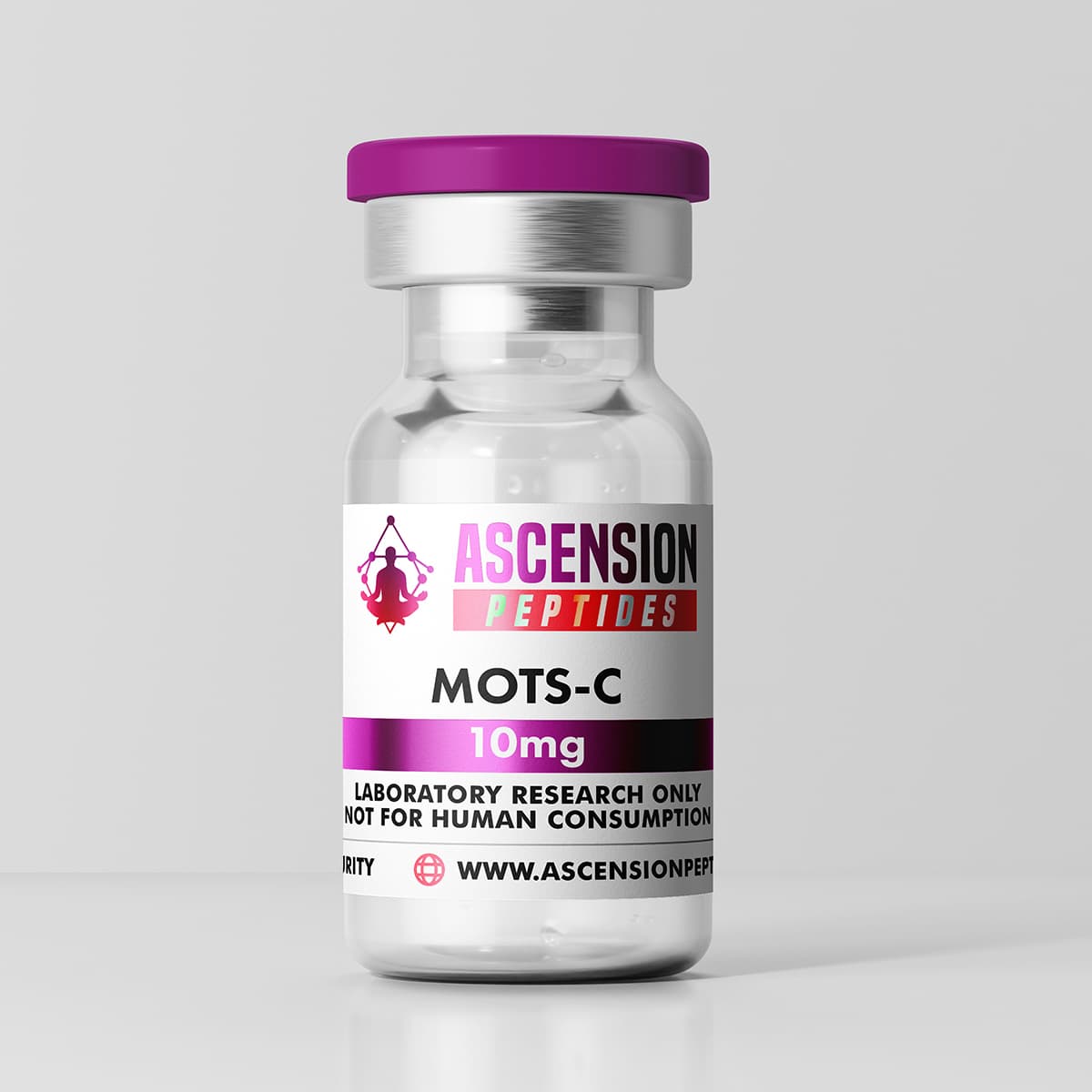
MOTS-c peptide is one of the few compounds in the longevity and metabolic space that actually has a mechanistic story worth paying attention to. It is not a synthetic hormone, not a growth factor mimic, and not another secretagogue. MOTS-c comes from mitochondrial DNA itself — a 16-amino-acid signal that tells your cells how to handle energy under stress.
🔑 Key Takeaways
- MOTS-c is a mitochondrial-derived peptide — encoded by mitochondrial DNA, not nuclear DNA — which makes it fundamentally different from most peptides people use.
- It activates AMPK, improving glucose handling, fat oxidation, and metabolic flexibility.
- Standard protocols run 5–10mg subcutaneously, 2–3 times per week for 4–8 weeks.
- Smaller, more frequent doses tend to outperform large infrequent ones because of how AMPK signaling works.
- MOTS-c has a real stability problem — it degrades faster than most peptides, so storage and sourcing matter more than usual.
- At higher doses, AMPK activation can work against muscle-building goals. This is not a bodybuilding peptide.
Most guides on MOTS-c peptide either bury the practical details under science jargon or skip the nuances that actually matter for people using it. This one covers the mechanism, dosing logic, the stability issue most guides ignore, and what the experience realistically looks like.
MOTS-c degrades faster than most peptides, so cold-shipped, third-party-tested material matters more here than usual — Ascension's MOTS-c 10mg is the vial most of the protocols below are run on.
What Is MOTS-c Peptide?
MOTS-c stands for Mitochondrial Open Reading Frame of the 12S rRNA Type-c. The name is dense, but the concept is simple: your mitochondria — the parts of the cell responsible for producing energy — encode this short peptide as a kind of efficiency signal.
When energy demand is high or the cell is under metabolic stress, MOTS-c gets released. It travels from the mitochondria to the nucleus, where it influences how genes related to metabolism, stress response, and inflammation get expressed. Think of it as a distress signal and an upgrade notice at the same time.
MOTS-c was first identified in 2015 by researchers at the University of Southern California. It belongs to a small family of mitochondria-derived peptides (MDPs) alongside Humanin and SHLP peptides. What makes this family interesting is that they are encoded by mitochondrial DNA, not nuclear DNA — which is unusual and part of why the signaling effects are so broad.
Your body produces MOTS-c naturally. Levels increase during exercise and fasting. But they also decline with age, which correlates with the metabolic slowdown, reduced exercise tolerance, and increased inflammation that most people start noticing in their late 30s and 40s. That age-related decline is the main reason MOTS-c keeps showing up in longevity conversations alongside compounds like NAD+ peptides and SS-31.
How MOTS-c Works: AMPK Activation
The central mechanism behind MOTS-c peptide is AMPK activation. AMPK (AMP-activated protein kinase) is often called the metabolic master switch because it coordinates how cells produce, store, and use energy.
When AMPK is activated, a cascade of metabolic shifts happen:
- Glucose uptake improves. Cells pull in more glucose through GLUT4 transporters, which directly supports insulin sensitivity.
- Fat oxidation ramps up. The body shifts toward burning fatty acids as fuel more efficiently.
- Mitochondrial biogenesis increases. The body builds more mitochondria, expanding long-term energy capacity.
- Inflammatory signaling calms down. Chronic low-grade inflammation — the kind linked to aging and metabolic syndrome — gets dialed back.
This is also why exercise is so beneficial metabolically — exercise naturally activates AMPK through the same pathway. MOTS-c levels rise during physical activity, which is why some people call it an "exercise-mimetic" peptide. That label overpromises — MOTS-c will not replace training — but the signaling overlap is real and meaningful.
MOTS-c Peptide Benefits
The benefits of MOTS-c peptide cluster around metabolism, body composition, exercise performance, and aging. Here is what each looks like in practice.
Metabolic Support and Insulin Sensitivity
This is the strongest and best-supported benefit. MOTS-c improves how cells handle glucose and switch between fuel sources. For people dealing with sluggish metabolism, early insulin resistance markers, or blood sugar instability, this is usually the benefit that shows up first — often as more stable energy and fewer erratic hunger swings.
Body Composition and Fat Loss
MOTS-c is not a fat burner in the traditional sense. It does not spike thermogenesis or crush appetite. What it does is support fat oxidation and metabolic flexibility, which can make body recomposition noticeably easier when diet and training are already in place. Think of it as clearing a metabolic bottleneck rather than forcing a result. People who have been stuck despite doing the basics reasonably well tend to be the ones who notice this most.
Exercise Performance and Recovery
Because MOTS-c supports mitochondrial function and energy regulation, many users report that workouts feel more productive — better endurance, more consistent output, and somewhat faster recovery between sessions. This shows up most clearly in aerobic and endurance work. It is not a pre-workout effect. It is a baseline shift that becomes apparent after 1–2 weeks of consistent use.
Healthy Aging and Longevity
MOTS-c levels decline with age. That decline tracks with reduced metabolic flexibility, increased systemic inflammation, lower exercise capacity, and the general feeling that your body handles stress less efficiently than it used to. Supplementing MOTS-c is an attempt to address that decline directly at the mitochondrial level. The longevity data is still developing, but the mechanistic foundation is stronger than most peptides in this category.
Inflammation Reduction
Through AMPK activation, MOTS-c helps modulate inflammatory pathways. This is not anti-inflammatory like ibuprofen — it targets the chronic, low-grade systemic inflammation that accumulates from aging, metabolic dysfunction, and sedentary patterns. For people who feel generally "inflamed" without a clear acute cause, this can be a meaningful benefit.
💡 Where MOTS-c Fits Best
MOTS-c peptide works best as part of a broader metabolic strategy — not as a standalone rescue tool. It will not override a broken diet, zero exercise, or chronic sleep deprivation. But when the basics are in place, it can meaningfully shift how the body handles energy, stress, and recovery.
The MOTS-c Stability Problem
This is something most MOTS-c guides skip, and it matters more than people realize. MOTS-c is a short, fragile peptide. It degrades faster than many of the more commonly used peptides like BPC-157 or CJC-1295.
What this means in practice:
- Reconstituted MOTS-c has a shorter usable window. Once you add bacteriostatic water, use it within 2–3 weeks max. Some peptides last a month or more — MOTS-c does not hold up as long.
- Temperature sensitivity is real. Always refrigerate after reconstitution. Never leave reconstituted MOTS-c at room temperature for extended periods. Heat degrades it fast.
- Vendor quality matters disproportionately. With a peptide this fragile, poor handling during manufacturing, shipping, or storage can mean you are injecting degraded product and blaming the peptide for not working. If your MOTS-c protocol feels like it is doing nothing, sourcing is the first thing to question.
- Lyophilized (powder) form is more stable. Keep vials sealed and refrigerated until you are ready to reconstitute. Do not reconstitute multiple vials in advance.
MOTS-c Dosage: Protocols That Actually Make Sense
The standard MOTS-c peptide dosage falls in the 5–10mg range, injected subcutaneously 2–3 times per week, with cycles running 4–8 weeks.
Why Smaller, More Frequent Doses Work Better
This is a practical insight that separates good MOTS-c protocols from mediocre ones. Because of its relatively short half-life (estimated 4–6 hours), large infrequent doses create a spike-and-crash pattern in AMPK activation. Smaller doses spread across 3 injections per week keep signaling more consistent.
In practical terms: 5mg three times a week often outperforms 10mg twice a week, even though the weekly total is lower. Steady signaling matters more than peak dose with this peptide.
Cycling: Why On/Off Periods Matter
MOTS-c protocols typically use 4–8 weeks on followed by an equivalent break. The cycling logic is twofold: first, it prevents the body from downregulating its response to sustained AMPK activation. Second, it gives you a clean window to assess whether the peptide actually moved anything meaningful — body composition, energy, fasting glucose, workout performance — versus placebo drift.
For the full dosing deep-dive with reconstitution math and administration steps, read our MOTS-c dosage guide.
What Does MOTS-c Actually Feel Like?
Expectations need to be managed here. MOTS-c peptide does not feel like much on any individual day. There is no rush, no buzz, no immediate energy spike. People who respond well typically describe the effects as cumulative and subtle:
- Steadier energy through the day — fewer afternoon crashes
- Workouts feel slightly more productive after 1–2 weeks
- Appetite becomes more stable and predictable
- Body composition shifts gradually, especially midsection fat
- Recovery between training sessions improves modestly
- A general sense that the body handles physical stress a bit better
One user description that captures it well: "It is like coffee but not fake energy." That is about right. The people who are disappointed by MOTS-c are usually expecting it to feel dramatic. The people who like it are tracking objective markers — waist measurements, fasting glucose, workout logs — and watching the trend lines move over weeks.
If you are waiting for a single dramatic moment, you will probably miss the actual benefit entirely.
MOTS-c Side Effects and the Histamine Issue
MOTS-c is generally well tolerated, but there is one side effect pattern that deserves more attention than it usually gets: histamine and mast cell activation.
Common Side Effects
The Histamine/Flushing Response
Some users experience noticeable flushing, skin redness, itching, or even mild hives after MOTS-c injections. This appears to be a mast cell activation response — not an allergic reaction in the traditional sense, but a histamine release triggered by the peptide.
If this happens to you:
- Inject more slowly — rapid injection can trigger a stronger histamine response.
- Start at the low end of dosing (5mg) and see if the reaction settles after 2–3 injections.
- Consider taking a non-drowsy antihistamine 30 minutes before injection if the flushing is bothersome.
- If hives or significant itching persist beyond the first few sessions, reduce dose or discontinue.
This is not dangerous for most people, but it is worth knowing about in advance so you do not panic or assume you got a contaminated product. For a fuller breakdown, check our MOTS-c side effects guide.
The Anti-Anabolic Trade-Off: Why MOTS-c Is Not a Bodybuilding Peptide
This is a nuance that most MOTS-c guides gloss over. At higher doses, significant AMPK activation can actually work against an anabolic environment.
AMPK and mTOR (the pathway that drives muscle protein synthesis) have an inverse relationship. When AMPK goes up, mTOR tends to get suppressed. At moderate doses and standard protocols, this is not usually a problem — the metabolic benefits outweigh any minor anabolic dampening. But if you push MOTS-c to high doses while also trying to maximize muscle growth, you may be working against yourself.
In practical terms:
- MOTS-c pairs well with fat loss, recomposition, endurance, and longevity goals.
- It is not ideal during a dedicated bulking phase where maximizing mTOR signaling is the priority.
- If you are stacking MOTS-c with growth hormone peptides like CJC-1295/Ipamorelin for recomposition, keep the MOTS-c dose moderate (5–7.5mg) rather than pushing to 10mg.
This does not mean MOTS-c destroys gains. It means there is a dose-dependent trade-off that you should be aware of when designing your protocol around specific goals.
Who Should Consider MOTS-c Peptide?
MOTS-c fits well for certain profiles and poorly for others. Here is an honest breakdown.
Good candidates:
- People over 35–40 noticing metabolic slowdown, stubborn body composition, or declining exercise recovery despite consistent effort.
- Metabolic health focus — anyone wanting to improve insulin sensitivity and glucose handling alongside diet and exercise.
- Endurance-focused athletes looking for mitochondrial and aerobic capacity support without hormonal manipulation.
- Longevity-minded users already building a stack around mitochondrial health, NAD+ support, or fasting protocols.
Not the right fit:
- People wanting rapid fat loss — look at Tesamorelin or GLP-1 peptides instead.
- Dedicated bulking phases — the AMPK/mTOR trade-off makes this a poor time to use MOTS-c at higher doses.
- Competitive athletes under WADA testing — MOTS-c is prohibited at all times under Section 4.4 (Metabolic Modulators) as an AMPK activator.
- People looking for dramatic short-term results — MOTS-c is subtle and cumulative, not dramatic.

MOTS-c Stacking: What Pairs Well
MOTS-c works through mitochondrial and metabolic pathways, so it stacks logically with peptides that hit complementary angles.
For specific combination protocols, our Retatrutide + MOTS-c stack guide and AOD + Tesamorelin + MOTS-c stack guide go deeper.
MOTS-c vs Other Metabolic Peptides
MOTS-c is the most mitochondria-specific option here. If you want raw weight loss, GLP-1 peptides are more direct. If you want metabolic optimization and long-term cellular health, MOTS-c has a stronger mechanistic foundation.
MOTS-c Before and After: What Results to Realistically Expect
MOTS-c before and after photos are not where the result shows up, and that is the honest place to start — the change is in the numbers, not the mirror. MOTS-c is metabolic and cumulative rather than cosmetic, so a real before and after is built from tracked numbers — fasting glucose, a weekly waist measurement, one repeatable workout benchmark — not a single snapshot.
The pattern most reports follow: steadier energy in weeks one to two, workouts feeling more productive by weeks two to four, waist and glucose trend lines moving around weeks four to six, and effects levelling off by weeks six to eight, which is the point to judge a cycle. Response varies, and the people who see the least are usually the ones who never logged a baseline to compare against.
We cover this in full — the week-by-week timeline, the three markers to log before your first dose, who responds most, and what to check if a cycle did nothing — in MOTS-c before and after.
Worth keeping in mind either way: most of what is known about MOTS-c improving insulin sensitivity comes from mouse and cell studies rather than human trials, so treat any before and after as personal data rather than an established result. What users actually describe is in our MOTS-c review, and because a flat cycle is so often a material-quality problem with this peptide, verified sourcing matters — see where to buy MOTS-c.
Related comparisons: SLU-PP-332 vs MOTS-c and MOTS-c vs metformin.