Same switch. Two very different hands on it.
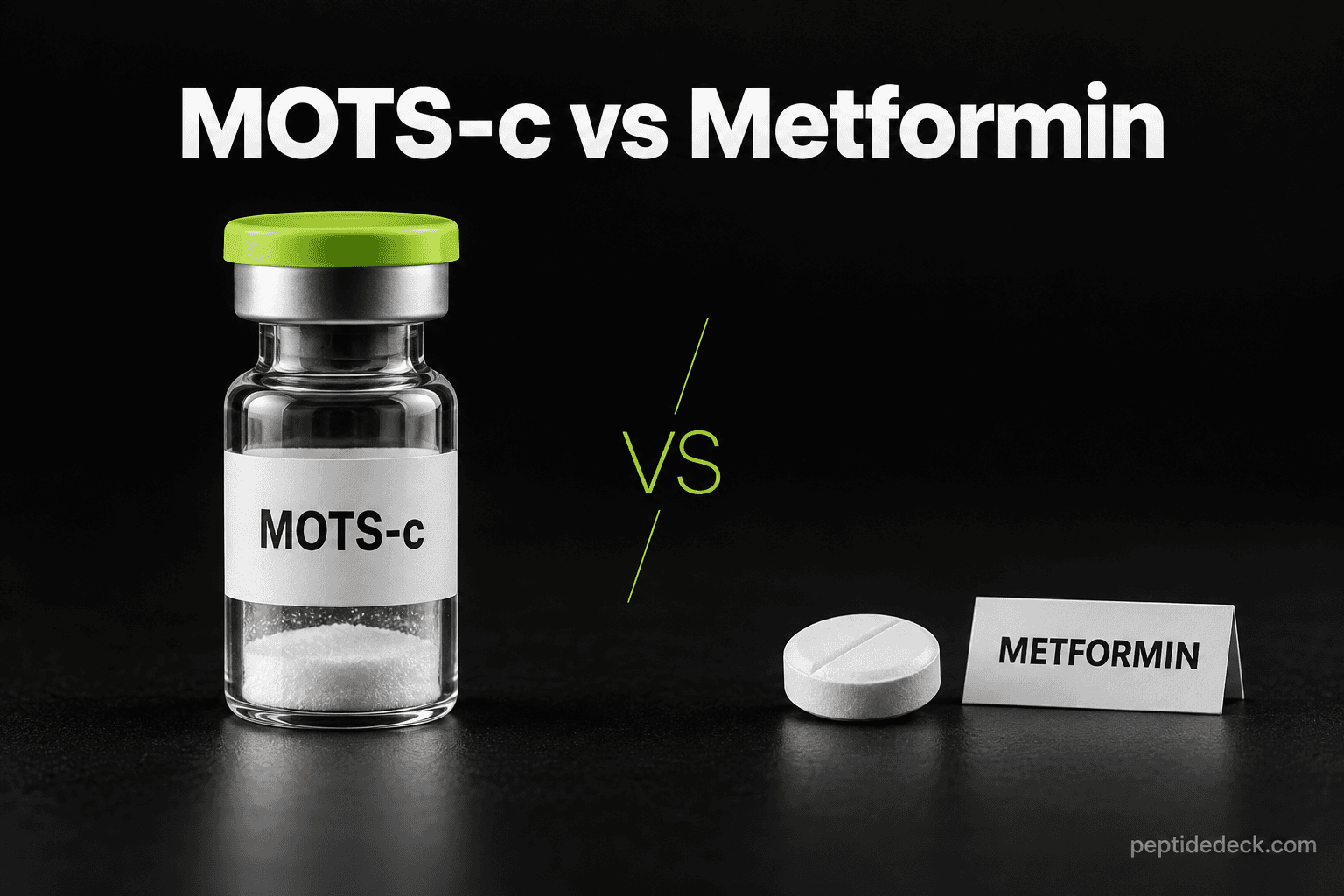
MOTS-c vs metformin comes up because both end at AMPK, the enzyme that tells your cells to burn fuel instead of storing it. One is a pill that has been prescribed to hundreds of millions of people since the 1950s and is the subject of the largest human anti-ageing trial ever designed. The other is a peptide your mitochondria make, discovered in 2015, with one small human trial to its name. If the switch is the same, the question is what each hand does on the way to it, and what else it touches.
🔑 Key Takeaways
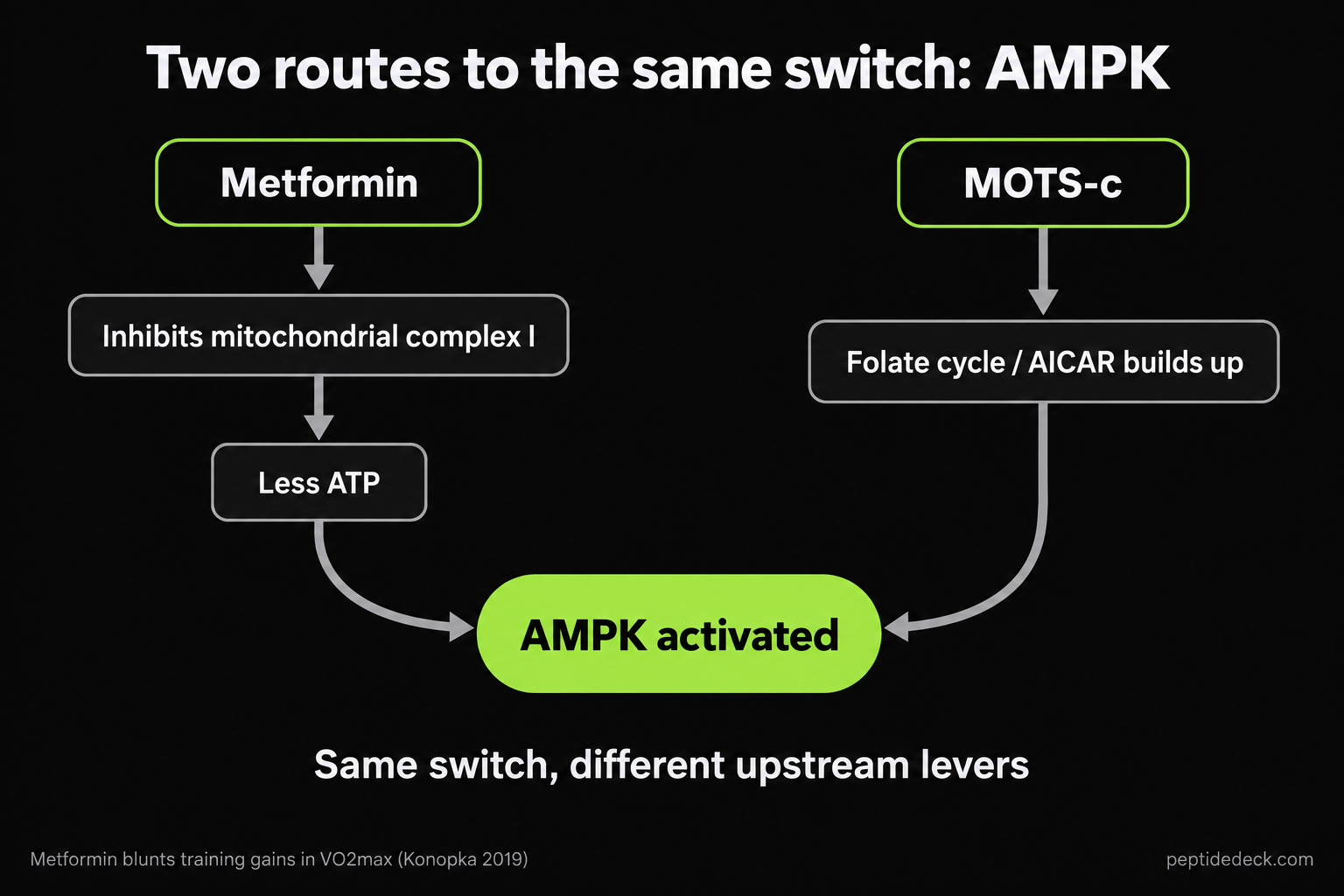
- Metformin reaches AMPK by partially inhibiting mitochondrial complex I. MOTS-c reaches it through the folate cycle. Same destination, opposite relationship with your mitochondria.
- Metformin has decades of human data, a clear glucose effect, and an ongoing trial for ageing itself. MOTS-c has mouse data, an interesting human genetic association, and one phase 1/2a trial.
- Metformin blunts some of the fitness gains from training. MOTS-c, at least in mice, does the opposite.
- For blood sugar, this is not a contest. For exercise performance, it is not a contest in the other direction.
- Whether they should be used together is a better question than which one wins. The stacking section covers it.
This page compares the two. For the peptide on its own, see the MOTS-c peptide guide. For MOTS-c against another longevity compound, see MOTS-c vs NAD+.
MOTS-c vs Metformin at a Glance
Two Routes to the Same Switch
AMPK is the cell's fuel gauge.
When energy runs low, the ratio of AMP to ATP rises and AMPK activates. It then pushes the cell toward burning fat and glucose, suppresses building processes like protein and lipid synthesis, and over time drives the creation of new mitochondria. Exercise activates it. Fasting activates it. So do both of the compounds in this comparison, but by routes that have very different side effects.
Metformin gets there by mildly poisoning the mitochondria. It partially inhibits complex I of the electron transport chain, which reduces ATP production, which raises the AMP-to-ATP ratio, which activates AMPK. That is a simplification, and metformin has other actions in the liver and gut, but the complex I mechanism is central to how it lowers glucose. The important consequence is that metformin makes mitochondria slightly less efficient as the price of activating the fuel gauge.
MOTS-c is a peptide encoded within the mitochondrial genome itself. Under metabolic stress it translocates to the nucleus. On the way it interferes with the folate and methionine cycle, causing AICAR, a natural AMPK activator, to build up. AMPK switches on without any hit to mitochondrial respiration. Your body makes more MOTS-c during exercise, and it declines with age, which is why it attracted the exercise-mimetic label.
Same end point, different journey. And the journey turns out to matter when you add training.
MOTS-c vs Metformin for Blood Sugar
Metformin, and it is not close.
Metformin lowers HbA1c by roughly 1 to 1.5 percentage points in people with type 2 diabetes, mainly by reducing hepatic glucose output and improving insulin sensitivity. It is the first-line drug in every major guideline and has been for two decades. The evidence base is enormous.
MOTS-c improved glucose handling and insulin sensitivity in mice, and the CB4211 analogue trial in people with obesity and fatty liver showed a modest glucose signal. There is also a human genetic finding: a MOTS-c variant common in East Asian populations is associated with higher diabetes risk in sedentary men, suggesting the peptide plays a real role in human glucose regulation. That is interesting biology. It is not a treatment for high blood sugar.
MOTS-c vs Metformin for Longevity
Here the gap narrows, and the story gets interesting.
Metformin's longevity case rests on observational data, the most cited being a 2014 analysis suggesting diabetics on metformin outlived non-diabetics not on it, and on a mechanistic story that runs through AMPK, mTOR and inflammation. That case was strong enough to justify TAME, a planned 3,000-person, six-year trial designed to test whether metformin delays age-related disease as a class. TAME has struggled for funding and has not reported. Meanwhile, the observational picture has become more mixed, with later analyses finding smaller or no survival advantages once biases were addressed.
MOTS-c's longevity case is younger but has a piece metformin lacks: a human genetic association with lifespan. A variant in the MOTS-c sequence is enriched in Japanese centenarians. In mice, late-life MOTS-c treatment improved physical capacity and healthspan markers. It is also a molecule that declines with age, which makes replacing it a more intuitive intervention than adding a drug the body never made.
Neither has a human trial showing longer life. Metformin has the trial designed to find out. MOTS-c does not.
The Exercise Problem
This is the part most metformin-for-longevity articles skip.
In 2019, a randomised trial gave older adults either metformin or placebo alongside 12 weeks of aerobic training. The placebo group improved their VO2max and their muscle mitochondrial respiration as expected. The metformin group improved VO2max by roughly half as much and showed no gain in mitochondrial respiration at all. Metformin, by dampening complex I, appears to blunt exactly the adaptation that exercise is supposed to produce. Other work has found it interferes with gains in muscle mass from resistance training in older adults.
MOTS-c points the other way. It is released during exercise, its levels are higher in trained muscle, and injecting it into aged mice roughly doubled their running time. Its AMPK activation does not come at the expense of mitochondrial function, so there is no mechanistic reason to expect it to fight training, and the mouse data suggest it helps.
For someone who exercises seriously, that is the deciding difference. Metformin for longevity may be trading a possible long-term benefit for a measurable short-term cost in fitness. MOTS-c, on current evidence, does not carry that trade.
Dosage Compared
One dose has a label. One has a forum.
Metformin is oral, 500 to 2,000 mg a day in divided doses or as an extended-release tablet, started low to limit stomach upset. The longevity crowd typically uses 500 to 1,000 mg, often extended-release at night. It is generic and costs a few dollars a month. It requires a prescription.
MOTS-c is injected, typically 5 to 10 mg subcutaneously two to three times a week for 4 to 8 weeks, then a break. Smaller frequent doses are preferred because AMPK activation is transient. The peptide is less stable in solution than most, so reconstitute only what you will use within about two weeks and refrigerate it. The MOTS-c dosage guide covers timing around training and the reconstitution maths, and the where to buy MOTS-c page covers sourcing.
Side Effects Compared
Metformin's are well known because so many people take it.
Gastrointestinal upset affects a quarter or more of people starting metformin, and is the main reason for the slow titration. Long-term use depletes vitamin B12 in a meaningful minority and should be checked. Lactic acidosis is rare and mostly a concern with kidney impairment. And there is the training interference described above, which is not a side effect in the usual sense but is a cost.
MOTS-c's profile is thin because so few people have taken it under observation. The CB4211 trial reported it as well tolerated. Community reports centre on injection-site redness and transient fatigue after dosing. Because it activates AMPK, it may suppress mTOR-driven muscle protein synthesis at higher doses, which is a consideration for anyone prioritising muscle gain. The MOTS-c side effects guide goes through what is and is not known.
Using MOTS-c and Metformin Together
Both hands on the same switch.
There is no study of the combination. Mechanistically they converge on AMPK by different routes, so the effect would be at least partly redundant. The more interesting question is whether MOTS-c could offset metformin's interference with training by supporting mitochondrial function while metformin dampens it. That is a hypothesis, not a finding. If you are on metformin for diabetes, adding MOTS-c is a separate decision with its own thin evidence. If you are taking metformin only for longevity and you train hard, the 2019 trial is a reason to reconsider the metformin before you think about adding anything.
Which One Should You Choose?
Ask what you are treating.
Choose metformin if you have type 2 diabetes or prediabetes, you want the option with decades of human safety data and a prescription pathway, or your longevity approach favours the compound with a trial designed to test it.
Choose MOTS-c if your glucose is fine and your goal is exercise capacity, metabolic flexibility or ageing well while continuing to train, and you accept that you are working mostly from mouse data and a single small human trial.
Choose neither for weight loss. Metformin produces a modest 2 to 3 kg on average. MOTS-c has no human weight-loss result of note. The compounds with real weight-loss data are covered in the fat loss peptide ranking.
Frequently Asked Questions
The Verdict
Metformin is the drug. MOTS-c is the signal the drug is trying to imitate.
If your problem is blood sugar, take the drug. If your interest is ageing well and you do not train, metformin has the deeper evidence and a trial designed to settle the question. If you train seriously and your glucose is fine, the 2019 exercise data is hard to ignore, and MOTS-c is the option that works with your workouts rather than against them, on the understanding that its evidence is a fraction of metformin's.
References
- Konopka AR, et al. Metformin inhibits mitochondrial adaptations to aerobic exercise training in older adults. Aging Cell 2019;18(1):e12880. PubMed
- Lee C, et al. The mitochondrial-derived peptide MOTS-c promotes metabolic homeostasis and reduces obesity and insulin resistance. Cell Metab 2015;21(3):443-454. PubMed
- Reynolds JC, et al. MOTS-c is an exercise-induced mitochondrial-encoded regulator of age-dependent physical decline and muscle homeostasis. Nat Commun 2021;12:470. PubMed
- Fuku N, et al. The mitochondrial-derived peptide MOTS-c: a player in exceptional longevity? Aging Cell 2015;14(6):921-3. PubMed
- Bannister CA, et al. Can people with type 2 diabetes live longer than those without? Diabetes Obes Metab 2014;16(11):1165-73. PubMed
- Barzilai N, et al. Metformin as a tool to target aging. Cell Metab 2016;23(6):1060-1065. PubMed
- Walton RG, et al. Metformin blunts muscle hypertrophy in response to progressive resistance exercise training in older adults. Aging Cell 2019;18(6):e13039. PubMed
Medical Disclaimer: This content is for informational purposes only and does not constitute medical advice. Always consult a qualified healthcare provider before starting any new supplement, medication, or treatment. PeptideDeck may earn a commission from affiliate links at no additional cost to you.