Peptide Calculator
All you have to do is tell the peptide calculator about your vial. It will tell you how much bacteriostatic water to add, how many units to draw, how often to inject, how long the vial will last, when to discard it, and how many vials you will need for your entire cycle.
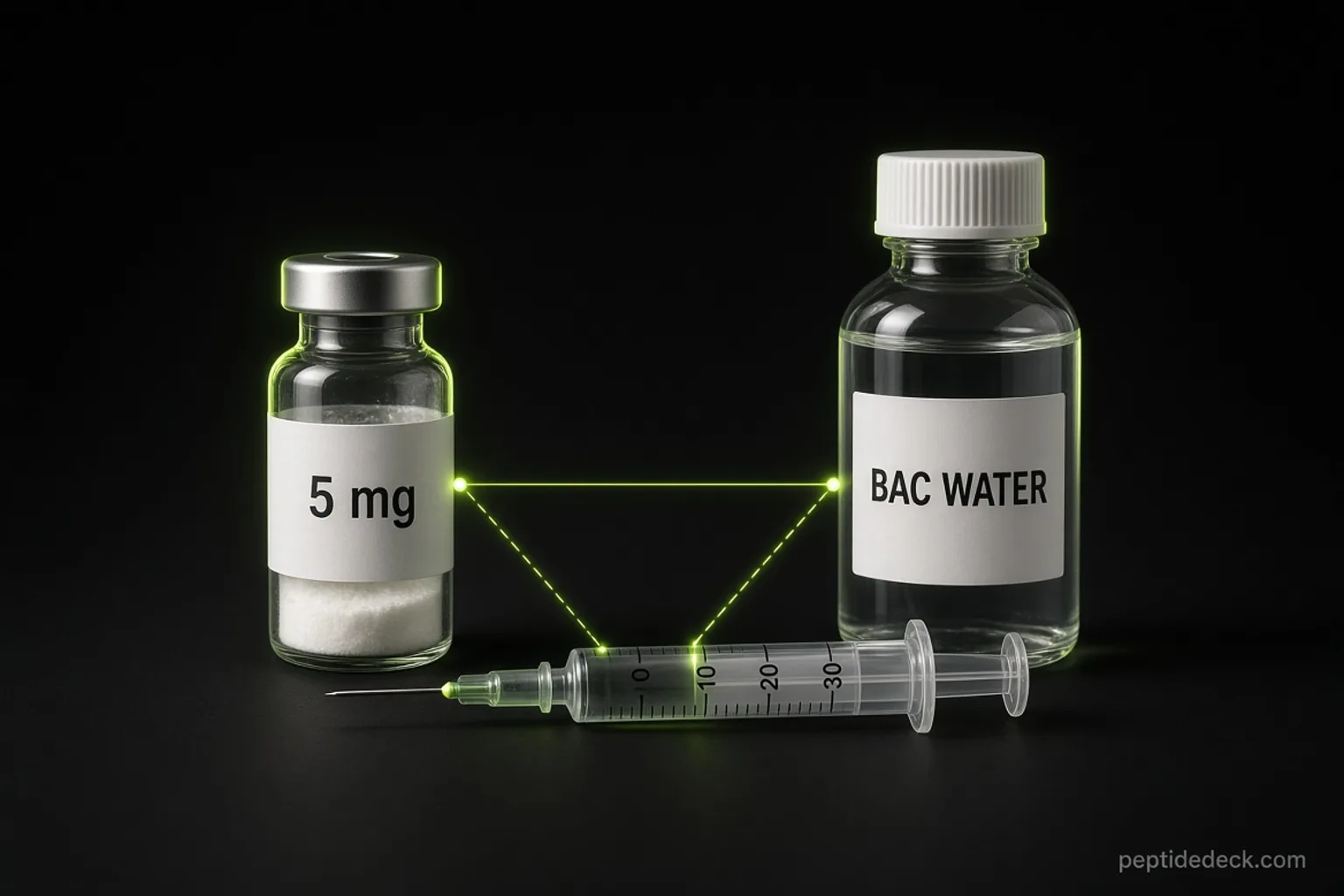
How many units do I draw for BPC-157?
If you have a 5 mg vial of BPC-157 and want to inject 250 mcg per injection, you would add 2 mL of water to your vial and draw to 10 units. 10 units equals 0.1 mL on your syringe. This calculation is based off using a 0.5 mL syringe, and every unit you draw has 25 mcg of peptide in it.
If you would also like to know when to inject, how long the vial lasts, if you want to run another peptide at the same time, or how much this will cost,plan it out below
Step 1: Tell the calculator about the peptide you are mixing
The amount of peptide in the vial is the starting point for every number that follows.
Is your vial a freeze-dried powder or a liquid?
Learn more
mg vs mcg - what's the difference?
Milligrams (mg) and micrograms (mcg) are units of measurement for weight. There are 1,000 micrograms in every milligram. Peptides typically come in vials that are measured in milligrams but are injected in doses measured in micrograms. For example, if you have a 5mg vial of BPC-157 and your dose is 250mcg, you would first need to convert the 5mg into micrograms which equals 5,000mcg. If you ever input a number into the calculator and it seems 1,000 times too big or too small, you're probably using the wrong unit of measurement. Don't worry, the calculator will recognize this and allow you to fix it with one tap.
Do you have a pre-mixed or compounded vial?
If you have purchased a compounded version of semaglutide or tirzepatide from a compounding pharmacy or if your supplier offers a pre-mixed version of these peptides, you can use this option. These vials already have the peptide mixed in them, so there is no need for you to mix anything.
If your peptide is already liquid, select "Liquid (already mixed)" above and enter how many mg/mL it is. This should be on the label. If you only know the total mg and total mL of the liquid, divide total mg by total mL to get your mg/mL (e.g., 10mg/2mL = 5mg/mL). The calculator will skip the water step for you and go straight to the units, as you do not need to add water. Store the peptide as directed by your pharmacy, as they will likely have different discard instructions than those shown here.
Step 2: Determine How Much Water You Want To Use
Water sets the concentration, and concentration decides how far you pull the plunger.
For this peptide, it is recommended you add 2 mL of water to the vial, as this is how much most people add. This will give you a concentration of 2.5 mg/mL and make it easy to measure out your dose of 250 mcg (10 units on a 0.5 mL insulin syringe).
Compare volumes and choose the water
Preserved; use within 4 weeks when stored in the refrigerator.
Learn more
Want To Know Why You Can Use Different Amounts Of Water?
No matter how much water you add, the amount of peptide in the vial stays the same. Adding water simply changes the concentration of the peptide and therefore, how much you have to draw up for your dose. Let's say you have a vial of peptide with 5mg of peptide in it and your dose is 250mcg. If you add 1 mL of water, you will have a concentration of 5mg/mL and will need to draw up 5 units on your syringe. However, if you add 2 mL of water, you will have a concentration of 2.5mg/mL and need to draw up 10 units on your syringe to get your 250mcg dose. Depending on your dose, you may find it easier to draw up your dose with less water in the vial (larger doses) or more water in the vial (smaller doses).
How much liquid a vial can take
Most peptides come in small glass vials that hold 3ml. Some hold 2ml. The powder in the vial takes up very little room. You can put 2.5ml to 3ml of water in a 3ml vial and it will fill it to the top of the stopper. If the calculator says to add more water than your vial can hold, get a smaller, thinner syringe instead. The smallest one, the 0.3ml one, has the biggest space in between the ticks. Also, you can get smaller vials. Don't try to put more liquid in the vial than it can hold, it will just shoot back out around the needle.
Why use Bacteriostatic Water?
Bacteriostatic water is just regular sterile water with 0.9% benzyl alcohol in it. This prevents bacteria from growing in your vial, thus allowing you to use the same vial for roughly 4 weeks. Sterile water can be used to mix your peptides if you want, it works just as well, but you can only use it for a day as it doesn't have anything in it to stop bacteria from growing.
How to mix your peptide vial:
- Get everything you need out. Make sure to wash your hands. You will need the vial of peptide, a vial of bacteriostatic water, a syringe to mix the peptide with (doesn't have to be an insulin syringe, a regular 1ml or 3ml syringe works well), alcohol swabs, and some insulin syringes.
- Pop the caps off of your vials and swipe the tops with an alcohol swab. Let them dry for roughly 10 seconds.
- Pull up the amount of water you need to add (from Step 2 of the calculator) into your mixing syringe. Tap it to get any bubbles out.
- SLOWLY add the water to the peptide vial. Don't squirt it directly on the powder or it will foam up, run it along the side of the glass.
- Roll the vial between your hands until the powder is dissolved. Don't shake it, just roll it gently. If there are a few spots of powder left, put it in the fridge for a minute and roll it again.
- Write the date on the vial and stand it upright in the fridge. Your discard date is on the dose card.
Step 3: What is your dose?
The dose turns concentration into a number of units you can read straight off the syringe.
Usual range: 250 mcg to 500 mcg
250 mcg once daily
- Usual range
- 250 mcg to 500 mcg
- Typical course
- 8 weeks
Often dosed 1-2x daily
The most common peptide syringe. Easy to read up to 50 units.
Dose by body weight and syringe help
A set amount per injection, in mcg or mg.
Learn more
Reading units on a U-100 syringe
A U-100 insulin syringe is marked in units. 100 units is 1 mL, so 1 unit is 0.01 mL.
The calculator converts your dose straight into units, so you read the answer off the barrel with no math.
Pull the plunger until the top of the black rubber stopper lines up with the tick. On a 1 mL barrel the small ticks are 2 units apart. On a 0.5 mL barrel they are 1 unit apart. On a 0.3 mL barrel they are 1 unit, sometimes half a unit.
Which syringe to use
All three barrels are U-100 insulin syringes. Only the size changes.
1 mL (100 units) fits the biggest draws. 0.5 mL (50 units) is the most common for peptides and easy to read. 0.3 mL (30 units) has the widest tick spacing, best when your draw is under about 10 units.
A 29 to 31 gauge needle, 5/16 to 1/2 inch long, suits injections under the skin. The calculator warns you if a draw will not fit, or is too small to read, on the barrel you picked.
Check the syringe says U-100, not U-40
U-40 syringes exist for pet insulin. They have 40 units per mL, not 100.
Every number in this calculator assumes U-100. Draw a U-100 unit count on a U-40 syringe and you inject two and a half times the liquid.
Look for "U-100" printed on the barrel or the box. If it says U-40, do not use these numbers.
Dosing by body weight
Some peptides are dosed per kilogram. Multiply your weight in kg by the mcg/kg figure to get the dose per injection.
80 kg at 5 mcg/kg is 400 mcg. If you weigh in pounds, divide by 2.2 first: 176 lb is 80 kg.
Enter your weight and the mcg/kg and the calculator does this for you, then converts the result into units.
Watch: how the peptide calculator works (52 seconds)
Vial, water, dose, then the units to draw and how long the vial lasts. No audio needed; captions are on.
More peptide calculators
- CJC-1295 / Ipamorelin calculatorUnits for both, one syringe or two
- PT-141 dosage calculatorUnits for 0.5 to 1.75 mg, doses per vial
- TB-500 dosage calculatorUnits for 2 to 2.5 mg, vials per cycle
- Semaglutide reconstitution calculatorWater to add, units for every weekly step
- HGH reconstitution calculatorIU to syringe units for 10, 12 and 36 IU vials
- Molecular weight calculatorSequence to MW, net charge, pI and mg to nmol
- AI Peptide CoachAsk about dosing, stacking or storage
- Half-life calculatorSee how weekly GLP-1 doses build up
- Microdosing plannerCompare one weekly dose against several
How the Peptide Calculator Works
Three numbers, one answer. The peptide calculator runs the same arithmetic you would do on paper, so you can check it any time you are holding a syringe and want to be sure.
- 1
Concentration
mg in the vial ÷ mL of water = mg/mL. A 5 mg vial with 2 mL of water is 2.5 mg/mL.
- 2
Dose volume
dose in mg ÷ mg/mL = mL. A 0.25 mg (250 mcg) dose ÷ 2.5 mg/mL = 0.1 mL.
- 3
Units
mL × 100 = units on a U-100 insulin syringe. 0.1 mL is 10 units.
Shortcut: mcg per unit = mg/mL × 10. At 2.5 mg/mL every unit holds 25 mcg, so 250 mcg is 10 units and 500 mcg is 20. Once you know the mcg per unit for your vial, you can convert any dose in your head, or let the peptide calculator do it for every dose in your plan.
Peptide Calculator FAQ
How much bacteriostatic water do I add to a peptide vial?
Enough to make your dose land on an easy-to-read tick. A common starting point is 1 mL per 5 mg of powder, so a 5 mg vial gets 1 mL and a 10 mg vial gets 2 mL. For small doses like 250 mcg of BPC-157, 2 mL in a 5 mg vial gives a 10-unit draw, which is easier to read than 5 units. The Water step of the peptide calculator shows every option side by side.
What does a peptide reconstitution calculator do?
A peptide calculator turns three numbers, the mg in your vial, the mL of water you add and the dose you want, into one answer: how many units to pull on your syringe. It also gives the concentration, how many doses the vial holds and when to throw it out. The point is to take the arithmetic out of the moment you are holding a needle.
What syringe do I use for peptide injections?
A U-100 insulin syringe, which means 100 units per mL, with a fixed 29 to 31 gauge needle. They come in 0.3 mL, 0.5 mL and 1 mL sizes and are sold at most pharmacies. Do not use a U-40 syringe; its units are a different size. When the ticks on a big barrel are too close to read your dose, the peptide calculator suggests a smaller syringe.
How do I convert mcg to units on an insulin syringe?
Work out the strength first: vial mg divided by water mL gives mg/mL. Multiply by 10 and you have mcg per unit, then divide your dose by that. Example: 5 mg in 2 mL is 2.5 mg/mL, so 25 mcg per unit, so a 250 mcg dose is 10 units. The peptide calculator does this for any dose you type.
Can I use this peptide calculator for semaglutide, tirzepatide or retatrutide?
Yes. For a powder vial, use the peptide calculator like you would for any other peptide. For a compounded vial that arrives as liquid, choose the pre-mixed option and enter the mg/mL on the label. The Schedule step also has weekly titration ladders for the GLP-1 peptides, so the draw steps up with you.
How much water do I add to a pre-mixed or compounded vial?
None. A pre-mixed vial is already at its final strength. Choose the pre-mixed option in the peptide calculator and enter the concentration from the label in mg/mL. If the label gives total mg and total mL instead, divide the two: 10 mg in 2 mL is 5 mg/mL.
Does adding more water change my dose?
No. The peptide in the vial is fixed; water only changes how much liquid carries each dose. More water means more units for the same mcg, which makes tiny doses easier to read, and less water keeps big doses from overflowing the syringe. Your dose in mcg is the same either way.
Is this a peptide dosage calculator or a reconstitution calculator?
Both. The reconstitution part of the peptide calculator turns vial size and water into a concentration, and the dosage part turns your dose into units, doses per vial, vial life and vials per cycle. You can also start from body weight in mcg per kg and let it work back to units.
This calculator does the arithmetic. It is not medical advice. Confirm every dose with a qualified professional before you inject anything, and use a fresh sterile needle every time.