Most MOTS-c reviews are guesses. This one is a count.
If you've searched for MOTS-c reviews, you've seen the pattern. Vendor pages promise energy, fat loss and "mitochondrial renewal". Reddit threads say it changed someone's cardio, or did nothing at all, or left welts the size of a palm. Both can't be the whole story. So we read every MOTS-c thread we could pull from Reddit, 175 of them, and counted what 388 people said happened when they actually used it.
🔑 Key Takeaways
- Energy and cardio are what people notice, when they notice anything. Fat loss is rarely the headline.
- About one user in nine felt nothing at all, and raising the dose did not seem to rescue them.
- The welts are real and common. A handful of reactions came only after months of trouble-free use.
- People on retatrutide reported a side effect almost nobody else did. It shows up a few hours after a meal.
- Only 22 of 388 people ran the dose most guides recommend. What the rest did is more interesting.
Below: how we counted, the full tally in a table and chart, the doses Redditors really use and how they compare with ours, what the science does and doesn't back up, the red flags in vials, and an honest answer to whether MOTS-c is worth the money.
How We Read 175 MOTS-c Reddit Threads
The method matters more than the number.
We pulled every thread with "MOTS-c" (or a spelling of it) in the title from r/Peptides and r/moreplatesmoredates through a public Reddit archive, read on October 20, 2026. That gave 175 threads with readable text, from September 2019 to October 19, 2026, and 2,683 comments. Most of the activity is recent: about two-thirds of the reports date from 2026, which tracks the surge of interest that came with retatrutide stacks.
We counted a person only when they described their own use. Questions, plans, "my friend tried it" stories, vendor posts and pasted AI summaries were all left out. Each person counted once per effect, even if they mentioned it in five comments or three threads. A report counts if the user tied the effect to MOTS-c, even tentatively.
Two limits to keep in mind. First, Reddit skews toward people with something to say: those who felt great and those who had a bad reaction post more than those who felt "maybe a bit better". Second, 150 of the 388 were taking other compounds at the same time, most often SS-31 or retatrutide, so a report is what the user believed MOTS-c did, not proof that it did.
MOTS-c Reviews at a Glance: What 388 Users Reported
Here is the whole tally.
Shares add up to more than 100% because one person can report several things. The bracket shows how many people in that row gave a dose, so the medians lean on small groups for the rarer effects.
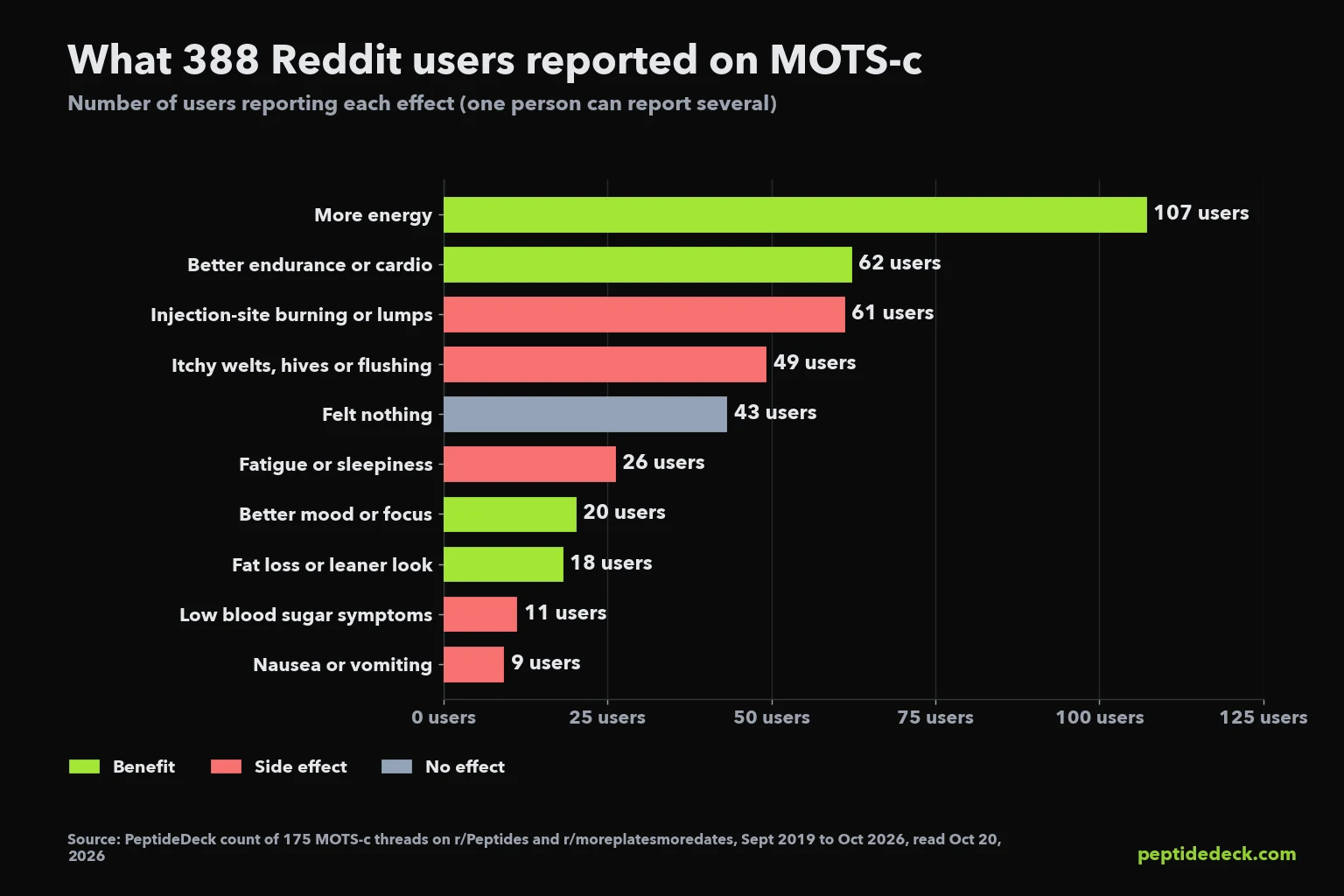
Of the 312 people who gave a clear overall verdict, 155 (50%) were positive, 83 (27%) negative, 39 (12%) mixed and 35 (11%) said it did nothing. That is a far more divided picture than any product page suggests.
MOTS-c Results: What People Say It Feels Like
It is not a stimulant. Almost everyone agrees on that.
Energy is the main event. When you are dragging through the afternoon, or a calorie deficit has flattened your workouts, this is the change people describe: fewer slumps, no nap needed, more left in the tank. 107 users reported it. A common pattern was a pre-workout shot on training days, with the lift felt within an hour or two. Others described a slower build over two to three weeks. A few, including one user over 40 and in menopause, said the biggest difference was simply no longer crashing mid-day.
Endurance is where the stories get specific. Cyclists, runners, swimmers and combat-sport athletes made up a big share of the 62 endurance reports. One user swam over five times their usual distance after the first dose, then admitted they were also on TRT and training hard. Another set a personal best on a 4.5 km run during a short daily course and never matched it after stopping. These are the most vivid reviews in the threads, and also the hardest to separate from training.
Fat loss is quieter than the marketing. Only 18 people said they got leaner, mostly around the midsection, and many were also on tirzepatide or retatrutide. Six said their blood sugar improved, including one who watched fasting glucose fall from the 105 to 120 range into the mid-90s over two months. If you're looking for a scale-mover, the threads point elsewhere, and our MOTS-c before and after guide sets a realistic timeline.
The benefit often fades. Several users said the first dose felt strongest, a second cycle did less than the first, or the effect wore off within a few weeks of stopping. One cyclist put it well: a clear plus while on it, no real loss when it ended.
MOTS-c Side Effects on Reddit: What Comes Up Most
This is where the threads get louder.
Welts and itching lead the list. 91 people (23%) reported some skin or site problem. Most were local: a burning sting, a raised bump, a red patch for a day or two. But 49 described something bigger: itchy welts, spreading redness, hives away from the shot, or reactions lasting up to a week. It is the side effect that made the most people quit.
Three patterns repeat. Reactions seemed worse at higher concentrations and doses around 2 mg and up. Switching from the belly to the glutes or shoulder, or to an intramuscular shot, was the most cited fix. And a few people reacted only after months of clean use, then had every old injection site flare at once. There is a known route for this: some injected peptides trigger mast cells directly through a receptor called MRGPRX2, without a true allergy (McNeil, Nature 2015). Nobody has tested MOTS-c on that receptor, so treat it as a likely explanation, not a proven one. Our MOTS-c side effects page covers how to handle the milder version.
Six reports went beyond the skin. Throat swelling and chest tightness on a fifth weekly 5 mg shot. A hand-sized welt with a heart rate jump to 110 after months of use. Lip swelling and a tight throat. A brief collapse with an irregular heartbeat. Swelling of the cheeks after a shot. Throat or lip swelling, trouble breathing or fainting is an emergency, not a forum question.
Tired instead of energized. 26 people got the opposite of what they wanted: sleepiness one to three hours after the shot, lethargy, or a crash. Several were in a deep deficit on retatrutide at the time. The usual Reddit advice was "run SS-31 first", which we cover below. The data doesn't settle it either way.
Blood sugar dips, mostly in GLP-1 users. 11 people described shaky, sweaty, light-headed episodes, often an hour or two after the shot or a few hours after a carb-heavy meal. One user's glucose monitor showed overnight lows within five days that cleared a day after stopping. Five of the 11 were also on a GLP-1 drug, mostly retatrutide or tirzepatide. MOTS-c works through the same energy sensor (AMPK) that metformin touches, so stacking it on a GLP-1 drug in a deficit is a plausible setup for lows. Our retatrutide and MOTS-c stack guide covers spacing and food.
The rarer ones. Nausea or vomiting soon after injecting (9 users), raised blood pressure on dose days (2), nosebleeds in the first week (1), and trouble sleeping when dosed late in the day (6). The fix for that last one was always the same: dose in the morning.
MOTS-c Dosage on Reddit vs What We Recommend
Reddit dosing is all over the map.
We saw everything from 100 mcg a day to 10 mg twice a day. But the middle is clear enough to describe. Here is how it lines up with the protocol on our MOTS-c dosage chart.
Two things stood out in the dose data.
First, the people who felt nothing were not under-dosing. Their median was 5 mg a shot and about 13 mg a week, higher than the 3 mg median of the people who felt more energy. More was not the fix for non-responders: three of them were already at 10 mg a shot.
Second, the tired and the itchy were on modest doses, around 2 mg a shot. That fits a slow start. Our two-week test at 2.5 mg twice a week exists to find out whether your skin and your glucose tolerate MOTS-c before you triple the weekly amount. None of these doses, ours included, has been tested in a human trial; the three-times-a-week rhythm comes from a mouse study. For the draw itself, see how to reconstitute MOTS-c and how to inject MOTS-c.

The Stacks Redditors Pair With MOTS-c
Few people run it alone.
150 of the 388 named at least one other compound. The most common partners were SS-31 (53 users), retatrutide (47), NAD+ (28), tirzepatide (16), tesamorelin (16) and 5-Amino-1MQ (10).
The SS-31 question came up in 68 of the 175 threads. The popular claim is that you need a few weeks of SS-31 to "repair" mitochondria before MOTS-c works or stops making you tired. The reports split three ways: some said SS-31 first turned a bad experience into a good one, some ran MOTS-c alone and felt great, and some did the full SS-31 lead-in and still felt nothing. No study has tested that sequence. Our MOTS-c vs SS-31 comparison explains what each one actually does.
Retatrutide users mostly wanted MOTS-c to fix deficit fatigue. Some said it did. Others got the blood sugar dips above, or felt worse, and several commenters pointed out that very low carbs were the more likely cause of the fatigue in the first place. The three-way AOD, tesamorelin and MOTS-c combination has its own page: the AOD, tesamorelin and MOTS-c stack.
What the Science Actually Supports
Here is the gap between Reddit and the lab.
MOTS-c is a 16-amino-acid peptide coded in mitochondrial DNA. In the first paper, MOTS-c injections protected mice from diet-induced obesity and age-related insulin resistance, working through the energy sensor AMPK and the folate cycle (Lee et al., Cell Metabolism 2015). A 2018 study showed it moves into the cell nucleus under metabolic stress (Kim et al., Cell Metabolism 2018).
The endurance story comes from Reynolds et al. (Nature Communications 2021). Young, middle-aged and old mice ran better on MOTS-c, and old mice dosed three times a week had better physical capacity. In people, the same paper found that exercise raised MOTS-c levels in muscle and blood. Nobody was given MOTS-c. Two of the authors were consultants and shareholders in CohBar, the company developing a MOTS-c analog.
That analog, CB4211, is the only related molecule tested in people. In a small phase 1b, 11 adults with obesity and fatty liver took 25 mg daily for four weeks against 9 on placebo. Liver enzymes and glucose fell, but liver fat dropped in both groups and weight only trended down (CohBar, August 2021). It is a different molecule, dosed daily.
No clinical trial has tested native MOTS-c in people for energy, endurance or fat loss. So the 134 energy and endurance reports are not confirmation. They are a signal that matches the mouse data, from people who expected to feel it, often while taking three other things.
MOTS-c has no FDA approval. An FDA advisory committee voted on it in July 2026, but only about compounding; our page on whether MOTS-c is FDA approved explains the vote. MOTS-c is also named on the WADA Prohibited List as an AMPK activator, banned at all times, so tested athletes should skip it (USADA).
Fake Vials and Other Red Flags
Many "it did nothing" reviews blame the vial.
Source quality came up in 18 of the threads, through talk of lab tests, underdosed vials and vendors that "did nothing" for some users and worked for others. Some non-responders used vials with third-party tests and still felt nothing, so a bad vial is not the only explanation. But a vial with no batch test leaves you guessing.
Watch for these:
- No batch-matched lab report. A real certificate shows the batch number on your vial, purity by HPLC, and an identity check by mass spec. Expect a molecular weight near 2,174.6 Da.
- A price far below the market. MOTS-c is expensive to make. A 10 mg vial priced at a fraction of the going rate is a warning, not a bargain.
- Powder that won't dissolve, looks cloudy after mixing, or a vial that looks under-filled.
- Health claims on the label or site, like "burns fat" or "reverses aging". Sellers that promise outcomes tend to cut corners elsewhere.
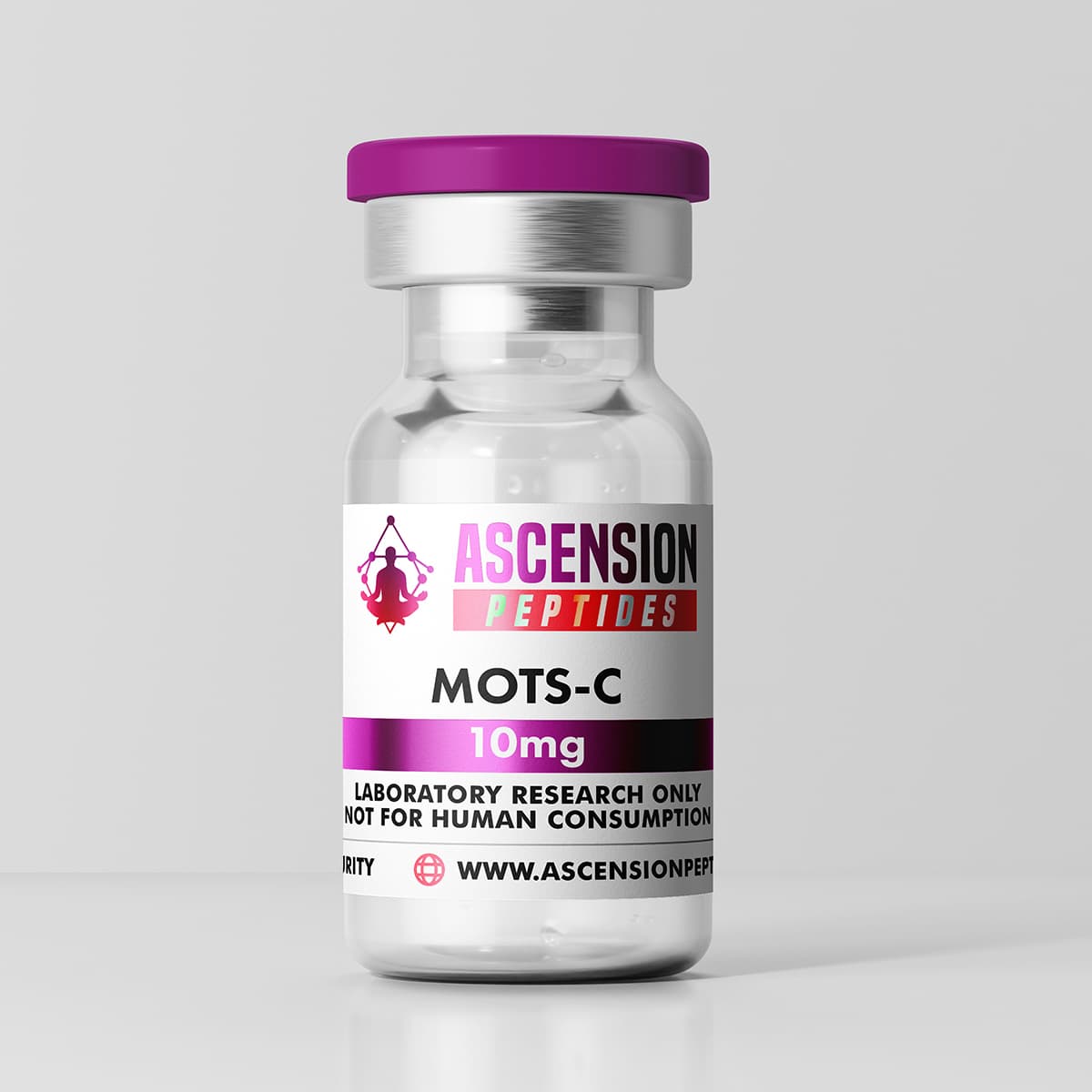
For context on price, Ascension Peptides, our partner, lists MOTS-c at $62 for 10 mg, or $31 with code PEPTIDEDECK, about $3.10 per mg. Our guide on where to buy MOTS-c compares sellers and what their lab reports show. PeptideDeck may earn a commission if you buy through our links.
Is MOTS-c Worth It? An Honest Answer
It depends on what you expect.
Start with cost. At the Reddit median of about 10 mg a week, MOTS-c runs about $31 a week with the code. Our standard 15 mg a week is about $46.50, and a full eight-week cycle uses 120 mg, or twelve 10 mg vials, about $372 with the code. That is a lot to spend on something one in nine users never felt.
The threads point to who tends to like it:
- People who train for endurance and want more in the tank, especially those who dose before sessions.
- People in a long deficit who feel flat, as long as they eat enough carbs and watch for lows.
- Older users who feel run down in the afternoon.
And who tends to be disappointed: anyone expecting visible fat loss on its own, anyone expecting a stimulant hit, and anyone prone to hives or reactions to other injectables.
The honest limitation: nothing on Reddit, and nothing in the science, proves MOTS-c does in people what it did in mice. The 50% positive verdict could be part placebo, part training, part the other compounds. That doesn't make the reports worthless. It means a short, cheap test beats a long, expensive commitment. Start low, log your energy and any skin reaction, check fasting glucose if you're on a GLP-1, and decide after a month. If it does nothing at 5 mg, the threads suggest more won't help.
For the rest of the picture, our MOTS-c peptide guide covers how it works and who it is for.
Frequently Asked Questions
Sources
- PeptideDeck count of 175 Reddit threads with MOTS-c in the title, r/Peptides and r/moreplatesmoredates, September 2019 to October 19, 2026, read October 20, 2026. Representative threads below.
- MOTS-C Experiences, r/Peptides, July 2022.
- 15+ Days in on MOTS-c and NOTHING, r/Peptides, December 2023.
- Impressed with Mots-c again, r/Peptides, June 2020.
- MOTS-C | User experience, r/Peptides, April 2021.
- Mots-C exhaustion, r/Peptides, June 2026.
- MOTS-c allergic reaction, r/Peptides, August 2026.
- Best protocol to combat Mots c histamine reactions?, r/Peptides, June 2026.
- Any reason not to take mots-c IM?, r/Peptides, July 2026.
- Reta + MOTS-C = blood sugar dump?, r/Peptides, June 2026.
- MOTS-C poor responders: Did SS-31 improve your response to MOTS-c?, r/Peptides, May 2026.
- Should I start SS-31 before MOTS-C?, r/Peptides, July 2026.
- Reta Tesa Mots-C might be the ultimate shred stack, r/Peptides, June 2026.
- Coming off mots-c, r/Peptides, June 2026.
- Lee C, et al. The mitochondrial-derived peptide MOTS-c promotes metabolic homeostasis and reduces obesity and insulin resistance. Cell Metab. 2015;21(3):443-454. PMID 25738459.
- Kim KH, et al. The mitochondrial-encoded peptide MOTS-c translocates to the nucleus to regulate nuclear gene expression in response to metabolic stress. Cell Metab. 2018;28(3):516-524. PMID 29983246.
- Reynolds JC, et al. MOTS-c is an exercise-induced mitochondrial-encoded regulator of age-dependent physical decline and muscle homeostasis. Nat Commun. 2021;12:470. PMID 33473109.
- McNeil BD, et al. Identification of a mast-cell-specific receptor crucial for pseudo-allergic drug reactions. Nature. 2015;519:237-241. PMID 25517090.
- CohBar. CohBar announces positive topline results from the phase 1a/1b study of CB4211 under development for NASH and obesity. August 10, 2021. BioSpace.
- USADA. What is the MOTS-c peptide? usada.org.
Medical Disclaimer: This content is for informational purposes only and does not constitute medical advice. Reddit reports are personal accounts, not clinical evidence. MOTS-c has no FDA approval and has not been tested in human clinical trials. Always consult a qualified healthcare provider before starting any new supplement, medication, or treatment. PeptideDeck may earn a commission from affiliate links at no additional cost to you.