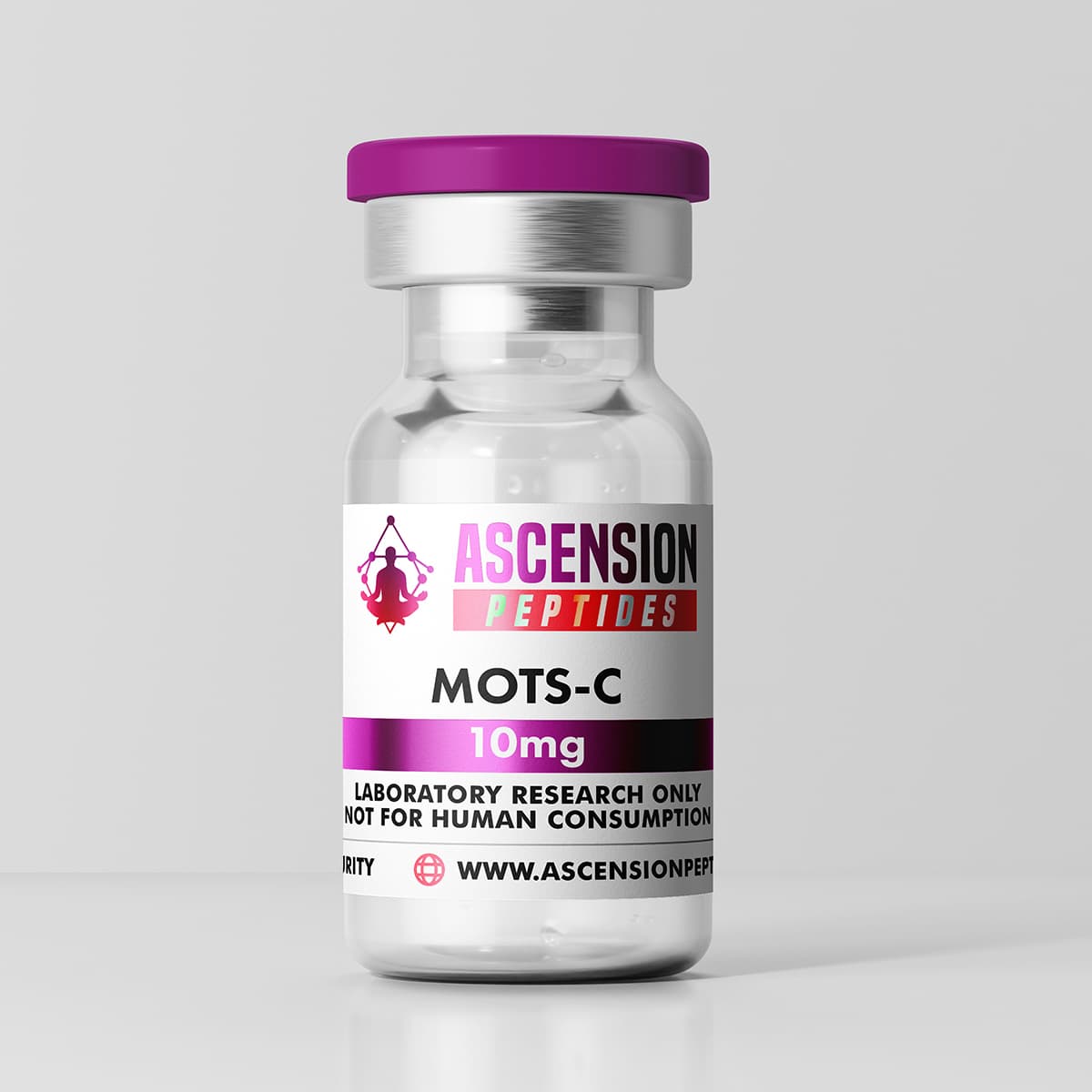
No. MOTS-c is not FDA approved, for any indication, in any form.
That answer has not changed, but the reason people keep asking has. In July 2026 an FDA advisory committee voted in MOTS-c's favour, and a wave of marketing followed that treated the vote as though it were approval. It is not. The two things are not even on the same regulatory track, and confusing them is the single most common mistake being made about MOTS-c right now.
🔑 The Short Answer
- MOTS-c is not FDA approved — no approved drug contains it, and it has no approved indication
- The July 2026 vote was about compounding, not approval. The Pharmacy Compounding Advisory Committee recommended it for the 503A Bulks List by 7 yes, 5 no, 2 abstentions
- That vote is advisory and non-binding. FDA keeps final authority and had issued no decision at the time of writing
- Even a favourable outcome is not approval. It would let compounding pharmacies use MOTS-c under 503A — a different statute with a much lower bar than drug approval
- FDA staff opposed inclusion for all seven peptides reviewed, citing unresolved questions on identity, quality, effectiveness, safety and immunogenicity
Approval and the Bulks List Are Two Different Processes
This is the distinction everything else depends on, so it is worth being precise.
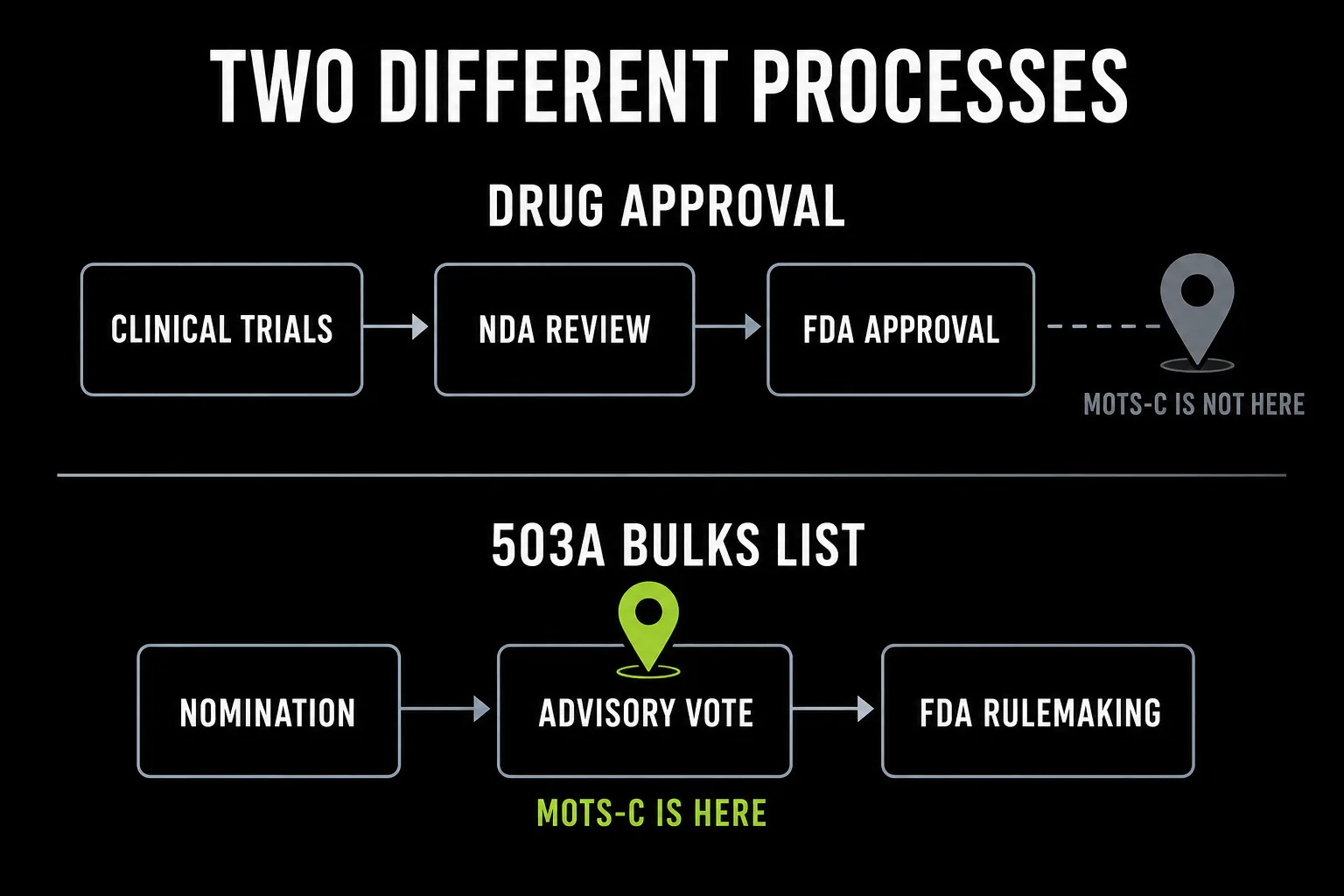
Drug approval means a sponsor ran adequate and well-controlled clinical trials, submitted a New Drug Application, and FDA concluded the drug is safe and effective for a specific indication. MOTS-c has never been through this. There is no sponsor, no NDA, and no completed human efficacy trial to build one on.
The 503A Bulks List is something else entirely. Section 503A of the Federal Food, Drug, and Cosmetic Act governs what a compounding pharmacy may use to make a patient-specific preparation. A substance on that list can be compounded; it has not been judged safe and effective for anything. The evidentiary bar is lower, the question asked is narrower, and the outcome is not an approved drug.
So "MOTS-c passed the FDA panel" and "MOTS-c is FDA approved" are not two ways of saying the same thing. The first is true and modest. The second is false.
What Actually Happened in July 2026
FDA's Pharmacy Compounding Advisory Committee met on 23-24 July 2026 to consider seven peptides for the 503A Bulks List. MOTS-c was on the Day 1 agenda alongside BPC-157, KPV and TB-500.
Six of the seven peptides were recommended — MOTS-c, BPC-157, KPV, TB-500, Epitalon and Semax. Emideltide, also called DSIP, was the only one rejected. Our full breakdown of every tally is in the 2026 FDA peptide vote.
Two details get dropped from most summaries. MOTS-c's margin was the narrowest of the four peptides heard on Day 1: 7-5 with two abstentions, against 8-6 with one abstention for the others. And FDA's own scientific staff recommended against including all seven, citing unresolved questions about substance identity, product quality, effectiveness, short and long-term safety, immunogenicity, and the limited clinical evidence base.
What Still Has to Happen
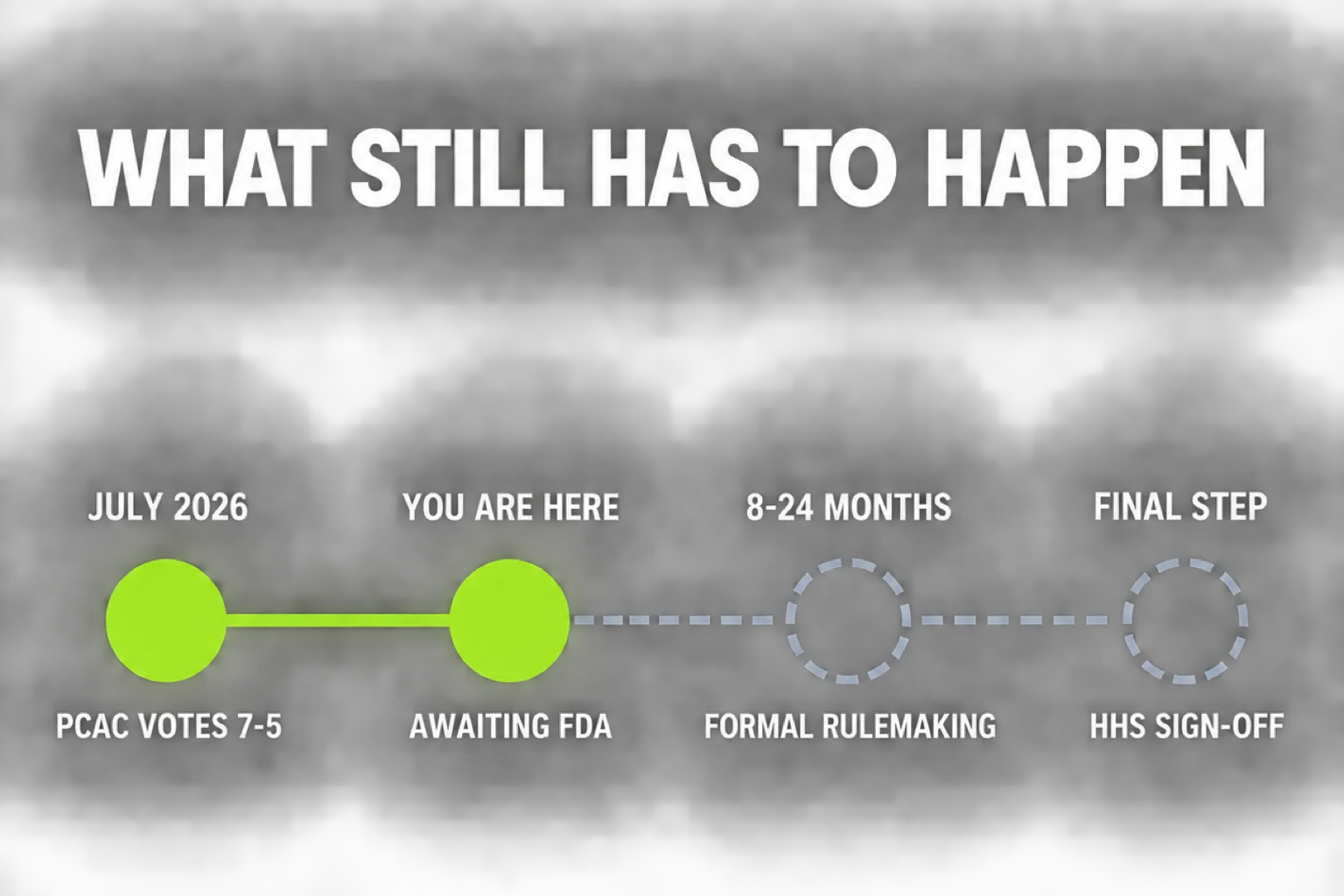
A favourable advisory vote does not change anyone's legal position on its own. Before MOTS-c could actually be compounded under 503A:
- FDA has to act. The agency decides whether to propose adding the substance. It is not obliged to follow the committee, and its staff argued the other way.
- Formal rulemaking has to run its course. This is a notice-and-comment process that typically takes 8 to 24 months.
- The Secretary of Health and Human Services has to sign off on the addition to the list.
Until all of that completes, compounding pharmacies cannot legally use MOTS-c under 503A. Any pharmacy or clinic presenting the July vote as authorisation to compound it today is ahead of the law.
So What Is MOTS-c Sold As?
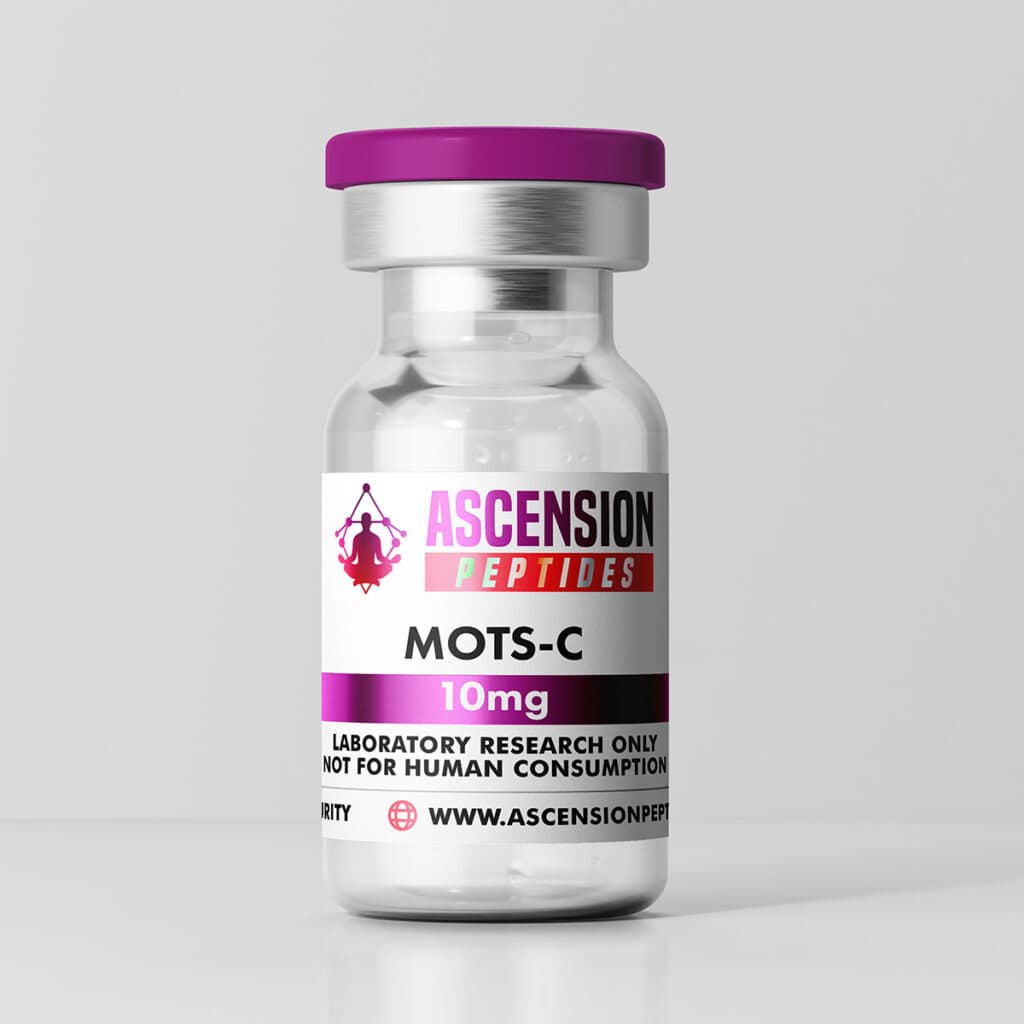
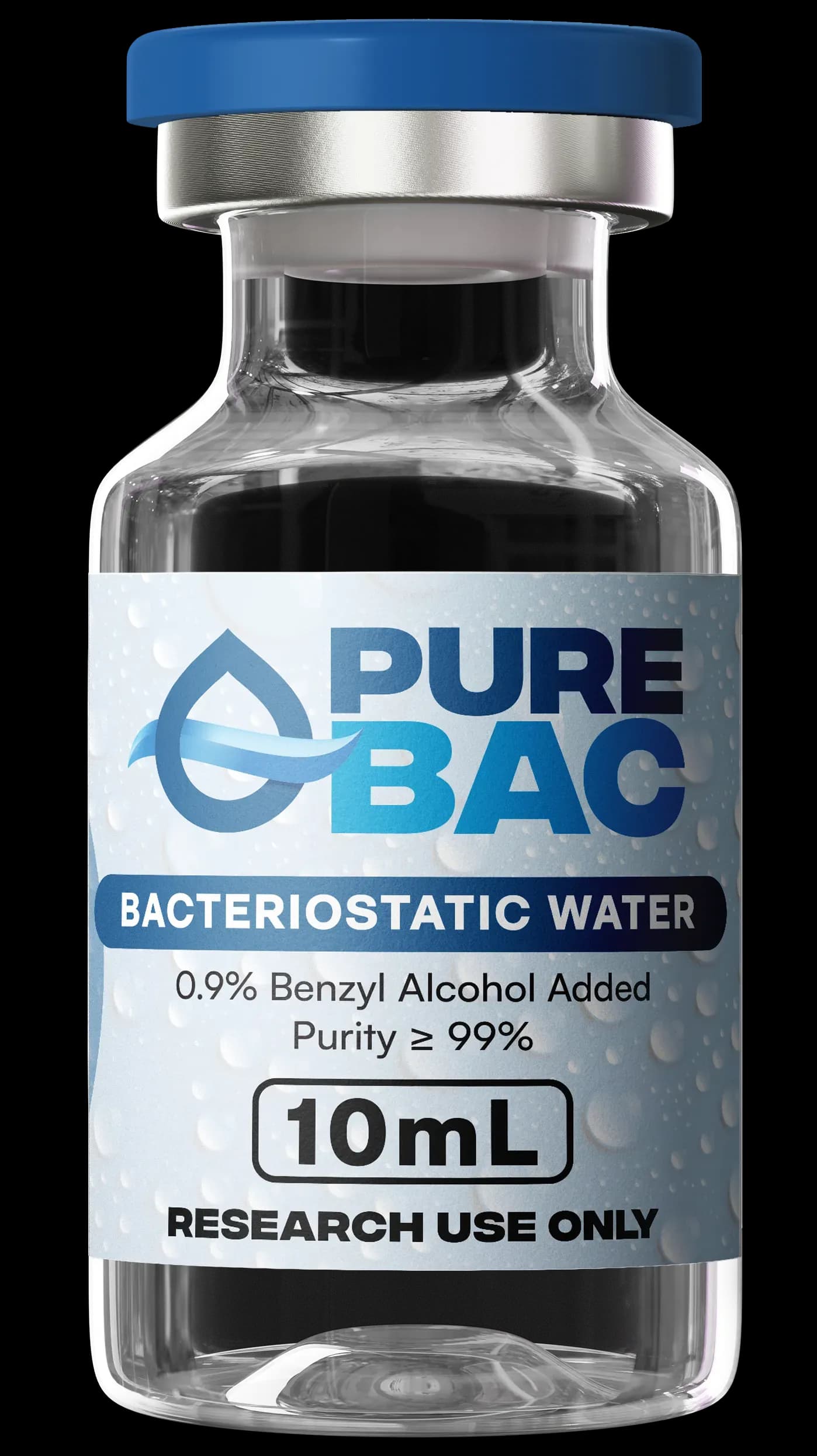
Research material. Vendors sell it as a research compound, labelled for laboratory use and not for human consumption, which is why it ships as a lyophilised powder with no prescribing information, no dosing instructions and no patient leaflet.
That labelling is not a formality vendors would drop if they could. It is the legal basis on which the product is sold at all. It also means nobody has verified what is in the vial except the vendor and whatever third-party lab they chose to use — which is why reading the certificate of analysis matters so much. We cover that in where to buy MOTS-c, which also ranks vendors against each other on their documentation.
Is It Legal to Buy?
Buying and possessing MOTS-c as a research chemical is not itself a federal crime in the US — it is not a controlled substance. What is prohibited is selling it for human use, or marketing it with therapeutic claims. That is why vendor sites describe benefits in the third person and attach research-use disclaimers.
The practical consequence for a buyer is that you carry the risk that would normally sit with a manufacturer and a regulator. There is no recall mechanism, no adverse event reporting pathway, and no guarantee of identity or purity beyond the paperwork the seller supplies.
What About Athletes?
MOTS-c is prohibited in sport. Unapproved substances are captured by the catch-all S0 category of the WADA Prohibited List, which covers any pharmacological substance not currently approved by any governmental regulatory health authority for human therapeutic use. MOTS-c's AMPK-activating metabolic profile also brings it within the scope of S4, metabolic modulators.
The list is revised annually, so anyone subject to testing should check the current edition rather than rely on a summary — including this one.
Why Isn't There Better Evidence?
Because the human trials have not been run.
There are no completed human efficacy trials for MOTS-c. As of early 2026 there were no active Investigational New Drug applications and no FDA-registered clinical trials underway. The human data that exists amounts to a Phase 1a/1b trial of the analog CB4211 and a seven-day intravenous study of native MOTS-c — safety and feasibility work, not efficacy.
The preclinical literature is genuinely interesting, with work through 2025 pointing to roles in pancreatic beta-cell senescence, diabetic cardiac mitochondrial function and age-related insulin resistance. But preclinical promise is where most compounds are when they fail, not evidence of effect in people. Our MOTS-c review and MOTS-c peptide guide go through what the research does and does not establish.
What Would Approval Actually Require?
Realistically that is a decade of work and a sponsor willing to fund it for a molecule the body already makes and nobody can easily patent. That commercial reality, more than any scientific verdict, is why MOTS-c is unlikely to be an approved drug soon.
Frequently Asked Questions
This article is educational and not medical or legal advice. Regulatory status can change; the position described here reflects the record as of August 2026. Consult a qualified clinician before using any research compound.