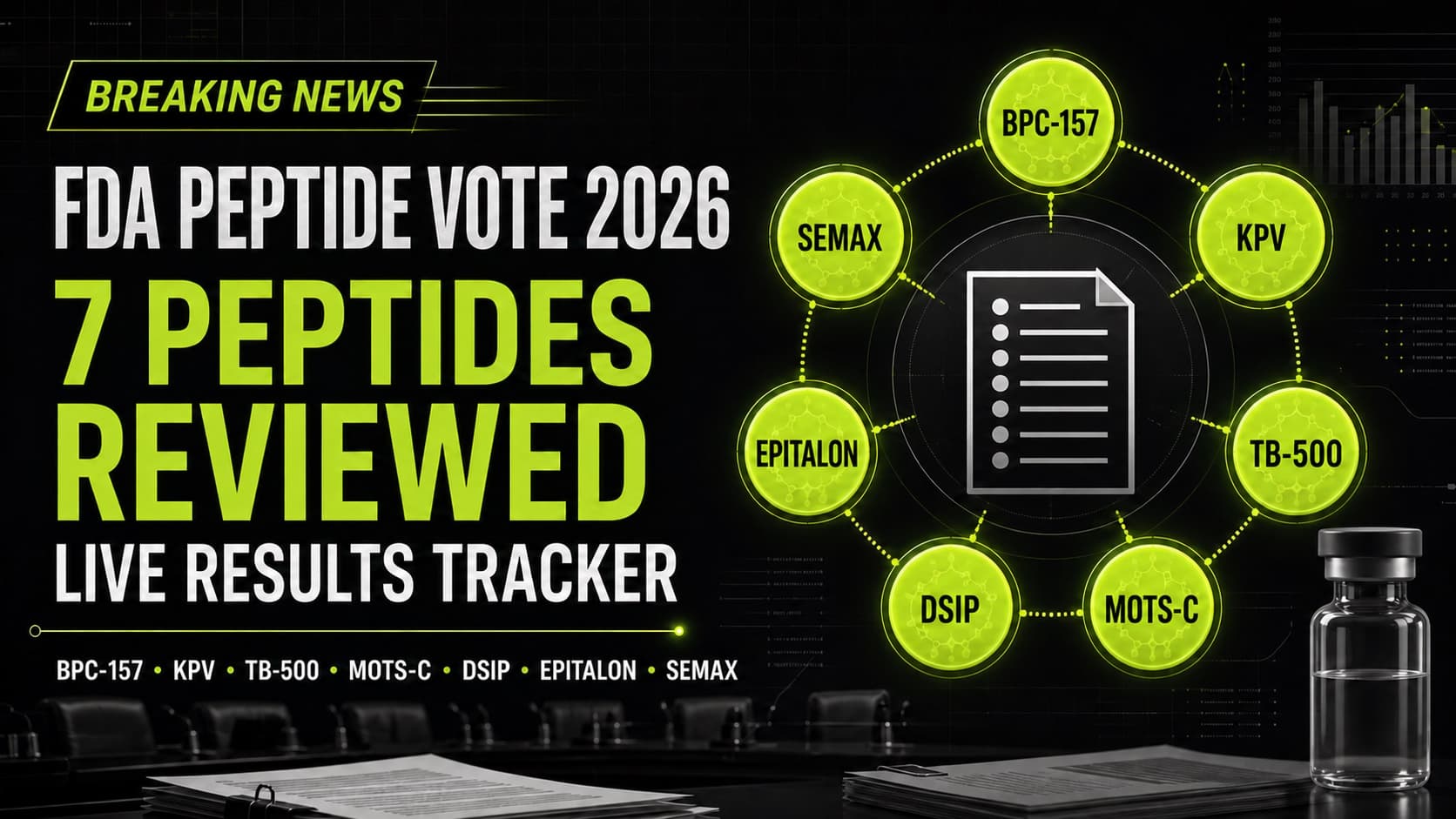
Updated July 25, 2026: The FDA peptide vote 2026 is complete. Across the July 23–24 meeting, the Pharmacy Compounding Advisory Committee recommended six of the seven peptides for the federal 503A Bulks List: BPC-157, KPV, TB-500, MOTS-c, Epitalon and Semax. Emideltide, also called DSIP, was the only peptide rejected. Every tally remains non-binding, and FDA has not yet issued its final agency decision.
BPC-157, KPV and TB-500 each received favorable 8–6 votes with one abstention on Day 1. MOTS-c received favorable 7–5 votes with two abstentions. On Day 2, both forms of Emideltide failed 6–7 with one abstention, both forms of Epitalon passed 7–4 with one abstention, and both forms of Semax passed 8–5 with one abstention. The committee voted separately on the free-base and acetate form of every peptide.
What you need to know today
- Six peptides received favorable recommendations. BPC-157, KPV, TB-500, MOTS-c, Epitalon and Semax advanced at the advisory-committee stage.
- Emideltide/DSIP was rejected. Both the free-base and acetate questions failed 6–7, with one abstention for each.
- Day 2 added two favorable outcomes. Epitalon passed 7–4–1 and Semax passed 8–5–1. The same tally was reported for both forms of each peptide.
- Every recommendation is non-binding. FDA must decide whether and how to act. The agency had posted no final list addition for any of the seven peptides at the time of this update.
- This meeting is not a drug-approval proceeding. The committee is considering whether pharmacists should be able to use specified bulk substances for patient-specific compounding under section 503A.
- FDA staff opposed inclusion for all seven. Its briefings identified unresolved questions involving substance identity, product quality, effectiveness, short- and long-term safety, immunogenicity and limited clinical evidence.
- Ulcerative colitis was the use FDA evaluated. Popular claims involving tendons, ligaments, muscle recovery, Crohn’s disease, and celiac disease were not the indications evaluated for the committee question.
- Pharmacies cannot treat these tallies as final authorization. An official FDA step is still needed before the legal position changes under the 503A Bulks List pathway.
Status check: None of the seven peptides received FDA drug approval at this meeting. A favorable advisory vote concerns one compounding pathway; it does not certify existing products, establish an approved indication or immediately place a substance on the final 503A Bulks List.
FDA Peptide Vote 2026: Results for All Seven Peptides
Day 1 ended with favorable recommendations for all four peptides
The first day covered BPC-157, KPV, TB-500 and MOTS-c. FDA posed two questions for each name: whether the free-base substance should be placed on the 503A Bulks List and whether the acetate substance should be placed on the list. The committee answered yes eight times.
| Peptide | Use FDA evaluated | Free-base vote | Acetate vote | Status |
|---|---|---|---|---|
| BPC-157 | Ulcerative colitis | 8 yes, 6 no, 1 abstention | 8 yes, 6 no, 1 abstention | Recommended |
| KPV | Wound healing and inflammatory conditions | 8 yes, 6 no, 1 abstention | 8 yes, 6 no, 1 abstention | Recommended |
| TB-500 | Wound healing | 8 yes, 6 no, 1 abstention | 8 yes, 6 no, 1 abstention | Recommended |
| MOTS-c | Obesity and osteoporosis | 7 yes, 5 no, 2 abstentions | 7 yes, 5 no, 2 abstentions | Recommended |
The close votes reveal a divided committee rather than a settled scientific judgment. Supporters focused on patient demand, clinician judgment and the possibility that licensed pharmacy preparation could be safer than poorly characterized online supply. Opponents focused on thin effectiveness data, limited safety evidence and unresolved quality questions. FDA staff recommended against adding every Day 1 substance.
Day 2 backed Epitalon and Semax but rejected Emideltide
| Peptide | Use FDA evaluated | Free-base vote | Acetate vote | Committee result |
|---|---|---|---|---|
| Emideltide (DSIP) | Opioid withdrawal, chronic insomnia and narcolepsy | 6 yes, 7 no, 1 abstention | 6 yes, 7 no, 1 abstention | Not recommended |
| Epitalon | Insomnia | 7 yes, 4 no, 1 abstention | 7 yes, 4 no, 1 abstention | Recommended |
| Semax | Cerebral ischemia, migraine and trigeminal neuralgia | 8 yes, 5 no, 1 abstention | 8 yes, 5 no, 1 abstention | Recommended |
The FDA peptide vote 2026 ended with six favorable peptide-level recommendations and one unfavorable recommendation. Because FDA asked separate questions for free base and acetate, the meeting produced fourteen form-specific tallies: twelve favorable and two unfavorable. The two unfavorable votes were both for Emideltide.
Why the complete scoreboard changes the story
The original breaking update focused on BPC-157 because its vote occurred first and drew the most immediate coverage. The final result is broader: the committee disagreed with FDA staff on six peptides across both days, but it did not approve every substance automatically. Emideltide became the single instance where the committee’s negative outcome aligned with the staff recommendation.
BPC-157 Vote: The 8–6–1 Result
The committee’s 8–6–1 tally
On Thursday, July 23, the Pharmacy Compounding Advisory Committee, usually shortened to PCAC, considered BPC-157 free base and BPC-157 acetate during the first day of a two-day public meeting. Eight members voted in favor of recommending the substances for the list, six voted against, and one abstained. That narrow majority put the committee on the opposite side of FDA staff, whose written review recommended against inclusion.
The official FDA meeting page contains the agenda, briefing materials, roster, conflict disclosures, public submissions, and meeting webcast information. The result was also reported the same day by ABC News, The Associated Press, and Reuters.
The two BPC-157 forms covered by the recommendation
The committee question covered two related bulk drug substances: BPC-157 free base and BPC-157 acetate. That wording matters. FDA’s review repeatedly notes that “BPC-157” is used loosely in commerce, while chemical names, salt forms, manufacturing descriptions, analytical standards, and labeling may not consistently identify the same material.
The committee’s recommendation therefore does not bless every vial, capsule, nasal product, or raw powder sold under the BPC-157 name. If FDA ultimately adds the two substances to the list, qualifying pharmacies would still need to source and identify the correct material, meet compounding requirements, and prepare a prescription for an identified patient.
The Short Answer: Did FDA Approve BPC-157?
No—this was an advisory recommendation
No. The July 23 vote did not approve BPC-157 as a drug. FDA approval normally follows a formal application supported by adequate evidence for a defined product, dose, route, patient population, manufacturing process, labeling, effectiveness, and safety profile. No such approval was granted at this meeting.
PCAC advises FDA on pharmacy-compounding questions. Its vote asks whether the two BPC-157 bulk substances should be placed on a list used by traditional compounding pharmacies operating under section 503A of the Federal Food, Drug, and Cosmetic Act. The committee does not issue drug approvals, and its recommendation does not create an approved BPC-157 indication.
The status as of publication
As of this July 24 update, FDA had not posted a final agency action adding BPC-157 to the 503A Bulks List. The FDA BPC-157 vote is significant because it creates a favorable advisory record, but the agency remains responsible for the next legal step.
Readers who want a broader introduction to the compound can use our BPC-157 guide. Read that background separately from this news update: the regulatory status described here is tied to the July 23 committee result and can change again when FDA acts.
What the 503A Bulks List Actually Does
A pathway for patient-specific pharmacy compounding
Section 503A applies to traditional pharmacy compounding for an identified individual patient based on a valid prescription or, in limited circumstances, an anticipatory amount tied to prescription history. A compounded drug is made for a clinical need that cannot be met by an available commercial product in the required form. It is not the same system used to approve and market a manufactured drug at national scale.
One condition under 503A concerns the bulk drug substances a pharmacist may use. A substance can qualify if it is used in an FDA-approved drug, has an applicable United States Pharmacopeia or National Formulary monograph, or appears on FDA’s list of bulk drug substances for which there is a clinical need. The July meeting centered on that third route.
The FDA peptide vote 2026 is therefore about eligibility for a defined compounding pathway, not permission for ordinary retail sales or proof that every proposed use works.
What list inclusion would not permit
Even a final listing would not turn BPC-157 into an over-the-counter supplement, authorize unrestricted bulk manufacturing, or validate every advertised claim. It would not permit a seller to skip prescription, pharmacy, sourcing, quality, labeling, and state-law requirements. It also would not convert an online bulk-peptide seller into a licensed compounding pharmacy.
For readers comparing these categories, our approved-vs-hype peptide comparison explains why drug approval, pharmacy compounding, supplement sales, and unlicensed peptide commerce are separate legal and evidence questions.
What Changed After the 8–6 Vote
A favorable recommendation now sits in the official record
The clearest change is procedural: FDA now has a formal recommendation from its advisory committee supporting inclusion. The discussion, public comments, scientific briefing, vote explanations, and tally become part of the agency record. That gives BPC-157 supporters a much stronger position than they had before the meeting.
The vote also shows that a majority of the assembled committee accepted a clinical-need argument despite FDA staff’s objections. Members voting yes emphasized regulated pharmacy preparation, clinician judgment, patient demand, and the idea that a controlled compounding route could be preferable to purchases from poorly characterized online sources.
The vote increases momentum, not immediate access
The result creates momentum for an FDA policy change. It does not itself make a new prescription product available Friday morning. FDA must review the full meeting and decide on an official response. It could pursue formal rulemaking, announce an interim enforcement position, request more information, narrow conditions, or take another approach within its authority.
In other words, the FDA BPC-157 vote changed the strength of the recommendation, not the substance’s legal status by itself.
That same limit applies across the FDA peptide vote 2026: a favorable tally becomes part of the agency record, while a later FDA action determines the operative policy.
Anyone considering where a BPC-157 product comes from should still apply the verification principles in our BPC-157 access and sourcing guide. A favorable committee vote cannot confirm the identity, sterility, strength, or handling of a product already being sold.
What Did Not Change on July 23
No approved indication or dosing label exists
The committee did not create an approved indication for ulcerative colitis, tendon injury, ligament injury, muscle recovery, joint pain, gut symptoms, or general wellness. It did not establish an FDA-reviewed dose, treatment duration, route, contraindication list, interaction list, or monitoring plan.
That point is especially important because online BPC-157 dosing advice often presents precise schedules with more confidence than the human evidence supports. Our existing BPC-157 dosage discussion should be read as educational context, not as a protocol produced or endorsed by the July committee.
No immediate blanket permission for pharmacies
The vote did not place the substances into the final regulation by itself. A pharmacy cannot rely on an advisory tally as if it were the operative list. Federal requirements, state pharmacy law, prescription validity, ingredient standards, and professional obligations still apply.
No change to sports anti-doping rules
The World Anti-Doping Agency treats non-approved substances under its S0 category. The FDA committee has no authority to change WADA rules, league policies, athletic commission rules, or an athlete’s testing obligations. Competitive athletes should not interpret the compounding recommendation as clearance for sport.
Why FDA Staff Recommended Against Inclusion
Substance identity and characterization
FDA’s BPC-157 briefing document says the free base and acetate were not adequately characterized for the agency’s evaluation. Among the issues were inconsistent naming, missing or inadequate descriptions of physical and chemical properties, incomplete impurity information, limited analytical detail, and uncertainty about how marketed materials correspond to the nominated substances.
This is not a technical footnote. A peptide’s amino-acid sequence, salt form, purity, aggregation, degradation products, residual solvents, and storage conditions can affect what a patient receives. A label that simply says “BPC-157” does not answer all of those questions.
Insufficient evidence of effectiveness
The nominated clinical use FDA evaluated was ulcerative colitis. Agency reviewers concluded that the submitted information did not provide enough reliable evidence to show effectiveness for that use. The available clinical material was small, old, brief, incompletely reported, and not sufficient to establish a dependable benefit-risk conclusion.
FDA also explained that evidence for other highly promoted uses was outside the committee evaluation or too incomplete to support review. A successful vote on the clinical-need question should not be rewritten as proof that BPC-157 heals tendons, ligaments, muscles, or the gastrointestinal tract in people.
Unresolved safety questions
The staff review identified uncertainty about immunogenicity, aggregation, peptide-related impurities, hypersensitivity, route-specific risk, repeated exposure, and long-term use. FDA found no adequate clinical program that could define common adverse effects, rare serious effects, dose relationships, medication interactions, or risks in vulnerable patient groups.
A small number of exposed people with short follow-up cannot rule out uncommon or delayed harm. That is one reason FDA staff and several committee members resisted treating patient demand or clinician experience as a substitute for controlled evidence.
What Human Evidence Did FDA Review?
Ulcerative colitis reports were limited and short
FDA identified two clinical reports involving rectal administration for ulcerative colitis. Treatment lasted no more than two weeks, and the reports lacked the design quality and reporting detail needed for a firm conclusion. They do not establish how an oral capsule, subcutaneous injection, nasal product, or transdermal formulation would perform.
The route gap matters because peptides can behave differently depending on where and how they are administered. Local rectal delivery in a gastrointestinal condition cannot be assumed to predict systemic exposure, tissue concentrations, effectiveness, or safety from an injection or oral product.
Other small human reports do not answer the committee question
The wider literature includes a 12-person bladder-pain pilot, a very small retrospective knee-pain chart review, and a two-person intravenous safety pilot. Each may help researchers formulate better questions, but none supplies the size, controls, dosing range, follow-up, or replication expected for a reliable treatment conclusion.
A 2025 systematic review in orthopaedic sports medicine likewise found that the clinical evidence was extremely limited. A newer 2026 development-focused review describes major formulation, pharmacokinetic, and translation barriers that remain unresolved.
No evidence package for common commercial routes
FDA’s briefing found no adequate human studies for the commonly proposed oral, subcutaneous, nasal, or transdermal routes. That does not prove those routes cannot work. It means the agency did not have reliable human data showing what exposure they produce, whether they help, how often adverse effects occur, or how product variability affects results.
Our oral-versus-injection BPC-157 comparison discusses the formulation question in more detail. The July vote did not settle that route debate.
The Adverse Events in FDA’s Review
Three FAERS reports were discussed
FDA’s briefing describes reports in its Adverse Event Reporting System involving an injection-site reaction, shortness of breath, diffuse skin darkening, and gum darkening. Some reports involved other peptides or therapies at the same time, and the available information did not allow FDA to prove that BPC-157 caused the events.
FAERS is a signal-detection system, not a database that automatically establishes causation or incidence. Reports can be incomplete, duplicated, influenced by other products, or missing reliable exposure details. Still, they are relevant when the controlled safety evidence is sparse.
Absence of many reports is not proof of low risk
BPC-157 use is difficult to measure, products may be sold outside conventional medical channels, and adverse events may never be recognized or reported. If the number of exposed patients and the exact products are unknown, a report count cannot produce a trustworthy rate.
FDA staff also noted that no adequate studies formally evaluated immunogenicity. Peptides and peptide aggregates can trigger immune responses, but the likelihood for a specific preparation depends on sequence, purity, formulation, route, storage, patient factors, and repeated exposure.
Why Ulcerative Colitis Was the Only Use Evaluated
FDA narrowed the review to the supported nomination
The agency evaluated BPC-157 free base and acetate for ulcerative colitis because that was the use for which it determined there was enough nomination information to conduct the committee review. FDA did not evaluate Crohn’s disease, celiac disease, or tendonitis under the vote question because the nomination lacked sufficient information and the agency did not identify suitable clinical studies in those populations.
That distinction is easy to lose in headlines. The committee’s positive recommendation was not a vote that BPC-157 works for every condition attached to it online. It was an advisory judgment about whether the substances should be available for patient-specific compounding based on a clinical-need framework.
Popular healing claims remain unconfirmed
BPC-157 is widely promoted for tendon, ligament, joint, muscle, and gut recovery. Laboratory findings help explain why scientists remain interested, but they cannot establish clinical benefit by themselves. Human trials need to define the product, route, dose, comparator, outcomes, adverse-event collection, and follow-up before those claims can be tested reliably.
Readers looking at transformation posts should also review our BPC-157 before-and-after evidence guide, which separates personal reports from controlled clinical evidence.
The Committee’s Split: Why Members Voted Yes or No
The case made by yes voters
Members supporting inclusion focused on clinical need, patient autonomy, professional judgment, and product quality. Their practical argument was that people are already seeking BPC-157; allowing licensed pharmacists to prepare it under 503A controls could offer a more accountable path than purchases from sellers with little transparency.
Supporters also heard from clinicians and patients who described perceived benefits and the lack of satisfactory options for some difficult conditions. For these members, the purpose of the 503A question was not to declare efficacy but to decide whether prescribers and pharmacists should have a lawful patient-specific option.
The case made by no voters
Opponents focused on missing evidence and the inability to define the substance consistently. They argued that a pharmacy cannot compound its way around basic uncertainty about identity, effectiveness, dosing, and long-term safety. Several viewed the evidence as too thin to satisfy the statutory clinical-need standard.
The split produced the narrow 8–6 result and one abstention. It also explains why the final FDA response matters: the committee did not reach anything close to consensus, and FDA’s own scientific review remained negative.
The FDA BPC-157 vote therefore records a genuine policy disagreement, not a unanimous scientific judgment.
The BPC-157 Regulatory Timeline
| Date | Event | What it meant |
|---|---|---|
| September 2023 | FDA placed BPC-157-related substances in Category 2 of its interim 503A nomination policy. | The agency identified significant safety concerns while nominations were under evaluation. |
| April 22, 2026 | The outside nominations were withdrawn, and FDA removed the substances from Category 2. | Removal did not add BPC-157 to Category 1 or the final 503A Bulks List. FDA chose to evaluate it on its own initiative. |
| June 30, 2026 | FDA posted the BPC-157 and meeting briefing documents. | The staff review recommended against list inclusion and detailed quality, effectiveness, and safety concerns. |
| July 23, 2026 | PCAC voted 8–6 with one abstention in favor of inclusion. | A favorable but non-binding recommendation entered the official record. |
| July 24, 2026 | PCAC recommended Epitalon and Semax but rejected Emideltide/DSIP. | The two-day review ended with six of seven peptides recommended. A final agency response is still pending. |
| Next | FDA reviews the record and determines its action. | Possible routes include formal list rulemaking or an interim policy statement. No public deadline has been announced. |
Why the April change was often misunderstood
When FDA removed BPC-157 from Category 2 in April, some online posts described the change as permission to compound again. That was too broad. The nominations had been withdrawn, so FDA removed the substances from the category for items under active evaluation. They did not automatically enter Category 1, and they were not inserted into the final Bulks List.
The July 23 meeting was the next material event. It created an affirmative recommendation, but one more distinction remains: an advisory recommendation is still not the operative FDA list.
That sequence is the best way to read the FDA BPC-157 vote without confusing an interim category change, an advisory recommendation, and a final agency rule.
The FDA peptide vote 2026 adds a new advisory stage to that timeline for seven named peptides, but it does not skip the agency action that must follow.
Claims vs Reality After the Vote
| Claim circulating online | What is accurate on July 24 |
|---|---|
| “FDA approved BPC-157.” | False. An FDA advisory committee recommended two BPC-157 bulk substances for a compounding list. No drug approval was issued. |
| “The vote was 8–6.” | Mostly accurate but incomplete. The recorded tally was 8 in favor, 6 against, and 1 abstention. |
| “BPC-157 is now legal everywhere.” | Misleading. The committee vote is non-binding; federal and state requirements remain, and FDA has not completed its action. |
| “The committee proved BPC-157 heals injuries.” | False. The question concerned clinical need for 503A compounding, and the use evaluated was ulcerative colitis. |
| “Every product labeled BPC-157 is now legitimate.” | False. Product identity, purity, sterility, strength, storage, and seller licensing remain product-specific questions. |
| “Pharmacies can mass-produce it after the vote.” | False. Section 503A concerns patient-specific traditional compounding and includes multiple conditions beyond list status. |
| “The FDA decision is final.” | False as of publication. FDA still must decide how it will respond to the committee recommendation. |
What Happens Next at FDA
FDA reviews the meeting record
After the meeting, FDA can review the committee vote, member explanations, staff analysis, public testimony, written docket comments, and other submitted material. Advisory committees provide outside advice; the agency is not legally required to follow the recommendation.
The FDA BPC-157 vote gives inclusion meaningful momentum, and agencies often give their advisory committees considerable weight. Yet the close tally and contrary staff recommendation make it unsafe to predict the exact final wording, conditions, or timing.
Formal rulemaking may take time
Adding a substance to the final 503A Bulks List generally involves notice-and-comment rulemaking. That process can include a proposed rule, public comments, agency review, and a final rule. It may take months or longer, and FDA has not announced a BPC-157 completion date.
After the FDA peptide vote 2026 concludes, the committee’s discussion and fourteen form-specific votes will be advice for FDA to weigh—not fourteen self-executing legal changes.
An interim enforcement position is possible
Current news reporting notes that FDA could issue a temporary policy explaining its enforcement approach while formal action proceeds. That possibility is not the same as an announced policy. Until FDA publishes one, pharmacies and clinics should not present speculation as a current exemption.
Could Compounding Pharmacies Offer BPC-157?
Not solely because of the committee vote
A pharmacy needs an operative legal basis, not just an advisory recommendation. The substance must qualify under section 503A, and every other applicable federal and state condition must be satisfied. The July 23 tally alone does not complete that chain.
If FDA formally lists BPC-157 free base and acetate or publishes an applicable interim policy, qualifying 503A pharmacies could have a clearer route to prepare patient-specific prescriptions. The exact terms of the FDA action would determine the boundaries.
Quality questions would remain pharmacy-specific
List status does not guarantee that every pharmacy uses the same active material, analytical methods, formulation, beyond-use date, sterility process, shipping controls, or patient instructions. Prescribers and patients would still need to identify the dispensing pharmacy and understand the preparation.
Our BPC-157 market guide explains the difference between licensed pharmacy dispensing and ordinary peptide retail. That distinction will remain relevant even if FDA ultimately accepts the committee’s recommendation.
What the Vote Means for Patients and Clinicians
It may create a future regulated access route
The practical promise of the vote is a possible patient-specific pharmacy pathway. Supporters argue that physician oversight, a prescription, pharmacy documentation, and enforceable quality standards are better than an opaque online supply chain.
That potential benefit depends on the final policy and its implementation. It does not erase the shortage of reliable clinical data or provide a standard treatment protocol. A clinician considering any compounded preparation must still evaluate the condition, alternatives, evidence limits, patient risks, interactions, and monitoring needs.
Questions patients should ask
- Has FDA published a final or interim action that applies to this exact product and pharmacy?
- What licensed pharmacy will dispense the prescription, and in which state is it authorized?
- Is the ingredient BPC-157 free base or BPC-157 acetate, and how was identity confirmed?
- What evidence supports the proposed use and route in humans?
- What are the known uncertainties, potential adverse effects, and warning signs?
- How will the product be stored, shipped, tracked, and discarded?
- What established treatments are available for the same condition?
What the Vote Means for Sellers and Telehealth Companies
Marketing language must remain precise
A seller cannot truthfully turn “committee recommended list inclusion” into “FDA-approved treatment.” It also cannot claim that the 8–6 vote establishes effectiveness for recovery, gut health, pain, or another outcome. Drug-approval claims and compounding eligibility are different.
Basic background on how short amino-acid chains differ from proteins and conventional small-molecule drugs is available in our guide to what peptides are. That chemistry context does not alter the legal limits of the FDA BPC-157 vote.
Clinics should date their regulatory statements and link to the actual FDA action. If FDA later publishes a policy, the clinic should describe the scope, affected substances, pharmacy type, and conditions rather than using a blanket legality claim.
Unlicensed retail products do not become pharmacy products
A commercial website selling vials without a patient prescription does not become a 503A pharmacy because PCAC voted yes. Licensure, prescription handling, pharmacist responsibility, ingredient sourcing, quality systems, and state oversight cannot be replaced with a laboratory report or marketing disclaimer.
What the Vote Means for Athletes
Anti-doping status is separate from FDA compounding policy
WADA’s S0 category covers pharmacological substances without current approval by a governmental regulatory health authority for human therapeutic use. The July 23 advisory recommendation does not create such approval and does not change the prohibited-list analysis.
Athletes subject to testing should consult the current rules of their anti-doping organization and qualified sports-medicine professionals. Pharmacy dispensing, if it becomes available, would not automatically make a substance permitted in competition or out of competition.
The July 24 Votes: Emideltide, Epitalon and Semax
Emideltide was the only peptide rejected
Emideltide, also called delta sleep-inducing peptide or DSIP, was evaluated in free-base and acetate forms for proposed uses involving opioid withdrawal, chronic insomnia and narcolepsy. Both questions failed by the same 6–7 tally with one abstention. It was the only peptide-level rejection during the two-day meeting.
FDA’s briefing said the criteria weighed against inclusion because of inconsistent substance naming, limited evidence, safety uncertainty and the availability of established treatments for the proposed conditions. Reporting from the meeting noted that committee members opposing inclusion also questioned whether a compounding pathway would reduce online sales and whether the thin evidence justified routine availability.
Epitalon received a favorable 7–4–1 vote
Epitalon free base and epitalon acetate were recommended for the list by seven yes votes to four no votes with one abstention. The use FDA evaluated was insomnia. Marketing often attaches broader longevity claims to Epitalon, but those claims were not the committee question and were not established by the vote.
Semax received a favorable 8–5–1 vote
Semax free base and Semax acetate were the final substances considered. Both received eight yes votes, five no votes and one abstention. FDA reviewed proposed uses involving cerebral ischemia, migraine and trigeminal neuralgia. Supporters cited a larger international literature than for several other peptides, while FDA staff said the material it could evaluate remained insufficient for the proposed uses.
The FDA peptide vote 2026 is now complete at the advisory-committee level. A favorable or unfavorable tally for one substance does not determine another because each has a different evidence record, proposed clinical uses and quality assessment.
FDA action is the next regulatory event
The meeting has ended, but none of its recommendations changed the final 503A regulation by itself. FDA must now review the record and determine its response. A later update will be required if the agency posts meeting minutes, an interim enforcement statement, a proposed rule, a final rule or another official decision affecting any of the seven substances.
The most reliable primary-source check is FDA’s current 503A bulk-substances policy page. Social posts and clinic pages may update faster, but speed does not make them legally controlling.
MOTS-c drew the narrowest margin of the four peptides heard on Day 1. For what its 7-5 result actually changes, and what still has to happen before anything does, see is MOTS-c FDA approved.
One detail that got lost in most coverage of this meeting: the only clinical use FDA evaluated for BPC-157 was ulcerative colitis, and KPV's research base is inflammatory bowel disease. In substance this was a gastrointestinal vote. We cover what it means for gut health peptides alongside the compounds that were not on the agenda.
The vote has since drawn legislative attention. On September 1, 2026, Rep. Nancy Mace introduced the PEPTIDES for Veterans Act, which would order the VA to study peptide-based therapies for chronic pain, mental health and other service-connected conditions. Our breakdown of what the PEPTIDES for Veterans Act actually does covers the timeline, the evidence the VA would be reviewing, and why the rules differ for veterans and currently serving members.
Frequently Asked Questions
Sources and Scientific References
- U.S. Food and Drug Administration. July 23–24, 2026 Meeting of the Pharmacy Compounding Advisory Committee. Meeting page, agenda, roster, and materials.
- U.S. Food and Drug Administration. Final agenda for the July 23–24, 2026 PCAC meeting. Scheduled discussion and vote times for all seven peptides.
- U.S. Food and Drug Administration. FDA Briefing Document for BPC-157-Related Bulk Drug Substances. June 30, 2026.
- U.S. Food and Drug Administration. FDA Briefing Document for KPV-Related Bulk Drug Substances. 2026.
- U.S. Food and Drug Administration. FDA Briefing Document for TB-500-Related Bulk Drug Substances. 2026.
- U.S. Food and Drug Administration. FDA Briefing Document for MOTS-c-Related Bulk Drug Substances. 2026.
- U.S. Food and Drug Administration. FDA Briefing Document for Emideltide-Related Bulk Drug Substances. 2026.
- U.S. Food and Drug Administration. FDA Briefing Document for Epitalon-Related Bulk Drug Substances. 2026.
- U.S. Food and Drug Administration. FDA Briefing Document for Semax-Related Bulk Drug Substances. 2026.
- U.S. Food and Drug Administration. Bulk Drug Substances Used in Compounding Under Section 503A. Current agency policy and list information.
- U.S. Food and Drug Administration. Certain Bulk Drug Substances for Use in Compounding May Present Significant Safety Risks. Updated April 22, 2026.
- ABC News. FDA advisers narrowly vote to add six peptides to a drug compounding list. July 24, 2026.
- Fierce Pharma. Peptide adcomm Day 2: Emideltide voted down in panel's first pushback. July 24, 2026.
- STAT. FDA advisory panel narrowly rejects compounding of one peptide, backs two others. July 24, 2026.
- BPC-157 as an Investigational Peptide Therapeutic: Formulation and Translational Barriers. PubMed PMID 42198317, 2026.
- Safety and Efficacy of Approved and Unapproved Peptide Therapies for Musculoskeletal Injuries and Athletic Performance. PubMed PMID 41966639, 2026.
- Regeneration or Risk? A Narrative Review of BPC-157 for Musculoskeletal Healing. PubMed PMID 40789979, 2025.
- Emerging Use of BPC-157 in Orthopaedic Sports Medicine: A Systematic Review. PubMed PMID 40756949, 2025.
- Safety of Intravenous Infusion of BPC157 in Humans: A Pilot Study. PubMed PMID 40131143, 2025.
- Effect of BPC-157 on Symptoms in Patients with Interstitial Cystitis: A Pilot Study. PubMed PMID 39325560, 2024.
- Injectable Peptide Therapy: A Primer for Orthopaedic and Sports Medicine Physicians. PubMed PMID 41476424, 2026.
The information in this article is for educational purposes only and does not constitute medical advice. Always consult a healthcare professional before starting any new supplement or compound. Results vary by individual.