Search "gut health peptides" and you will get the same list on every page: BPC-157, KPV, larazotide, a few antimicrobial peptides, usually a mention of glutamine that is not a peptide at all. What almost none of those pages do is tell you which entries are approved drugs with pivotal trial data behind them, which have never been tested in a human being, and which have already failed.
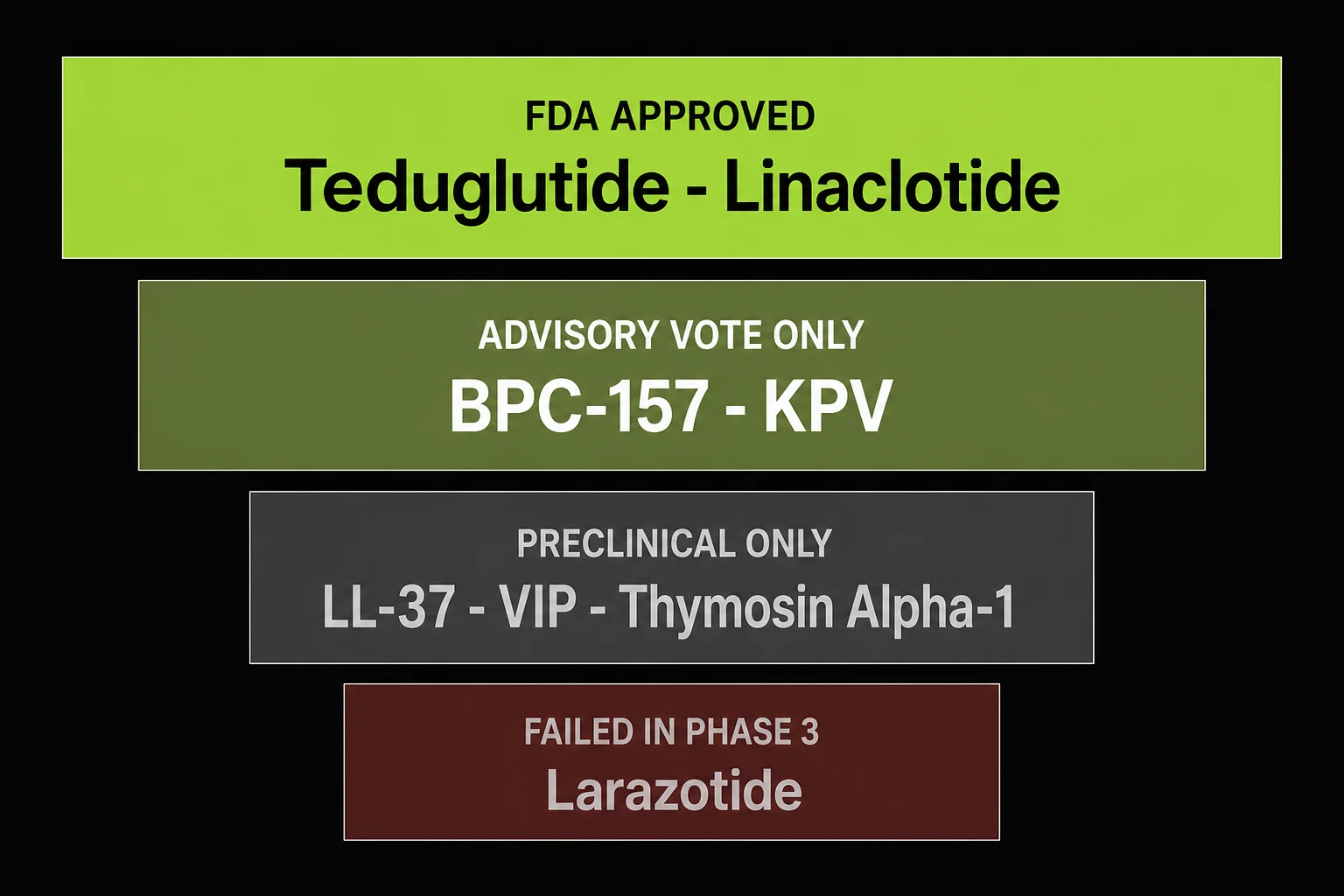
The gap is enormous. Two peptides on the standard list are FDA-approved medicines. Two more picked up a favorable federal advisory vote in July 2026. Three have never progressed past animal models. One ran a 525-patient Phase 3 trial and was discontinued at the interim analysis. Grouping all of them under "promising compounds for gut health" is the single most misleading thing written about this category.
This guide sorts them by what the human evidence actually supports, and is explicit about where that evidence stops.
🔑 Key Takeaways
- Only two are approved drugs — teduglutide for short bowel syndrome and linaclotide for IBS-C. Everything else on the standard list is research-grade or investigational
- The July 2026 FDA advisory vote was, in substance, a gut vote — the only clinical use the agency evaluated for BPC-157 was ulcerative colitis, and KPV's core science is experimental colitis
- An advisory vote is not an approval. The tallies were non-binding, FDA staff recommended against inclusion, and the agency has issued no final decision
- Larazotide failed. The leading "leaky gut" peptide was discontinued in Phase 3 in June 2022, and pages still listing it as promising are years out of date
- Route is the unresolved problem — FDA's own review found no adequate human data for oral, subcutaneous, nasal or transdermal BPC-157, which covers essentially everything sold online
The Evidence Tiers at a Glance
Sorted by the strength of the human evidence rather than by popularity, the category separates cleanly into four groups.
Why 2026 Was a Gut Year for Peptide Regulation
On 23 July 2026 the FDA's Pharmacy Compounding Advisory Committee voted on whether several peptides should be added to the 503A Bulks List, which governs what compounding pharmacies may legally work with. BPC-157 received a favorable 8–6 vote with one abstention. KPV received the same 8–6–1 tally.
The coverage that followed almost universally framed this as a healing-and-recovery story: tendons, ligaments, injury repair. That framing gets the substance backwards.
FDA evaluated BPC-157 for exactly one nominated clinical use, and that use was ulcerative colitis. The agency explicitly did not evaluate Crohn's disease, celiac disease or tendonitis, because the nomination lacked sufficient information and reviewers identified no suitable clinical studies in those populations. KPV's entire research base is inflammatory bowel disease models. The most consequential peptide vote in years was, at the level of the actual evidence reviewed, about the gut.
Three things about that vote need stating plainly, because the marketing that followed it blurred all three.
First, the committee is advisory. Every tally is non-binding and FDA has not issued a final agency decision. Second, FDA's own staff recommended against inclusion for both compounds, citing inadequate substance characterization, insufficient evidence of effectiveness, and unresolved questions about immunogenicity, aggregation, impurities and long-term exposure. Third, the vote question was about whether patient-specific compounding should be permitted under a clinical-need framework. It was not a finding that either compound works.
Our full breakdown of the 2026 FDA peptide vote covers all seven compounds and both days of the meeting.
Tier 1: The Two Gut Peptides That Are Actually Approved Drugs
These two get skipped in most peptide write-ups, which is strange, because they are the only entries with the evidence everything else is reaching for.
Teduglutide (Gattex): GLP-2 for Short Bowel Syndrome
Teduglutide is a recombinant analog of glucagon-like peptide-2, the intestinotrophic hormone released by enteroendocrine L-cells. Native GLP-2 is degraded by DPP-4 within about seven minutes. Substituting glycine for alanine at position 2 blocks that cleavage and extends the half-life to roughly two hours, which is what made it a viable drug.
What it does is genuinely structural. GLP-2 receptor activation increases villus height and crypt depth, expands absorptive mucosal surface area, and slows gastric emptying and intestinal transit. It grows the working surface of the intestine rather than modulating symptoms.
The pivotal STEPS trial randomized patients with parenteral-support-dependent short bowel syndrome to daily subcutaneous teduglutide or placebo for 24 weeks. At weeks 20 and 24, 63% of the teduglutide group achieved at least a 20% reduction in weekly parenteral support volume, against 30% on placebo. Open-label extensions carried treatment out to roughly 30 months with the gains maintained and, in some patients, still accruing.
It is also a good illustration of what a real gut drug label looks like. Teduglutide carries a warning for accelerated neoplastic growth — colonoscopy is required before starting and periodically during treatment — plus risks of intestinal obstruction, biliary and pancreatic disease, and fluid overload. A compound that genuinely remodels intestinal tissue has consequences that a compound with no measurable effect does not.
Teduglutide is a prescription medicine for a rare, serious condition. It is not something to source as a research peptide, and short bowel syndrome is not a proxy for general digestive complaints. If the GLP-1 versus GLP-2 distinction is unfamiliar, we cover it in GLP-1 vs GLP-2.
Linaclotide (Linzess): The Peptide That Solved the Oral Problem
Linaclotide is a 14-amino-acid peptide approved in 2012 for IBS with constipation and for chronic idiopathic constipation, with a pediatric functional constipation indication added later. It agonizes guanylate cyclase-C on the luminal surface of intestinal epithelium, raising cyclic GMP, which increases chloride and bicarbonate secretion into the lumen and accelerates transit. The same cGMP signalling appears to reduce visceral pain signalling, which is why it addresses IBS-C pain rather than constipation alone.
The interesting part for anyone thinking about oral peptides is why linaclotide works as a capsule. It is minimally absorbed — it is not trying to reach the bloodstream. Its target sits on the luminal side of the gut wall, so the capsule delivers it exactly where it needs to be and systemic exposure is essentially irrelevant. That is a specific solution to a specific problem, not a general demonstration that peptides survive digestion.
The dose-limiting side effect is the mechanism doing its job: diarrhoea, in roughly one in five patients. It also carries a boxed warning against use in children under two, following fatal dehydration in juvenile animal studies. Full detail is in our linaclotide guide.
Tier 2: An Advisory Vote, Not an Approval
BPC-157
BPC-157 is a 15-amino-acid partial sequence derived from a protein found in human gastric juice, which is the origin of essentially all of its gut-health positioning. The preclinical literature is genuinely large: rodent models of colitis, gastric ulceration, fistula healing, NSAID-induced GI damage, and anastomotic healing, with proposed mechanisms spanning angiogenesis, nitric oxide signalling and growth factor pathways.
The human literature is not large. It is two clinical reports of rectal administration in ulcerative colitis, neither lasting more than two weeks, and neither carrying the design quality or reporting detail needed for a firm conclusion. That is the entire human GI evidence base that FDA had to evaluate, and it is why agency reviewers concluded the submitted material did not establish effectiveness.
The rest of the human literature does not help with gut questions: a 12-person bladder-pain pilot, a very small retrospective knee-pain chart review, and a two-person intravenous safety pilot. A 2025 systematic review in orthopaedic sports medicine reached the same conclusion — the clinical evidence is extremely limited.
None of this means BPC-157 does nothing. It means the honest description is "a large preclinical signal and almost no human data," and that anyone telling you it repairs the human gut lining is describing rodent studies. Our BPC-157 gut health research guide goes through the GI studies individually, and the BPC-157 overview covers the compound more broadly.
KPV
KPV is the C-terminal tripeptide of alpha-melanocyte-stimulating hormone — lysine, proline, valine, and nothing else. Its appeal is that it retains the anti-inflammatory activity of the parent hormone without the pigmentation effects, and that being three residues long it is absorbed intact by the PepT1 di/tripeptide transporter, which is expressed on colonic epithelial cells and on immune cells in inflamed tissue.
That transporter detail is the most interesting thing about it. PepT1 expression increases in inflamed colonic tissue, so the delivery route is partially self-targeting in exactly the condition being studied. In mouse models of chemically induced colitis, KPV reduced inflammatory markers and tissue damage, with NF-κB pathway inhibition as the proposed mechanism.
Human gut data: none. No controlled trial, no published human colitis study. The July 2026 8–6–1 vote was cast on the same clinical-need framework and the same thin evidence base as BPC-157's. See our KPV peptide guide for dosing detail and the LL-37 and KPV research overview for the mechanism work.
Tier 3: Real Mechanisms, No Human Gut Data
These three appear on gut-health lists on the strength of biology that is real but has never been tested as a treatment in people.
LL-37 is the only human cathelicidin, produced by epithelial and immune cells throughout the GI tract. Cathelicidin-knockout mice are more susceptible to chemically induced colitis, which is a legitimate reason to be interested. It is also a two-sided molecule — antimicrobial and barrier-supporting in some contexts, pro-inflammatory in others — and there is no human GI trial. Details in our LL-37 guide.
VIP, vasoactive intestinal peptide, is a 28-amino-acid enteric neurotransmitter that regulates intestinal secretion, motility and barrier function. It belongs on any list of peptides that matter to the gut, and it is also the clearest cautionary example in the category: VIPoma, a tumour that secretes excess VIP, presents as severe watery diarrhoea, hypokalaemia and achlorhydria. More of a gut-regulating peptide is not automatically better. Our VIP peptide guide covers the wider research.
Thymosin alpha-1 is approved in a number of countries outside the US for hepatitis B and C and as a vaccine adjuvant, which is a real regulatory record — for immune indications, not gastrointestinal ones. Its presence on gut lists rests on the immune system's involvement in gut inflammation, which is an inference rather than a finding. See the thymosin alpha-1 guide.
The One That Failed: Larazotide and the Leaky Gut Story
Larazotide acetate deserves its own section, because it is still listed as promising on pages that have not been updated in four years, and because its failure is the most informative event in this entire category.
Larazotide is an eight-amino-acid peptide that acts as a zonulin antagonist, tightening the epithelial tight junctions that regulate paracellular permeability. It is, in other words, the compound that the entire "leaky gut" thesis was built around — and unlike anything else in that conversation, it was actually tested properly.
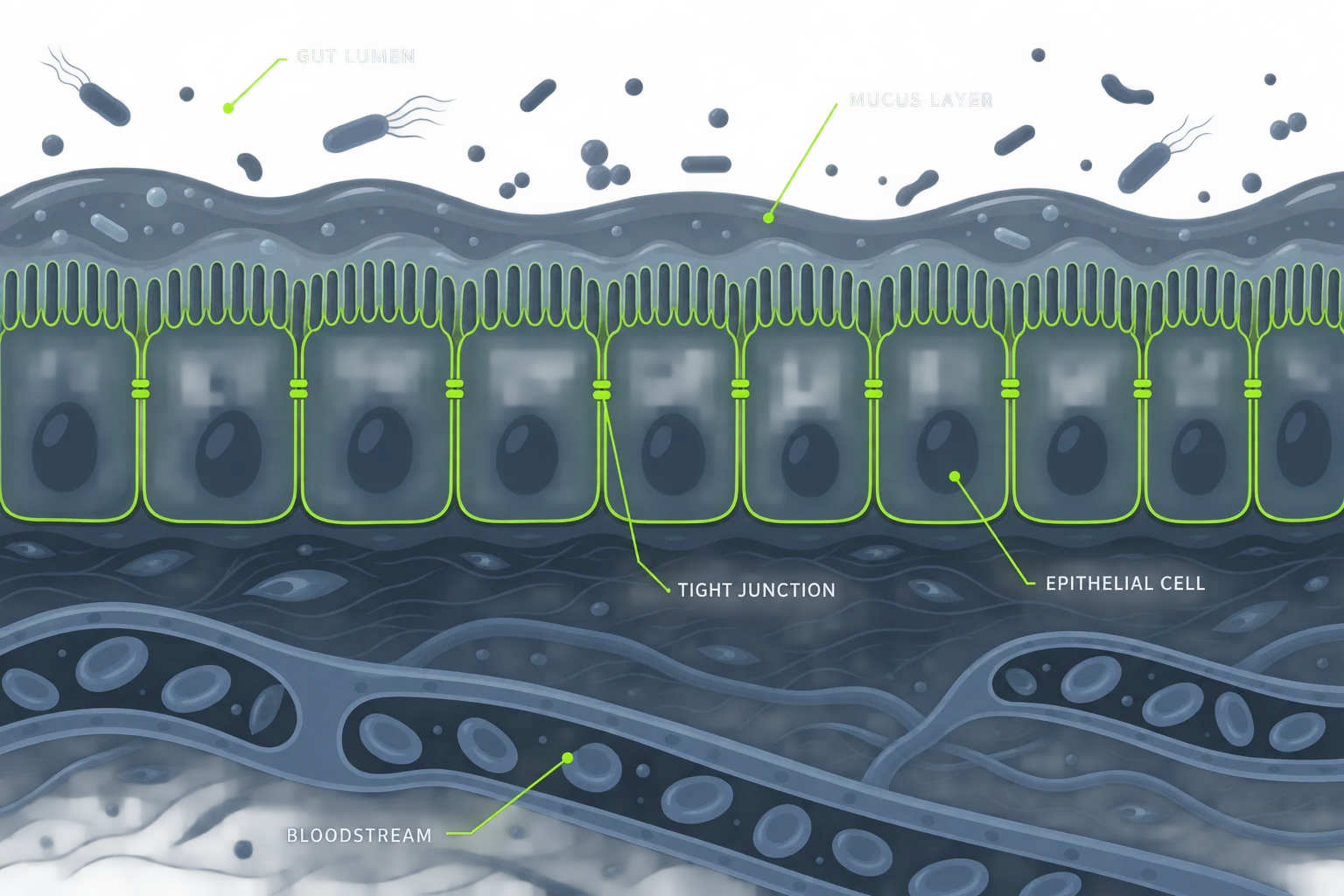
A Phase 2b trial in celiac patients with persistent symptoms despite a gluten-free diet produced a positive result at the 0.5 mg dose, which was enough to justify a pivotal program. The Phase 3 CeDLara trial enrolled 525 patients across 0.25 mg, 0.5 mg and placebo arms, with a 12-week double-blind phase followed by a 12-week safety phase.
In June 2022, an interim analysis found that the sample size required to demonstrate a significant difference against placebo had grown large enough that continuing was not viable. The trial was discontinued. The sponsor, 9 Meters Biopharma, subsequently wound down.
The useful lesson is not that tight junctions are unimportant. It is that a well-designed, adequately powered human trial of the best-developed permeability-modulating peptide did not produce a clinical benefit — after a positive Phase 2. That is exactly the pattern that should make anyone cautious about compounds whose evidence stops at the rodent stage, which describes most of the tier above.
GLP-1 Drugs Are Gut-Acting, Not Gut Treatments
Semaglutide and tirzepatide get folded into gut-health lists because their mechanism is unmistakably gastrointestinal — they slow gastric emptying, which is a large part of how they reduce food intake.
That is a mechanism, not an indication. Delayed gastric emptying is also the source of the nausea, vomiting, constipation and reflux that these drugs are known for, and both classes carry labelling relating to gastrointestinal adverse events including ileus. Reports of persistent gastroparesis in some patients are an active area of investigation.
People with existing motility disorders should treat that mechanism as a caution rather than a benefit. Improvements in gut-related inflammatory markers on these drugs are real but are largely downstream of weight loss, not evidence of a direct therapeutic effect on the gut.
Route Is the Unresolved Problem
This is the practical issue that determines whether any of the tier-2 and tier-3 compounds could work at all, and it is where the marketing is furthest from the evidence.
Peptides are broken down by gastric acid, pepsin and pancreatic proteases. A 15-amino-acid peptide swallowed in a capsule faces the same digestive machinery as a 15-amino-acid fragment of a steak. The two approved gut peptides show the only two solutions that have actually been validated: linaclotide is taken orally because it works on the luminal surface and does not need absorption, and teduglutide is injected because it needs systemic exposure and could not survive the alternative.
BPC-157 sits between those, and the honest answer is that nobody knows. Its gastric-juice origin is used as an argument for oral stability, which is a plausible hypothesis rather than a demonstrated fact. FDA's 2026 review was unambiguous on this: the agency found no adequate human studies for the oral, subcutaneous, nasal or transdermal routes — which covers essentially every form sold. The two short human GI reports used rectal administration, a route almost nobody buying it uses.
Local rectal delivery into an inflamed colon tells you very little about what an oral capsule or a subcutaneous injection produces in terms of exposure, tissue concentration, effect or safety. We go deeper on this in BPC-157 oral vs injection and BPC-157 capsules.
Matching the Compound to the Actual Problem
Most people arriving at this topic have a specific complaint rather than a general interest in peptides. Here is what the evidence supports for each, stated at the confidence the data actually warrants.
The row most people do not want is the "leaky gut" one. Intestinal permeability is a real, measurable phenomenon, and it is genuinely implicated in several conditions. What does not currently exist is a peptide shown in humans to improve it in a way that improves how anyone feels.
Dosing: What the Research Actually Used
Two of these have label doses. The rest have research conventions, which is a meaningfully different thing, and the table below marks which is which.
Read the fourth column before the second. For the bottom four rows, the number in the amount column is a convention that circulates in research communities, not a figure any trial established. Nobody has run a human dose-response study for BPC-157 or KPV in a gut condition, so there is no evidence-based dose to report. If you are working with reconstituted material, our reconstitution calculator handles the conversion, but the calculator cannot supply a correct starting number that the literature does not contain.
Safety, and What Nobody Can Tell You Yet
The two approved drugs have characterized safety profiles, because thousands of monitored patients generated them. Teduglutide's label carries the neoplastic growth warning and the colonoscopy requirement; linaclotide's dose-limiting effect is diarrhoea and it is contraindicated under age two.
For the research-grade compounds, the accurate statement is that the safety profile is unknown, and "unknown" is not a synonym for "clean." FDA's 2026 review identified unresolved questions about immunogenicity, aggregation, peptide-related impurities, hypersensitivity, route-specific risk, repeated exposure and long-term use, and found no adequate clinical program capable of defining common adverse effects, rare serious effects, dose relationships or drug interactions.
The agency also discussed FAERS reports involving an injection-site reaction, shortness of breath, diffuse skin darkening and gum darkening. Some involved other peptides taken concurrently, and the available information did not establish causation. FAERS is a signal-detection system, not a causation database — but it matters more than usual when the controlled evidence is this sparse.
One point that gets misused constantly: the low number of reported adverse events is not evidence of safety. Exposure is unmeasurable, products are often bought outside conventional medical channels, and events frequently go unrecognized or unreported. Without a denominator, a report count cannot produce a rate. Our peptide side effects guide covers the general framework.
Separately, there is a real risk in self-treating a GI complaint with a research compound: inflammatory bowel disease, celiac disease and colorectal cancer share symptoms with ordinary digestive upset, and the cost of delayed diagnosis is high. That is a genuine argument for a colonoscopy before a peptide vial.
If You Are Going to Buy Anyway
Plenty of readers will proceed regardless, and vague warnings help nobody. The things that actually reduce risk are specific.
Insist on a batch-specific third-party certificate of analysis, dated and matching the lot you receive — not a generic PDF for a product line. FDA's central complaint about BPC-157 was inadequate substance characterization, and that problem is worse, not better, in the unregulated market. Purity, salt form, impurity profile and degradation products all vary between suppliers, and a label reading "BPC-157" answers none of those questions.
Buy one compound at a time. Multi-peptide blends make it impossible to attribute either a benefit or an adverse reaction, which is why we treat blends like KLOW as convenience products rather than research tools. And handle storage properly — lyophilized material stays stable far longer than reconstituted, which degrades in solution on a timescale of weeks. Vendor testing standards are compared in our peptide vendor rankings.
Finally, be honest with yourself about the read-out. "My digestion feels better" is not a measurement, gut symptoms fluctuate substantially on their own, and the placebo response in GI trials is among the highest in medicine — the larazotide Phase 3 is a demonstration of exactly that. If you cannot state in advance what would count as a failure, you will conclude it worked.
Frequently Asked Questions
This article is for research and educational purposes and is not medical advice. Teduglutide and linaclotide are prescription medicines. BPC-157, KPV, LL-37 and VIP are not approved for any use in the United States, and the July 2026 advisory votes did not change that. Persistent digestive symptoms warrant a diagnosis from a physician before any self-directed treatment.