The Short Version
- Bioregulators are ultra-short peptides — two to four amino acids — developed in the Soviet Union from 1970s military medicine by Vladimir Khavinson, who died in January 2024. Each is claimed to switch on gene expression in one specific organ.
- They are not one class but three. Six are genuine registered Russian medicines. Most are registered food supplements that are legally barred from claiming any effect. A few — including Epitalon, the most famous of all — are registered nowhere on earth, not even in Russia.
- The one molecule ever tested properly in the West failed. Thymogen's peptide went through a randomised double-blind placebo-controlled trial as oglufanide and returned 23% versus 21% for placebo.
- No pharmacokinetic study has ever been published for any of them, by any route. Nobody has measured intact peptide in blood after an oral capsule, a sublingual spray, or an injection.
- Every signature finding comes from one research group in St Petersburg. Not refuted — never independently replicated.
Search "bioregulators" and you will find perhaps forty products named after organs you half-remember from biology class. Endoluten for the pineal gland. Vladonix for the thymus. Pielotax for the kidneys. Each one promises to restore the organ it is named after, and each one comes wrapped in the same handful of statistics: a 40% lifespan extension, a fourfold drop in mortality, telomeres wound back by decades.
Those numbers trace back to real papers. The problem is what the papers actually say, which is frequently not what the product pages say they say — and in three cases we will document below, is the direct opposite.
This guide covers every bioregulator in the range: what each one is chemically, which organ it targets, whether it is a drug or a supplement or neither, and what evidence exists for it. Where the evidence is thin, we say so. Where it is absent, we say that too, because for several of these compounds "no published studies" is the honest and complete answer.
The Complete Bioregulator List
Twenty-five compounds, organised by the organ each targets. The Composition column gives the amino acid sequence for the synthetics, cross-checked against Khavinson's own published tables and his granted patents. The Evidence column is our grading, explained directly beneath.
How to read the evidence column
Registered drug — approved as a medicine in Russia, with a real label, approved indications and at least some clinical trial data. Six compounds qualify. This means a regulator reviewed it; it does not mean the evidence would satisfy the FDA or EMA.
Extract, some trials — human data exists but comes entirely from the originating group.
Preclinical only — animal and cell-culture work, no adequate human data.
Patent / single paper — the entire evidence base is one patent application or one in-vitro paper.
No published studies — we searched PubMed and Europe PMC full text and found nothing. Not weak evidence. None.
That last category deserves emphasis, because it is larger than the marketing suggests. Taxorest, Ventfort, Stamakort, Svetinorm and Suprefort return zero hits in both PubMed and Europe PMC full-text search. These are not obscure compounds — Suprefort is the pancreas product, one of the best-selling items in the range. Its only "clinical study" is a non-peer-reviewed report of 34 patients hosted on a retailer's own website, with no randomisation, no blinding, no journal and no DOI.
Untangling the Names: Why One Organ Has Four Different Products
This is the single most confusing thing about bioregulators, and no page currently ranking for the term resolves it. The confusion is not accidental — it follows from how the range was built.
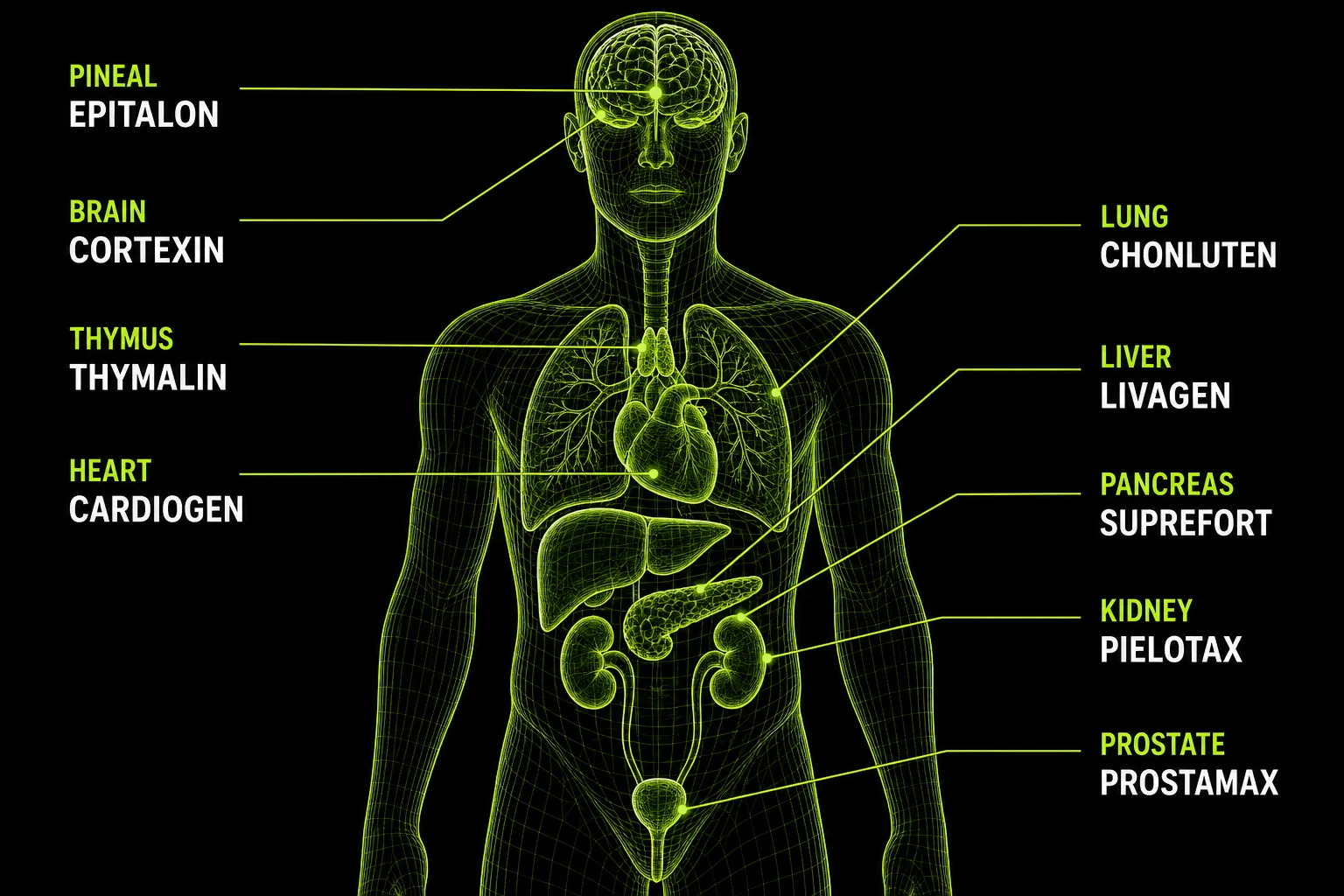
For most organs there are two or three products: a natural extract from calf tissue, a synthetic short peptide modelled on that extract, and often a capsule version sold under a third name. They are chemically different things with different evidence and different legal status, and they are routinely discussed as though interchangeable.
The pineal chain, resolved
Five products, and only the first three share a source material:
- Epithalamin — bovine extract from the epithalamo-pineal region of the brain. A registered Soviet medicine since 1990. Injectable. Production reportedly discontinued.
- Pineamin — bovine pineal gland polypeptides plus glycine. A current registered Russian drug from Geropharm, prescription-only, with a narrow licence for menopausal symptoms where hormone therapy is contraindicated.
- Endoluten — peptide complex A-8 from the pineal gland. A food supplement, sold in capsules. Its label legally claims only to be "an additional source of peptides."
- Epitalon (Epithalon) — the synthetic tetrapeptide Ala-Glu-Asp-Gly. Registered nowhere in the world.
- Pinealon — the synthetic tripeptide Glu-Asp-Arg. Despite the name, this is not a pineal product at all — it is a brain/CNS peptide.
Two corrections worth making explicitly. First, "Endoluten is just Epithalamin in a capsule" is marketing, not established fact. The source tissue is described differently, the regulatory class is different, and no published comparative assay establishes that they are the same material. Even the Khavinson-affiliated vendor describes Endoluten as a "simplified version" — that is, the weaker one.
Second, there is no injectable Endoluten. The Russian registry lists capsules, tablets and a sublingual liquid, and nothing else. Anyone selling you an injectable Endoluten is selling you something else, most likely relabelled Epitalon powder.
Epitalon was designed, not discovered
The usual story is that Epitalon is the active fragment purified out of Epithalamin. The published record runs the other way round. Khavinson's own 2002 monograph states the tetrapeptide "has been designed" from the extract's amino acid composition. A 2025 review in IJMS puts it plainly: AEDG was synthesised based on Epithalamin's amino acid composition "prior to its discovery in pineal gland polypeptide complex solution."
AEDG was only actually detected inside the pineal complex in 2017 — roughly 24 years after it was first synthesised — where it turned out to be one of many tetrapeptides making up about 22% of the mixture. The same paper's conclusion that the extract's effects "are determined by the effect of its component AEDG" does not follow from that finding.
The other chains
- Thymus: Thymalin (extract, registered drug) → Thymogen (Glu-Trp, registered drug) and Vilon (Lys-Glu, unregistered) → Vladonix (capsule supplement, A-6)
- Brain: Cortexin (extract, registered drug) → Cortagen (Ala-Glu-Asp-Pro, unregistered) → Cerluten (capsule supplement, A-5)
- Heart: Chelohart (extract) → Cardiogen (Ala-Glu-Asp-Arg)
- Vessels: Ventfort (extract, A-3) → Vesugen (Lys-Glu-Asp)
- Lung: Taxorest (extract, A-19) → Chonluten (Glu-Asp-Gly) and Bronchogen (Ala-Glu-Asp-Leu)
- Liver: Svetinorm (extract, A-7) → Livagen (Lys-Glu-Asp-Ala)
- Pancreas: Suprefort (extract, A-1) → Pancragen (Lys-Glu-Asp-Trp)
- Cartilage: Sigumir (extract, A-4) → Cartalax (Ala-Glu-Asp)
- Bladder: Chitomur (extract) → Vesilute (Glu-Asp)
The detail that undercuts the whole premise
The central claim of bioregulator marketing is that each peptide is keyed to one specific organ. But Vilon and Normoftal are the identical molecule — Lys-Glu, 275 daltons — sold as two different products for two entirely different organ systems, the immune system and the retina.
This is not an outside criticism. Both appear, with the same sequence and the same molecular weight, in Khavinson's own 2014 table of peptides synthesised at his institute. That same table describes Vilon as a "stimulant of tissue regeneration" — not an immunomodulator, which is how Western vendors position it.
Prostatilen, Vitaprost and Samprost are not the same product
Almost every English-language source presents these as one drug under three names. They are three separately registered trade names from three different companies, and the substances genuinely differ.
Vitaprost's active is declared as 100 mg of prostate extract containing 20 mg of water-soluble peptides — 20%. Prostatilen's is 30 mg of extract yielding 3 mg of peptides — 10%. Samprost is a third preparation, from a fourth manufacturer.
That difference is measurable. A 2025 study compared the substances directly on rat lymphatic vessels and found them moving in opposite directions: Prostatilen increased contraction frequency by 23.7% and 37.6% at two doses, while Samprost had no effect at the lower dose and inhibited contraction at the higher one. Treating them as interchangeable is not a harmless simplification.
One further warning: Vitaprost Plus is not a peptide product. It contains 400 mg of lomefloxacin, a fluoroquinolone antibiotic, and carries the full fluoroquinolone risk profile — tendon rupture, Stevens-Johnson syndrome, photosensitivity, seizures.
Three code systems that do not line up
Products in this range carry letter-number codes, and buyers reasonably assume the numbers mean the same thing across the line. They do not. There are three separate coding systems.
- A-1 to A-21 — the natural extracts (Cytomax)
- AC-2 to AC-7 — the synthetic peptides (Cytogen)
- AA-1 to AA-21 — synthetic peptides used inside the multi-component Revilab products
The numbers do not correspond. The pineal product is A-8 in one system but AA-1 in another. Cardiac muscle is AA-8. So anyone who reads "A-8" off a Cytomax box and matches it to "AA-8" on a Revilab ingredient list has moved from the pineal gland to the heart without noticing. Match codes only within a single line.
Two more corrections worth having: Pielotax is A-9 (kidney), not A-6, and Visoluten is A-11 (eye), not A-3.
Capsule strengths: the 100-fold difference nobody prints
This is the most practically useful specification in the whole range, and almost no vendor states it:
- Cytomax capsules contain 10 mg of peptide complex
- Cytogen capsules contain 0.1 mg — 100 micrograms of peptide
A synthetic Cytogen capsule contains roughly one hundred times less material than a natural Cytomax capsule. That makes sense chemically — one defined tripeptide versus a crude tissue extract — but it flatly contradicts the common marketing claim that the synthetics are "10–15 times more concentrated."
Note also that the "20 mg" figure on many labels is the two-capsule daily dose, not the capsule strength. At least one US relabeller has printed the four-capsule daily maximum, 40 mg, as though it were the per-capsule content.
Drug, Supplement, or Neither: The Three Tiers
Checked against the Russian State Register of Medicines, these products fall into three legally distinct groups. Vendors routinely blur them together, and this is the most practically useful distinction in the whole subject.
Tier 1 — Registered medicines (six)
Thymalin, Thymogen, Cortexin, the prostate-extract drugs (Prostatilen, Vitaprost and Samprost), Retinalamin and Pineamin. These have real labels, approved indications, stated contraindications and listed adverse reactions. Cortexin is used in Russian paediatric neurology for cerebral palsy and epilepsy; Vitaprost for chronic prostatitis; Retinalamin for retinal disease.
Two caveats. Thymalin and Epithalamin were approved under Soviet Ministry of Health orders in 1982 and 1990, under an evidentiary regime with no equivalent to a modern drug dossier. And every one of these is injectable or local — not one was ever registered for oral use.
Tier 2 — Registered food supplements
The entire Cytomax and Cytogen capsule range: Endoluten, Vladonix, Cerluten, Ventfort, Sigumir, Suprefort, Svetinorm, Testoluten, Thyreogen, Glandokort, Pielotax, Taxorest, Zhenoluten and the rest. In Russia these are classified as БАД — biologically active food additives. Their labels carry the mandatory line "Не является лекарственным средством" (not a medicinal product), and the only claim they are legally permitted to make is "an additional source of peptides."
No approved indication. No permitted efficacy claim. The therapeutic language on English-language product pages has no counterpart on the Russian label.
What the Russian registration certificates actually certify
We read three 2025 certificates for products in this range. They certify conformity to ТР ТС 021/2011 and 022/2011 — the customs union regulations on food safety and food labelling. No pharmaceutical regulation appears anywhere on them.
The only approved claim on each is "a source of peptides." There is no thyroid claim on the thyroid product and no adrenal claim on the adrenal product. The expert body providing the basis for registration is the Institute of Nutrition — a food science body, not a clinical one. And the named manufacturer and applicant are contract companies; neither is Khavinson's institute.
Tier 3 — Registered nowhere
Vilon, Cortagen, Cardiogen, Chonluten, Prostamax — and Epitalon. The most famous bioregulator in the world is not a registered medicine anywhere, and is not a registered supplement in Russia either. It exists solely as a research chemical.
Prostamax: a product the originators don't sell
Prostamax appears in neither of the St Petersburg Institute's own catalogues — not among the seven Cytogens, not among the twenty-one Cytomaxes, where the prostate product is Libidon. It is absent from Khavinson's own 2013 review of clinical evidence for the class. His 2022 paper cites a patent for it, not a study.
Yet in June 2026 the FDA issued a warning letter naming Prostamax specifically as an unapproved new drug, citing vendor claims that it "reduces chronic inflammation in the prostate." A product the originators do not sell, never registered and never published on, marketed hard enough to attract enforcement.
Do Bioregulators Actually Work?
Here is the finding that should anchor everything else, and it appears on no vendor page we could find.
The one molecule tested properly in the West failed
Thymogen is Glu-Trp. That exact dipeptide was licensed to a US company as IM-862, or oglufanide disodium, and received FDA orphan drug designation in 2001. It was then taken through real Western oncology trials.
The pattern is textbook:
- Open-label study in AIDS-related Kaposi's sarcoma, 44 patients: 36% major response rate. Impressive.
- Randomised, double-blind, placebo-controlled trial, 202 patients: 23% versus 21% for placebo. P = 0.46. No effect.
- Phase II in metastatic renal cell carcinoma at 20 mg three times daily: zero objective responses.
Development was halted. The same compound that looked strong without a control group did nothing once one was added.
This matters far beyond Thymogen. Essentially the entire Russian bioregulator literature is uncontrolled or open-label. When one molecule from that literature was finally put under blinding, its apparent effect vanished. That is the correct prior for the rest of the range.
There is a silver lining worth stating: those Western trials dosed at roughly 2,400 times the Russian nasal dose and reported no grade 2 or 3 toxicities. The safety signal is genuinely reassuring even though the efficacy signal is not.
What the famous mortality study actually says
The "266 patients, fourfold reduction in mortality" claim comes from a 2003 paper by Khavinson and Morozov. The 266 is a sum of three separate groups: 94 elderly women in St Petersburg, 152 patients in Kiev, and a separate group of 20.
The famous mortality table covers only the St Petersburg arm, in groups of 22 to 24 people. And the headline 4.1-fold figure comes from the group of 20 — which was not one of the randomised arms, contained men where the control group was all women, and was one to three years younger at baseline than its comparator. At age 80, a three-year age difference substantially drives six-year mortality.
To be fair and precise: the paper does describe stratification randomisation and double-blinding for its main arms, and PubMed indexes it as a randomised controlled trial. The problem is not that randomisation was never claimed — it is that nothing can be verified. There is no protocol, no allocation concealment, no CONSORT flow diagram, no pre-specified primary endpoint, no power calculation, no survival curves and no confidence intervals. The statistics section lists six different tests without mapping any of them to a result.
One more structural point. The 152-patient Kiev cohort, the 12-year follow-up published in 2006, and the 15-year follow-up published in 2011 are not three studies. They are progressively longer follow-ups of the same patient stream. The 2003 paper asserts "the absolute independence of the trials," which is not accurate — Khavinson co-authored both.
Three claims that are contradicted by their own sources
1. "Epitalon extended mean lifespan in mice by 12.3%"
The study says the opposite. Anisimov's 2003 SHR mouse experiment states that Epitalon "did not influence food consumption, body weight or mean life span." The 12.3% figure refers to maximum lifespan. The same paper also states it "did not influence total spontaneous tumor incidence" — one tumour type, leukaemia, fell.
2. "Epitalon lengthened telomeres in human cells"
Technically true and routinely misread. The 2003 telomerase paper used cultured human fetal lung fibroblasts — 50 ng/mL for four days in a dish. It was not a study in people, and it is regularly presented as though it were.
3. "Bioregulators reduce cancer risk"
In the same 2002 experiment on HER-2/neu mice — run by Khavinson's own long-time collaborator Anisimov, published in International Journal of Cancer — Epitalon reduced tumours, but Vilon significantly increased mammary cancer incidence, shortened tumour latency and raised the cumulative number of tumours. Lung metastases were 2.6-fold higher than in the Epitalon arm.
A bioregulator accelerated cancer in the group's own experiment. Whatever else this shows, it means you cannot reason from one compound in this class to another.
Nor is the class internally consistent in the other direction: in a rat bladder carcinogenesis model, Vilon reduced tumour incidence while Epitalon showed no inhibitory effect at all — exactly the reverse of the mouse result.
What is missing entirely
- Zero registered clinical trials. ClinicalTrials.gov returns nothing for epitalon, epithalamin, thymalin, cortexin, retinalamin or pineamin. For comparison, cerebrolysin — a similar brain peptide preparation — has 42.
- Zero pharmacokinetic data. The FDA's 2026 review states flatly: "No pharmacokinetic data were found for epitalon (free base) or epitalon acetate."
- Zero systematic reviews or meta-analyses. The FDA searched the Cochrane Database and found nothing.
- Zero independent replications. The Alzheimer's Drug Discovery Foundation's assessment is blunt: "every preclinical and clinical study discussed here has been conducted by Dr. Khavinson's group in Russia with no independent confirmation of their results."
The one genuinely independent Western experimental test we could locate — a 1993 study at the University Children's Hospital in Tübingen — was null.
And the most pointed criticism comes from inside the programme. Vladimir Anisimov, Khavinson's principal collaborator on the animal work, wrote in 2006 that geroprotector data including "peptide preparations modulating the pineal gland" were "scarce, contradictory and often not reliable from the points of view of the adequacy of the experiments to current scientific requirements," and that most results "could not convincingly evidence the life span extension and safety of the suggested geroprotectors."
Two more things the marketing leaves out
A properly controlled animal study of Retinalamin was negative. Thirty-six rabbits, randomised into four groups, photochemical retinal damage, with multifocal and full-field electroretinography, histology and apoptosis staining. The conclusion: "no significant differences in any of the studied parameters" and "no significant functional and morphological evidence of neuroprotective effects of Retinalamin were found." It was published in the same Russian ophthalmology journal that carries all the positive work.
And the placebo arm in the best prostate trial behaved impossibly. The one genuinely placebo-controlled study — 120 men, three arms, 30 days — reported that the placebo group's residual urine volume rose from 45.9 to 55.0 mL and its symptom scores did not move. In Western BPH trials, placebo reliably produces a 4–6 point symptom improvement. A flat-to-worsening placebo arm is the signature of unblinded assessment, and it inflates every between-group difference in the study.
An undisclosed conflict of interest
Khavinson founded Cytomed — the company that manufactures Prostatilen — in 1989 and served as its general director until 1992. He is also a named co-author on the first three clinical papers published on that drug. None of those papers discloses the relationship.
More broadly, the St Petersburg Institute he directed sells these products directly; his own correspondence address on a 2022 paper is at the retail domain. He was a named inventor on roughly 149 patents assigned to the commercial sellers. Both of his flagship review papers state that the authors declare no conflict of interest.
The fair characterisation
This work has not been debunked. It has been ignored — no Western group has attempted replication and failed, because no Western group has attempted replication at all. That is materially different from "disproven," and also different from "promising."
The honest summary: a fifty-year, single-institution body of work, roughly half of it concentrated in three journals connected to that institution, with no prospectively registered trials, no pharmacokinetic data, and no independent replication of any signature finding.
Oral vs Injectable: The Question Nobody Has Answered
Most bioregulators are sold as capsules. Peptides are normally destroyed by stomach acid and gut enzymes. So does swallowing one do anything?
The vendor argument is that the intestine has a dedicated transporter, PEPT1, which evolved to absorb short peptides from digested food. That is true, and it is a better argument than the crude "peptides can't survive digestion" objection. But it has three problems, and they get worse as you go.
First, PEPT1 only carries di- and tripeptides. It handles roughly 400 dipeptides and 8,000 tripeptides — and nothing with four or more residues. So the argument works for Vilon (KE), Pinealon (EDR) and Cartalax (AED). It does not work for Epitalon (AEDG), which is a tetrapeptide. The single most-marketed compound in the range is precisely the one the transporter argument cannot cover.
Second, being transported into a gut cell is not the same as reaching the bloodstream. PEPT1 delivers peptides into the enterocyte, which is full of peptidases that break most of them into free amino acids before they ever reach portal blood. This is why drugs designed to exploit PEPT1 — valacyclovir, enalapril — are deliberately engineered prodrugs built to survive that step. Bioregulators are plain unmodified peptides with no such protection.
Third, and decisively: nobody has measured it. There is no published pharmacokinetic study of any Khavinson bioregulator, by any route. Not oral, not sublingual, not injected. The entire capsule market rests on no absorption data whatsoever.
One awkward corroborating detail: every product the originators actually registered as a medicine is injectable or local. Thymalin, Cortexin, Pineamin and Epithalamin are all intramuscular; Vitaprost is a suppository. The oral capsule range is a separate, later, supplement business.
There is also a real possibility that oral bioregulators do something without being absorbed at all. One study found oral Vilon and Epitalon changed enzyme activity in the intestinal lining of aged rats — a genuine effect, but a purely local one, entirely compatible with zero systemic absorption.
Dosing Protocols
There is no authoritative protocol for most of these compounds. What exists is a spread of conventions that disagree with each other by orders of magnitude.
Oral capsules
The standard manufacturer protocol is 1–2 capsules once or twice daily with food, for 30 days, repeated two to three times a year. Most Cytomax capsules declare 10 mg of peptide complex each.
The contradiction inside the Khavinson channel itself
The registered Russian label for Endoluten says 1–2 capsules, 1–2 times daily, with food, for a month — up to four capsules a day.
The same company's dealer network instructs one capsule every three days, before food.
That is roughly a twelvefold difference in dose, with opposite food instructions, from two official channels of the same organisation, with no published rationale for either.
Injectable synthetics
For Epitalon the community protocol is 5–10 mg per day subcutaneously for 10–20 days, one to three times a year. It is worth knowing where that number came from, because it did not come from a study of Epitalon.
The total documented human exposure to Epitalon in the published literature is: 5 micrograms per eye given parabulbar for 10 days in a retinitis pigmentosa study, and 0.5 mg per day sublingually for 20 days in a circadian rhythm study. That is it.
The 5–10 mg injected figure is borrowed from Epithalamin's intramuscular regimen — a different substance, a chemically undefined bovine extract — and transplanted onto a synthetic tetrapeptide. Community dosing spans 250 micrograms to 10 mg per day, a fortyfold range, with no pharmacokinetic data to arbitrate it.
The gap gets stranger. Oral Epitalon capsules are sold at 1 mg per capsule while injectable protocols run 5–10 mg per day — implying a bioavailability assumption of roughly 10,000-fold that nobody has measured.
If you are reconstituting a lyophilised vial, our reconstitution guide and dosing calculator cover the mechanics, and the bacteriostatic water guide covers the diluent.
Safety, Side Effects and the Cancer Question
The marketing claim is that bioregulators have no side effects. The registered labels disagree with the marketing — and they are the more reliable source.
Cortexin's label, as a registered medicine, lists anaphylactic shock, angioedema, urticaria, allergic dermatitis, psychomotor agitation, headache, dizziness, tachycardia, arrhythmia, anxiety, insomnia and raised blood pressure. It also carries a specific paediatric warning: lidocaine as a diluent in children increases the severity of adverse reactions and is not recommended.
Pineamin's label lists vaginal bleeding in up to 1 in 10 patients, injection-site infiltration, and allergic reactions. Its contraindications include precancerous or malignant tumours, specifically oestrogen-dependent gynaecological and breast cancers — which sits awkwardly against the historical claim that Epithalamin, from the same source tissue, was used to treat hormone-dependent tumours.
Meanwhile a distributor FAQ for the supplement line asserts that "peptides have no contraindications and cannot cause allergic reactions." The registered label for Endoluten contradicts even that, listing individual intolerance, pregnancy and breastfeeding as contraindications.
Why "no reported side effects" means very little here
The FDA searched its adverse event database for epitalon through December 2025 and found zero reports. That is not a safety record — it is an absence of surveillance. Reporting is voluntary, compounders generally do not report, and grey-market research-chemical buyers report to nobody at all.
Supplement labels in Russia are not required to carry a side-effect section. An empty side-effect section is a legal artefact, not a finding.
The cancer question
Telomerase activation cuts both ways. Vendors present it as rejuvenation. The FDA presents it as a risk, noting that long telomeres are associated with increased malignancy risk, and warning that chronic exposure "could result in carcinogenicity." No two-year carcinogenicity study exists for epitalon.
The rodent data lean favourable but cannot bear weight: every study used a single fixed dose with no dose-response, most used female animals only, and exposure was intermittent — 5 days a month — whereas the scenario that concerns regulators is continuous daily use. The favourable results and the risk scenario are not the same experiment.
And as noted above, one compound in this class demonstrably promoted mammary cancer in transgenic mice. Anyone with a personal or family history of cancer has no basis for reassurance here in either direction.
The organ-extract question nobody addresses: hormones
Several of these products are extracts of endocrine tissue — Thyreogen from thyroid, Glandokort from adrenal, Testoluten from testis, Zhenoluten from ovary, Bonothyrk from parathyroid. A reasonable question is whether an extract of a hormone-producing gland contains hormones.
We checked the manufacturer, the Institute and three reseller networks. Not one product claims to be hormone-free, and none says anything about hormone content in either direction. No assay has been published for any of them.
The implicit defence is size exclusion — the extracts are described as a fraction "up to 10 kDa," which sounds like it would exclude hormones. It does not. Thyroxine is 777 daltons. Triiodothyronine is 651. Cortisol is 362. Testosterone is 288. All four pass through a 10 kDa cut-off without resistance. Parathyroid hormone, at roughly 9.4 kDa, sits inside the stated range — which makes the parathyroid product the most plausible candidate for co-purification.
There is a published base rate for exactly this question. A 2013 analysis of comparable glandular supplements found triiodothyronine in nine of ten products tested and thyroxine in five of ten, at clinically active amounts — in products that, like these, made no hormone claim. That does not tell you what is in a Khavinson extract, but it does tell you the concern is empirical rather than theoretical.
This is not a claim that these products contain hormones. It is the observation that the stated specification provides no assurance that they do not, and that nobody has measured it. For anyone with thyroid or adrenal disease, or taking thyroid hormone replacement, that is a material unknown.
What the source animal actually is
No certificate names a species. Registered labels say only "young animals." Vendor descriptions are inconsistent and sometimes self-contradictory: one product is described as coming from "healthy calves," another from "calves under one year," and Testoluten from "sexually mature bulls" — which is not a calf. Reseller copy for the line sometimes says "calves and pigs."
Porcine content is nowhere excluded, which matters for anyone avoiding pork for religious or dietary reasons. No age or BSE-status declaration appears in any registered documentation.
Two names that trap English readers
Ovagen is a liver and gastrointestinal product, not an ovary product, despite how it reads in English. The ovary product is Zhenoluten.
Testagen is not the synthetic counterpart to Testoluten — it is made by a different company. The pairing tables on affiliate sites are largely invented: the Institute's synthetic line runs to only seven products, and of the organ extracts discussed here, only Visoluten has a genuine counterpart.
Who should avoid them
No formal safety evaluation has ever been done, so contraindications are inferred rather than established. On the available evidence: anyone pregnant or breastfeeding (every label says so), anyone under 18, anyone with a cancer history, anyone on immunosuppressants or with autoimmune disease, and anyone with a sleep or circadian disorder — community reports cluster on circadian disruption, with one user describing persistent early waking that continued for eight months.
Why the Vendor Data Can't Be Trusted
While researching this guide we checked vendor claims against primary sources. The error rate was high enough to be worth its own section.
- Wrong sequences. One major vendor lists Cardiogen as "Ala-Glu-Asp-Lys." The granted patent says Ala-Glu-Asp-Arg. Crystagen is widely printed as "Pro-Glu-Asp"; the patent claims Glu-Asp-Pro — the residues are in the wrong order.
- Sequences for things that don't have one. Visoluten is a tissue extract with no defined sequence and zero Europe PMC hits. Vendors print one anyway.
- Fabricated citations. Two peptide-dosing sites cite PMID 18402695 in support of Pancragen. That paper is about soybean microRNA. They also cite PMID 15677927, which is a review of calcaneal fractures.
- Invented dosing. One aggregator lists Prostamax at 10–20 mg daily. The patent specifies 0.01–100 micrograms per kilogram — three to four orders of magnitude lower. For Pancragen, the only documented human dose is 10 micrograms intramuscularly; vendors sell 20 mg vials and suggest 1–2 mg.
- Sold isn't studied. Pancragen was studied as the amidated form, KEDW-NH₂. Vendors ship the free acid.
Even the primary literature has inconsistencies. Khavinson's own papers give Bronchogen's sequence as AEDL in one place and ADEL in another. The proposed DNA-binding site has changed four times across twenty years — ATTTTC, then CNG, then GGAG/GCGC, then GCGG/GGGC — without converging.
Where They Came From
Vladimir Khatskelevich Khavinson (27 November 1946 – 6 January 2024) graduated from the Kirov Military Medical Academy in Leningrad in 1971 and began gerontological research for the Soviet Ministry of Defence from the mid-1970s, working with Vyacheslav Morozov — a co-discoverer largely written out of the English-language account.
The founding problem was radiation. The earliest published experiments gave rats 400 rad of X-rays and then thymus or pineal extracts; radiation carcinogenesis was the original model. Khavinson founded the St Petersburg Institute of Bioregulation and Gerontology in 1992 and was elected a full academician of the Russian Academy of Sciences in 2022.
Two frequently repeated origin details we could not source anywhere: that the work began with submarine crews, and that it was commissioned by the Kremlin. Neither appears in any primary, encyclopedic or peer-reviewed source — only in vendor blogs. The commonly cited "research began in 1971" is also loose; 1971 is his graduation year, and the funded programme dates to roughly 1974–75.
It is worth knowing that Wikipedia's own article on Khavinson carries an editorial banner flagging promotional content, and that most pages in this niche still write about him in the present tense two years after his death.
The proposed mechanism
The claim is that peptides this short slip through the cell and nuclear membranes and bind directly to specific DNA sequences, switching genes on in a tissue-specific way.
What the experiments actually show is narrower. Fluorescently labelled peptides do appear in the nucleus of HeLa cells. In a test tube, the peptides change the fluorescence of labelled DNA fragments, which is an indirect proxy for binding. There is no crystal structure, no genome-wide binding map, and no demonstration that binding causes a transcriptional change. Much of the "CNG site" work most often cited as mechanism is actually about a wheat seedling enzyme.
The one paper in this area published in a top-tier journal is a 2019 Nucleic Acids Research modelling study — and its own conclusion runs against the general claim: "the vast majority of the dipeptides were found to be unable to bind dsDNA."
The tissue-specificity claim — the entire premise of organ-targeted products — has, as far as we can determine, never been tested experimentally at all.

Legal Status and What They Cost
Russia and CIS: six registered medicines, roughly forty registered food supplements.
United States: not approved for anything. Epitalon held orphan drug designation for retinitis pigmentosa from 2010 until it was withdrawn in 2016. In July 2026 an FDA advisory committee voted 7–4–1 to recommend Epitalon for the compounding bulks list — overriding FDA's own scientific staff, who recommended against all seven peptides under review, and for insomnia specifically, not longevity. That vote is non-binding and still unsigned. Our full breakdown of the July 2026 FDA peptide vote covers what it did and did not decide.
Europe: no approved products in the UK, Ireland, France, Germany, Spain, Italy, Belgium, Norway, Canada or Australia, and none authorised by the EMA. Epitalon is not recognised in the European or Japanese Pharmacopoeia. Belgium's national health institute classified epitalon-containing preparations as illegal pharmaceutical preparations. The UK is the notable divergence — the Khavinson capsule line sells openly there as food supplements.
Australia is the strictest: most research peptides are prescription-only, and the TGA issued infringement notices and fines for unlawful peptide importation through 2026.
Typical prices
- Oral capsules: about $135 for 60 capsules — a 30-day course — with Endoluten the premium item at roughly $210. At two to three courses a year that is $270–$630 annually per organ target.
- Injectable synthetics: Epithalon is around $30–60 per 10 mg vial; Pinealon about $75 per 20 mg.
- Pineamin, the registered drug, runs 17,580–38,924 roubles per pack of ten vials.
One irony worth noting: the grey-market synthetics are better characterised than the "authentic" supplements. A batch certificate of analysis on a defined tetrapeptide tells you more than an ingredient list reading "peptide complexes A-5, A-6, A-7."
Where to Buy Bioregulators
Two separate markets exist, and they barely overlap. The oral Cytomax and Cytogen capsules come from the Russian supplement trade and its Western resellers. The injectable synthetics come from research-peptide vendors, and are the only part of the range with third-party batch testing.
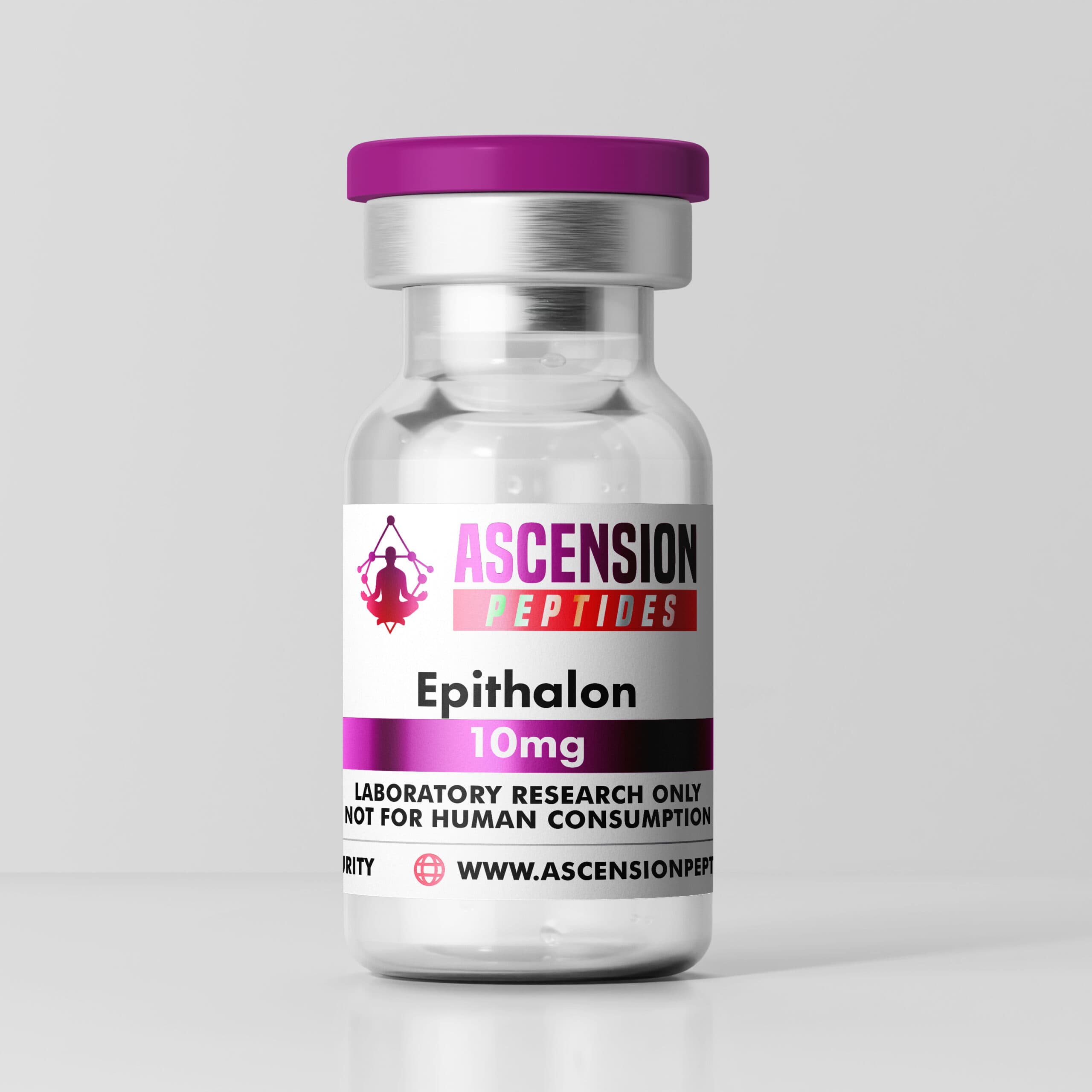
Of the compounds in this guide, Ascension Peptides stocks two — Epithalon 10 mg and Pinealon 10 mg, both $50, with a downloadable third-party certificate of analysis from Kovera Labs and US shipping. They do not carry the oral capsule range, Thymalin, Cortexin or Vilon.
Read this before ordering
Everything in the evidence section above still applies. You would be buying a compound with no pharmacokinetic data, no registered trial, no independent replication and no established human dose, at a dose extrapolated from a different molecule. It is sold for research use only and is not approved for human use anywhere.
If you buy anyway, the minimum standard is a batch-specific certificate of analysis from an independent lab — not a generic one for the product line.
Frequently Asked Questions
Individual Bioregulator Guides
Deeper coverage of the compounds in this range:
- Epitalon — the pineal tetrapeptide, and Epithalon dosage protocols
- Pinealon — the EDR tripeptide, brain and cognition
- Vilon — the KE dipeptide
- Cartalax — cartilage and joints
- Bronchogen — the lung peptide
- Thymalin — the registered thymus medicine
This article is for informational and educational purposes only and is not medical advice. Bioregulator peptides are not approved for the treatment of any condition outside Russia and the CIS, and most are sold for laboratory research use only. Talk with a licensed clinician before starting any peptide protocol, particularly if you are pregnant, breastfeeding, have a history of cancer, or take immunosuppressive medication.