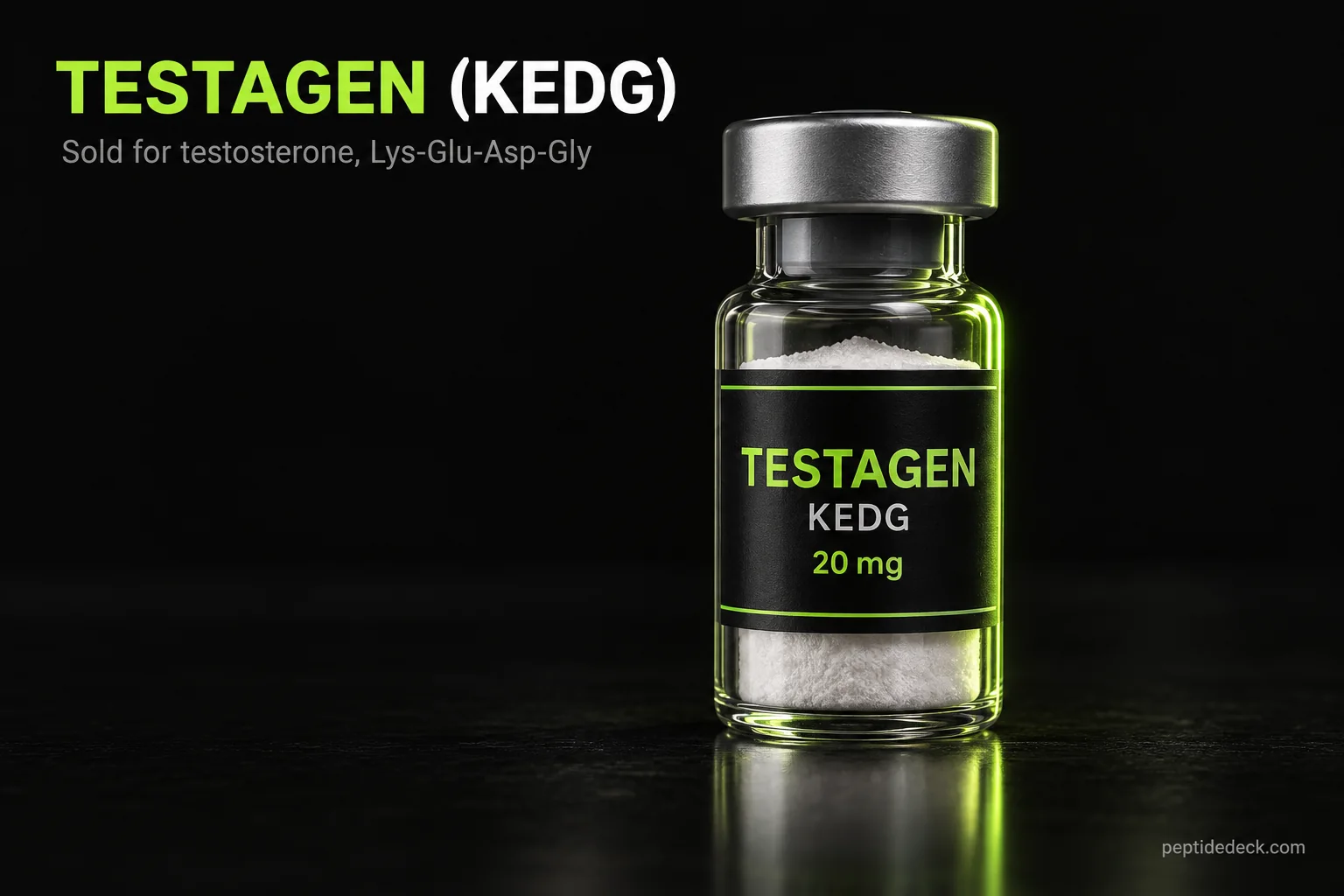
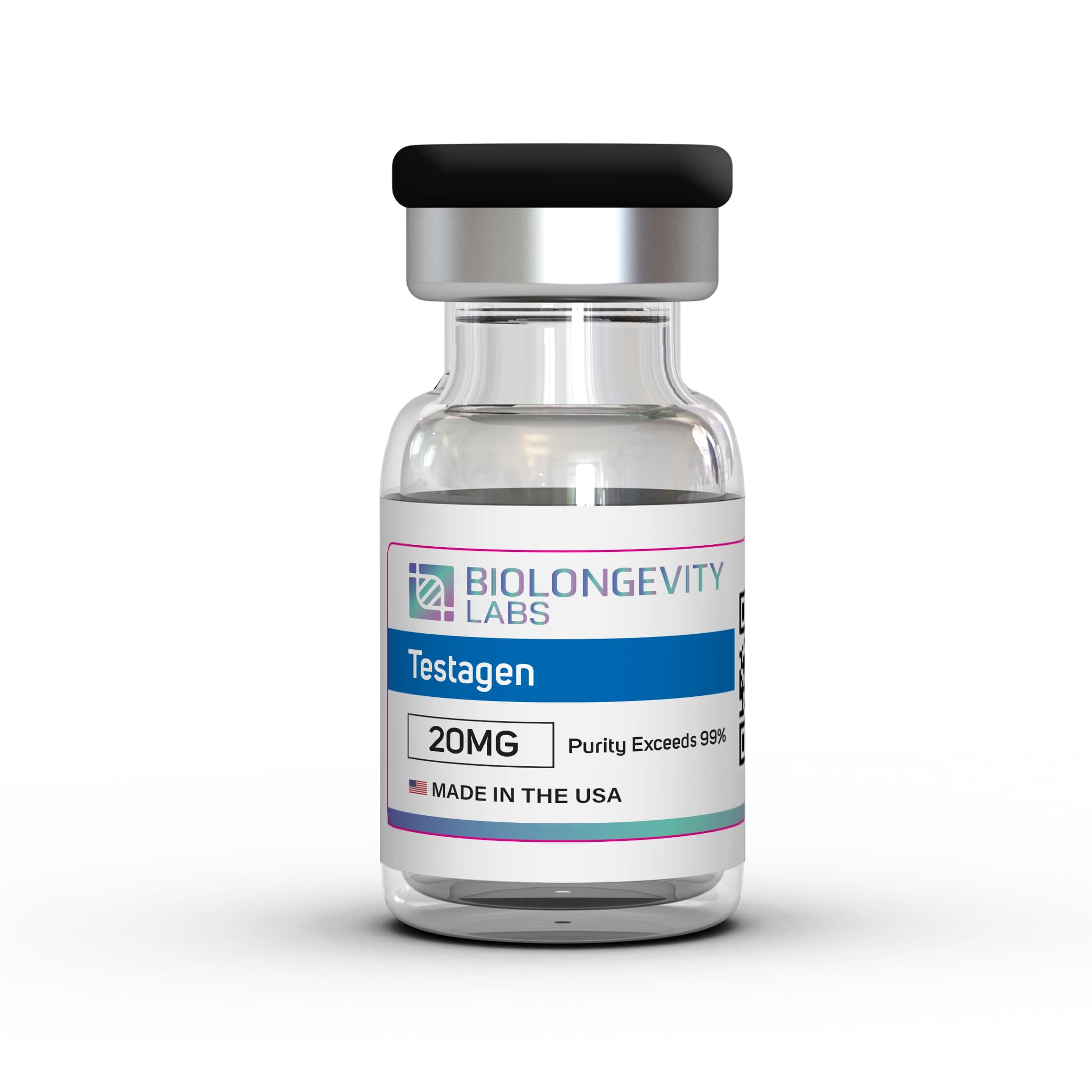
Nobody has ever measured it.
Not once, in any study, in any species, has anyone given this peptide and then measured testosterone. That is worth knowing before you read a single benefit claim, because every page selling Testagen peptide sells it as a testosterone peptide. The name says so. The vendor pages say so. The dosing charts titled "testosterone support protocol" say so.
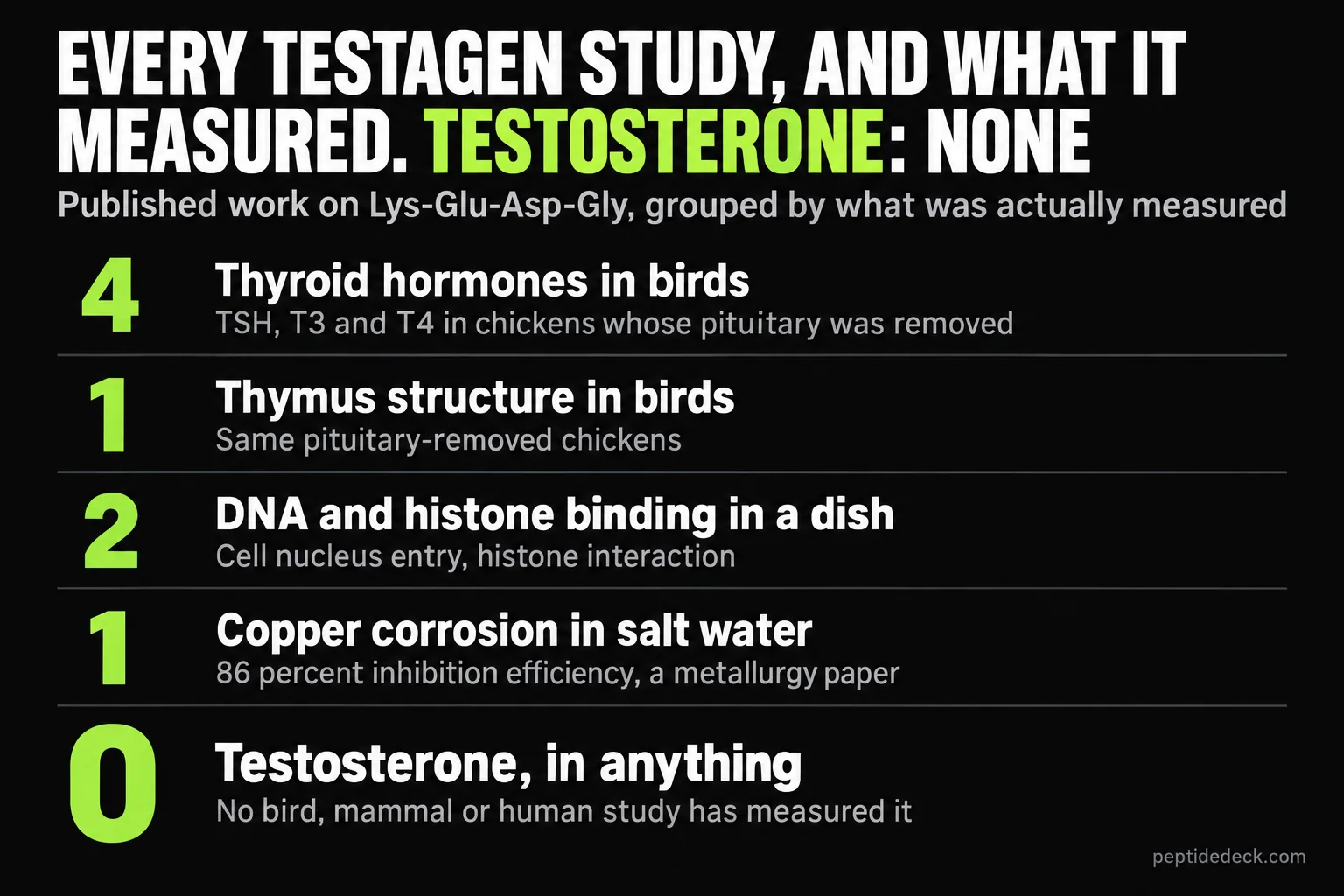
What the published studies actually measured is thyroid hormones and thymus tissue, in chickens whose pituitary glands had been removed. That is a real body of work, and it is about a different gland from the one on the label. Here is the whole picture.
🔑 Key Takeaways
- Testagen is a synthetic four-amino-acid peptide, Lys-Glu-Asp-Gly, designed from the amino acid composition of anterior pituitary extract — not from testicular tissue.
- Every published study of it was done in chickens with their pituitary removed, and measured thyroid hormones, thyroid and thymus structure, immunity and blood clotting. None measured testosterone.
- The developers' own 2022 review lists it as a "regulator of the male reproductive system" and, uniquely in that table, gives no citation for the claim.
- "Testagen" is also the brand name of a transdermal testosterone product with a registered clinical trial. The peptide has none. The two get conflated constantly.
- The top ten pages print at least four different sequences for it, including Prostamax's, and recommend doses from 100 micrograms to 20 milligrams a day.
- What the chicken work actually shows, why it is more interesting than the marketing, and how to check a vial, below.
Start with where the molecule came from, because it is not where the name suggests.
What Testagen Peptide Actually Is
A pituitary peptide. That is how its makers describe it.
Testagen is lysine-glutamic acid-aspartic acid-glycine, KEDG, about 431 daltons. It was developed by Boris Kuznik's group in Chita, Russia, working within the Khavinson bioregulator tradition, and the origin is stated in the first paper on it: the peptide was "synthesized on the basis of amino acid composition of pituitary cytomedins" — specifically of the anterior lobe of the pituitary. Its sibling, Ala-Glu-Asp-Gly, was built the same way from the posterior lobe, and is better known as Epitalon. Testagen differs from Epitalon by one amino acid.
Nothing in that design involves the testes. The name, and the "testes bioregulator" label on vendor pages, is a marketing inference: the pituitary sits at the top of the hormonal chain that ends in testosterone, so a pituitary peptide has been sold as a testosterone peptide. Whether it actually does anything to testosterone is the question nobody has asked in a study.
Two more things carry the same name, and both distort what you find when you search:
- Testagen TDS, a testosterone spray. A transdermal 5% testosterone product under the brand name Testagen has a registered clinical trial on the global registry — a skin-transfer pharmacokinetic study by a drug-delivery company, scheduled to begin in 2027. That is real testosterone, applied to the skin. It has nothing to do with the peptide, but it is the only "Testagen" with a clinical trial to its name, and its existence is part of why the peptide carries a reputation it has not earned.
- Testoluten, the extract. The Khavinson Institute's own testis product is a tissue extract in capsules called Testoluten. Testagen is not its synthetic counterpart, despite what the pairing tables on affiliate sites say; it was designed by a different group from a different gland.
What the Testagen Studies Actually Measured
Thyroid. Thymus. Chickens.
The pituitary-removal work, 2008 to 2014
Five papers, one experimental design. Chickens — some newly hatched, some a year old, some five — had the pituitary gland surgically removed, which wrecks the thyroid: follicles swell, hormone output collapses, and secondary hypothyroidism develops. The thymus shrinks, immunity drops, and blood becomes prone to clotting. Then the birds were given KEDG, or its sibling AEDG, for 40 days.
The results were consistent across all five papers. Thyroid-stimulating hormone, T3 and T4 came back up. The thyroid's structure recovered. The thymus recovered its architecture, with KEDG doing more for it than AEDG did. Immune and clotting parameters normalised. Every paper also notes the same limitation: the recovery was greater in young birds than in old ones.
That is a coherent finding — a pituitary-derived peptide partially standing in for a missing pituitary, in birds. What none of the five papers report is testosterone, luteinising hormone, testicular weight, sperm, or any reproductive measure at all. The hormone axis they studied was the thyroid one.
The cell work
Two papers from a Moscow group established that KEDG, fluorescently tagged, gets into cultured human cells and their nuclei, and that it binds histone proteins H1, H2B, H3 and H4 in a test tube. This is the mechanistic basis for every "epigenetic" claim you will read. It is real, and it is a dish.
The corrosion paper
The most recent Testagen study, published in 2025 in a chemistry journal, tested KEDG as a corrosion inhibitor for copper in salt water. It achieved 86% inhibition efficiency. This has no bearing on your hormones, but it is one of only two papers in the literature that use the trade name "Testagen," and it says something about how thin the biomedical record is that a metallurgy study makes up a meaningful share of it.
The Claim With No Citation
Go to the source and the testosterone story has a hole in it.
In 2022 the Khavinson group published a review that tables each of their short peptides against its function and cites the supporting studies. Most rows carry a bracketed reference. The row for Testagen reads: "Regulator of the male reproductive system." Then nothing. No bracket, no study. The 2021 systematic review from the same group makes the same claim and cites three papers — the histone-binding study, a review of cell differentiation, and a third — none of which measured anything reproductive.
Two of the top-ranking guides mention a study of men with chronic prostatitis in which testosterone rose. Neither gives a reference, and I could not find a published study of Lys-Glu-Asp-Gly reporting testosterone in any patient group. If it exists, it is not indexed, and a claim that cannot be located is not evidence you can buy on.
The number that frames all of this: a search of the global clinical trials registry for "Testagen" returns exactly one trial. It is for the testosterone spray. A search for the peptide's sequence returns none. No human has been given Lys-Glu-Asp-Gly in a study.
One Peptide, Four Sequences: What Vendor Pages Get Wrong
The top ten cannot agree on what the molecule is.
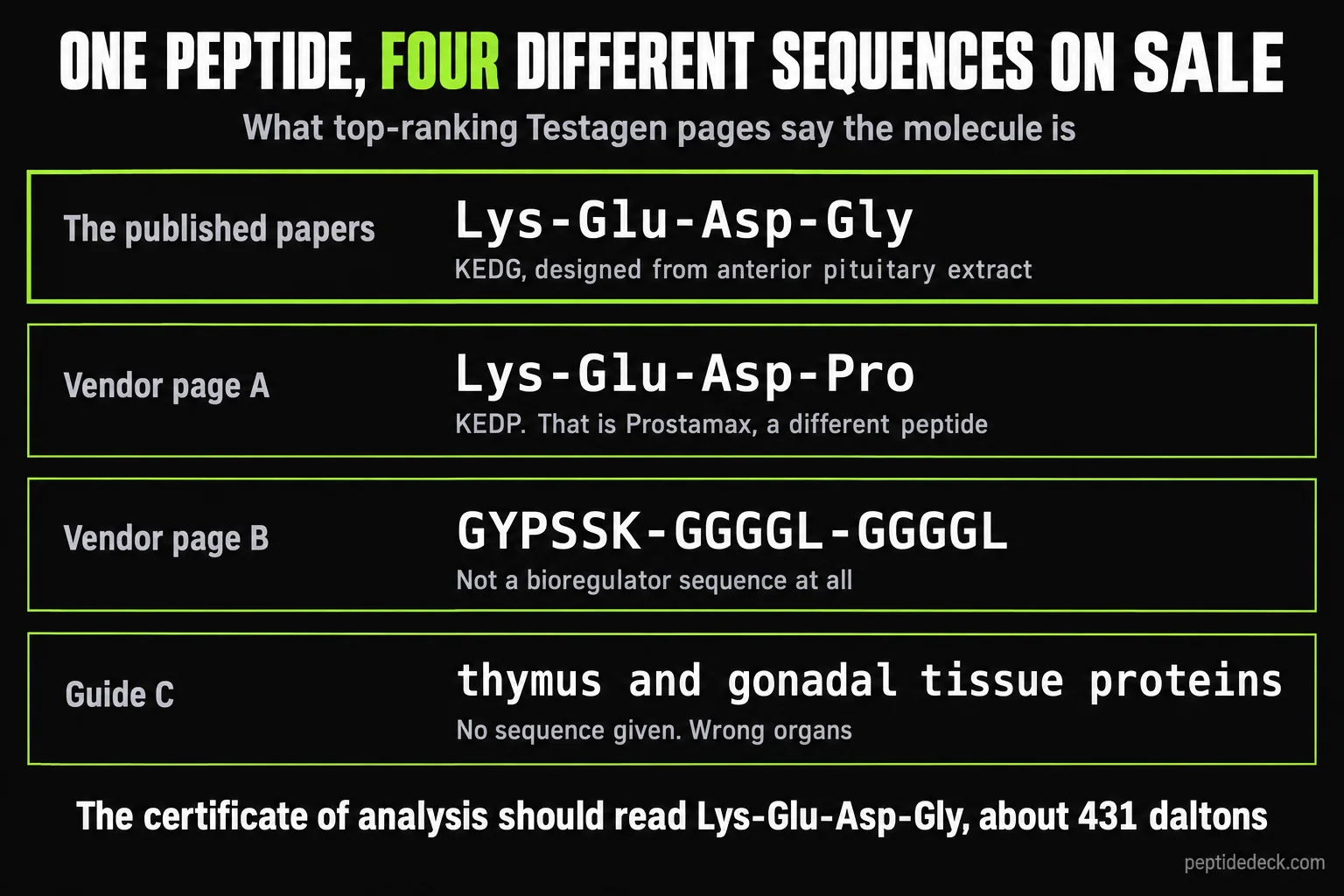
Among the ten pages ranking for this compound:
- One vendor prints the sequence as Lys-Glu-Asp-Pro. That is KEDP — Prostamax, the prostate bioregulator, a different peptide with a different single-letter code.
- One protocol site gives the sequence as "GYPSSK-GGGGL-GGGGL" in its compound profile and KEDG in its FAQ. The first is not a bioregulator sequence of any kind.
- One guide describes it as "derived from thymus and gonadal tissue proteins" and offers no sequence. It was derived from pituitary extract.
- Three pages give no sequence at all.
For a compound that is exactly four letters long, this is a remarkable error rate, and it has a practical consequence. If you order from a page that thinks it is selling KEDP, you have no way of knowing what is in the vial without a certificate of analysis showing the mass — Lys-Glu-Asp-Gly should come in near 431 daltons; KEDP is about 471.
Testagen Dosage: 100 Micrograms to 20 Milligrams
No published human dose exists. The guides supply six anyway.
- 100 to 300 micrograms a day, injected, titrated over 8 to 12 weeks
- 100 to 200 micrograms a day, injected, for 10 to 20 days a month
- 2 mg a day, injected, for 10 days
- 5 to 10 mg a day, oral or under the tongue, for 10 to 30 days
- 10 to 20 mg a day, for 20 to 30 days, repeated after one to two months
That is a 200-fold range. The lowest figures appear to reason from "ultrashort peptides are potent"; the highest divide a 20 mg vial into a plausible course. Neither traces to a measurement, because the only dosing in the literature is what was injected into hypophysectomised chickens for 40 days, which converts to a human dose exactly as well as it sounds.
To its credit, one vendor page in the top ten simply says "doses not precisely specified in available literature" and "dose-response relationships in mammals remain largely uncharacterized." That is the accurate statement, and this page adopts it.
What People Buy Testagen For, and What the Evidence Says
The buyer wants one thing. The studies measured another.
If your actual problem is low testosterone, the tested options are a blood test and a conversation about the treatments with decades of outcome data behind them. Our TRT hub covers what those involve. Testagen is not in that category, and the one product named Testagen that is — the gel — is a prescription drug, not this vial.
Side Effects and Safety
Unknown in mammals, let alone people.
No study has given Lys-Glu-Asp-Gly to a mammal and reported what happened, and there are no pharmacokinetic data by any route. The side effects on the top guides — injection-site redness, fatigue, headache, appetite change — are the generic list attached to every injectable peptide, not observations of this one. One protocol page lists erythrocytosis, raised liver enzymes and prostate effects as "serious concerns": those are the known risks of testosterone itself, apparently imported wholesale from the gel that shares the name.
Two points specific to this compound:
- The only measured effects are on the thyroid axis. In every study, the peptide raised TSH, T3 and T4 in birds missing a pituitary. Whether it does anything to a thyroid that has a pituitary is untested; anyone with a thyroid condition or on thyroid medication has a specific, evidence-based reason to involve a doctor that the "testosterone peptide" label would never suggest.
- The vial may not contain what the page says. With four different sequences in circulation for one product, a lot-matched certificate of analysis is the only way to know you have KEDG.
Testagen vs Epitalon: One Amino Acid Apart
They were designed together and tested side by side.
Testagen was built from the anterior pituitary and Epitalon from the posterior; they differ only in the first amino acid. In the chicken studies both restored thyroid function, and Testagen did more for the thymus. Beyond that the two records diverge completely: Epitalon went on to accumulate a large literature, including the melatonin and telomerase work that made it famous, while Testagen's record stopped at the bird studies and a corrosion paper. If you are choosing between them for a pineal or longevity purpose, Epitalon is the one with the evidence. If you want a testosterone peptide, neither has been tested for that. Our complete bioregulator guide ranks all twenty-five on this basis.
Buying Testagen: What to Check
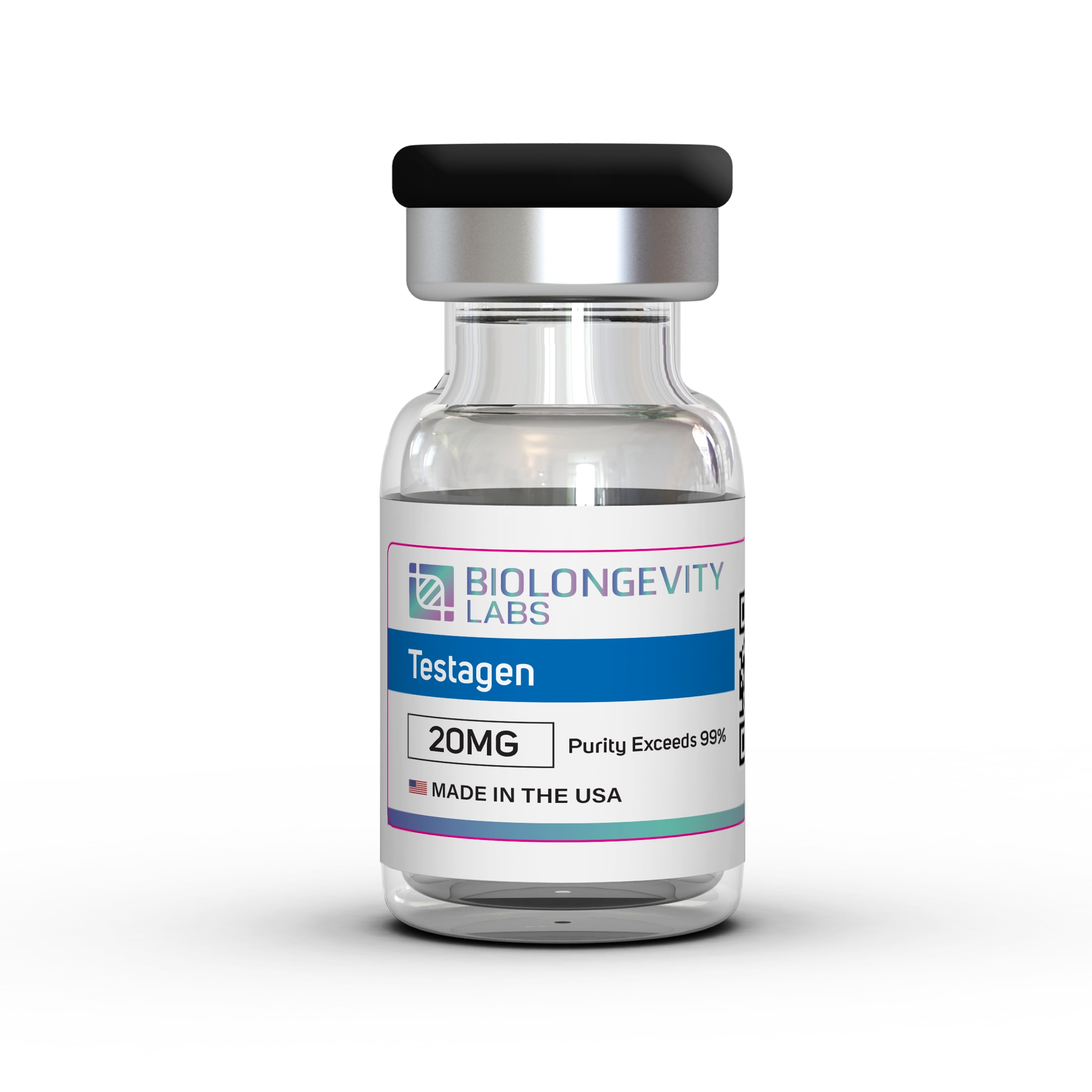
The standard listing is a 20 mg lyophilised vial, at prices I could verify from about $59 to $80.
- The sequence on the page. It should read Lys-Glu-Asp-Gly or KEDG. A page printing KEDP, a long string of letters, or "derived from gonadal tissue" has not checked the one fact that defines its product.
- A lot-matched certificate of analysis with the mass on it. Around 431 daltons for KEDG. How to read a peptide COA covers what a real one shows, and which independent labs' names should appear.
- What the page promises. "Boosts testosterone," "restores Leydig cells," "improves sperm" — no study has measured any of these. A vendor stating them as findings is describing evidence that does not exist.
For a wider view of who is worth ordering from, our peptide vendor comparison covers the sources we have checked directly.
The Bottom Line on Testagen Peptide
Testagen is a pituitary-derived peptide with a thyroid record, sold as a testosterone peptide with no testosterone record, under a name that also belongs to an actual testosterone drug.
The fair version: the five chicken studies are a coherent piece of work. A four-amino-acid fragment designed from anterior pituitary extract partially stood in for a missing pituitary, restoring thyroid hormones and thymus structure, consistently, across ages. That is a genuinely interesting result about what ultrashort peptides can do.
The equally fair version: it was never repeated in a mammal, never tested in a person, and never measured for the one hormone every buyer is paying for. The developers' own table leaves the male-reproductive claim uncited. The doses online span two orders of magnitude and the sequences span four molecules. If you buy it, you are buying the chicken thyroid result and a hypothesis — and you should know which is which.
Frequently Asked Questions
Medical disclaimer. This article is informational and does not replace individual medical advice. Testagen peptide has no approved medical use, no published study in mammals or people, and no pharmacokinetic data. Low testosterone, thyroid symptoms and fertility concerns need a proper diagnosis with blood tests; speak to a doctor before taking anything for them, and tell your doctor about any compound you are taking alongside prescription medication.