Getting up twice a night gets old fast.
So does the wait at the urinal, the stream that stops and starts, and the appointment where someone tells you your prostate is "a bit enlarged for your age, nothing to worry about yet." If you have started reading about prostate peptides, one of those things probably happened to you recently.
Prostamax peptide is the compound most of those searches land on. Before you order a vial, there are two things about it that no product page mentions, and both of them are on the public record.
🔑 Key Takeaways
- Prostamax is a synthetic four-amino-acid peptide, Lys-Glu-Asp-Pro, sold as the prostate member of the Khavinson bioregulator family.
- Published studies on it do exist. Almost all of them measured chromatin in white blood cells, not anything happening in a prostate.
- The clinical prostate evidence people cite when selling it belongs to a different product entirely — one given as a suppository, not an injection.
- In June 2026 the FDA sent a warning letter naming Prostamax by name. What triggered it is worth reading before you buy, and it is quoted below.
- The confident dosing charts circulating online are not derived from any published human protocol, because there isn't one.
- None of that makes it worthless. It does change what an honest expectation looks like.
Here is what is actually known, where the prostate data really comes from, and what the FDA said.
What Prostamax Peptide Is
Four amino acids: lysine, glutamic acid, aspartic acid, proline.
Written short, that is KEDP. Prostamax belongs to the short peptide bioregulators developed at the St Petersburg Institute of Bioregulation and Gerontology under Vladimir Khavinson, who died in 2024. The family assigns one peptide per organ — Epitalon to the pineal gland, Cartalax to cartilage, Pancragen to the pancreas — and Prostamax is the one assigned to the prostate.
The proposed mechanism is the same across the family: the peptide is small enough to reach the cell nucleus, where it is said to bind DNA and loosen tightly packed chromatin, letting genes that were switched off with age come back on. For Prostamax specifically, that is not a side note. It is essentially the whole published record.
What the Prostamax Studies Actually Measured
Not the prostate. That is the finding.
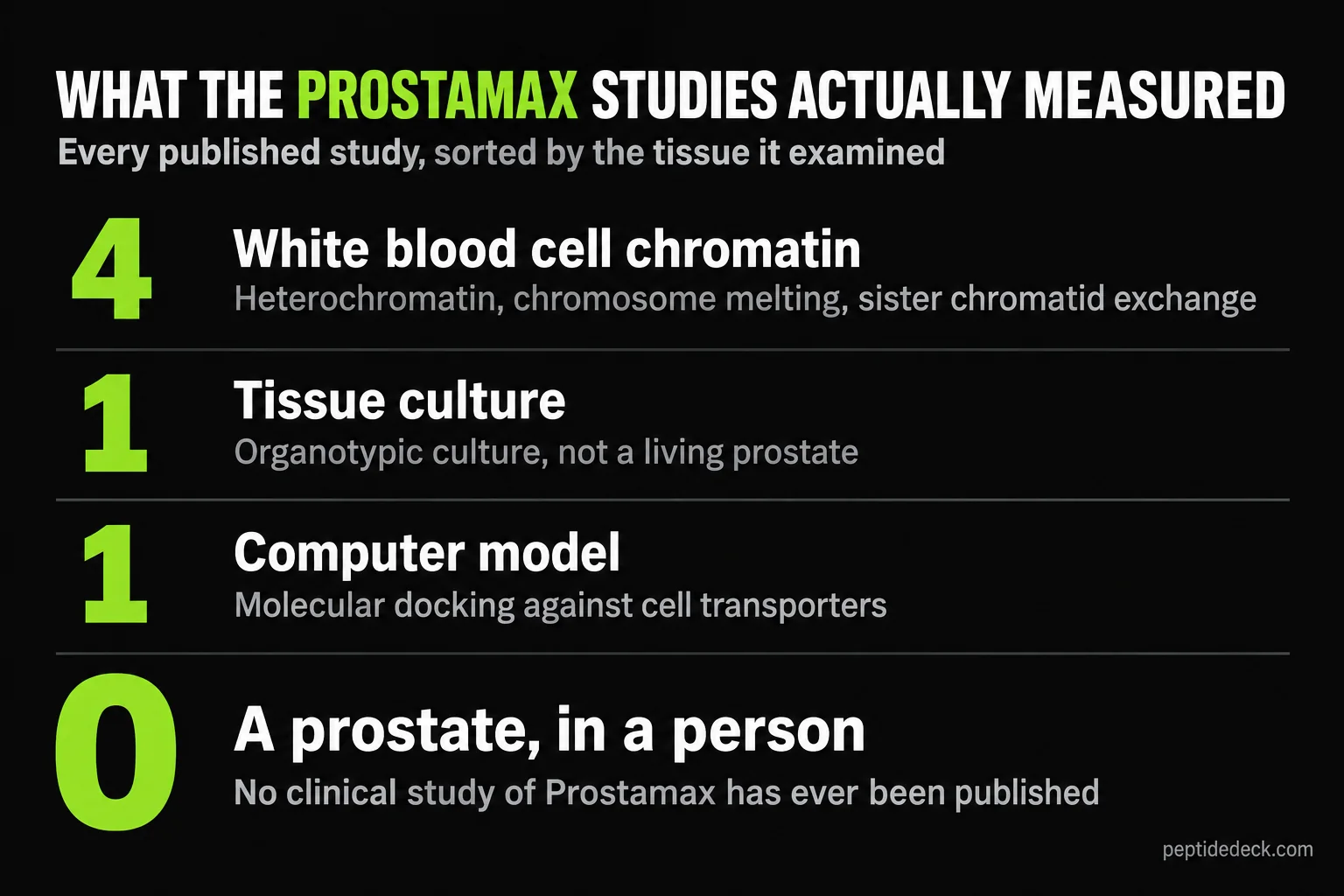
Search the literature for Prostamax and you get a handful of papers. Four of them examined chromatin in lymphocytes — white blood cells — taken from elderly donors. One looked at tissue culture. One is a computer model of how ultrashort peptides might cross cell transporters. None measured prostate volume, urinary flow, night-time urination, PSA or symptom scores in a person.
The chromatin work is real work. A 2005 paper from Khavinson's own group tested five peptides, Prostamax among them, on leukocytes from people aged 75 to 88, and reported activation of ribosome genes and loosening of densely packed chromatin. A 2012 study on cells from donors aged 75 to 86 found Prostamax increased Ag-positive nucleolar organiser regions from 0.95 to 2.5 per cell.
That same 2012 paper reported something else, and it deserves to be said plainly rather than buried: sister chromatid exchanges rose from 5.9 to 12.0 per cell. The authors read that as chromatin unpacking. It is also the measure toxicologists use as a marker of genomic instability, and nobody has followed it up in either direction. For a compound aimed at the prostate — an organ where the main clinical worry is uncontrolled cell growth — an unexplained doubling of that marker is a loose end, not a selling point.
Where the Prostate Evidence Actually Comes From
There is genuine clinical prostate data in this family. It belongs to a different product.
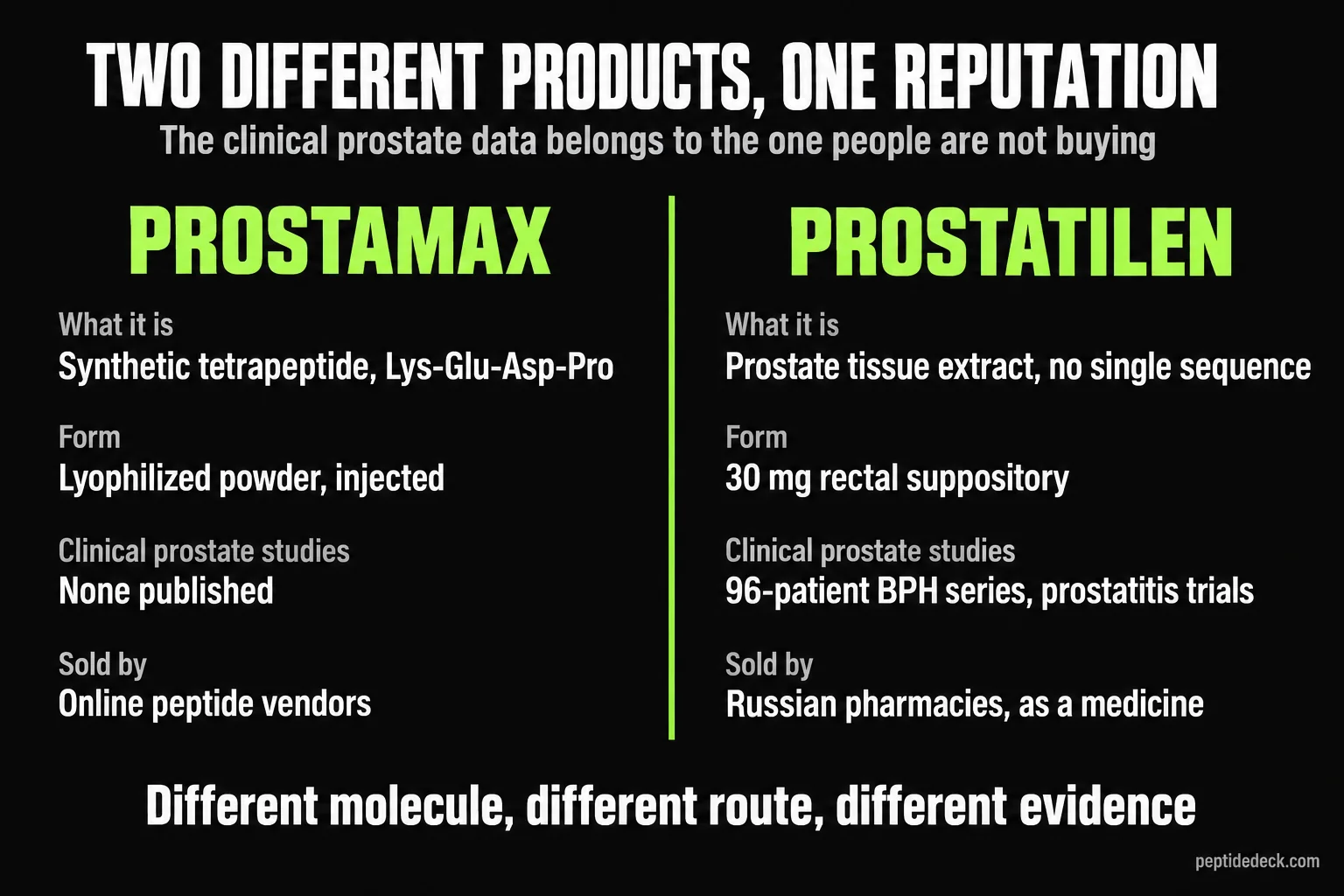
Prostatilen is a prostate tissue extract, not a defined sequence. It has been used in Russian urology for decades and it has the published record to match: a review of 96 men aged 51 to 89 with benign prostatic hyperplasia reported relief of obstructive symptoms, and a separate paper on repeated courses in prostatic adenoma reported reduced residual urine volume. There is prostatitis work alongside it.
Two details about that evidence matter enormously, and they are the two that get dropped when it is recycled into Prostamax marketing.
- It is a suppository, not an injection. The studied preparation is a 30 mg rectal suppository with dimexide, given in courses of fifteen. A vial of powder drawn into a syringe is not that.
- It is not the same molecule. Prostatilen is an extract of pooled tissue. Prostamax is one synthetic tetrapeptide. Evidence for a complex mixture is not evidence for one of the sequences somebody later designed.
There is also one properly designed trial in this corner of the family — a blind, randomised, placebo-controlled study in men aged 62 to 83 with benign prostatic hyperplasia, reporting improved urination that held for a month after treatment. It is not a Prostamax trial either. It tested Chitomur, a bladder bioregulator. The family can run a real trial when it wants to. It has not run one on this compound.
The FDA Warning Letter That Named Prostamax
On 17 June 2026, the FDA wrote to a Florida peptide seller.
The letter, reference number 729447, addressed to Wholesale Peptide of Brooksville, Florida, states that Prostamax is an unapproved new drug under section 505(a) of the Federal Food, Drug, and Cosmetic Act. What made it a drug, legally, was what the seller's own website claimed it did.
The claims the FDA quoted
"Prostamax reduces chronic inflammation in the prostate, swelling and vascular hyperemia."
"Research shows Prostamax can improve bladder control, reducing frequency and urgency of urination."
"Prostamax benefits BPH, for better daily living and comfort, and reducing the risk of complications."
Source: FDA warning letter 729447, 17 June 2026. The company was given fifteen business days to respond.
Read that carefully, because it is easy to over-read. The FDA did not test Prostamax and did not rule that it fails to work. It said that selling a substance while claiming it treats a disease makes that substance a drug, and this one has never been through the approval process that drugs go through.
What is useful for you is narrower and more practical: the three sentences above are almost exactly the benefit claims you will read on other pages selling this peptide. The agency has now put in writing that "research shows Prostamax can improve bladder control" is a claim it treats as a drug claim. As this article has already covered, the research it points to does not exist in the form that sentence implies.
Prostamax Dosage: What Actually Exists
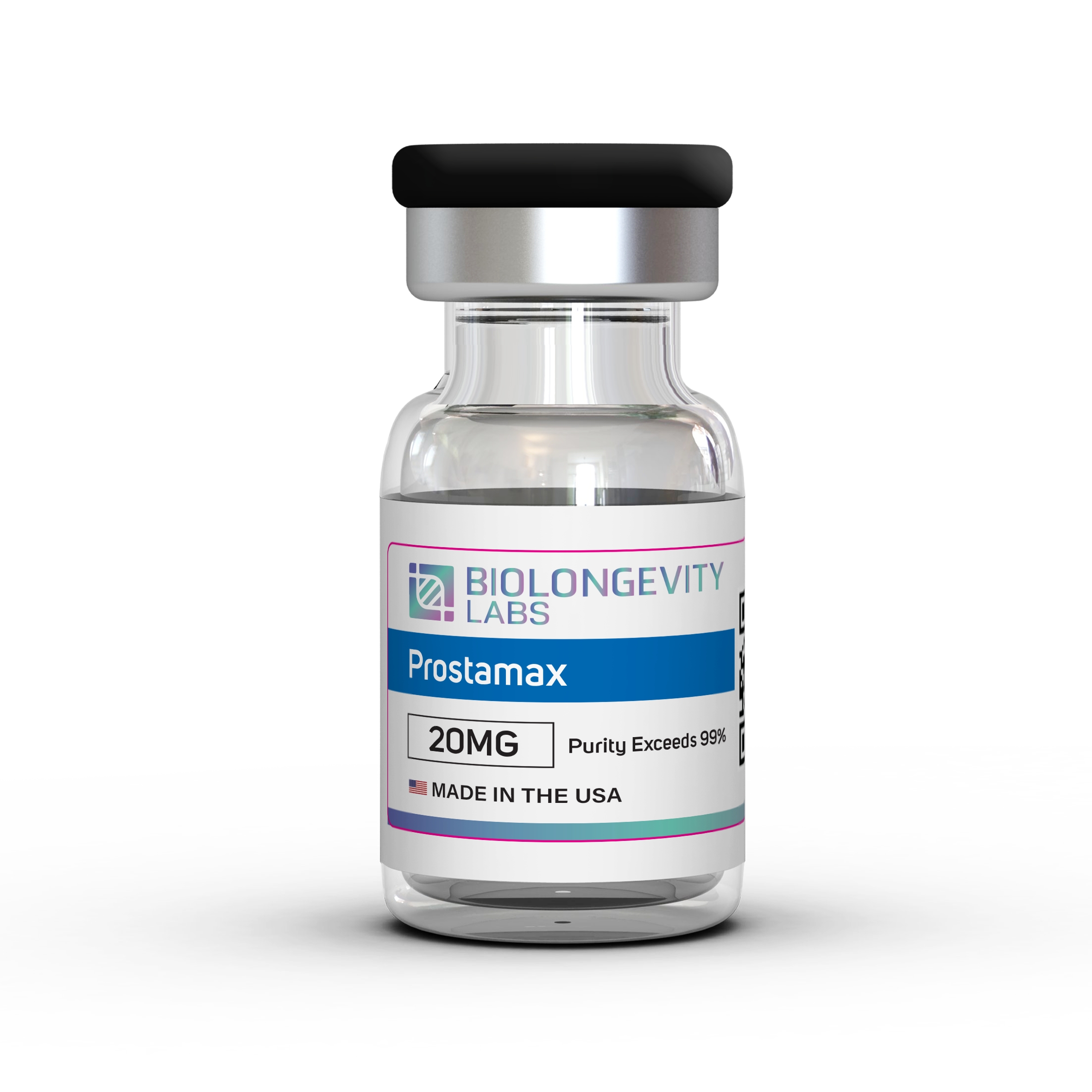
No published human protocol. None.
That is an uncomfortable thing to write on a page that ranks for dosage, so here is the situation precisely. The Prostamax studies were done on cells in dishes, where the dose is a concentration in culture medium rather than milligrams a day in a person. No study has given Prostamax to a human being and published what happened. There is therefore no protocol to report and nothing to convert.
The dosing charts you will find elsewhere — tiers, cycle lengths, reconstitution tables for the 20 mg vial — were not derived from any of that. They follow the general shape of the Khavinson capsule protocols used across the family: short courses of ten to twenty days, repeated two or three times a year. The shape has some basis in how these products were used. The milligram numbers attached to it are the vial size divided into portions that seem reasonable.
The honest summary is that the whole family's dosing is built on the same footing. Our bioregulator peptide guide works through where each compound's numbers came from, and Prostamax is at the thin end of that range rather than the thick one.
Side Effects and Safety
Unmeasured, which is different from clean.
No safety study of Prostamax in people has been published. There is no adverse event reporting, no dose-ranging work, no long-term follow-up, and no pharmacokinetic data by any route — nobody has published what blood level a dose produces, how long it lasts, or how it clears.
Two things belong on a prostate-specific page:
- Symptoms you feel are not the same as the thing causing them. Urinary symptoms in men over 50 are usually benign prostatic hyperplasia, but the same symptoms can come from infection, bladder problems or prostate cancer. Anything that softens symptoms while the cause goes unexamined has bought you comfort and cost you time. A PSA test and an examination come first, in that order, before any peptide.
- The chromatin finding above is unresolved. A doubling of sister chromatid exchanges was reported and never followed up. In an organ where cell proliferation is the central clinical concern, that is worth knowing even though nobody has shown it means harm.
Prostamax vs the Things That Have Been Tested
For an enlarged prostate specifically, medicine already has drugs with decades of outcome data.
That is not an argument that peptides are pointless. It is an argument about order of operations. If nocturnal trips to the bathroom are the problem you actually want solved, the tested options are one appointment away, and they can be run alongside anything else you decide to try.
Buying Prostamax: What to Check
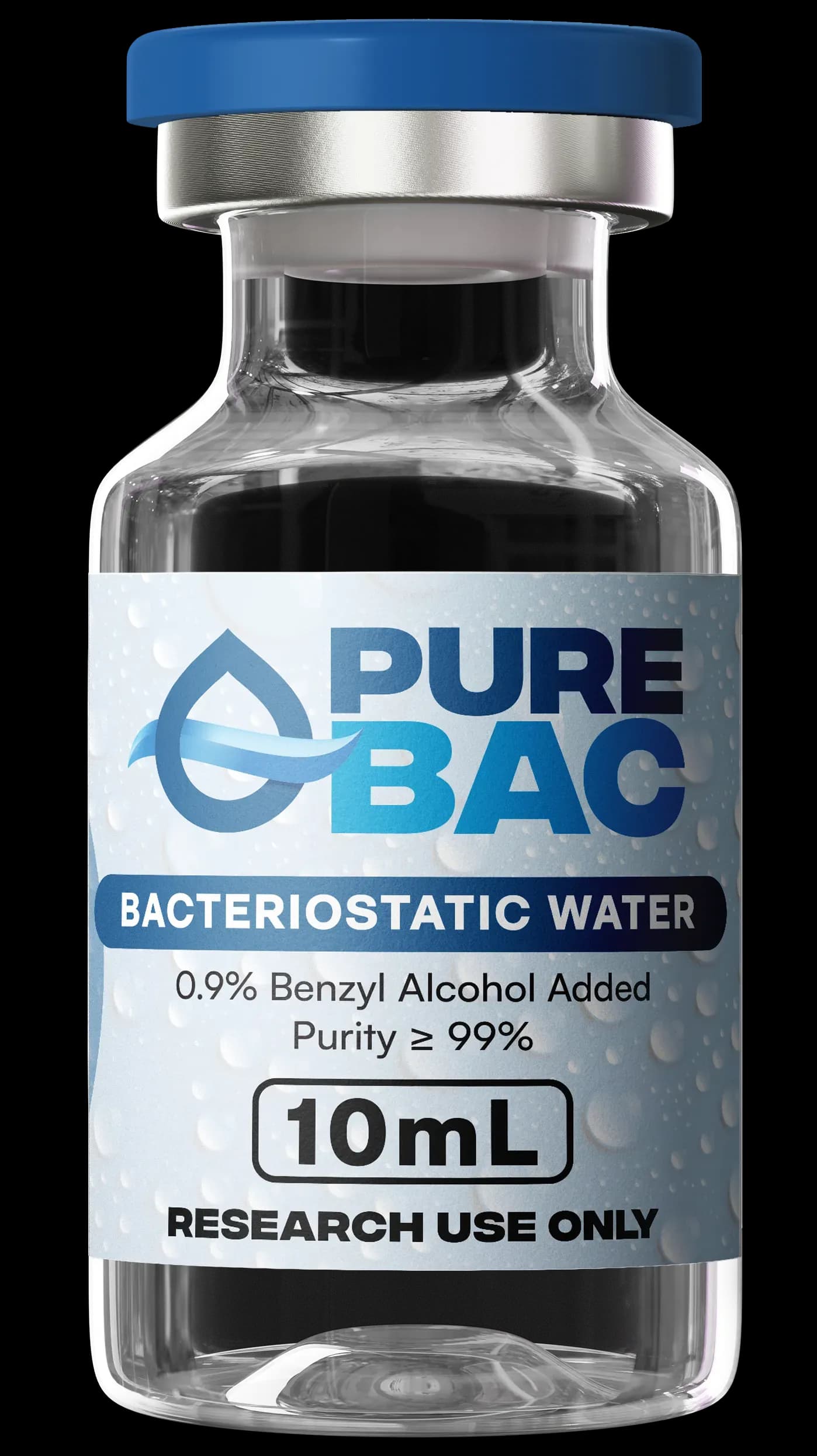
The standard listing is a 20 mg lyophilised vial. The one price I could verify at the time of writing was $79.97.
If you are buying anyway, the checks that matter here are slightly different from other peptides:
- A lot-matched certificate of analysis. The certificate for the batch number on your vial, not a catalogue sample. How to read a peptide COA covers what a real one shows.
- The sequence on that certificate. It should read Lys-Glu-Asp-Pro. KEDP sits one amino acid away from several other bioregulators in this family, and the abbreviations are easy to transpose.
- What the vendor's own page claims. This is the unusual one. A seller writing that the compound treats BPH or reduces prostate inflammation is making exactly the claims that drew an FDA warning letter in June. It tells you something about how carefully that vendor reads its own liability, never mind its science.
Our peptide vendor comparison covers the sources we have checked directly.
The Bottom Line on Prostamax Peptide
Prostamax is a real molecule with a real, narrow body of published work that is almost entirely about white blood cells.
The prostate reputation it carries was borrowed from Prostatilen, a different preparation in a different form, and the confident dosing charts were reverse-engineered from a vial size. In June 2026 the FDA put the marketing claims in writing as drug claims. Anyone selling you certainty about this compound is selling something they do not have.
If you want the fair version: the chromatin work is genuine and the loosening effect reported across this family is interesting enough that people keep studying it. What does not exist yet is any published evidence that it does the specific thing men buy it for. Until someone measures a prostate, that gap is the whole story.
Frequently Asked Questions
Medical disclaimer. This article is informational and does not replace individual medical advice. Prostamax has no approved medical use, no published clinical study in people, and no pharmacokinetic data. Urinary and prostate symptoms need a proper diagnosis: see a doctor for an examination and a PSA test before treating them with anything, and tell them about any compound you are taking or considering.