
Most joint compounds work by quieting inflammation. Cartalax operates at a different level. It is one of the few peptides studied for telling cartilage cells to behave young again, by switching gene expression rather than masking pain.
🔑 Key Takeaways
- Cartalax is a short peptide bioregulator (sequence Ala-Glu-Asp, often shortened to AED) developed by the Khavinson school in St. Petersburg.
- It is positioned as a cartilage-specific bioregulator, sister to Vesugen (vascular), Cardiogen (cardiac), Pinealon (brain), and Epitalon (pineal/longevity).
- The proposed mechanism is epigenetic: Cartalax binds DNA in chondrocytes and modulates expression of genes involved in collagen II synthesis, proteoglycan production, and matrix metalloproteinase regulation.
- The bulk of the supporting evidence is Russian observational data and animal studies. Western peer-reviewed clinical trials are essentially absent.
- Standard community dosing is 1 to 2 mg per day subcutaneous, or 10 to 20 mg per day oral, in 10 to 20 day cycles, 2 to 3 times per year.
- Side effects across 40 years of Russian clinical use are described as mild and rare, mostly injection-site reactions. There are no large human safety datasets in Western literature.
- It is most often stacked with BPC-157 or TB-500 for joint and connective tissue work, where Cartalax targets the cartilage matrix and the others handle systemic healing.
- The honest framing: this is a low-side-effect, plausible-mechanism peptide with a long Russian clinical track record and almost no Western validation.
This page is the full reference on Cartalax. What it is, where it came from, how the bioregulator mechanism actually works, what the dosing protocols look like, how it stacks with BPC-157 and TB-500, who should consider it, and where the evidence is solid versus where it is just tradition.
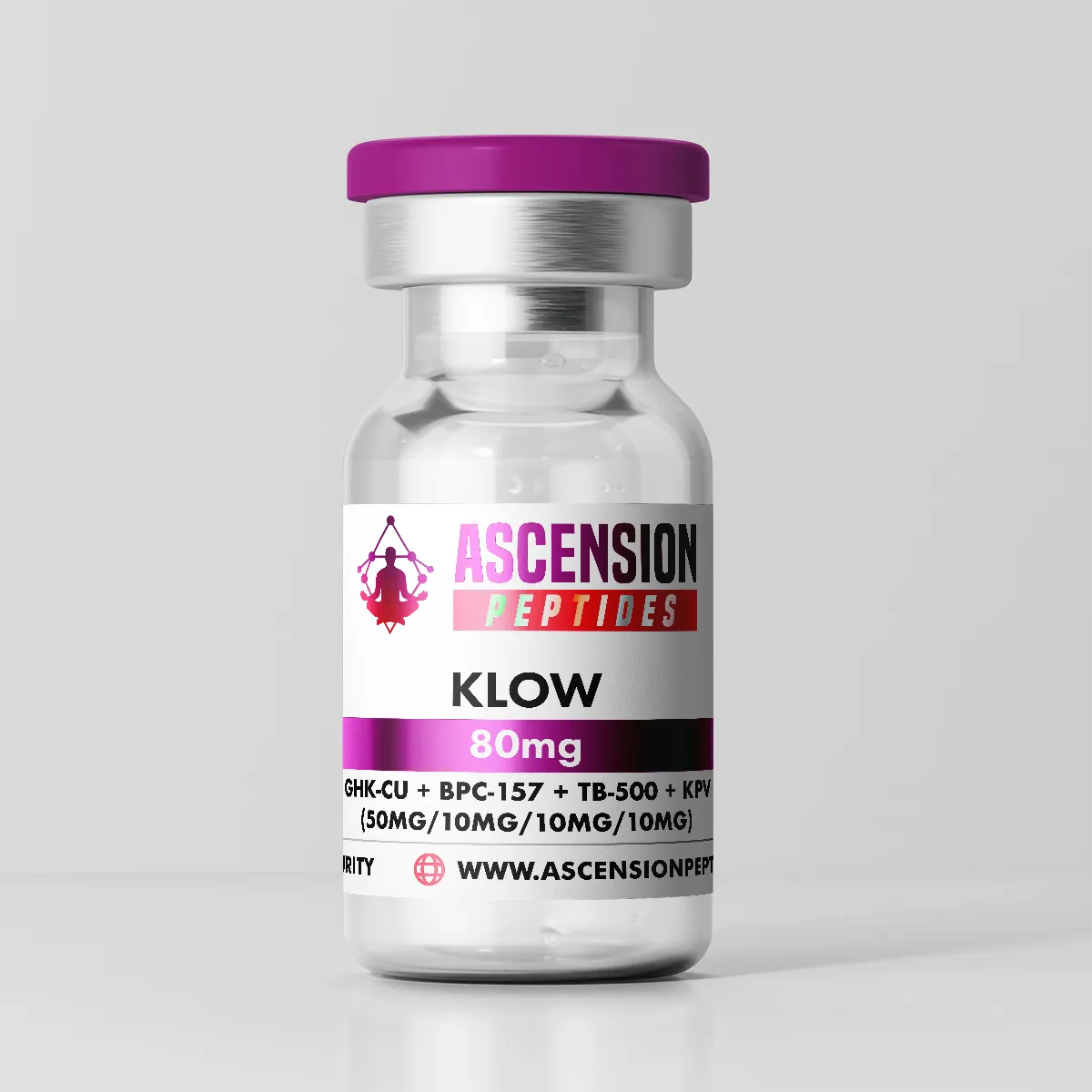
Cartalax targets the cartilage matrix; the connective-tissue side of the same job is BPC-157 and TB-500, both of which sit in Ascension's KLOW blend.
What Is Cartalax?
A three-amino-acid peptide bioregulator.
Cartalax is a short synthetic peptide with the sequence alanine-glutamic acid-aspartic acid (Ala-Glu-Asp), commonly written as AED. Some vendor literature mislabels it as AEDG or KEDG, which are different Khavinson peptides (Epitalon and Testagen). It belongs to a family of "short peptide bioregulators" developed at the St. Petersburg Institute of Bioregulation and Gerontology under Professor Vladimir Khavinson, beginning in the 1980s and continuing into the present.
Cartalax at a Glance
- Sequence: Ala-Glu-Asp (AED)
- Class: Short peptide bioregulator (Khavinson family)
- Target tissue: Cartilage and connective tissue
- Sister bioregulators: Vesugen (vascular), Cardiogen (cardiac), Pinealon (CNS), Epitalon (pineal/longevity), Vilon (immune)
- Estimated half-life: Approximately 30 minutes (short, like most short peptides)
- Origin: St. Petersburg Institute of Bioregulation and Gerontology, Khavinson lab
- Clinical use: Approximately 40 years in Russia and select Eastern European markets. Not approved in the US or EU
- Forms available: Injectable (lyophilized vial, reconstituted), oral capsules
The Khavinson bioregulator concept is unusual in Western pharmacology. The premise is that very short peptides, three to six amino acids, can pass into cells and into the nucleus, where they bind specific DNA sequences and modulate transcription. Unlike a typical signaling peptide that binds a surface receptor, a bioregulator works at the gene-expression level. Cartalax, in this framework, is the bioregulator assigned to cartilage tissue.
How Cartalax Works
The mechanism is gene expression, not pain blocking.
The proposed model, supported by in vitro work from the Khavinson group and a smaller body of Western chondrocyte studies, is that Cartalax enters cartilage cells (chondrocytes), reaches the nucleus, and binds short DNA promoter sequences that govern cartilage-specific genes. The downstream effects include:
- Increased collagen type II synthesis, the main structural collagen of articular cartilage
- Increased proteoglycan production, the molecules that give cartilage its compressive strength
- Reduced matrix metalloproteinase 9 (MMP-9) activity, which slows the enzymatic breakdown of the cartilage matrix
- Reduced expression of cellular senescence markers (p16, p21, p53) in chondrocyte populations
- Increased fibroblast proliferation, supporting the surrounding connective tissue
If you compare this to how a typical joint supplement works (glucosamine, chondroitin, hyaluronic acid), the difference is structural. Those supplements provide raw material or lubrication. Cartalax is proposed to change what cartilage cells are doing at the gene level. That is a bigger claim, with thinner Western evidence to support it.
What is genuinely supported and what is bridge logic
The in vitro chondrocyte data showing collagen II upregulation is real. The senescence marker reductions in chondrocytes are real. The Russian observational data on osteoarthritis pain reduction (often cited around 20 to 40%) is real, but observational and not blinded. The leap from "improves cartilage cell behavior in a dish" to "regrows cartilage in a human knee" is bridge logic. It is plausible. It is not demonstrated.
Cartalax Benefits
What the available evidence suggests it does.
Cartilage repair and joint maintenance
The core use case. In Russian clinical observational data, Cartalax cycles in patients with osteoarthritis correlated with reductions in joint pain scores, improvements in range of motion, and reduced reliance on NSAIDs. Effect sizes around 20 to 40% pain reduction over a 10 to 20 day cycle are commonly cited. These are observational, not randomized trial results.
Post-surgical recovery
Cartalax cycles are used as part of recovery protocols after ACL reconstruction, meniscus repair, and rotator cuff surgery. The logic is that connective tissue healing is rate-limited by collagen synthesis and matrix turnover, and Cartalax supports both. Real outcome data from Western surgical centers does not exist.
Connective tissue health
Beyond cartilage, the fibroblast proliferation effect supports tendon and ligament tissue more broadly. This is why Cartalax is sometimes stacked with TB-500 for athletes recovering from chronic tendinopathy or ligament strain.
Cellular aging in cartilage
The reduction in senescence markers (p16, p21) is one of the more interesting mechanistic findings. Cartilage degeneration with age is partly driven by chondrocyte senescence, where cells stop dividing and start producing inflammatory signals. Cartalax appears to slow this in chondrocyte cultures.
What is overstated
Some online sources claim Cartalax regrows cartilage after osteoarthritis has destroyed it, or replaces joint replacement surgery, or is "the Russian alternative to stem cells." None of those claims are supported by the actual evidence. The evidence supports a slower-decline, modestly-improved-function picture, not a regenerative miracle.
Cartalax Dosage
The community protocols converge on a narrow range.
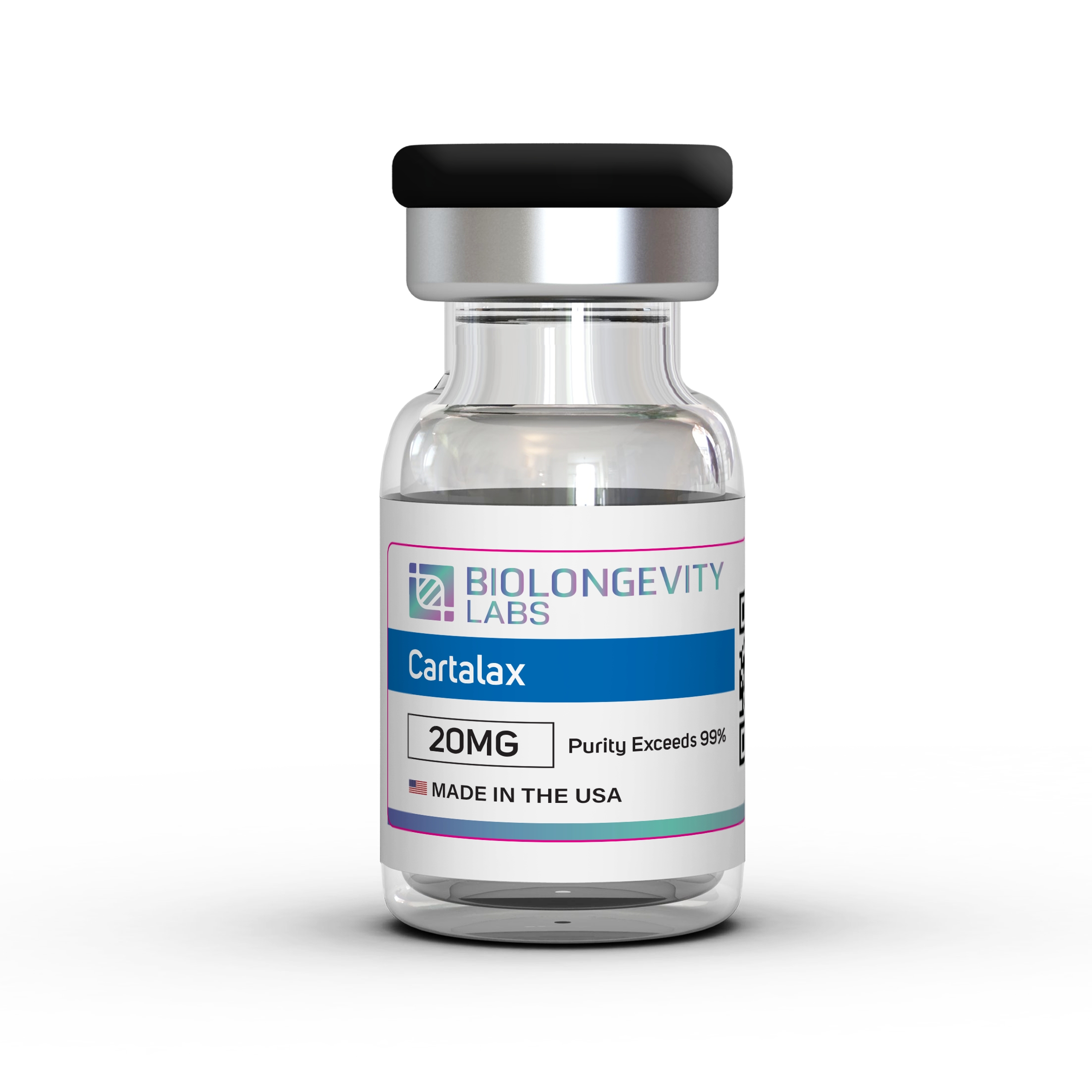
Cartalax is sold as either a lyophilized injectable powder (10 to 20 mg vials) or as oral capsules (5 to 10 mg per capsule). Both forms are used in cycles rather than continuously, consistent with Khavinson protocols that emphasize "pulse" rather than "chronic" dosing.
Body weight adjustments
Some protocols adjust dose by body weight, others do not. The body-weight-adjusted version looks like this:
- Under 70 kg (155 lb): 1.0 to 1.5 mg injectable per day
- 70 to 90 kg (155 to 200 lb): 1.5 to 2.0 mg injectable per day
- Over 90 kg (200 lb): 2.0 to 2.5 mg injectable per day
Reconstitution
For a 20 mg vial: add 3 mL bacteriostatic water for a final concentration of approximately 6.7 mg per mL. On a U-100 insulin syringe, 15 units (0.15 mL) delivers 1 mg. Refrigerate after reconstitution and use within 30 days.
Cycle, do not chronically dose
Khavinson protocols are explicit on this point. Bioregulators are designed to "remind" tissue of its young gene-expression program, then withdraw to let the tissue continue on its own. Continuous daily use for months is not how the protocol was developed and is not what the long-term safety data covers.
Cartalax Side Effects
The 40-year track record is the main reassurance, with caveats.
Across the Khavinson bioregulator family, side effects in Russian clinical use are described as minimal. Cartalax specifically has the same profile: rare injection-site reactions, occasional mild fatigue in the first few days, occasional mild GI upset with the oral form. Hormonal effects, blood pressure changes, and significant lab abnormalities are not reported in the available literature.
The honest caveats:
- Western safety data is essentially zero. The 40-year track record is real, but it is observational, in a different healthcare system, with different populations, and not blinded.
- Drug interactions have not been systematically studied, particularly with NSAIDs, corticosteroids, and immunosuppressants which are common in the same patient population.
- Pregnancy and nursing data does not exist. The Khavinson literature does not cover this population. Avoid in pregnancy or while nursing.
- Long-term continuous use safety is unknown because the protocol does not call for it.
Cartalax vs BPC-157, TB-500, and Hyaluronic Acid
Each works on a different layer of the joint problem.
The most useful framing: Cartalax is the cartilage-cell compound, BPC-157 is the acute healing compound, TB-500 is the connective tissue compound, and hyaluronic acid is the lubrication compound. They address different layers of the same joint, and they are not interchangeable.

Cartalax Stacks
The two stacks worth knowing.
The most common community stack is Cartalax plus BPC-157 plus TB-500, often as part of the broader healing stack with KPV and GHK-Cu. The logic: Cartalax handles the cartilage matrix, BPC-157 handles vascular and growth factor support, and TB-500 handles cell migration and connective tissue. This is the "comprehensive joint" version.
The bioregulator stack pairs Cartalax with other Khavinson peptides (Vesugen for vascular, Cardiogen for cardiac, Epitalon for systemic). Within Khavinson protocols, the stack is built by tissue rather than by goal: every aging tissue gets its bioregulator on a rotation. This is the "Russian longevity" version.
Where to Buy Cartalax
Sourcing is where this one is decided, so it is worth knowing exactly what to check.
Cartalax is not made by Pfizer. It is not made by Eli Lilly. The vendor landscape is mostly small-batch suppliers, some of whom rebottle bulk Russian or Chinese material, and a few who synthesize in-house. Quality control varies dramatically. What to verify:
- Purity report showing 98% or higher by HPLC, dated within 12 months
- Mass spectrometry confirming the 3-amino-acid sequence (M+H around 334 for AED)
- Sterility report for the lyophilized injectable form
- Sourcing transparency on whether the peptide is synthesized in-house or rebottled
For broader sourcing standards, see our peptide vendor guide and how to read a peptide COA.
Frequently Asked Questions
Medical disclaimer. This article is informational only and does not replace individualized medical advice. Cartalax is not approved by the FDA for any human use in the United States. The supporting evidence comes largely from Russian clinical observational data and in vitro studies. Anyone considering use, especially in the context of post-surgical recovery, ongoing osteoarthritis treatment, or other prescribed therapies, should speak with a qualified healthcare provider.