Your pancreas does not take requests.
It works quietly for decades, then starts slipping — and by the time a fasting glucose reading looks wrong, the slipping has been going on for years. If you are reading about Pancragen peptide, you already know that. You have probably also noticed that every page selling one says roughly the same thing in roughly the same order.
This one is different in a specific way. I pulled the actual studies behind Pancragen peptide, checked the doses they used, and compared them to what the vials on sale actually contain. The two numbers are not close.
🔑 Key Takeaways
- Pancragen is a four-amino-acid peptide, Lys-Glu-Asp-Trp, built for the pancreas by the Khavinson group in St Petersburg. It was designed from a sequence pattern rather than isolated from tissue.
- There is real published work behind it, and it is smaller than the marketing suggests: a handful of lab-model papers, two monkey studies, one cell-culture paper, and a single human study in 33 people with type 2 diabetes.
- The published dose is measured in micrograms. The vials on sale hold 20 milligrams. That gap is the single most important thing on this page.
- The molecule in the studies was the amidated form, KEDW-NH₂, protected against gut enzymes. What vendors ship is usually the plain free acid, which is not the same compound.
- In the only head-to-head test, an ordinary diabetes tablet lowered glucose harder than Pancragen did — which tells you what tier this sits in.
- Nobody has ever run a registered clinical trial on it. What that means for you depends entirely on what you were hoping it would replace.
Here is what the evidence actually says, in the order it was published, and what changes once you compare it against the vial in your hand.
What Pancragen Peptide Actually Is
Four amino acids. That is the whole molecule.
Pancragen is lysine-glutamic acid-aspartic acid-tryptophan, written KEDW, and it belongs to the family of short peptide bioregulators developed at the St Petersburg Institute of Bioregulation and Gerontology under Vladimir Khavinson, who died in 2024. Each compound in that family is assigned to one organ. Pancragen is the one assigned to the pancreas.
The origin story matters more than vendors let on. KEDW was not found in the pancreas and then studied. A 2006 paper describes the actual method: the group compared the amino acid sequences of insulin-releasing polypeptides, spotted a four-residue fragment they all shared, and synthesised it in a form protected against the enzymes in the gut. The peptide was designed, then tested. That is the same pattern as Epitalon, and it is worth knowing before you read a product page describing KEDW as a natural pancreatic peptide.
There are two pancreas products in this family and people mix them up constantly. Suprefort is a peptide extract taken from pancreatic tissue, sold in capsules, with no single defined sequence. Pancragen is the synthetic four-amino-acid stand-in for it. Same shelf, same marketing, different substance — and only one of them has the study list below.
What the Research Actually Shows
Less than the headlines, more than nothing.
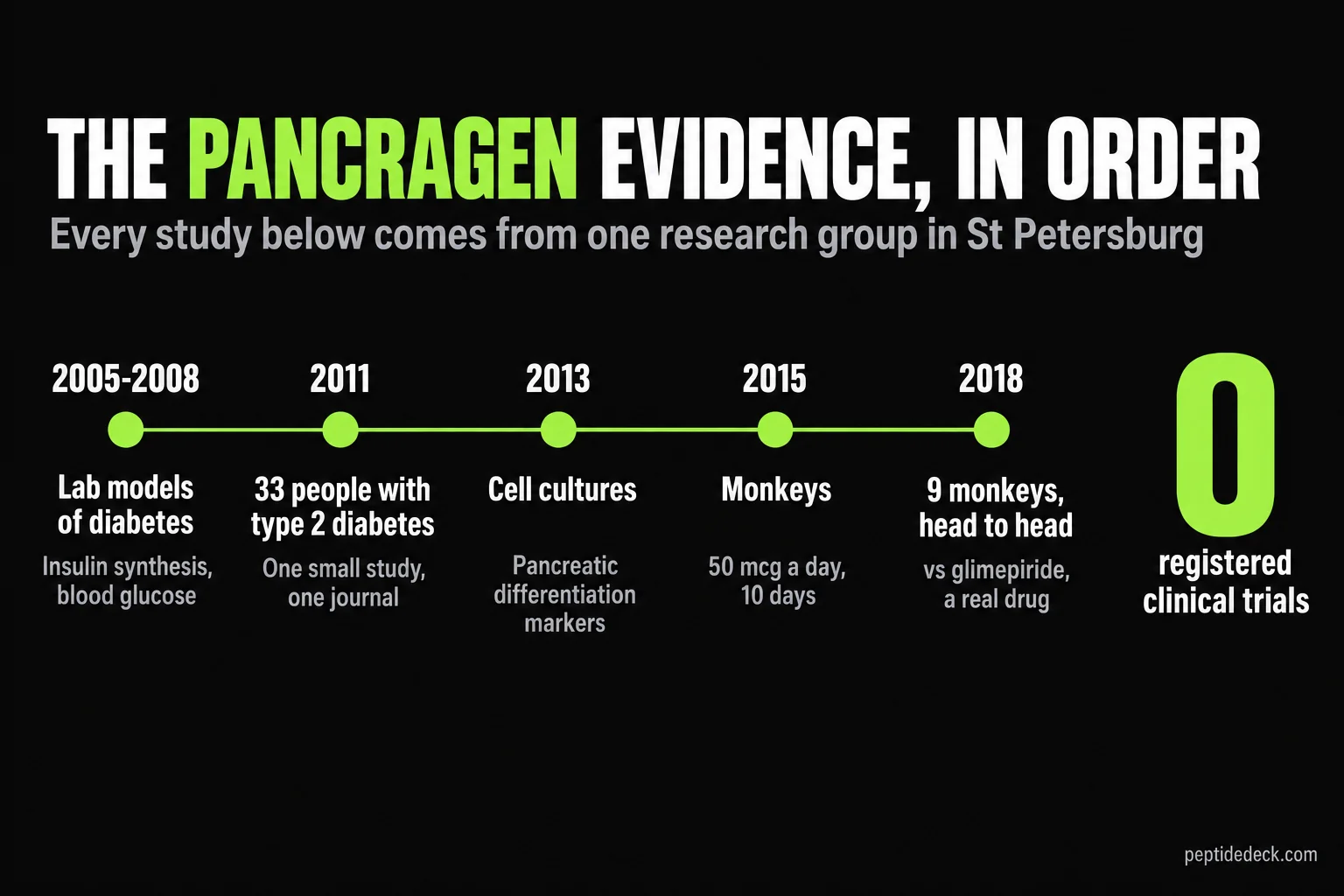
Every study below comes from the same institute. That is not automatically damning, but it does mean nobody outside the group that invented the compound has confirmed any of this.
The lab-model work, 2005 to 2008
The earliest papers used induced diabetes in lab models. A 2006 study reported that the peptide partially restored insulin synthesis, with the shape of the sugar curve coming back toward normal. The proposed mechanism was oddly specific: the authors suggested the peptide activates the promoter region of the preproinsulin gene by binding complementary nucleotide sequences.
A 2008 paper added a detail almost nobody quotes. Given by mouth, the peptide produced a pronounced glucose-lowering effect during treatment. Given by injection, it did not change capillary permeability but did normalise the stickiness of capillary lining cells. Different routes, different effects — which is inconvenient for any page that tells you the route does not matter.
The cell work, 2013
In aging pancreatic cell cultures, markers of cell identity fade. A 2013 paper reported that Pancragen pushed several of them back up — Pdx1 and Ptf1a in the enzyme-producing cells, and Pdx1, Pax6, Pax4, Foxa2 and Nkx2.2 in the islet cells. This is the paper behind every "supports beta cell differentiation" claim you will read. It is cell cultures, and the authors say so.
The monkeys, 2015 and 2018
This is the strongest work in the file, and it is small.
Old female rhesus monkeys received 50 micrograms a day by intramuscular injection for 10 days. Glucose cleared faster afterwards, insulin and C-peptide responses normalised, and part of the effect was still measurable three weeks after the last injection. That last detail is genuinely interesting: a ten-day course that outlasts itself by three weeks does not behave like a drug that simply lowers glucose while it is present.
Then, in a follow-up, nine old monkeys were split: five on Pancragen at the same dose, four on glimepiride, a standard diabetes tablet. Both lowered fasting glucose. But the tablet produced the stronger and longer glucose-lowering effect. Pancragen's edge, if it had one, was in normalising the insulin and C-peptide pattern rather than in dropping the number.
The human study, 2011
One study. Thirty-three people with type 2 diabetes, plus 30 healthy older adults for comparison.
The finding that the authors led with was not about glucose at all: nocturnal melatonin production was 70% lower in the diabetes group than in healthy people of the same age. In the group given Pancragen, fasting glucose fell, glucose on the tolerance test fell, and both insulin levels and the insulin resistance index came down. The people who did not receive it showed no change.
That reads well. Now the part that belongs next to it: the abstract describes no randomisation, no blinding and no placebo, the work was published in a single journal by the group that developed the compound, and the dose is not stated in the abstract. This is the sum total of human evidence for Pancragen. One study, 33 people, never replicated by anyone else.
The number that puts it in context: a search of the global clinical trials registry returns zero registered trials for Pancragen or KEDW. Not zero completed, not zero published — zero ever registered, in any country, for any indication.
The Gap Between What Was Studied and What Is Sold
This is the part no product page shows you.
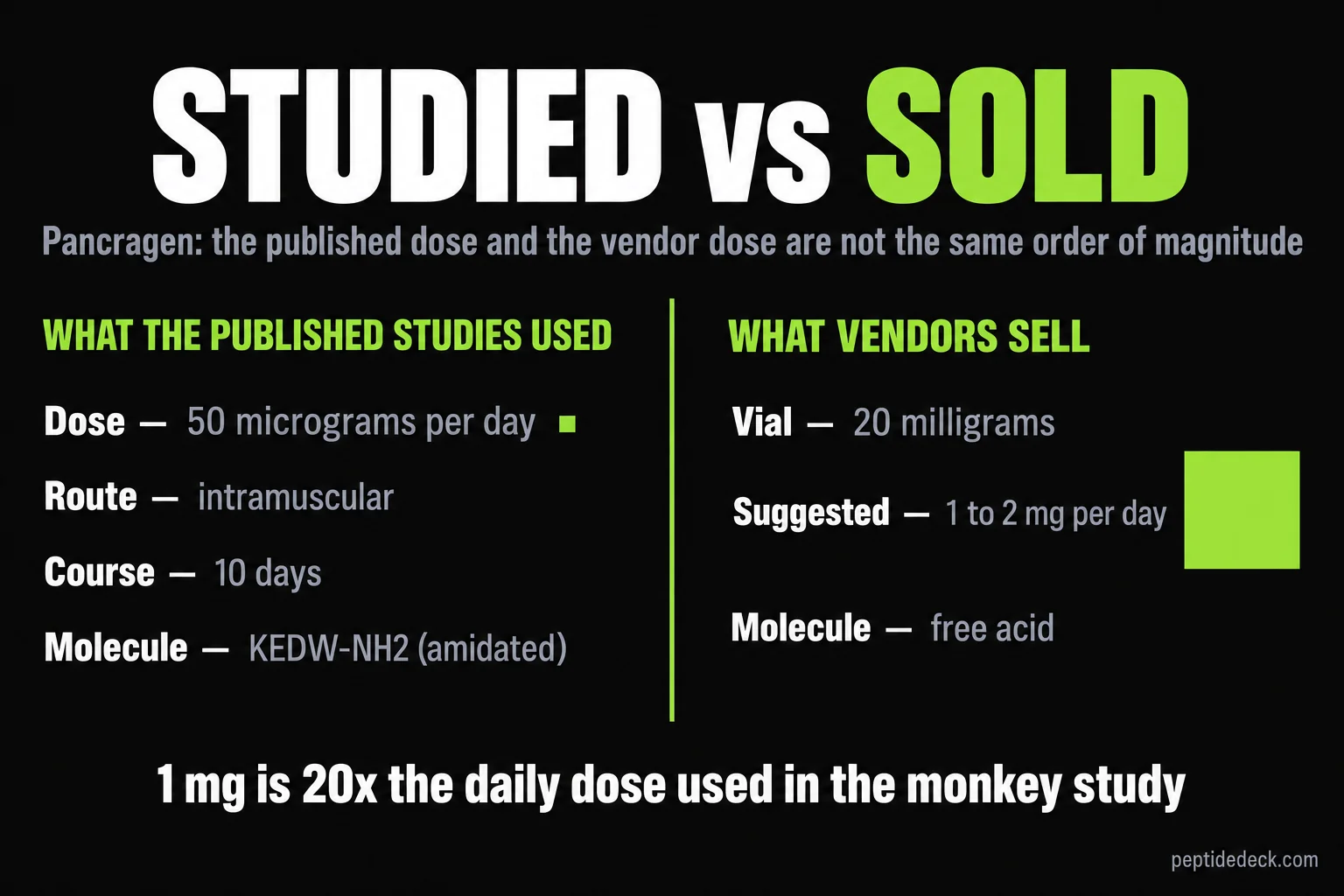
The monkeys got 50 micrograms a day. Vendors sell 20 milligram vials, and the dosing pages that circulate suggest 1 to 2 milligrams a day. One milligram is twenty times the daily dose given to a monkey, before you adjust for the fact that a rhesus monkey weighs a fraction of what you do.
Nobody has published what 1 to 2 milligrams of KEDW does in a person, because nobody has given it. The dosing numbers on aggregator sites did not come from the literature. They came from the vial size.
The second gap is the molecule itself. The studies used Lys-Glu-Asp-Trp-NH₂ — the amidated form, capped at one end specifically to survive digestive enzymes. Vendors generally ship the free acid. Those are two different compounds with the same four-letter abbreviation, and a certificate of analysis confirming "KEDW" does not distinguish them unless the mass is checked.
None of this makes Pancragen useless. It does mean the honest description of anyone using a 20 mg vial today is that they are doing something nobody has studied, guided by numbers nobody measured.
What People Use Pancragen For, and What Is Established
Start with what people want from it.
The searches that bring people to this compound are about blood sugar creeping up, an A1c that moved the wrong way, a pancreas flagged on a scan, or the general sense that metabolism is not what it was at 35. Those are real problems and they deserve a straight answer about what this peptide can and cannot touch.
If your blood sugar is genuinely out of range, the compound with a 68-week outcome trial behind it is a GLP-1 medication, and the cheap generic with sixty years of data is metformin — which we compared against a peptide alternative in MOTS-c vs metformin. Pancragen is not in that category and does not pretend to be in the literature. It only pretends to be there on product pages.
Pancragen Dosage: What the Literature Used
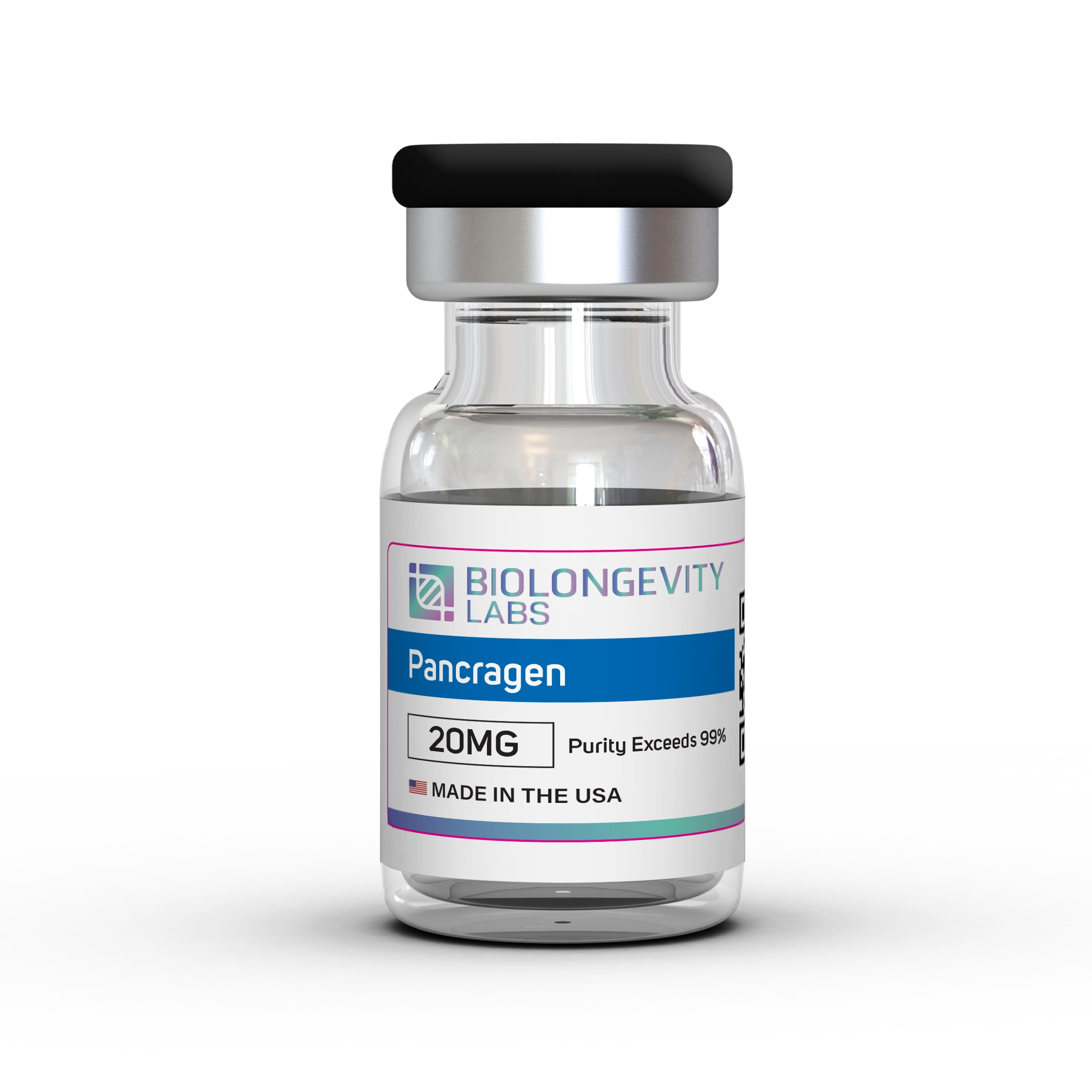
Here is every dose that has actually been published.
- Monkeys: 50 micrograms per animal per day, intramuscular, for 10 days. Both monkey studies used this.
- Lab models: oral and intramuscular routes both tested, with the glucose-lowering effect reported on the oral route.
- People: the one human study does not state its dose in the abstract. The literature for this family is written in micrograms, not milligrams.
And here is what circulates online instead: 1 to 2 mg a day by injection, in 10 to 20 day cycles, two or three times a year. That schedule — short course, long gap — is lifted from the general Khavinson protocol used for Cartalax, Vilon and the rest of the family. The cycle shape has a basis. The milligram figure does not.
I am not going to publish a recommended dose for a compound whose only human study is unreplicated and whose sold form differs from the studied one. Anyone quoting you a confident milligram number for Pancragen is quoting the vial, not the evidence.
Side Effects and Safety
The honest answer is that safety here is unmeasured rather than proven.
The monkey paper described the peptide as effective and safe over a 10-day course. No side-effect profile was collected in anything resembling the way a drug's profile is built — no dose-ranging, no long-term follow-up, no adverse-event reporting system, and no published data on what happens at the milligram doses people are actually taking.
Two things are worth flagging specifically:
- Glucose stacking. If a peptide lowers blood glucose and you are already on a medication that lowers blood glucose, those effects add up. The monkey study put Pancragen next to glimepiride for a reason — they act on the same variable. Anyone on insulin, a sulfonylurea or a GLP-1 who adds this without telling their doctor is running an experiment on their own hypoglycaemia risk.
- Sterility and technique. An injectable reconstituted at home carries the ordinary risks of that: contamination, injection-site reactions, and dosing errors that are easy to make when a vial holds several hundred times a plausible dose.
There are no pharmacokinetic data for Pancragen by any route. Nobody has published what blood level a given dose produces, how long it stays, or how it is cleared. Every dosing schedule you will read was built without that information.
Where Pancragen Sits Among the Bioregulators
It is one of twenty-five, and it is one of the better-studied ones.
That is a low bar, and it is still worth saying: compared with most of the family, Pancragen has a defined sequence, a proposed mechanism tested in more than one model, primate data, and a human study. Several of its shelf-mates have none of that. Our complete bioregulator peptide guide lays out all twenty-five with their sequences and evidence tiers, including the ones where the published sequence is printed wrong.
If you are working through this family, the ones with the most behind them are Epitalon for the pineal claims, Pinealon for the brain ones, and Pancragen here. The rest thin out quickly.

Buying Pancragen: What to Check
Only a handful of vendors carry it, and the standard listing is a 20 mg lyophilised vial. The one price I could verify at the time of writing was $94.97.
Three checks, in order of how much they matter:
- A lot-matched certificate of analysis. Not a generic one from the catalogue — the certificate for the batch number printed on the vial you receive. How to read a peptide COA covers what a real one contains.
- The molecular weight on that certificate. This is the check almost nobody does. Free-acid KEDW and the amidated KEDW-NH₂ differ by about one mass unit, and the certificate is the only place that difference shows up. If the vendor cannot tell you which form they sell, they do not know.
- Who is testing it. A vendor's own in-house number is a claim. An independent lab's report on a numbered lot is a document.
For a broader look at who is worth ordering from, our peptide vendor comparison ranks the sources we have actually checked.
The Bottom Line on Pancragen Peptide
Pancragen is a real compound with real, thin evidence, sold at a dose nobody has studied in a form that differs from the one that was.
If you came here hoping it would handle a rising A1c on its own, it will not, and the one time it was tested against an ordinary diabetes tablet, the tablet won on glucose. If you came here having already read the marketing, the useful correction is the arithmetic: micrograms in the studies, milligrams in the vial.
What it does have is a signal worth noting — a ten-day course whose effect on glucose handling was still partly present three weeks later, in primates, with insulin and C-peptide patterns normalising rather than simply being forced down. That is an unusual shape for a metabolic intervention, and it is the reason this compound is more interesting than most of its shelf-mates. It is also, so far, all there is.
Frequently Asked Questions
Medical disclaimer. This article is informational and does not replace individual medical advice. Pancragen has no approved medical use, no registered clinical trials, and no published pharmacokinetic data. Blood sugar problems are diagnosed and treated by a clinician, and anyone taking insulin, a sulfonylurea, a GLP-1 medication or any other glucose-lowering drug should speak to their doctor before adding anything that acts on the same system.