Two amino acids. Zero studies under its name.
That is the whole published record of Vesilute peptide, and it sits oddly beside the confident trial results you will read on the pages selling it — randomised, placebo-controlled, men aged 62 to 83, women aged 48 to 80, "no side effects detected." Those trials are real. They are in the literature. They were run on a different product.
If you are looking at Vesilute because getting up at night, urgency, or a prostate diagnosis has made bladder function a daily concern, you deserve the straight version: what the vial contains, what the trials tested, and why the two are not the same thing.
🔑 Key Takeaways
- Vesilute is the dipeptide Glu-Asp, sold as the bladder bioregulator of the Khavinson family. It is the shortest and least-studied compound in that family, by its developers' own account.
- Every trial result quoted for it — randomised, blind, older men with BPH, older women with overactive bladder — belongs to Chitomur, a bladder tissue extract sold in capsules. Not one study has tested the dipeptide on a bladder.
- The developers' 2022 table lists Vesilute as "bladder regulator" with no citation. They list a second, different dipeptide as bladder regulator too, also uncited.
- Two of the top-ranking pages sell "Vesilute" with Vesugen's three-amino-acid sequence. One database shows the second amino acid as a question mark.
- Recommended doses run from 10 micrograms every other day to 20 milligrams a day. No human has received the dipeptide in a study.
- What the Chitomur trials really showed, why they cannot be transferred, and how to check what you are buying, below.
Start with the trials, because they are the reason anyone believes in this compound, and they are worth understanding on their own terms.
What Vesilute Peptide Is
Glutamic acid, aspartic acid, and nothing else.
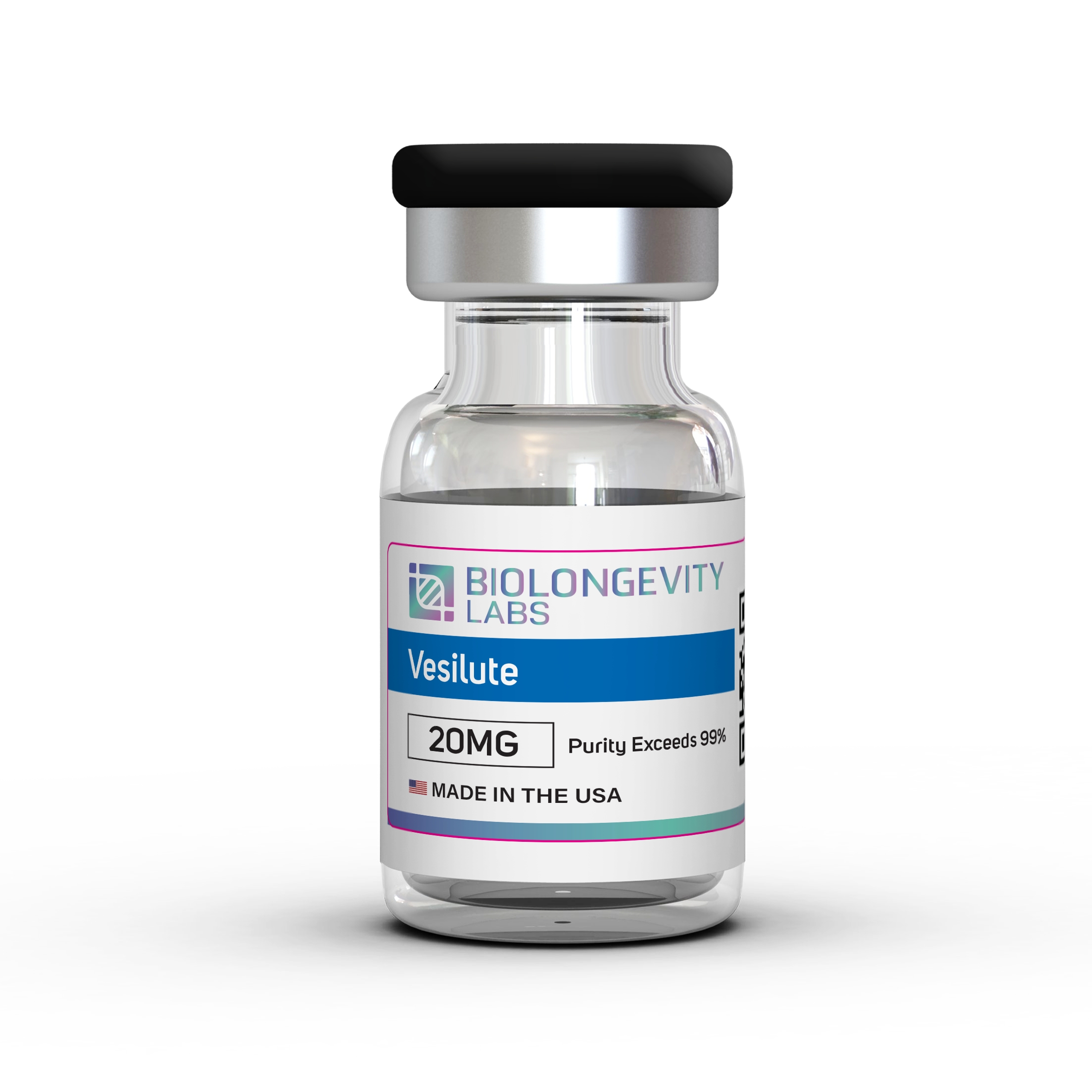
Written as ED, Vesilute — "Vesilut" in the developers' own papers — is a dipeptide of 262 daltons, the smallest molecule in the Khavinson bioregulator range. It is sold as the synthetic bladder bioregulator, the defined-sequence counterpart to Chitomur, the Institute's bladder tissue extract in capsules. Most vendors ship it as 20 mg of lyophilised powder for injection.
Its size is not a footnote. Glu-Asp is the shared core of this whole family: Vesugen is Lys-Glu-Asp, Cartalax is Ala-Glu-Asp, Pinealon is Glu-Asp-Arg, Epitalon is Ala-Glu-Asp-Gly. One careful vendor page points out that the Glu-Asp pair sits inside 14 of the family's 16 compounds — and then asks the obvious question, which is how a fragment that appears in almost every peptide in the range can be specifically for the bladder. Nobody has run the experiment that would answer it.
The Bladder Trials, and Whose They Are
Two randomised trials. Both real. Neither of Vesilute.
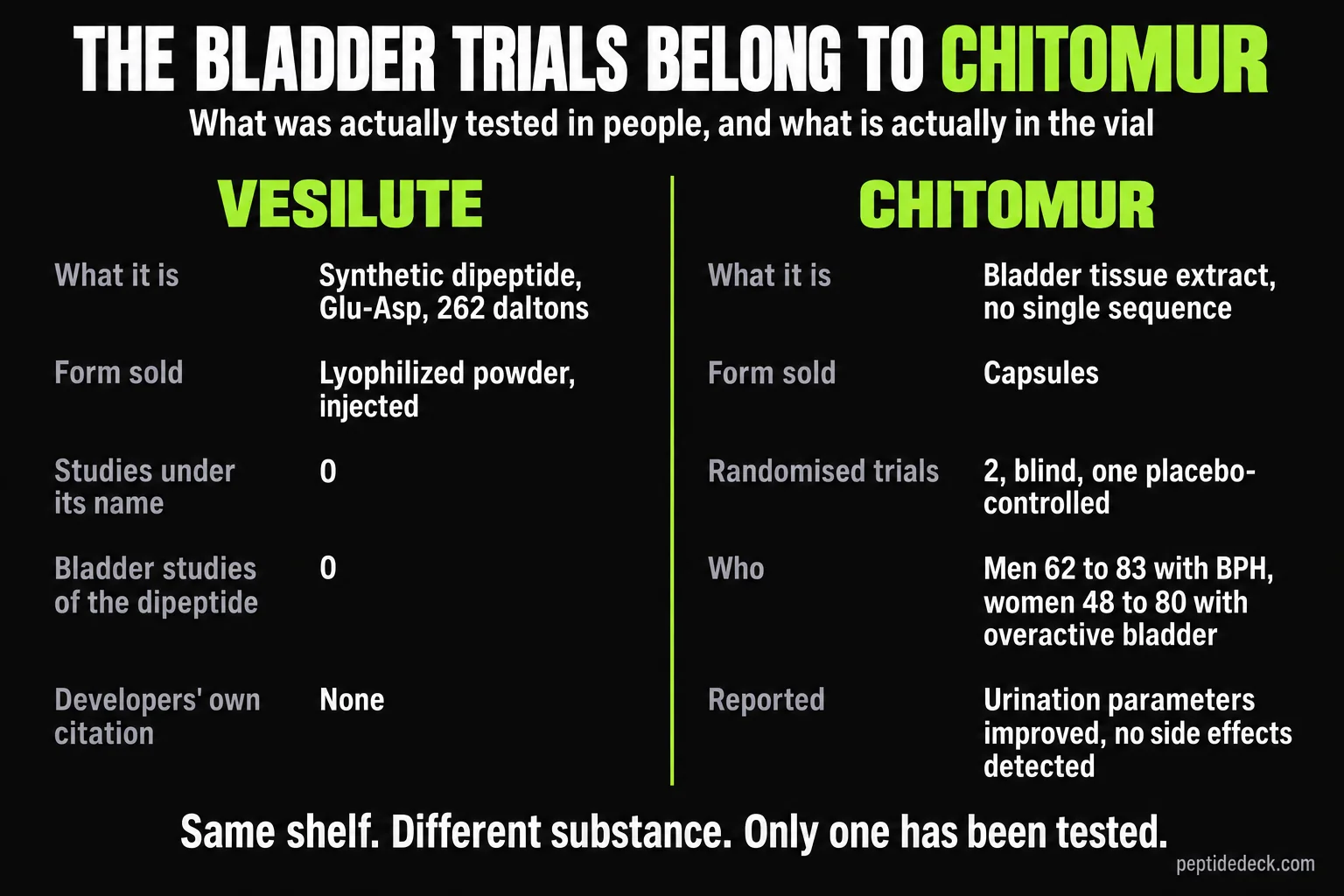
The Khavinson family does have proper bladder evidence, and for once it is not just a cell study. In 2013 two trials of Chitomur were published:
- Men aged 62 to 83 with benign prostatic hyperplasia. A blind, randomised, placebo-controlled trial. Chitomur "significantly improved the basic parameters of urination," quality of life improved with it, and the improvement held for a month after the course ended. No adverse effects were found.
- Women aged 48 to 80 with overactive bladder. A randomised blind trial. Urgency and episodes of urge incontinence decreased, bladder condition improved on urodynamic measurement, and patients reported reduced anxiety about their symptoms. Again, no side effects were detected.
These are the two studies behind every "clinically proven" line in the Vesilute guides, and one of them is the only placebo-controlled trial anywhere in the bioregulator family. They deserve respect. They also tested a capsule of pooled bladder tissue extract — a natural mixture of many peptides with no defined sequence — not a vial of a two-amino-acid synthetic. Evidence for a complex extract is not evidence for one fragment somebody later synthesised, any more than evidence for liver works as evidence for a single amino acid found in it.
One top-ranking guide does quote a Vesilute-specific study: 20 women with overactive bladder, bladder capacity rising from 267 to 320 mL, daytime urination falling from 14 to 11 episodes, nocturia from 4 to 2. It gives no author, journal, or PubMed ID, and I could not find any such study indexed under Vesilute, Vesilut, or Glu-Asp. Until someone can point to it, it is a set of numbers without a source.
What the developers themselves say: the Khavinson group's 2022 review tables every peptide in the range against its function and cites the supporting work. The Vesilut row reads "Bladder regulator" — and unlike Vesugen's row beside it, which cites three studies, it has no bracket at all. A second dipeptide in the same table, Kistiget (Asp-Gly), is also listed as "Bladder regulator," also without a citation. The Institute has two synthetic bladder peptides and no published study for either.
What Vesilute Has Actually Been Tested On
Almost nothing, and nothing with a bladder in it.
A PubMed search for Vesilute or Vesilut returns no papers. Search by sequence and the dipeptide appears only as one of many short peptides in the family's mechanistic work — docking studies of how ultrashort peptides might cross cell transporters, a screen of peptides against inflammatory pathways in a monocyte cell line, a survey of dipeptide-binding motifs on DNA. In none of them is Glu-Asp given to an animal or a person, and in none is a bladder involved.
Several guides work around this by citing the chromatin studies of Prostamax and Livagen, or the Prostamax prostatitis paper, as though they were Vesilute evidence. They are not. Different peptides, different papers.
One page in the top ten goes further. It reports that Vesilute improved symptoms in "70 to 80 percent" of chronic cystitis patients, sped urine flow by 40 percent, cut scar proteins by 50 percent and pain by 60 percent in interstitial cystitis — and attaches a PubMed ID to each claim. I looked all four up. They are a paper on acupuncture and hypothalamic hormone messenger RNA, a paper on PARP inhibitors and DNA repair, a paper on brain oscillations in migraine, and a paper on a microscopic finding in skin biopsies. Not one mentions Vesilute, a dipeptide, or a bladder. The percentages have no source. A second guide's five references are, in order, a paper on a different prostate drug, a review of sex differences in urinary tract biology, a paper on diet and fertility, a review of aging, and a review of cell differentiation — real papers, none of them about this compound.
Two Amino Acids, Four Versions on Sale
For a molecule this short, the error rate on vendor pages is remarkable.
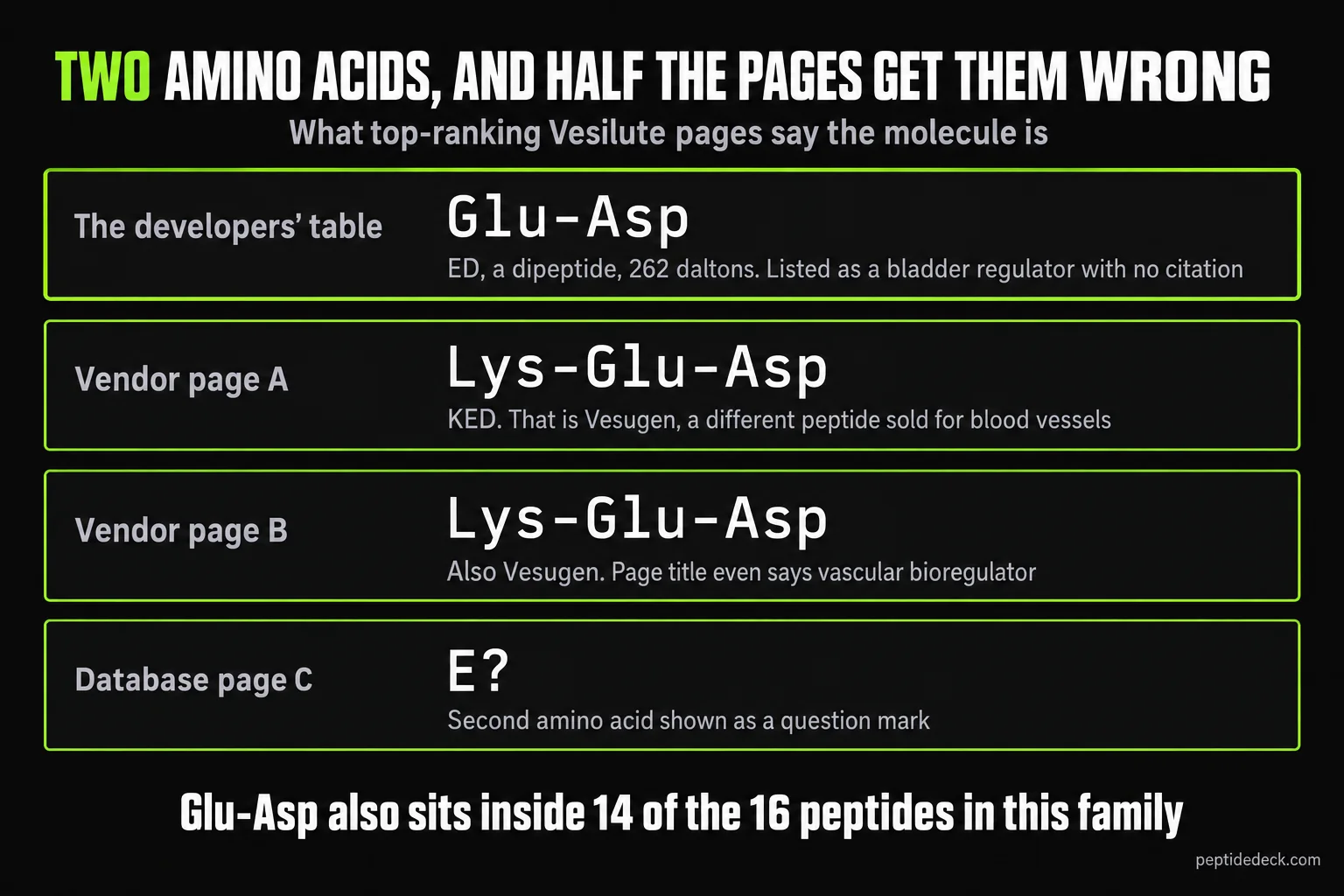
- Two of the ten pages describe Vesilute as the tripeptide Lys-Glu-Asp. That is Vesugen, the vascular peptide. One of those pages titles the product "Vesilute — Vascular Bioregulator" and describes it as "targeting vascular endothelium," which is Vesugen's description copied under Vesilute's name.
- One database entry renders the sequence as "E?" — the second amino acid literally a question mark.
- One guide gives no sequence at all and sells the compound for prostate health and male fertility.
The practical consequence is that "Vesilute" on a product page does not reliably tell you which molecule is in the vial. Glu-Asp should show a mass near 262 daltons on the certificate; Lys-Glu-Asp shows near 390. One vendor also notes that for this compound the trifluoroacetate counterion can account for more than 30% of the stated mass, so "20 mg" of Vesilute may contain markedly less peptide than the label implies — a technicality on most peptides, and a large one on a dipeptide.
Vesilute Dosage: 10 Micrograms to 20 Milligrams
No dose has ever been given to a human in a study, so all of these are invented. They also disagree by a factor of two thousand.
- 10 micrograms, injected, every other day, for 10 to 20 days
- 1 to 2 mg a day, injected, for 10 to 20 days, repeated every 3 to 6 months
- 10 to 20 mg per week, injected in two or three doses, for 2 to 6 weeks
- 10 to 20 mg a day, injected, for 10 to 20 days
- Two capsules once or twice a day for 10 to 30 days — which is Chitomur's capsule convention, not a dose of this vial
Notice that "10 to 20 mg" appears twice with different units — per week on some pages, per day on others — a sevenfold difference that a reader following a syringe-unit table would never notice. The 20 mg vial explains the upper end; the microgram figure is a guess from the compound's size. Neither is a measurement, because there is nothing to measure it against.
What People Buy Vesilute For, and What the Evidence Says
The table is short because the evidence is.
If bladder symptoms are the actual problem, the thing in this family with trial evidence is Chitomur — the capsule, sold in Russia as a supplement. And the things with decades of outcome data are the prescription options a urologist will discuss after a diagnosis, which matters because urgency, nocturia and a weak stream can come from infection, bladder disease, or prostate cancer as well as benign enlargement.
Side Effects and Safety
Unknown, because untested.
The "no side effects detected" line that appears on nearly every Vesilute page is a quotation from the Chitomur trials. It describes a capsule of tissue extract given to older adults under medical supervision. It says nothing about injecting a synthetic dipeptide, which no study has done. There are no pharmacokinetic data, no dose-ranging work, and no adverse-event record for Vesilute at all.
Two points worth making on this compound specifically:
- The molecule may not be the one on the label. With two vendors selling Vesugen's sequence under this name, the first safety question is what you are actually injecting. A lot-matched certificate with a mass near 262 daltons is the only answer.
- Symptoms treated are not causes found. A compound sold for "urinary wellness" that softens urgency while a cause goes undiagnosed has bought comfort at the price of time. Examination first, then whatever you decide to try.
Vesilute vs Vesugen: One Amino Acid, Two Products
They are confused constantly, and the difference is the entire evidence base.
Add a lysine to the front of Vesilute and you have Vesugen, which has around 25 papers, two small human studies, and a real vascular and neurological record. Vesilute has none of that. When a page describes Vesilute improving "microcirculation," "endothelial function" or "pulse wave velocity," it has copied Vesugen's claims — and in two cases Vesugen's sequence — under the wrong name. If your interest is blood vessels, buy the peptide that was studied for them. If your interest is the bladder, understand that neither the dipeptide nor the tripeptide has been tested on one; only the extract has. Our complete bioregulator guide lays out the whole family on this basis.
Buying Vesilute: What to Check
The standard listing is a 20 mg lyophilised vial, at prices I could verify from about $55 to $85. One listing was out of stock.
- The sequence. Glu-Asp, or ED, and nothing longer. A page printing Lys-Glu-Asp, "vascular bioregulator," or a question mark is selling something other than what it thinks.
- A lot-matched certificate of analysis showing mass near 262 daltons and, ideally, the counterion content. On a dipeptide the trifluoroacetate salt can be a third of the stated weight. How to read a peptide COA covers what a real one shows. Note that even one of the more careful vendors in the top ten states on its Vesilute page that no certificates are currently available for this product — ask before ordering.
- Whose trial is being quoted. If a page cites randomised trials, older men with BPH, or "no side effects detected," it is describing Chitomur. If it cites 20 women and a 267-to-320 mL capacity change, ask for the reference; there is none in the indexed literature.
For a wider view of who is worth ordering from, our peptide vendor comparison covers the sources we have checked directly.
The Bottom Line on Vesilute Peptide
Vesilute is a two-amino-acid fragment sold on the strength of trials that tested something else.
The fair version: the Khavinson family's bladder work is among its best — a placebo-controlled trial in older men and a randomised trial in older women, both positive, both clean on side effects. That is a genuine result, and it belongs to Chitomur.
The equally fair version: Vesilute has no study under its name, no bladder study of its sequence, no citation from its own developers, no human dose, and no reliable identity on the pages that sell it. If you buy it, you are buying a hypothesis that the smallest fragment of a tissue extract carries the extract's effect. That hypothesis has never been tested, and the people best placed to test it have not.
Frequently Asked Questions
Medical disclaimer. This article is informational and does not replace individual medical advice. Vesilute has no approved medical use, no published study in people or animals, and no pharmacokinetic data; the clinical trials quoted for it were conducted on a different product. Urinary symptoms in adults can indicate infection, bladder disease or prostate cancer as well as benign enlargement; see a doctor for a diagnosis before treating them with anything, and tell your doctor about any compound you are taking alongside prescription medication.