This one has actually been given to people.
That puts it in a different category from most of what sits beside it on the shelf. Two small studies gave Vesugen peptide to a total of 73 patients and measured what happened. One of those studies is the source of every blood-flow figure in the top ten guides. The other found something in the blood of its 32 patients that not one of those guides mentions, and it is the kind of finding you would want to know about before injecting a compound sold for "vascular power."
So this guide does something the others do not: it reads both human studies to the end, puts the animal and cell work in its place, and tells you what is supported, what is borrowed, and what was quietly left out.
🔑 Key Takeaways
- Vesugen is a three-amino-acid peptide, Lys-Glu-Asp, developed in St Petersburg as the vascular member of the Khavinson bioregulator family. It is the best-evidenced of the small bioregulators, and the bar is low.
- It is one of very few compounds in this family with human data: 41 men with vascular erectile dysfunction, and 32 older patients with multiple conditions. Neither study had a control group.
- The 32-patient study reported improved biological-age markers — and a fall in CD34+ blood stem cells the authors called "significant inhibition of hemopoiesis," plus pro-oxidant activity. No guide in the top ten reports this.
- Most of the recent research is not about blood vessels at all. It is about neurons, Alzheimer's models and serotonin, and it is where the compound looks most interesting.
- One top guide calls it a dipeptide; one retail listing sells it with Pinealon's sequence; the recommended dose runs from 100 micrograms to 20 milligrams a day.
- What holds up, what was borrowed, and how to check a vial, below.
Start with the two studies that actually involved people, because they are the only reason to take any of the rest seriously.
What Vesugen Peptide Is
Three amino acids: lysine, glutamic acid, aspartic acid.
Written short that is KED, 390 daltons, and in the older Russian literature it appears as "Vezugen" or under its lab code, T-38. It was developed at the St Petersburg Institute of Bioregulation and Gerontology as the synthetic vascular bioregulator, the defined-sequence counterpart to Ventfort, the Institute's vessel extract sold in capsules. It differs from Pinealon (Glu-Asp-Arg) by two residues and from Cartalax (Ala-Glu-Asp) by one, and it is tested alongside both in most of its studies.
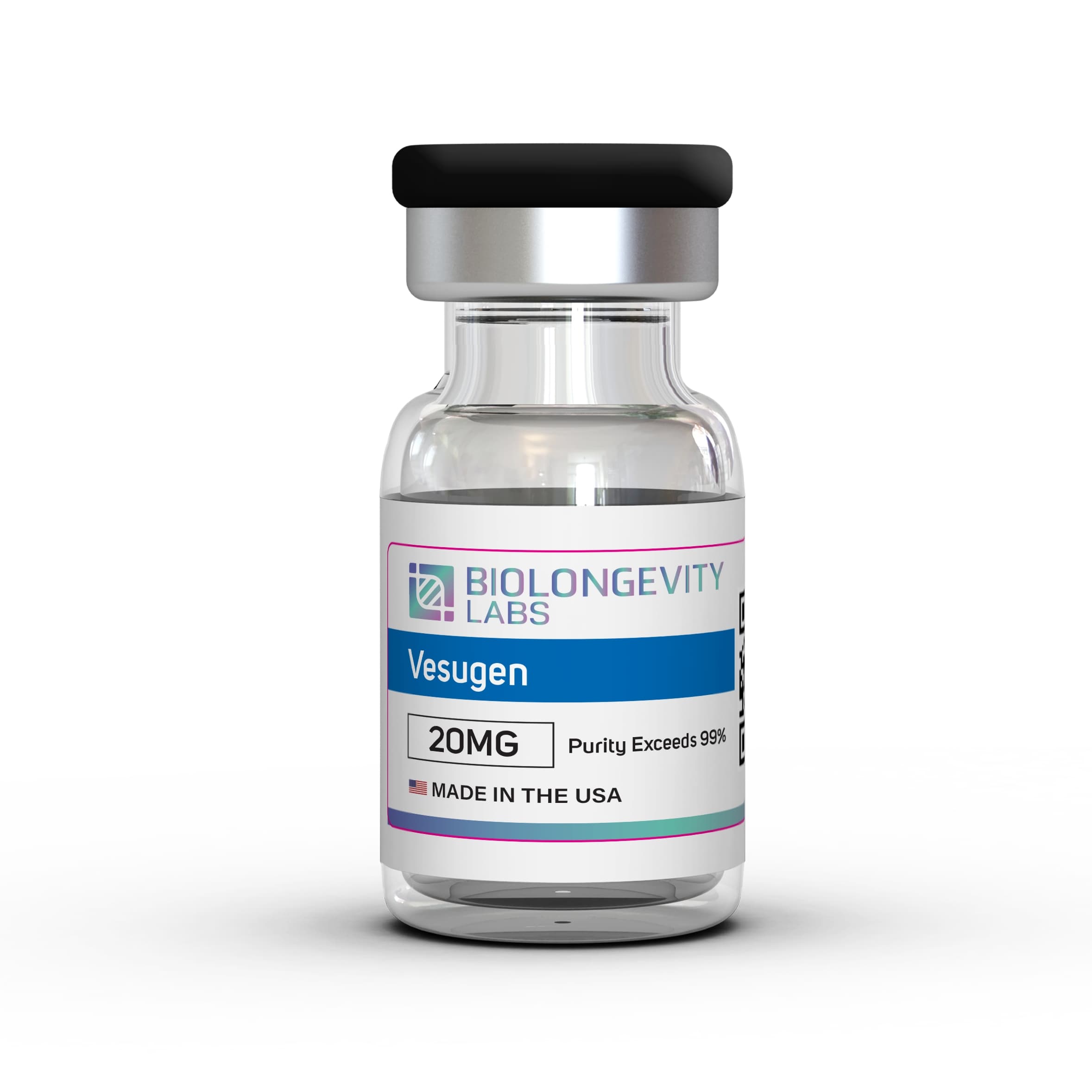
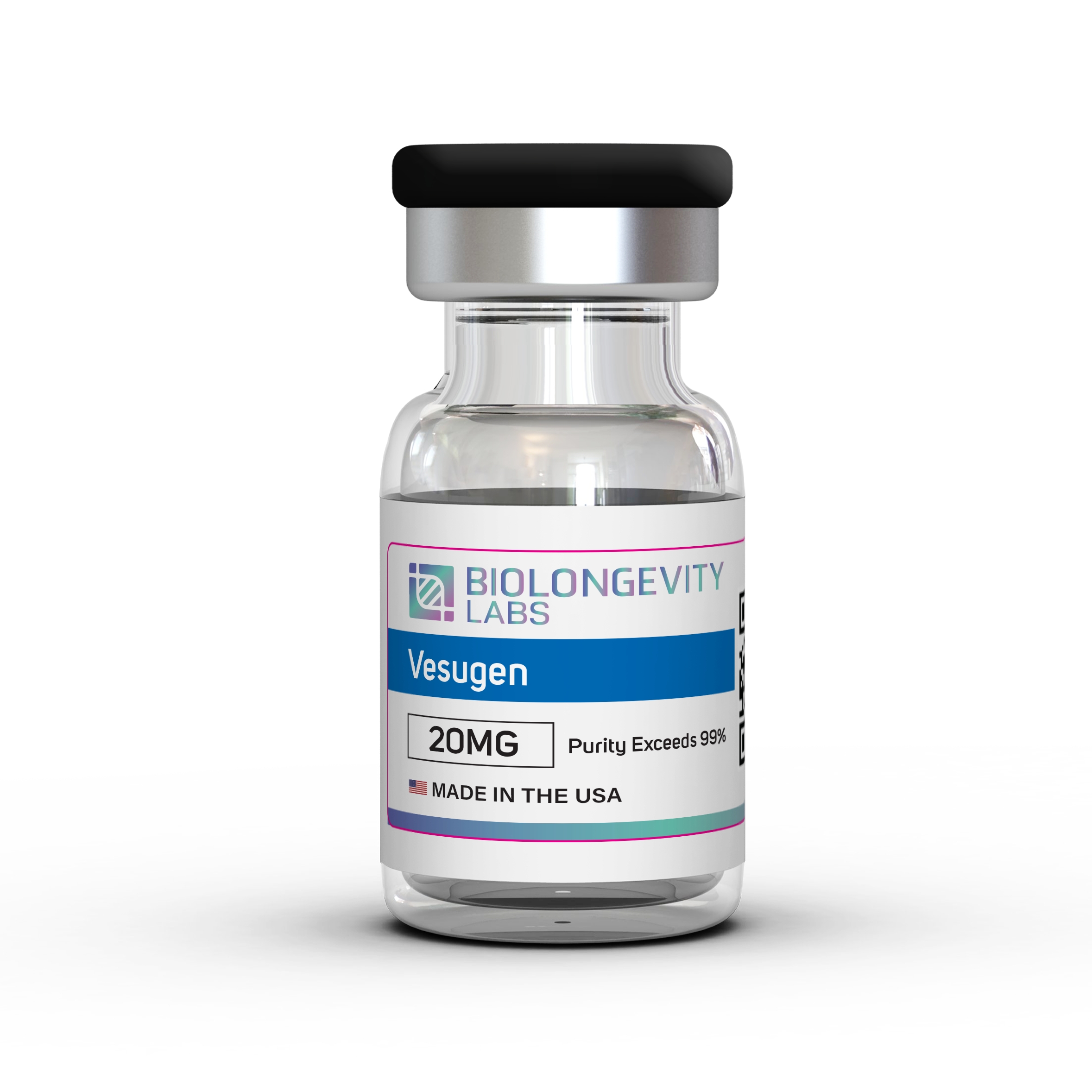
Two errors in the top ten are worth clearing before going further. One widely read guide describes Vesugen as "a dipeptide (two amino acids)." It is a tripeptide. And one retail listing for "Vesugen 20mg" gives the sequence as EDR with a CAS number that belongs to Pinealon — a different peptide from the same family. The certificate of analysis for Vesugen should read Lys-Glu-Asp and show a mass near 390.
The Two Human Studies, Read to the End
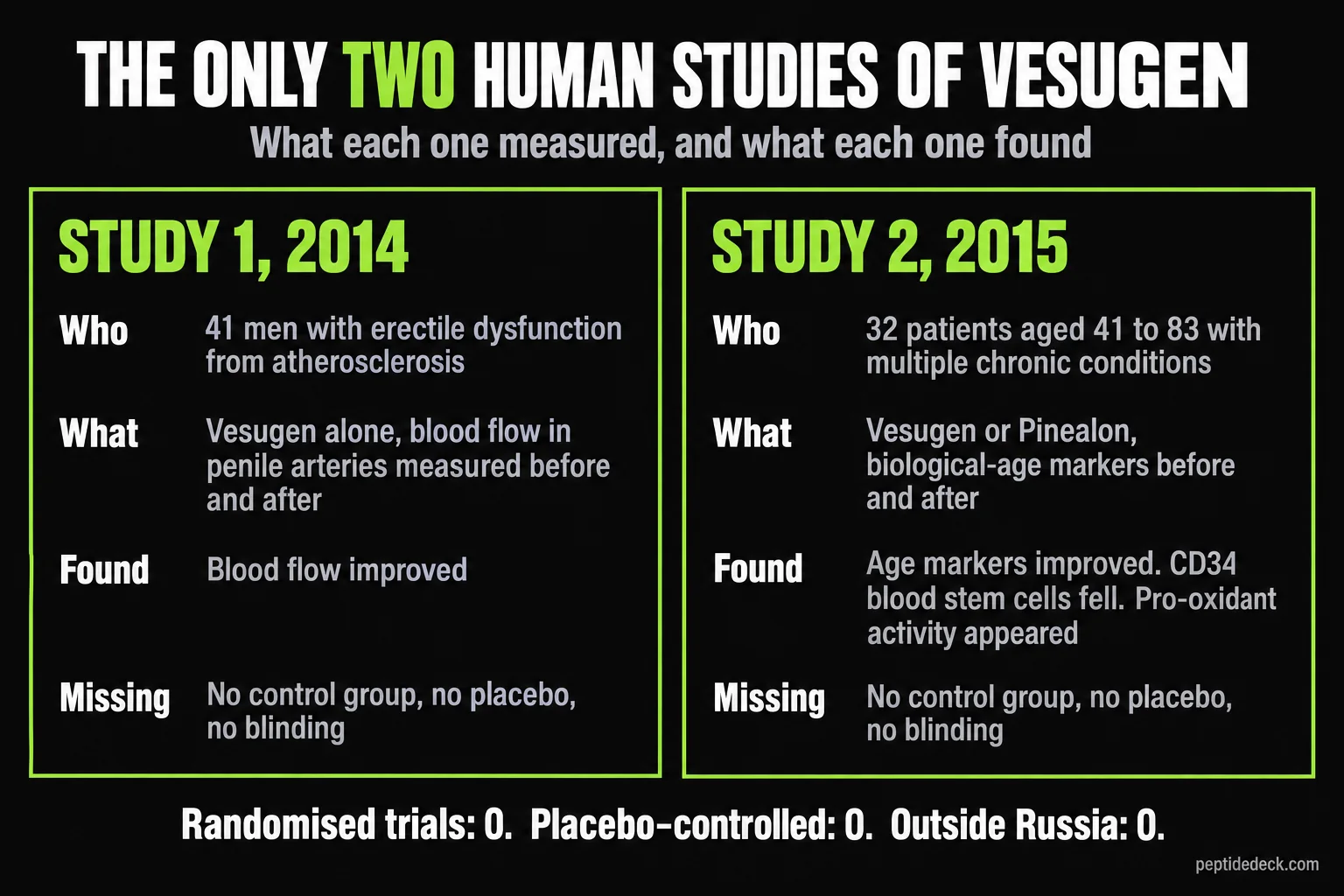
Seventy-three people, two studies, both from Russia, neither controlled.
Study one: 41 men, 2014
Forty-one men with erectile dysfunction of vascular origin — atherosclerosis narrowing the penile arteries — were given Vezugen as monotherapy. Blood flow in the main penile arteries was measured by ultrasound before and after treatment, and improved. This is the study behind every "improves blood flow" and "53 to 61 percent" figure you will read, and behind the erectile-function claims.
It is a real result, and it has the limits of its design. There was no control group and no placebo, so nothing separates the effect of the peptide from the effect of enrolling in a study, being examined, and being told a treatment was underway. Erectile function is among the most placebo-responsive outcomes in medicine. The measured artery flow is more objective than a questionnaire, which is a point in the study's favour; the absence of anyone who did not receive the peptide is the point against.
Study two: 32 patients, 2015
Thirty-two people aged 41 to 83 — 18 men, 12 women — with multiple chronic conditions and organic brain syndrome in remission received either Vesugen or Pinealon. The authors measured a panel of biological-age indicators and reported that both peptides had a "significant anabolic effect," improved central nervous system activity, and slowed the rate of aging by those indicators, with Vesugen doing more than Pinealon.
Then the abstract keeps going, and this is the part that does not make it into the guides. Chemiluminescence testing found pro-oxidant activity. And the count of CD34+ cells — the marker of blood-forming stem cells — fell, which the authors describe as "significant inhibition of hemopoiesis," adding that these cells "have not been involved in the adaptive reactions." They also found no effect on chromatin condensation, which they took as reassurance about genetic safety.
Read plainly: in the only human study that looked at blood-forming cells, Vesugen was associated with fewer of them. Thirty-two people is too few to know what that means, and a single uncontrolled study cannot establish cause. But a compound sold to healthy people for "recovery" and "vascular power" has a published signal against the blood cells that carry oxygen, and a buyer is entitled to know it exists.
The third mention
A 2018 paper on occupational-health nutrition describes short peptides including Vesugen improving a "work ability index" in people exposed to workplace hazards. It reports no numbers, no group sizes, and no design in its abstract. A 2022 review by the developers also states that oral KED "improved memory and attention in elderly individuals with functional CNS disorders," citing earlier Russian work. Neither adds a controlled result.
What the human record amounts to: two uncontrolled studies, 73 patients, one measured artery outcome that improved, one set of aging markers that improved, one blood-cell signal that went the wrong way, and zero randomised or placebo-controlled trials anywhere. A search of the global clinical trials registry for Vesugen returns nothing.
What the Vessel Studies Actually Show
Cells in dishes, behaving younger.
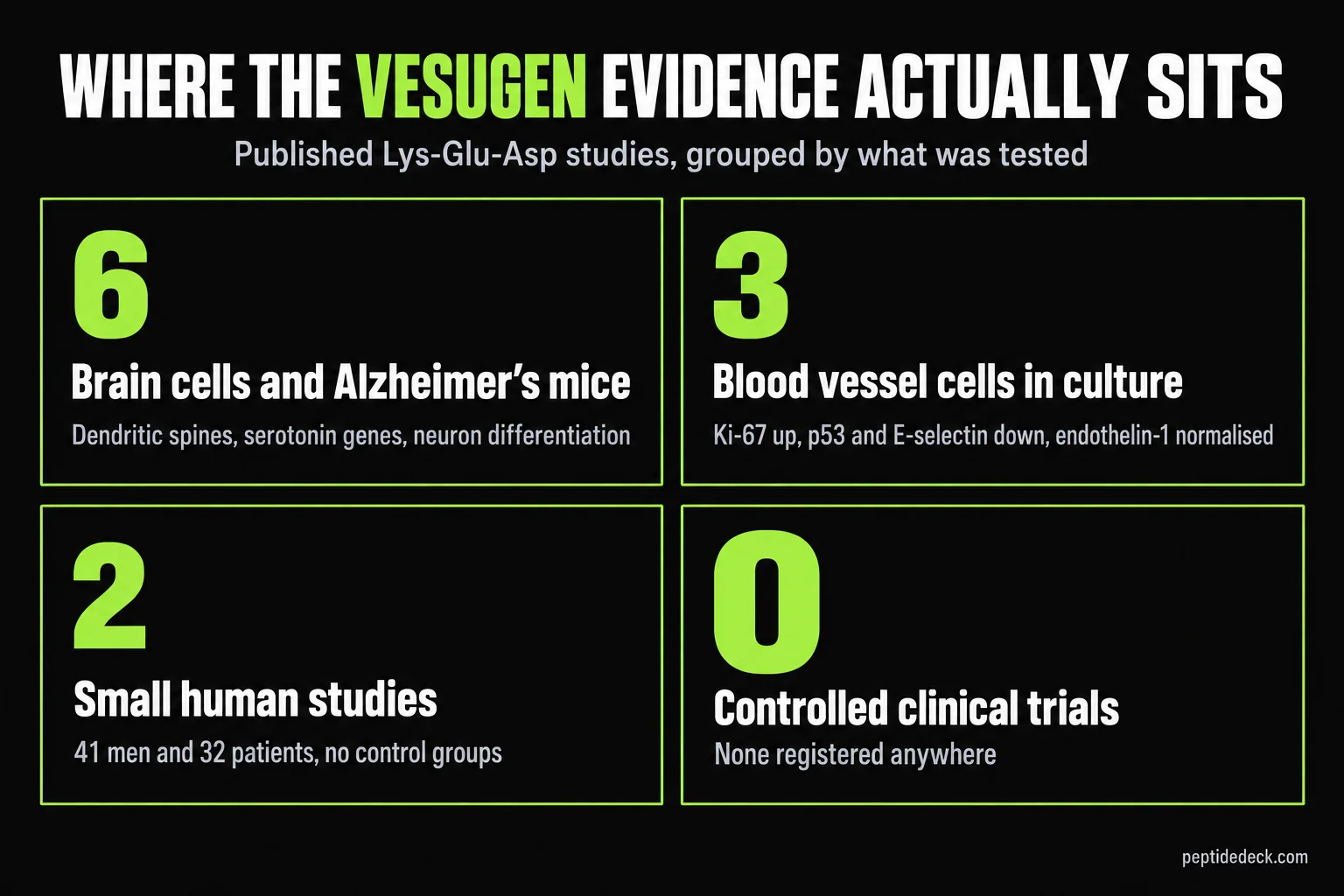
Three papers form the vascular case, and all three are cell culture.
- Proliferation restored. In vascular cell cultures from young and old animals, Vesugen raised Ki-67, the marker of dividing cells, which normally falls with age. Molecular modelling then found the peptide fitting a CATC motif in the promoter of the Ki-67 gene, the proposed epigenetic mechanism.
- Plaque molecule reduced. Under its lab code T-38, the peptide raised Ki-67, lowered p53, and reduced E-selectin — an adhesion molecule involved in building atherosclerotic plaque — in vascular cultures.
- Diseased endothelium normalised. In endothelial cells modelling atherosclerosis and restenosis, KED brought endothelin-1 back to normal, restored connexin-mediated cell contact, and raised SIRT1.
Together these are a coherent mechanistic story about aging endothelium in a dish. What they are not is a measurement of blood pressure, plaque, or vessel function in a living animal or a person, apart from the 41-man artery study above.
The Research Nobody Is Selling: Brain and Alzheimer's Models
Count the papers and Vesugen is a neuro peptide that happens to be marketed for vessels.
Six studies since 2013 put KED in brain tissue or brain models, and they are the most active line of research on it:
- In mouse hippocampal neurons under amyloid toxicity — a dish model of Alzheimer's — KED at 200 ng/mL increased mushroom-shaped dendritic spines by 20%. Pinealon in the same experiment increased them by 71% and brought the count back to normal. The authors recommended Pinealon, not KED, for further work.
- In 5xFAD Alzheimer's-model mice given 400 micrograms per kilogram daily by injection from two to four months of age, KED "tended to increase neuroplasticity" and prevented dendritic spine loss. Docking work found binding sites in genes tied to neuron differentiation and apoptosis.
- KED stimulated serotonin expression in aging brain cortex cultures, with a docking fit to a CCTGCC motif in the tryptophan hydroxylase gene.
- In human stem cells from periodontal ligament, KED alone raised GAP43 and nestin, markers of neuronal differentiation.
- In 2024, in cortical neurons made by reprogramming skin fibroblasts from elderly donors — a new human model of neuronal aging — KED promoted dendritic branching and countered age markers.
- In pineal cultures it lowered p53 and raised Ki-67, and in one odd but real test it modulated associative learning in honey bees.
This is why the developers' own 2022 table lists Vesugen as vasoprotector, neuroprotector and geroprotector with a citation for each — and why anyone reading the literature would call the neuro line the more promising one. It is also entirely animals and cells: the only human neuro claim is the memory-and-attention line in the developers' review, which traces to uncontrolled Russian work.
Vesugen Dosage: 100 Micrograms to 20 Milligrams
The guides disagree by two orders of magnitude.
- 100 to 200 micrograms a day total, oral capsules, for 30 days
- 0.5 to 2 mg a day, injected, for 10 to 20 days; "4 to 5 mg for severe vascular issues"
- 1 to 2 mg a day, injected, for 30 to 90 days
- 10 mg a day injected or 10 to 20 mg oral, for 10 to 20 days
- 10 to 20 mg a day, oral, in 10 to 20 day cycles
Two things about these numbers. First, the human studies exist, so for once the dose question is not pure invention — but the abstracts do not state the doses used, and one guide's claim of "one capsule a day for one month" in the 41-man study is not in the abstract either. Second, the only dose in the animal literature is 400 micrograms per kilogram, injected daily into mice, which does not translate to a person by simple arithmetic. The 20 mg vial is the source of the upper figures, as it is for every compound in this family.
This page does not recommend a dose. The literature contains none that was chosen for a human by anything other than convention.
What People Buy Vesugen For, and What the Evidence Says
Here the honest table is more interesting than usual, because some rows are not empty.
Notice which rows the marketing leads with — blood flow, recovery, performance — and which row the research leads with. They are not the same rows.
Side Effects and Safety
More is known than for its siblings, and what is known is not all reassuring.
The guides list injection-site irritation, mild digestive upset and headache, and one cites "fewer than 5 percent" and "under 3 percent" rates with no source. Those figures do not come from either human study. What does come from a human study is the pair of findings above: pro-oxidant activity on chemiluminescence, and a fall in CD34+ blood stem cells in 32 patients. The authors reported both without alarm and noted no chromatin damage. Nobody has followed them up.
Three points specific to this compound:
- The blood-cell signal. Anyone with anaemia, a history of low blood counts, or a bone-marrow condition has a documented reason to avoid this compound that no vendor page will give them.
- Pro-oxidant, not antioxidant. Several guides describe Vesugen as reducing oxidative stress. The one human study that measured it found the opposite direction.
- The angiogenesis question. A peptide that raises proliferation markers in vascular cells raises a theoretical concern about feeding blood supply to tumours. One careful guide flags this; the studies have not tested it.
There are no pharmacokinetic data by any route, and the doses used in the human studies are not stated in their abstracts.
Vesugen vs Pinealon: Tested Together, Not Equal
They were compared head to head twice, and the results point in different directions depending on the organ.
In the 32-patient study Vesugen produced the more visible anti-aging effect. In the Alzheimer's dish model Pinealon restored dendritic spines to normal while Vesugen managed a 20% improvement, and the authors backed Pinealon. If you want the brain, the family's own data favours Pinealon. If you want vessels, Vesugen is the only one with a human artery measurement. Our complete bioregulator guide ranks all twenty-five on exactly this kind of evidence, and Vesugen sits near the top of a short ladder.
Buying Vesugen: What to Check
The standard listing is a 20 mg lyophilised vial; the one price I could verify at the time of writing was $84.97.
- The sequence and the mass. Lys-Glu-Asp, near 390 daltons. A listing showing EDR, a CAS number for Pinealon, or calling it a dipeptide has not checked what it sells. How to read a peptide COA covers what a real certificate shows.
- Vesugen or Ventfort. Ventfort is the Institute's vessel extract in capsules, a natural mixture with no defined sequence. Vesugen is the synthetic tripeptide. Guides that quote "one capsule a day" protocols are describing the extract's convention, not a study of the vial.
- The claims. A page promising blood-pressure normalisation, plaque reversal or "vascular power" is promising things that have not been measured in a person. The honest pitch — improved penile artery flow in one uncontrolled study, and a lot of interesting neuron work — is smaller and true.
For a wider view of who is worth ordering from, our peptide vendor comparison covers the sources we have checked directly.
The Bottom Line on Vesugen Peptide
Vesugen is the best-evidenced small bioregulator, which is a real distinction and a modest one.
The fair version: it has been given to 73 people in published studies, improved a measured artery outcome in one and aging markers in the other, and has a coherent, repeated record in vascular and brain cells, plus a mouse Alzheimer's model. Among compounds sold beside it, almost nothing else can say that.
The equally fair version: neither human study had a control group, the one that looked at blood cells found fewer of them and more oxidation, the neuro line its developers now favour is entirely animals and cells, and the dose you will be told to take was chosen by convention rather than measurement. If you buy it, buy it knowing that the most-cited number about it comes from 41 men with no comparison group, and the least-cited number comes from 32 patients whose stem cells fell.
Frequently Asked Questions
Medical disclaimer. This article is informational and does not replace individual medical advice. Vesugen has no approved medical use, no controlled clinical trial, and no pharmacokinetic data, and the only human study that examined blood cells reported a fall in blood-forming stem cells. Erectile dysfunction, circulation problems and cognitive symptoms need a proper diagnosis; speak to a doctor before taking anything for them, and tell your doctor about any compound you are taking alongside prescription medication.