Nothing published on this peptide has ever involved a lung.
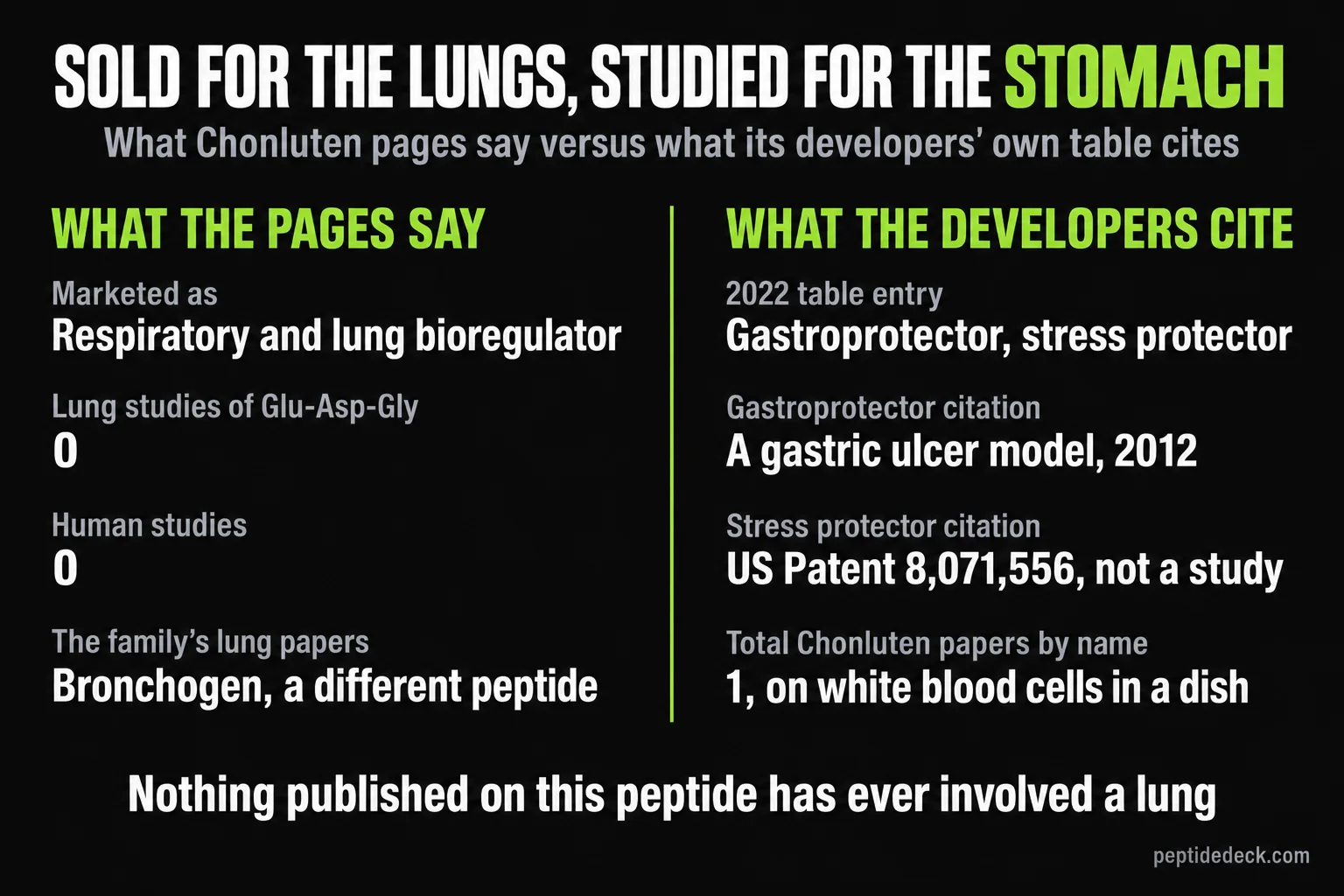
That is a strange thing to be true of a compound sold, on every one of the top ten pages, as a respiratory bioregulator — for "easier breathing," "faster recovery from infections," "support for chronic respiratory conditions." Chonluten peptide has exactly one published study under its own name, and that study is about white blood cells in a dish. Its developers, asked in their own 2022 review what it does, wrote "gastroprotector" and "stress protector" and cited a stomach-ulcer model and a patent.
If you are looking at Chonluten because breathing has become harder than it used to be — a cough that lingers, a chest that tightens on the stairs, a diagnosis with a long name — you deserve to know where the lung claims come from. They come from a different peptide.
🔑 Key Takeaways
- Chonluten is the synthetic tripeptide Glu-Asp-Gly, sold as the lung bioregulator of the Khavinson family and the counterpart to Taxorest, the Institute's lung extract.
- Its developers' own 2022 table does not call it a lung peptide. It lists "gastroprotector," citing a gastric-ulcer study, and "stress protector," citing a US patent.
- The family's actual lung research — bronchial cells, lung injury models — was done on Bronchogen, Ala-Glu-Asp-Leu. Guides quote it as Chonluten evidence.
- One page prints the sequence as Gly-Glu-Pro, one prints a 25-letter collagen motif, and one says the compound was "derived from bronchial or thymic tissue." It was designed, and it is three letters long.
- Recommended doses run from 250 micrograms to 20 milligrams a day. One guide's "10 to 15 percent FEV1 improvement" is labelled "(claimed)" by its own author.
- What the one real study found, where the lung claims actually belong, and how to check a vial, below.
Start with the developers, because they are the only people who have ever tested this molecule, and they do not say what the vendors say.
What Chonluten Peptide Is
Glutamic acid, aspartic acid, glycine.
EDG, 319 daltons, lab code T-34 in the developers' papers. It is one of the ultrashort synthetic bioregulators from the St Petersburg Institute of Bioregulation and Gerontology, and it is marketed as the synthetic counterpart to Taxorest, the Institute's lung-tissue extract in capsules. The family logic, as vendors present it, is that each extract has a synthetic twin keyed to the same organ — Svetinorm to Livagen for the liver, Chelohart to Cardiogen for the heart, Taxorest to Chonluten for the lungs.
Except that the Institute's own literature assigns the lung to a different synthetic peptide. Bronchogen, Ala-Glu-Asp-Leu, is the one with bronchial-epithelium studies and lung-injury models behind it. Chonluten's assignment in the developers' hands is the gut. The lung label appears to have been attached somewhere between the laboratory and the vendor page.
The Entire Chonluten Literature
One paper by name. Two more by sequence. None of them a lung.
The one study under its name
In 2022, an Italian group tested five Khavinson peptides — Epitalon, Vilon, Thymogen, Thymalin and Chonluten — on THP-1 cells, a human leukaemia monocyte line that can be pushed to become macrophages in culture. All five modulated proliferation signalling, and Chonluten was among those that damped the TNF and IL-6 response to a bacterial toxin. That is the origin of every "anti-inflammatory" and "reduces cytokines" claim. It is a real in-vitro result in an immune cell line. It involves no lung tissue, no airway, no animal and no person.
The gastric ulcer study
The developers' 2022 review lists Chonluten as a "gastroprotector," and the paper it cites is a 2012 study of T-34 in a gastric-ulcer model: the peptide normalised the expression of antioxidant and anti-inflammatory proteins whose synthesis is disturbed when ulcers form. This is the only published work in which the peptide is connected to an organ, and the organ is the stomach.
The skin explant study
In a 2012 comparison of five tripeptides on skin explants from young and old animals, four of them stimulated cell proliferation in young skin. T-34 — Chonluten — was the one that did not. It is a small negative result, and it is the only other organ-tissue experiment the peptide appears in.
The patent
The second function the developers give it, "stress protector," is supported by US Patent 8,071,556, "Peptide Substance Revealing a Stress Protective Effect." A patent is a claim of invention, not a study, and it reports no outcome in an animal or a person.
Where the lung evidence actually is. The paper most often quoted as Chonluten's respiratory evidence — a 2014 study in the journal Lung showing a Khavinson peptide regulating differentiation genes in human bronchial epithelium and acting in models of lung inflammation, fibrosis and toxic injury — is a study of Bronchogen, Ala-Glu-Asp-Leu. One careful guide in the top ten flags this explicitly. The others either cite it as Chonluten's or describe its findings without a citation. No study of Glu-Asp-Gly in lung tissue exists.
One Tripeptide, Four Sequences
For a molecule three amino acids long, the pages cannot agree on what it is.
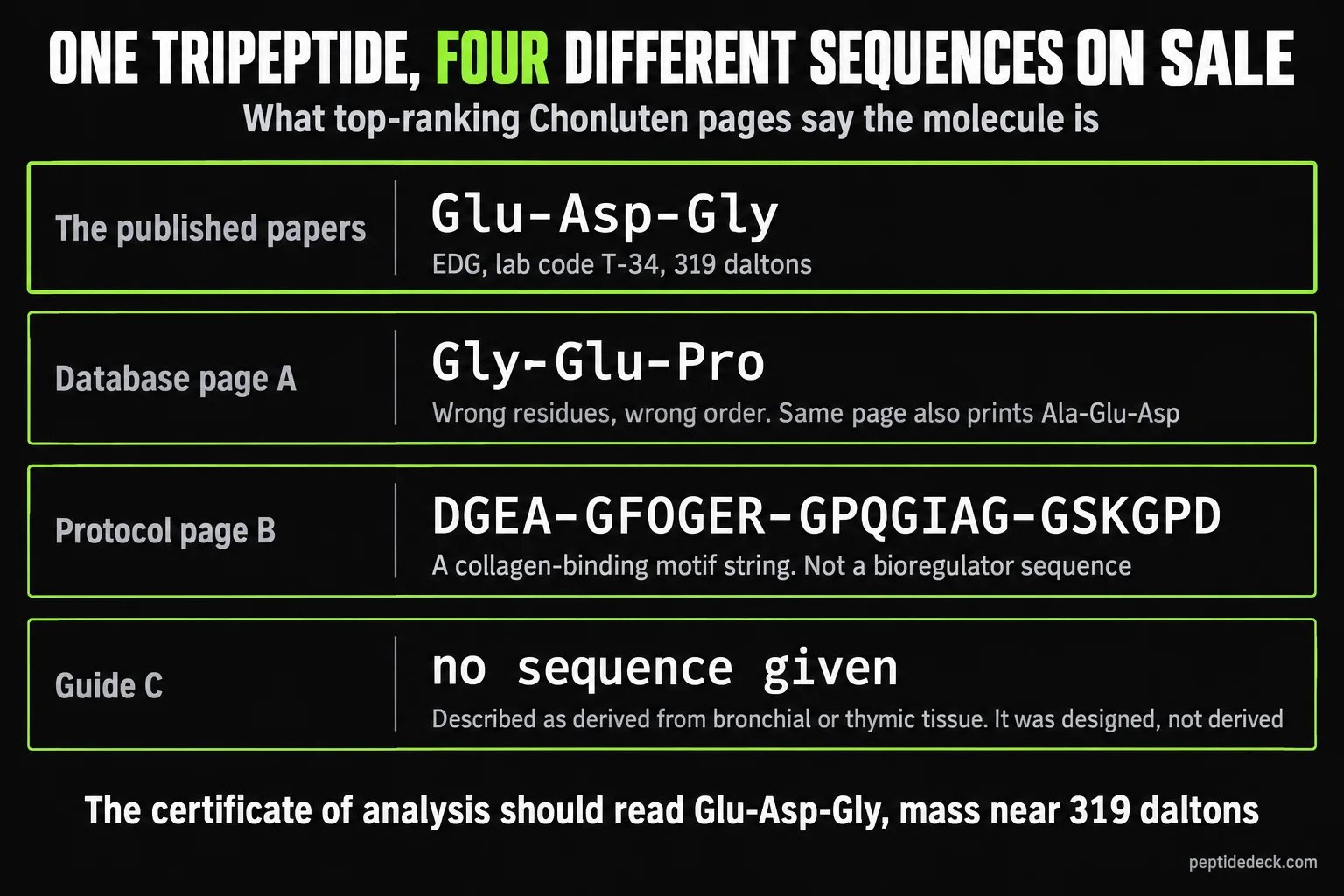
- One database page gives the sequence as "Gly-Glu-Pro" in its summary and "Ala-Glu-Asp" in its plain-English section. Neither is Chonluten; the second is Cartalax.
- One protocol page prints "DGEA-GFOGER-GPQGIAG-GSKGPD" — a string of collagen-binding motifs, not a bioregulator, and not three amino acids — while elsewhere calling it a tripeptide.
- One widely read guide gives no sequence and says Chonluten is "naturally derived from bronchial or thymic tissue." It is a synthetic tripeptide designed by analysis, and the developers' own record ties it to the stomach, not the bronchi or the thymus.
- Several vendor pages get it right: Glu-Asp-Gly, EDG, 319 daltons.
The practical point is the usual one. "Chonluten" on a listing does not guarantee Glu-Asp-Gly in the vial. A lot-matched certificate showing a mass near 319 daltons does.
Chonluten Dosage: 250 Micrograms to 20 Milligrams
Nothing has ever been given to a person, so every number here was invented.
- 250 micrograms a day, injected, titrating to 4 mg over 14 weeks
- 5 to 10 mg a day, capsules or injection, for 10 to 20 days
- 10 mg a day, intramuscular, for 10 days, two or three courses a year
- 10 mg a day, subcutaneous, for 10 to 20 days, repeated every 3 to 6 months
- 10 to 20 mg a day in capsules — "1 to 2 capsules once daily" or "2 capsules twice a day"
The capsule figures are Taxorest's convention, transferred to a synthetic vial. The only concentration in the literature is 100 nanograms per millilitre in the monocyte culture, which converts to a human dose exactly as poorly as it sounds. One page in the top ten states the situation correctly — "there is no established dosing for Chonluten" and the circulating figures "are not traceable to a study" — and this page adopts that position.
What People Buy Chonluten For, and What the Evidence Says
The claims are respiratory. The evidence is a monocyte and a stomach.
Two rows deserve a second look. The stomach row is the only organ-level evidence the compound has, and no vendor mentions it. The mortality row is the family's most famous human result — decades-long studies of elderly patients on the thymus and pineal extracts — and one top-ranking guide has attached it to a tripeptide that was never in those studies.
Side Effects and Safety
Unknown, and the one organ signal points somewhere unexpected.
No animal has been dosed with Chonluten in a published study, let alone a person, so the side effects listed on the guides — fatigue, headache, "transient respiratory changes," "flu-like symptoms" — are not observations of this compound. There are no pharmacokinetic data by any route.
Two points specific to Chonluten:
- Breathing symptoms are diagnoses waiting to happen. Persistent cough, breathlessness on exertion, and chest tightness are how asthma, COPD, heart failure, and lung cancer announce themselves. A compound that a person takes instead of getting those investigated costs time, and time is the one thing lung disease punishes. Anyone with a real respiratory condition — asthma, COPD, fibrosis — has a specific reason to involve the clinician already managing it before adding anything.
- The vial may not contain what the page says. With four sequences in circulation for one three-letter peptide, identity is the first safety question. The certificate answers it; the product name does not.
Chonluten vs Bronchogen: The Lung Peptide That Has Lung Studies
The family does have a synthetic lung peptide with evidence. It is not this one.
Bronchogen, Ala-Glu-Asp-Leu, has the bronchial-epithelium work: in cultured human bronchial cells it regulated the differentiation genes NKX2-1, SCGB1A1, SCGB3A2, FOXA1 and FOXA2, raised Ki-67 and Mcl-1 most strongly in aged cultures, and activated genes whose loss tracks with abnormal lung development; it was also tested in models of bacterial lung inflammation, fibrosis and toxic lung injury. Every one of those findings is routinely quoted on Chonluten pages. If a buyer wants the tripeptide-or-tetrapeptide with actual airway data, the family's literature points at Bronchogen — still animals and cells, still no human trial, but at least the right molecule. Our complete bioregulator guide maps which peptide the studies actually belong to across all twenty-five.

Buying Chonluten: What to Check
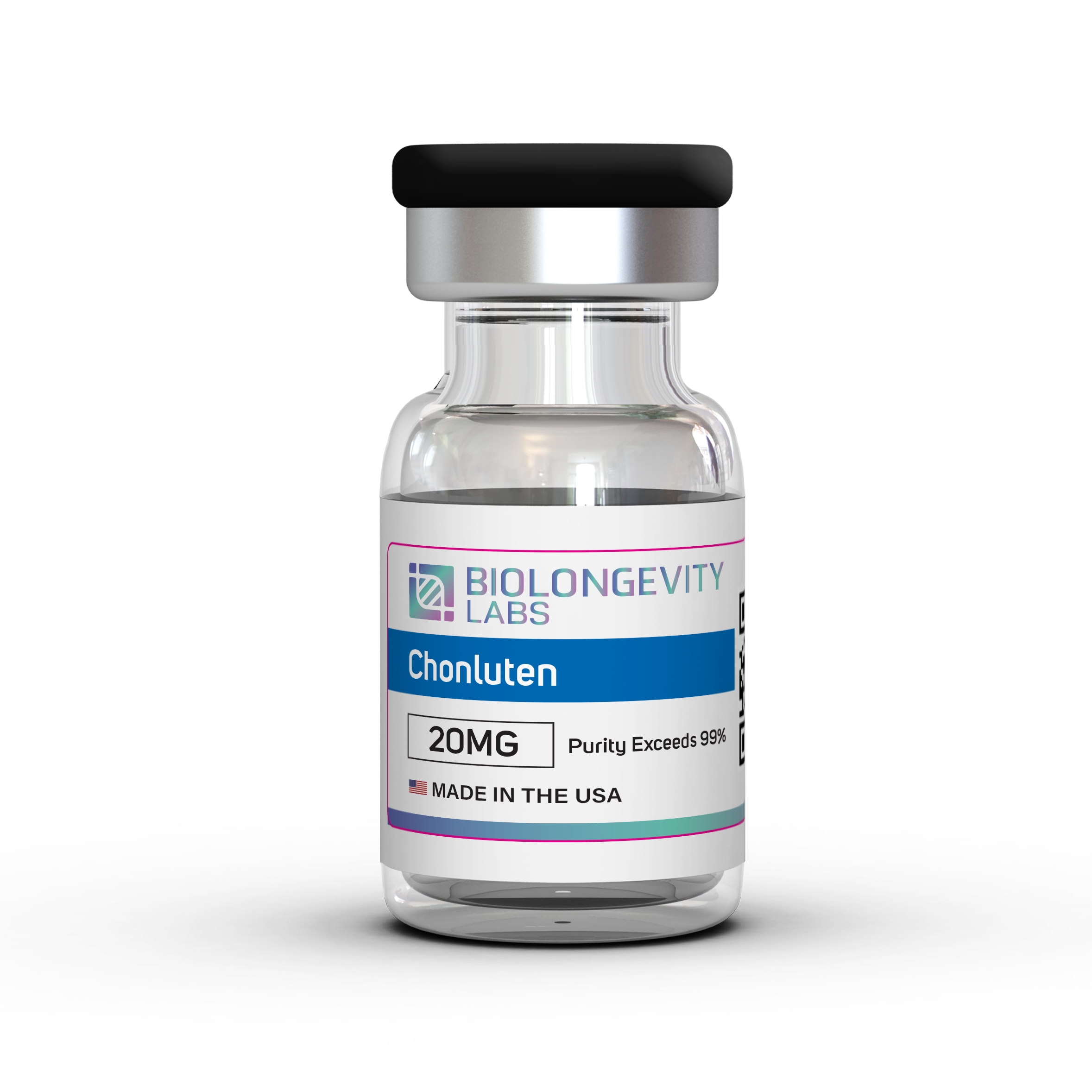
The standard listing is a 20 mg lyophilised vial, at prices I could verify from about $49 to $70.
- The sequence. Glu-Asp-Gly, EDG, three residues. A page printing Gly-Glu-Pro, Ala-Glu-Asp, or a string of twenty-five letters has not checked the one fact that defines its product. How to read a peptide COA covers what a real certificate shows; the mass should sit near 319 daltons.
- Whose study is being quoted. Bronchial epithelium, lung fibrosis, toxic lung injury: Bronchogen. Elderly mortality: Thymalin and Epithalamin. Cytokines in a dish: the one real Chonluten paper. A page that cannot keep these apart is not a page to buy from.
- Chonluten or Taxorest. Capsule protocols — "two capsules before breakfast" — belong to the Taxorest extract, a different product with a different (and also thin) record.
For a wider view of who is worth ordering from, our peptide vendor comparison covers the sources we have checked directly.
The Bottom Line on Chonluten Peptide
Chonluten is a lung peptide by label, a stomach peptide by its developers' account, and a monocyte peptide by its literature.
The fair version: the one real study is a genuine in-vitro anti-inflammatory result in human immune cells, and the gastric-ulcer work suggests the developers found something in the gut worth patenting. That is not nothing, and it is more than some shelf-mates have.
The equally fair version: nothing published on this peptide has ever involved a lung, an airway, an animal breathing, or a person; the respiratory evidence quoted for it belongs to Bronchogen; the mortality figure quoted for it belongs to the thymus and pineal extracts; and the pages selling it cannot agree on its three amino acids. If you buy it for your lungs, you are buying a label. The studies are somewhere else.
Frequently Asked Questions
Medical disclaimer. This article is informational and does not replace individual medical advice. Chonluten has no approved medical use, no published study in animals or people, and no pharmacokinetic data. Persistent cough, breathlessness and chest symptoms can indicate asthma, COPD, heart disease or lung cancer and need timely diagnosis; see a doctor before treating them with anything, and tell your doctor about any compound you are taking alongside prescription medication.