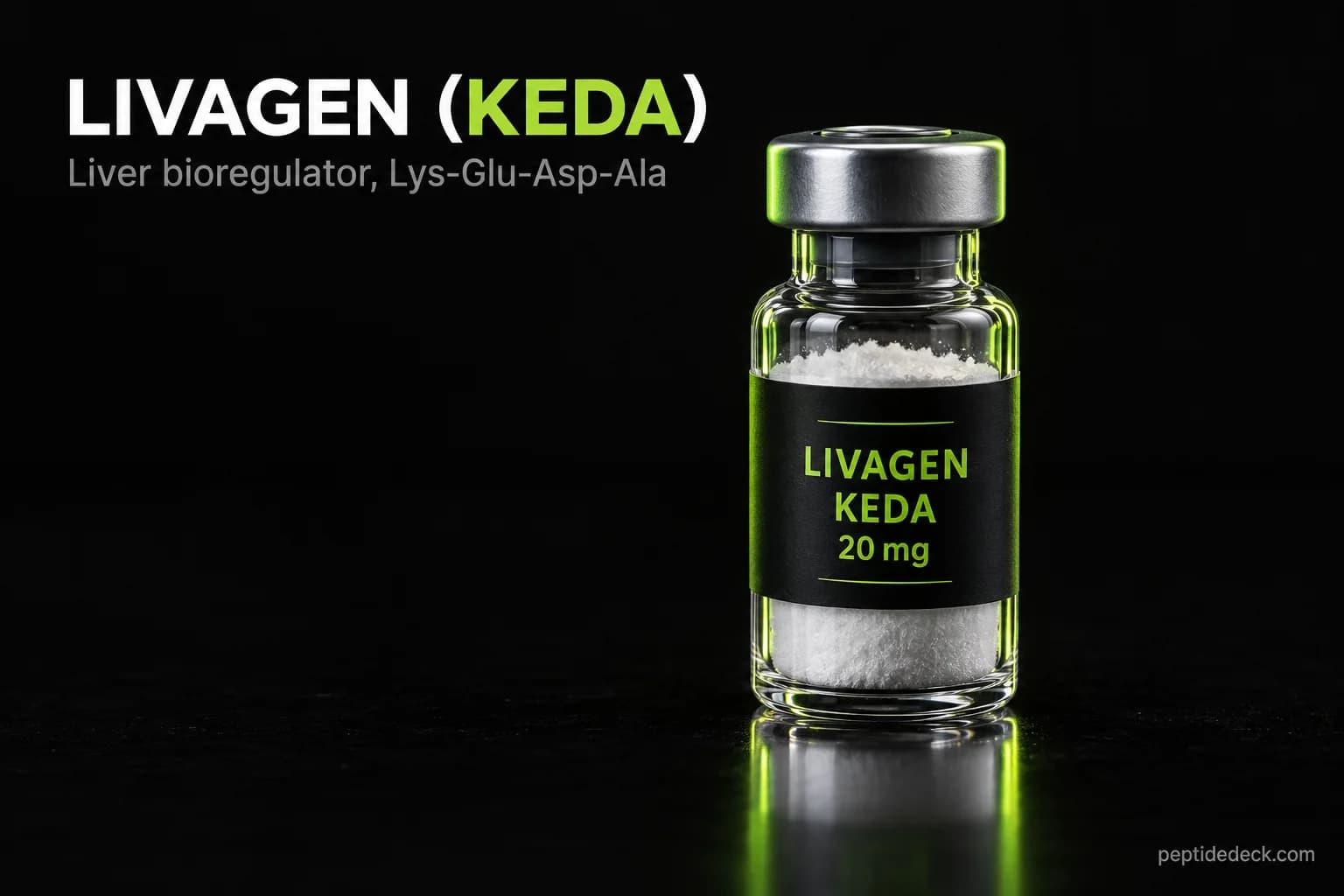
Half the guides have the organ wrong.
Search for this peptide and you will find it called a thymus peptide, a liver peptide, an immune peptide and a "proprietary" blend, sometimes on the same page. One widely shared guide gives it the two-amino-acid sequence of a completely different compound. If you have been trying to work out what Livagen peptide actually is before spending money on it, that confusion is not your fault.
It is also fixable, because the group that made Livagen wrote down exactly what they did. This guide starts there, then goes through every published study, the dose problem nobody flags, and what a fair expectation looks like.
🔑 Key Takeaways
- Livagen is a synthetic four-amino-acid peptide, Lys-Glu-Asp-Ala. It was built from an analysis of liver extract, not thymus — the primary paper says so, and the "thymus peptide" label is a copying error that spread.
- It has more published work behind it than most bioregulators: hepatocyte cultures, digestive enzymes after oral dosing, human blood serum, and white blood cells from people in their 80s and 90s.
- One finding matters more than the rest for anyone buying it: gut enzymes do not break Livagen down, which is unusual for a peptide and is the reason oral use is not automatically absurd here.
- Nobody has ever given Livagen to a human being and measured what happened. Every dose on every guide was invented, and they disagree with each other by a factor of 400.
- The strongest results came from cells taken from old donors and old animals. In young ones, it often did nothing — or nudged things the other way.
- What the evidence supports, what it does not, and how to tell a serious vendor from a copy-paste one, are all below.
Start with the question the top ten cannot agree on.
What Livagen Peptide Actually Is
A liver peptide. The record is unambiguous.
Livagen is lysine-glutamic acid-aspartic acid-alanine, written KEDA, one of the short synthetic bioregulators developed at the St Petersburg Institute of Bioregulation and Gerontology under Vladimir Khavinson. The 2005 paper that studied it in liver cells describes its origin in one sentence: the peptide was "obtained by directed chemical synthesis on the basis of amino acid analysis of the liver polypeptide preparations." The extract they analysed was Svetinorm, the Institute's liver product. Livagen is the defined-sequence stand-in for it.
So where does "thymus peptide" come from? Three of the ten top-ranking guides say it. One goes further and gives the sequence as Lys-Glu — a dipeptide. That is Vilon, the thymus bioregulator, a different molecule with a different name. Another guide calls the composition "proprietary," which for a four-letter sequence published twenty years ago is a polite way of saying the author did not look it up.
The confusion probably comes from the lymphocyte studies. Much of Livagen's published work was done on white blood cells, which are immune cells, and someone somewhere turned "studied on immune cells" into "an immune peptide." It is not. It just happened to be tested alongside its siblings on the tissue the researchers had in the fridge.
Two more names trap English readers, and they are worth clearing up here because they sit next to Livagen on every vendor shelf. Ovagen is also a liver and gastrointestinal product despite what it sounds like, and the sequence families overlap: Livagen and Pancragen share three of four amino acids and differ only in the last one.
What the Livagen Studies Actually Tested
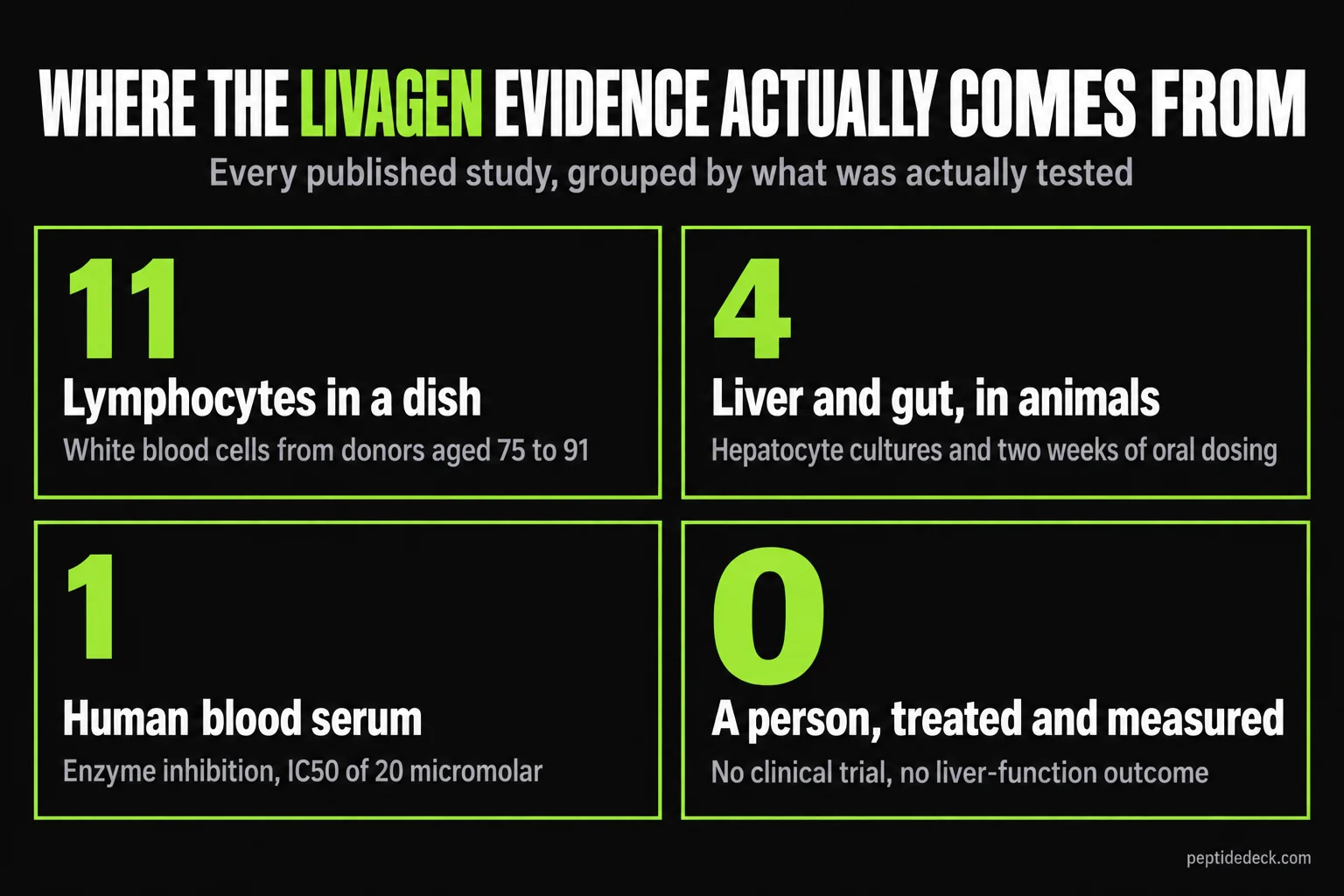
Seventeen papers. Here is what each kind of them did.
The liver work
This is the part that justifies the name, and it is genuinely interesting.
Liver cells were taken from animals aged one month to two years and grown in culture. Livagen raised protein synthesis in all of them, with the biggest effect in cells from the oldest animals, and in the old cells it also restored the amplitude of the roughly hourly rhythm that protein synthesis normally follows. The control was telling: Epitalon, the pineal bioregulator, was run through the same assay and did nothing to the liver cells. Whatever Livagen was doing there, its sibling was not.
A 2020 review from the same school pulled together work in models of liver fibrosis and hepatitis, reporting that Livagen and the liver extract it was designed from normalised immune and antioxidant markers and restored liver function, with the largest effect again in aged animals. Those are the papers behind every "supports liver function" claim you will read. They are real, they are in animals and cells, and they are all from one institute.
The gut finding almost nobody explains
Most peptides are destroyed in the gut. That is why so many are injected.
A 2005 study tested Livagen against the peptide-splitting enzymes of the small intestine and found they did not break it down — the authors call it "a weakly hydrolyzed peptide." Then they gave it orally for two weeks and measured digestive enzyme activity. In young animals, activity went down slightly. In old animals, it went up, and in most measures ended up close to where the young animals had started.
That pattern — nothing much in the young, normalisation in the old — repeats across the Livagen literature, and it is the single most useful thing to know before forming an expectation. It also means oral Livagen is not automatically nonsense the way oral use of most peptides is. Whether the amounts that survive are enough to do anything in a person is a separate question nobody has answered.
The blood serum finding
One study used human material, and it is easy to misread.
In human serum, Livagen inhibited the enzymes that break down enkephalins, the body's own opioid-like peptides, with an IC50 of 20 micromolar — twenty-five times more potent than Epitalon in the same test, and stronger than the standard inhibitors it was compared against. The authors then checked whether Livagen itself bound opioid receptors. It did not. This is a test tube result on blood outside a body, but it is the origin of every "pain modulation" and "mood" claim in circulation, and it is the one place the word "human" legitimately appears in the Livagen evidence.
The lymphocyte work
Eleven papers, one theme, stretching from 2003 to 2023.
White blood cells from people aged 75 to 91 were grown in culture and exposed to Livagen. Across the studies, tightly packed chromatin loosened, ribosomal genes reactivated, and regions of chromosomes 1 and 9 that condense with age decondensed. Later papers used cells from patients with hypertrophic cardiomyopathy, atherosclerosis and ductal breast cancer, and reported that Livagen had a "protective effect by all studied parameters" on the genomic instability those cells showed. In the cardiomyopathy study it was Epitalon, not Livagen, that came out most effective.
Impressive-sounding, and worth stating exactly what it is: cells in a dish, from old or sick donors, with chromatin markers measured. Not people treated. Not liver function measured. Not anything you would feel.
The number that frames everything above: a search of the global clinical trials registry returns zero registered trials for Livagen. Not one has been started, in any country, for any purpose. Seventeen papers, and none of them gave the peptide to a person.
Livagen Dosage: A 400x Disagreement
The ten top-ranking guides do not agree on the dose. They do not agree within an order of magnitude.
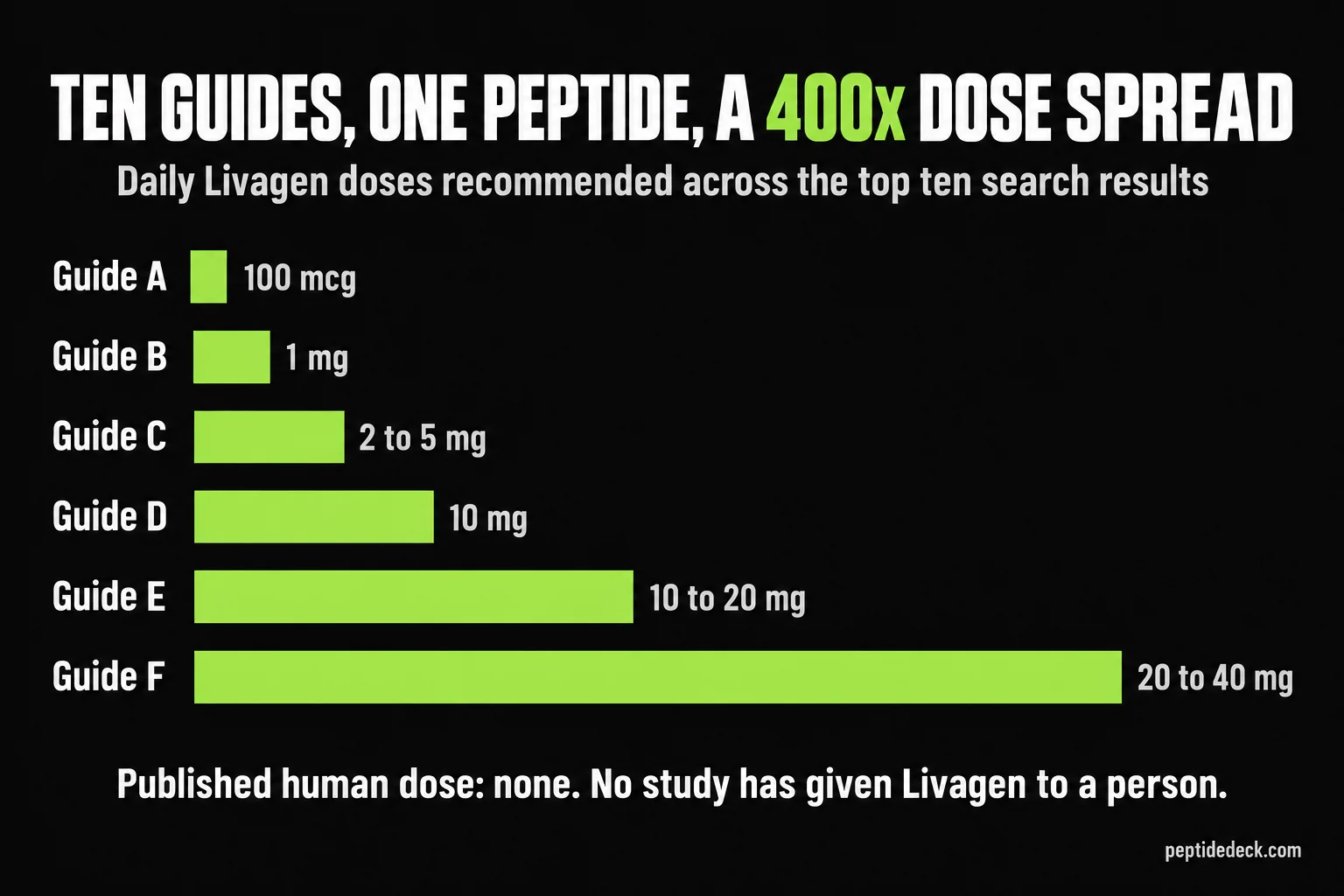
Here is what the top ten actually recommend, side by side:
- 100 to 200 micrograms a day, injected, for 10 to 20 days
- 1 mg a day, injected, for 10 days, every 3 to 6 months
- 2 to 5 mg a day, injected, for 10 to 20 days
- 1 to 5 mg a day, injected, for 10 days
- 10 to 20 mg a day, oral, for 10 to 30 days
- 20 to 40 mg a day, oral, for 10 to 30 days
From 100 micrograms to 40 milligrams is a 400-fold range. Two of these pages present their number with a reconstitution table and a syringe-unit conversion, which makes it look measured. It is not. None of them can be, because no study has ever administered Livagen to a human and published the amount.
What the numbers actually trace back to is the shape of the Khavinson capsule protocols — short courses of 10 to 20 days, repeated two or three times a year — with a milligram figure attached that fits the 20 mg vial the vendor sells. The cycle shape has a history. The milligrams are arithmetic on the packaging.
For that reason this page does not give you a dose. If you want the one honest anchor in the literature, it is this: in the oral study, the dose that normalised digestive enzymes in old animals was small enough that the authors led with the finding that the peptide survives the gut at all, not with the amount.
What People Take Livagen For, and What Holds Up
Match the claim to the evidence and most of the marketing thins out fast.
Notice the pattern in the first column. Where Livagen has real data, it is about the liver and the gut, exactly where its name points. The "thymus" and "immune" framing comes from the tissue used in the chromatin studies, not from anything measured about immunity.
Side Effects and Safety
Nothing has been measured, which is different from nothing having happened.
The guides list injection-site redness, mild fatigue, headache and occasional nausea. Those are the generic side effects of injecting any peptide at home, and none of them come from a Livagen study, because there is no Livagen study in people to take them from. There are no pharmacokinetic data by any route — nobody has published what blood level a dose produces or how long it lasts.
Two things belong specifically on a Livagen page:
- Chromatin loosening is not a free lunch. The whole proposed mechanism is switching silenced genes back on. Most of the silenced genes in an old cell are silenced for a reason, and one of the more careful guides in the top ten is right to raise the theoretical possibility of reactivating things that should stay off. Nobody has tested for this. The finding that Livagen had a "protective" effect on genomic instability in cells from breast cancer patients is encouraging on that specific point, and it is still one culture study.
- It touches liver enzymes and opioid-peptide breakdown. Both are pathways prescription drugs travel through. If you take anything metabolised by the liver, or anything acting on pain signalling, the interaction has not been studied and nobody can tell you it is fine.
Livagen vs the Rest of the Family
It sits near the top of the pile, and the pile is not tall.
Compared with its siblings, Livagen has a defined sequence, a documented origin, a tissue-specific result that a sibling failed to reproduce, an oral-survival finding, and seventeen papers. Prostamax has a handful of chromatin papers and nothing on the prostate. Pancragen has one small human study and a dose gap of two orders of magnitude. Livagen has no human study at all but a broader and more coherent animal-and-cell record than either. Our complete bioregulator guide ranks all twenty-five on exactly this kind of evidence.
If you are choosing between Livagen and Epitalon for the chromatin effect specifically, they are often studied together and behave similarly on lymphocytes, with Livagen more potent on serum enzymes and Epitalon more effective in the cardiomyopathy cells. In liver cells, only Livagen did anything.
Buying Livagen: What to Check
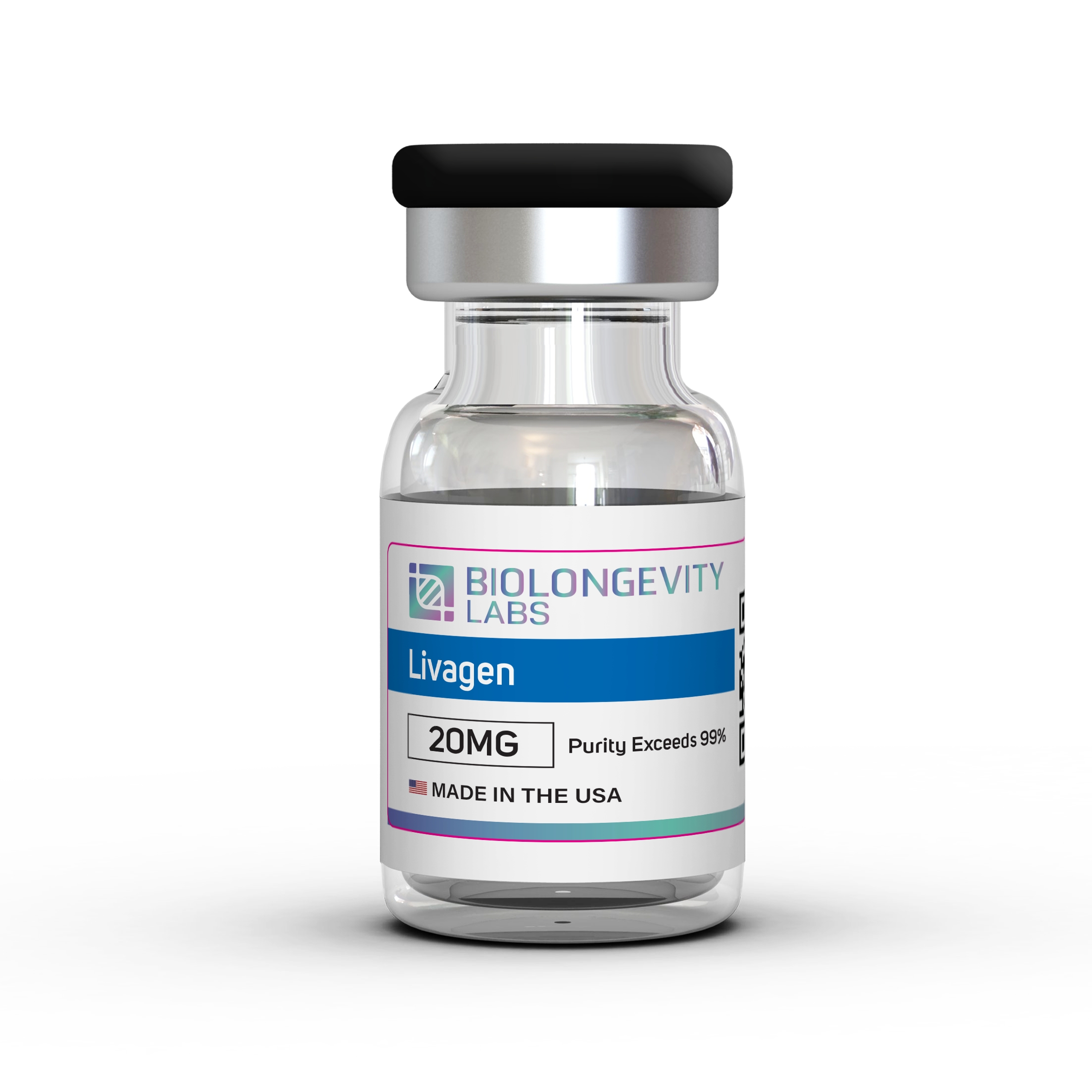
The standard listing is a 20 mg lyophilised vial, and the prices I could verify at the time of writing ran from about $60 to $80.
Given what the top ten get wrong, the checks here are unusually easy to run:
- The sequence on the page. It should read Lys-Glu-Asp-Ala or KEDA. A vendor describing Livagen as a "thymus peptide" or a "dipeptide" has copied a mistake and is unlikely to have checked anything else either.
- A lot-matched certificate of analysis. For the batch number on your vial, not a catalogue sample. How to read a peptide COA covers what a real one shows; the mass should sit near 461 daltons.
- The citations. One vendor in the top ten lists three PubMed IDs under its Livagen product as supporting research. I looked them up. They point to a paper on the legal doctrine of negligence, a study of how consumers buy houseplants, and a trial of antipsychotics in adolescents. Not one mentions Livagen. The real PubMed record is small enough to check in five minutes, and a vendor who has not done that has not checked its vials either.
For a wider view of who is worth ordering from, our peptide vendor comparison covers the sources we have checked directly.
The Bottom Line on Livagen Peptide
Livagen is a liver peptide with a real, narrow and rather interesting body of evidence, sold with a dose nobody has studied and an organ label half the internet has wrong.
The fair version: it survives the gut, which most peptides do not; it does something specific to old liver cells that its sibling does not; and it has a two-decade paper trail of loosening chromatin in cells from very old people. That is more than most compounds on the same shelf can say.
The equally fair version: none of that has ever been tested in a living person, the doses online were derived from the vial rather than the science, and "normalises old cells while doing little to young ones" is a pattern that should temper expectations for anyone under 60 buying it for a boost. Until someone measures a liver in a human, that is where the story ends.
Frequently Asked Questions
Medical disclaimer. This article is informational and does not replace individual medical advice. Livagen has no approved medical use, no published study in people, and no pharmacokinetic data. Liver symptoms and abnormal liver enzymes need a proper diagnosis; speak to a doctor before taking anything for them, and tell your doctor about any compound you are taking alongside prescription medication.