The heart peptide has never been tested on a heart.
Not a beating one. Cardiogen peptide is sold as the cardiac member of the Khavinson bioregulator family — for "cardiac tissue repair," "post-infarction recovery," "blood pressure regulation" — and its entire record in a living animal is a single study in which it was injected into old animals with a transplanted tumour. The tumour shrank. Nobody measured the heart.
That is not a reason to dismiss the compound. The tumour finding is genuinely interesting, and the tissue-culture work has a real signal in it. It is a reason to know exactly which claims have evidence behind them before you buy a vial for the organ on the label.
🔑 Key Takeaways
- Cardiogen is a synthetic four-amino-acid peptide, Ala-Glu-Asp-Arg, sold as the heart bioregulator of the Khavinson family.
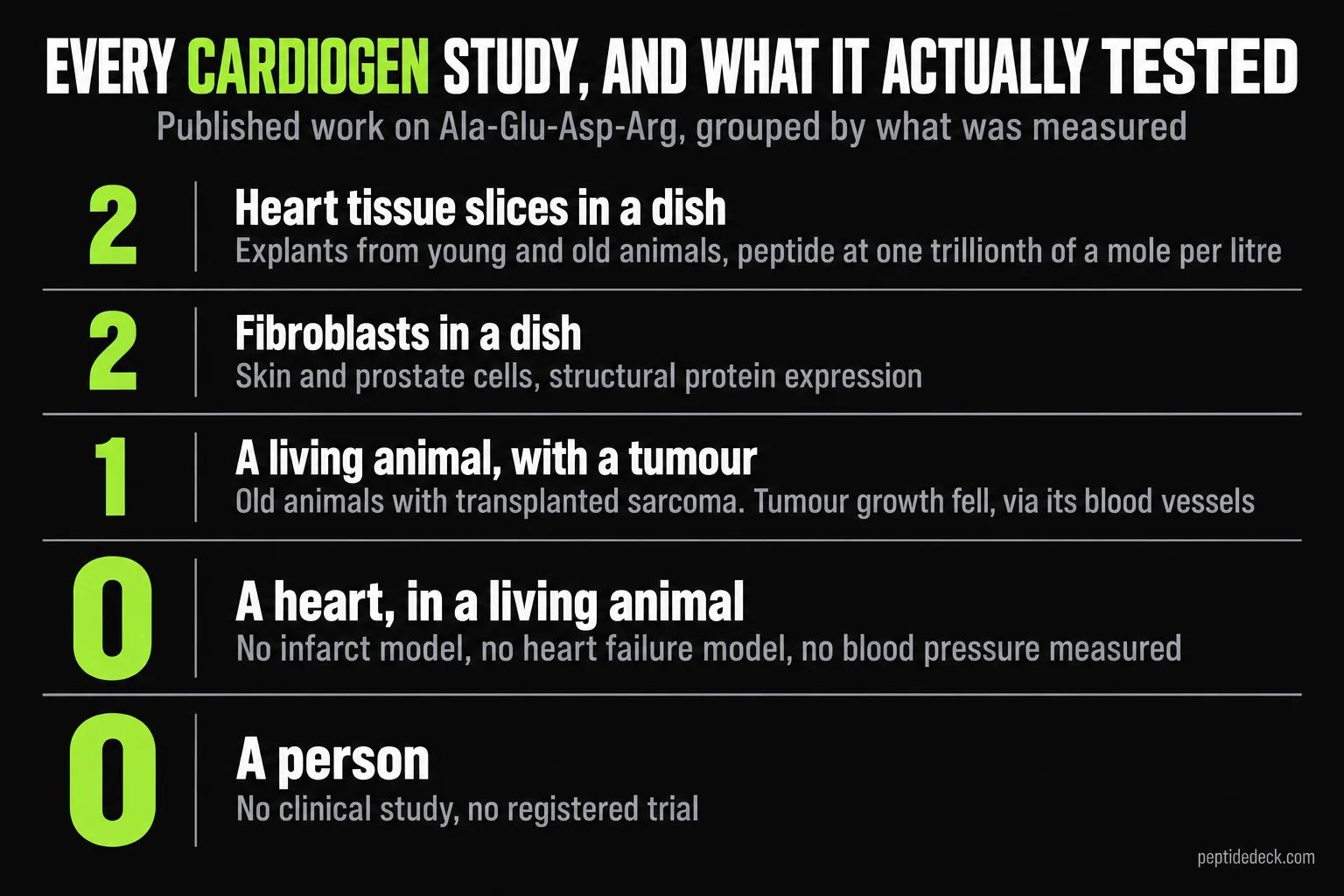
- Its heart evidence is two studies of heart-tissue slices in a dish, one at a concentration of a trillionth of a mole per litre. No study has tested it in a living heart, a heart attack model, or a person.
- The one living-animal study is a cancer study: in old animals with transplanted sarcoma, Cardiogen injections inhibited tumour growth by acting on the tumour's blood supply. Two of the top ten pages turn this into "anti-cancer properties."
- The developers' own 2022 review lists it as a "cardioprotector" and cites, for that claim, a US patent — not a study.
- The top ten recommend doses from 200 micrograms to 80 milligrams a day, and one page reports blood-pressure reductions in millimetres of mercury with no source.
- What the tissue work actually shows, why the tumour study cuts both ways, and how to check a vial, below.
Start with the one experiment that put this peptide into a living body.
What Cardiogen Peptide Is
Alanine, glutamic acid, aspartic acid, arginine.
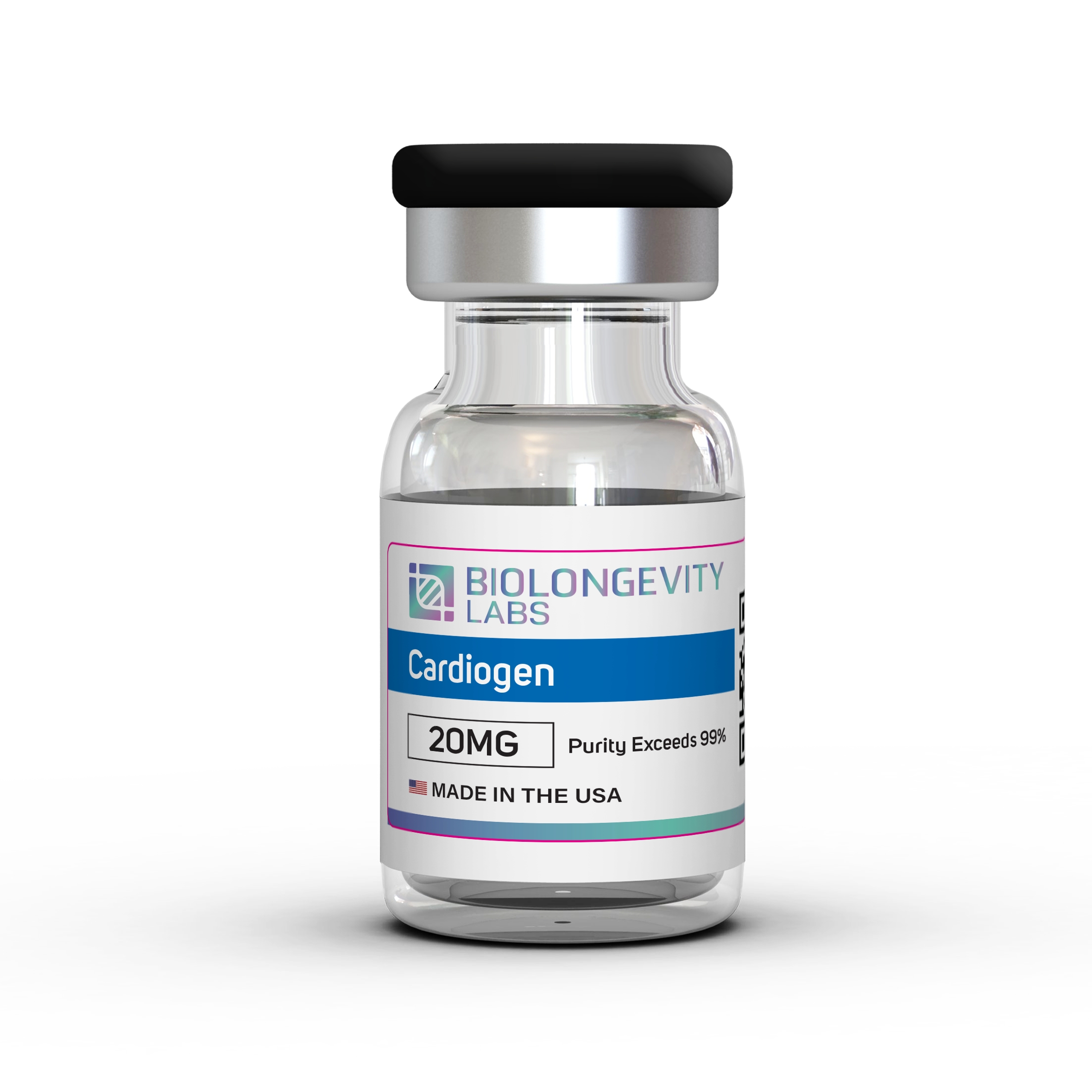
AEDR, about 489 daltons. It belongs to the short synthetic bioregulators developed at the St Petersburg Institute of Bioregulation and Gerontology under Vladimir Khavinson, the family that includes Vesugen for vessels, Pancragen for the pancreas and Prostamax for the prostate. Cardiogen is the one assigned to the heart, the synthetic counterpart to Chelohart, the Institute's heart-tissue extract. Vendors sell it as 20 mg of lyophilised powder for injection; the Institute's own reference material calls it "cardioprotector."
Two things about the name. First, one top-ranking guide says the sequence is "a dipeptide or tripeptide, exact sequence varies by formulation" — it does not vary; it is a tetrapeptide, AEDR, and a vendor that cannot state that has not checked. Second, the only "Cardiogen" with a registered clinical trial or an FDA approval is CardioGen-82, a rubidium-82 generator used for PET heart scans. It is a radioactive imaging agent, not a peptide, and a search of the trials registry for "cardiogen" returns it and nothing about this compound.
The Only Study in a Living Animal Was a Cancer Study
Old animals. A transplanted sarcoma. Cardiogen injections.
In 2009, researchers gave Cardiogen to aged animals carrying transplanted M-1 sarcoma and measured the tumour. Growth was inhibited in a dose-dependent way. The mechanism, on the tissue slides, was haemorrhagic necrosis and tumour-cell apoptosis — and the authors were specific that this was not a direct toxic effect on the tumour cells: "inhibition of tumor growth was not caused by the direct cytostatic effect of the drug on the tumor." Instead, the signs pointed to a "specific mechanism of cardiogen action, realized through the vascular network of the tumor." The peptide appeared to act on the tumour's blood vessels, and the tumour died back for lack of supply.
Two of the top ten pages present this as "emerging research on anti-cancer properties." It is worth reading the other way too. A compound whose one whole-animal effect is disrupting a tissue's vascular network has shown something about blood vessels, not about hearts — and "acts on the vasculature of growing tissue" is not obviously a property you want in a peptide injected for cardiac repair. Nobody has followed it up in either direction. It remains the only time Cardiogen has been given to a living animal in a published study.
What the Heart Studies Actually Are
Tissue in a dish, and a very small amount of peptide.
The heart-tissue cultures
Two papers form the whole cardiac record. In 2006, explants of heart, lung, prostate and pancreas from young and aged animals were grown in culture and exposed to Cardiogen, Bronchogen, Prostamax and Pancragen respectively, at 0.05 nanograms per millilitre. Each peptide stimulated growth in its "own" tissue. In 2009, myocardial explants from 3-month-old and 24-month-old animals were exposed to Cardiogen at a concentration of 10⁻¹² molar — a trillionth of a mole per litre. It stimulated cell proliferation in both young and old tissue, where only two of twenty individual amino acids managed the same in old tissue, and it lowered expression of p53, which the authors read as reduced apoptosis.
That is a coherent, tissue-specific signal, and it is a signal in a dish. No heart in a living animal has been given Cardiogen and measured — not after a heart attack, not in heart failure, not for blood pressure, not for rhythm. The picomolar concentration is also worth holding on to when you reach the dosing section: the peptide did something at one trillionth of a mole per litre in culture, and the vials sell 20 milligrams.
The fibroblast work
A 2012 paper reported that AEDR raised the expression of structural proteins — actin, tubulin, vimentin — by two to five times, and the nuclear-matrix proteins lamin A and C by two to three times, in cultured mouse embryonic fibroblasts; the authors proposed this as the basis of the "previously reported cardioprotective activity." A 2010 paper found Cardiogen, alongside Vesugen and another short peptide, raised differentiation markers in aging cultures of human prostate fibroblasts, with Vesugen the most active of the three. Both are mechanism papers; neither involves a heart.
The review
A 2022 review from the developers argues that senescent cardiovascular cells secrete an inflammatory cocktail — the "inflammaging" phenotype — and that vasoprotective peptides including Vesugen and AEDR regulate the molecules involved. It is a review of targets and prospects, and it cites the culture work above as its Cardiogen evidence.
The Cardioprotector Claim, Traced
Follow the citation and it ends at a patent office.
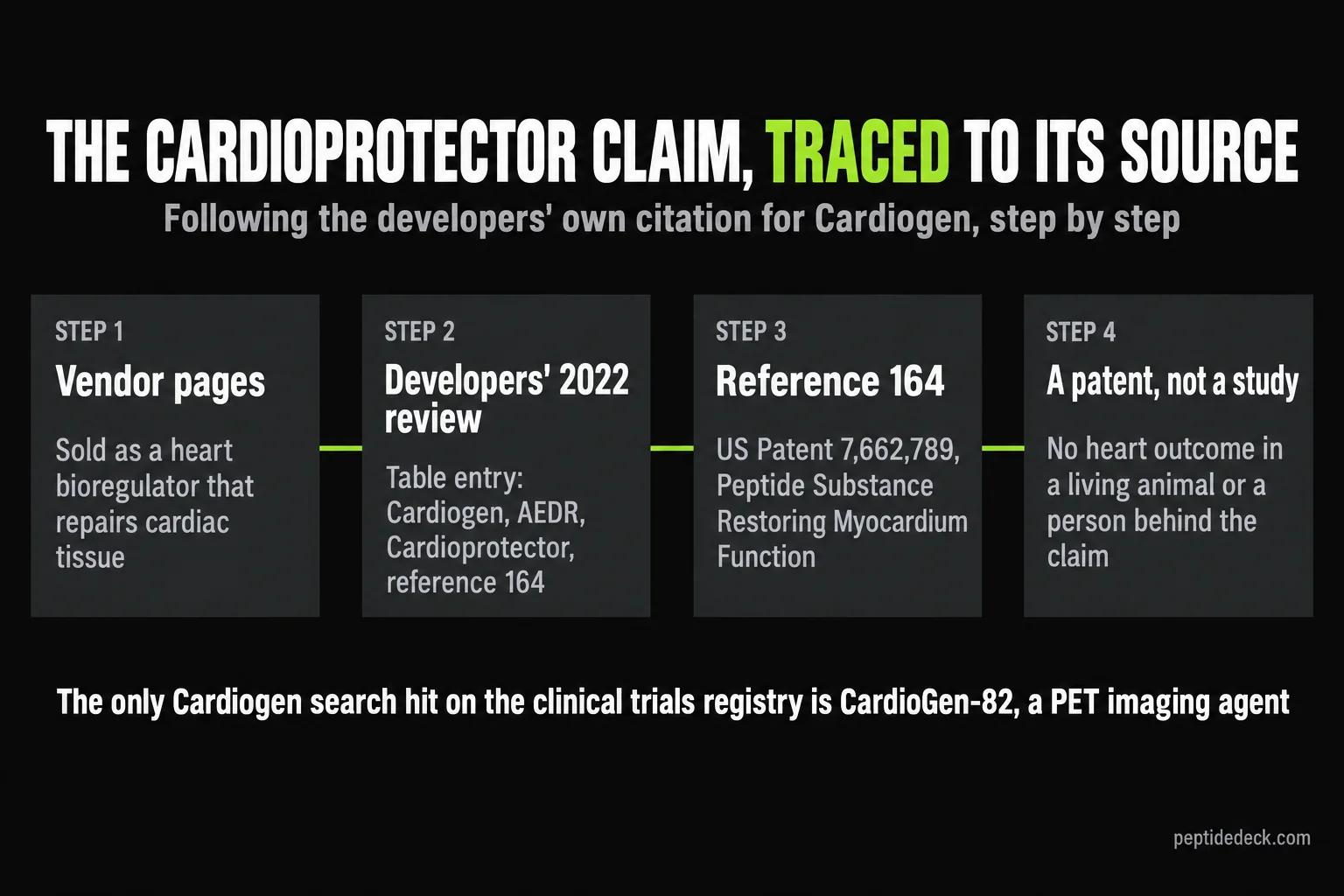
In 2022 the Khavinson group published a review tabling each of their short peptides against its function, with a reference for each. The Cardiogen row reads "Cardioprotector [164]." Reference 164 is "Peptide Substance Restoring Myocardium Function," United States Patent 7,662,789, granted in 2010. A patent is a legal claim of invention; it is not a study, it is not peer-reviewed, and it reports no outcome in an animal or a person. The 2021 systematic review from the same group cites two references for Cardiogen's "regulation of cardiovascular system function": a paper on peptides binding histone proteins in a test tube, and a review.
So the developers themselves, asked to support the label, produce a patent and a mechanism paper. Every vendor page then compresses that into "cardioprotective," "restores myocardium" and "post-infarction recovery." The words come from the patent's title.
The blood-pressure numbers. One top-ranking guide reports that Cardiogen produces "5 to 15 mmHg reduction in systolic blood pressure" and "3 to 10 mmHg reduction in diastolic," plus "improved ejection fraction in heart failure patients." It cites nothing, and no published study of AEDR has measured blood pressure or ejection fraction in anyone. Another guide describes "improved cardiac function markers over 12 months" and "30 years of clinical use," also uncited. There is no clinical use to cite; the compound is registered as a medicine nowhere. A third guide supports its "cardiac repair" section with a PubMed ID that resolves to a 1968 case report on Waldenström's disease in the kidney region — a paper with no connection to peptides, hearts or repair.
Cardiogen Dosage: 200 Micrograms to 80 Milligrams
No dose has ever been given to a person in a study. The guides supply six.
- 0.2 to 2 mg a day, injected, in 10 to 20 day courses — presented, to its credit, as "community-reported, no trial-established dose"
- 350 micrograms per injection, daily, for 10 weeks
- 10 mg a day, injected, for 10 to 20 days
- 10 to 20 mg, injected, every 3 to 7 days
- 10 to 20 mg a day, oral, for 10 to 20 days
- 20 to 80 mg a day in capsules, for 20 to 30 days
From 200 micrograms to 80 milligrams is a factor of four hundred. The capsule figures belong to Chelohart, the extract, whose capsule conventions have been transplanted onto a synthetic peptide. The injectable figures divide a 20 mg vial into plausible courses. None traces to a measurement, because the only measurements are a picomolar concentration in a dish and an unstated dose in tumour-bearing animals.
One page in the top ten says it plainly: "anyone presenting a precise optimal Cardiogen dose as established fact is overstating the evidence." That is the accurate position and this page takes it.
What People Buy Cardiogen For, and What the Evidence Says
The claims are cardiac. The data are not.
If the actual problem is a heart condition — high blood pressure, a prior infarction, heart failure — the treatments with decades of outcome data are the ones a cardiologist prescribes, and the honest thing to say about Cardiogen is that it has never been placed next to any of them, in any model, in anyone.
Side Effects and Safety
Unknown in people, and the animal data raise a question rather than answer one.
No study has given Cardiogen to a human, so the injection-site redness, fatigue and "temporary blood pressure fluctuation" listed on the guides are not observations of this compound. There are no pharmacokinetic data by any route. What the literature does contain is one whole-animal experiment in which the peptide's effect was to disrupt the blood supply of growing tissue — a tumour, in that case. Whether the same action would occur in other vascular beds, or in a heart that is trying to grow new vessels after injury, has not been tested.
Two points specific to this compound:
- Anyone with a heart condition is the last person who should guess. The peptide is marketed to people with cardiac disease and has never been tested in one, in any species. That is a reason to involve the cardiologist who is already managing the condition, not a reason to add a vial quietly.
- The tumour result is not a safety signal in either direction, and it is not nothing. A vascular mechanism in one tissue is a flag for the next experiment, which nobody has run.
Cardiogen vs Vesugen: The Family's Two Cardiovascular Peptides
They are tested together, and one of them has a human record.
Vesugen, Lys-Glu-Asp, has around 25 papers, three vascular culture studies, and two small uncontrolled human studies — one of which measured artery blood flow in 41 men. Cardiogen has five papers, no human study, and no living-heart study. When the two were compared directly in prostate fibroblast cultures, Vesugen was the more active. If your interest is blood vessels, the family's own evidence points at Vesugen. If your interest is the heart muscle, neither has been tested on one in a living animal, and only Cardiogen carries the name. Our complete bioregulator guide ranks all twenty-five on exactly this kind of comparison.
Buying Cardiogen: What to Check
The standard listing is a 20 mg lyophilised vial, at prices I could verify from about $50 to $70.
- The sequence. Ala-Glu-Asp-Arg. A page that says the sequence "varies by formulation," or prints a different final residue, has not checked what it sells. How to read a peptide COA covers what a real certificate shows; the mass should sit near 489 daltons.
- Cardiogen or Chelohart. Chelohart is the Institute's heart extract in capsules. Guides quoting "one to four capsules daily" or "20 to 80 mg" are describing the extract's convention, not a study of the synthetic peptide.
- What the page promises. Blood-pressure reductions in mmHg, ejection-fraction improvement, "30 years of clinical use" — none of these exist in the literature for this compound. A page stating them as findings is describing evidence it does not have.
For a wider view of who is worth ordering from, our peptide vendor comparison covers the sources we have checked directly.
The Bottom Line on Cardiogen Peptide
Cardiogen is a heart peptide with a tumour study, a patent, and two dishes of heart tissue behind it.
The fair version: the culture work is tissue-specific and repeatable within its own terms — heart explants respond to it at extraordinarily low concentrations, and old tissue responds when individual amino acids no longer do. The sarcoma study is a real whole-animal result with a real mechanism. Among the small bioregulators, that is not the thinnest record.
The equally fair version: none of it is a heart in a living body, none of it is a person, the developers support the "cardioprotector" label with a patent filing, and the blood-pressure and heart-failure claims on the pages selling it have no source at all. The one time this peptide was put into a living animal, it acted on blood vessels in a way that shrank a tumour — an intriguing finding, and not the one anyone buying a "heart bioregulator" was told about.
Frequently Asked Questions
Medical disclaimer. This article is informational and does not replace individual medical advice. Cardiogen has no approved medical use, no published study in people, no study in a living heart, and no pharmacokinetic data. Heart conditions, high blood pressure and chest symptoms need a proper diagnosis and treatments with outcome data behind them; speak to a doctor before taking anything for them, and tell your doctor about any compound you are taking alongside prescription medication.