Search for Ovagen studies and you get cows.
Not a metaphor. Type the name into PubMed and every result is about a veterinary hormone product used to make cattle and pigs ovulate, which happens to share the name. Not one paper about the peptide you were looking for. If you have been trying to find out whether Ovagen peptide actually does anything for the liver before buying a vial, that dead end is the first thing worth understanding, because it explains everything that follows.
The peptide does have published studies. They are filed under its sequence, not its name, and when you read them they are about a different organ from the one on the label.
🔑 Key Takeaways
- Ovagen is a synthetic three-amino-acid peptide, Glu-Asp-Leu, from the Khavinson bioregulator school. It is sold everywhere as a liver and gut bioregulator.
- Every published study of that sequence is a kidney study. The developers' own 2022 review lists it as a nephroprotector first, and the one citation behind the liver label is a patent, not a paper.
- The name "Ovagen" belongs to at least three unrelated things, which is why the research is nearly impossible to find and why one top-ranking guide contradicts itself about which organ it targets.
- Recommended doses across the top guides run from 10 micrograms to 200 milligrams a day. No human has ever been given it in a study.
- The kidney data is genuinely interesting, and it is not what anyone is buying it for.
- What the evidence actually supports, what the liver claims trace back to, and how to check a vial, below.
Begin with the name, because the name is the problem.
What Ovagen Peptide Is, and What Else Is Called Ovagen
Three amino acids: glutamic acid, aspartic acid, leucine.
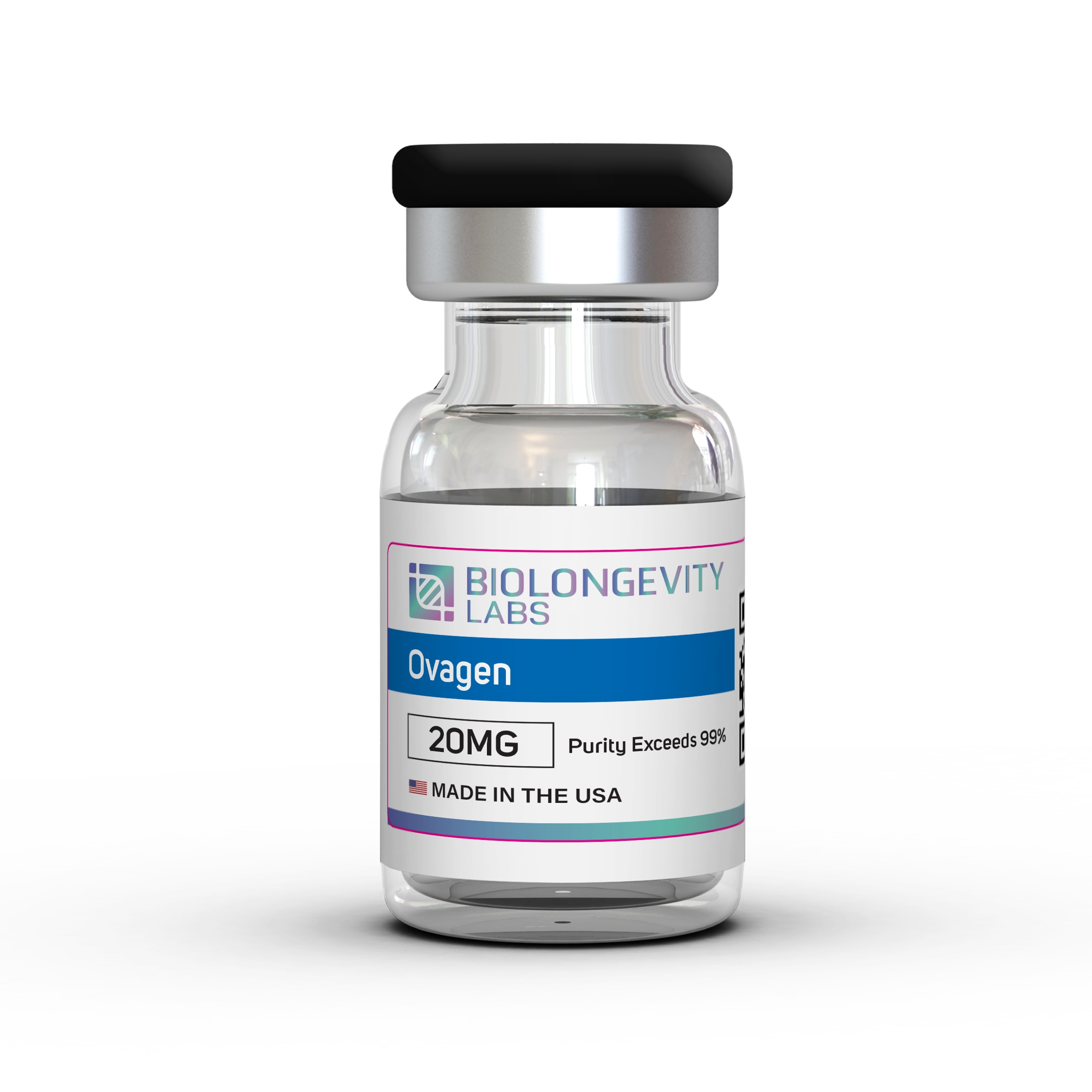
Written short, that is EDL, and the vials sold online contain that synthetic tripeptide, 375 daltons, usually 20 mg of it. It belongs to the family of ultrashort bioregulators developed at the St Petersburg Institute of Bioregulation and Gerontology under Vladimir Khavinson, alongside Livagen, Pancragen and Cartalax. Every vendor page and every guide in the top ten calls it a liver and gastrointestinal bioregulator.
Two other products carry the same name, and both will find you before the studies do.
- A veterinary hormone. Ovagen is a long-established follicle-stimulating hormone product used in animal breeding. It owns the PubMed search results: pig oocytes, beef cows, embryo freezing. None of it has anything to do with the peptide.
- A capsule supplement. A European brand sells "Ovagen Peptide Complex," sixty capsules of liver-tissue extract for around 95 euros, as a food supplement. That is a natural extract with no defined sequence — a different substance from the synthetic tripeptide in a vial, the same way the extract Svetinorm differs from Livagen.
The English name also misleads on its own. One top-ranking guide opens by calling Ovagen liver-derived and then, a few paragraphs later, redefines it as an ovarian peptide for reproductive function. It is not. The ovary product in this family is Zhenoluten. Ovagen has never been an ovary peptide; it just sounds like one.
What the Studies of This Peptide Actually Tested
Kidneys. All of them.
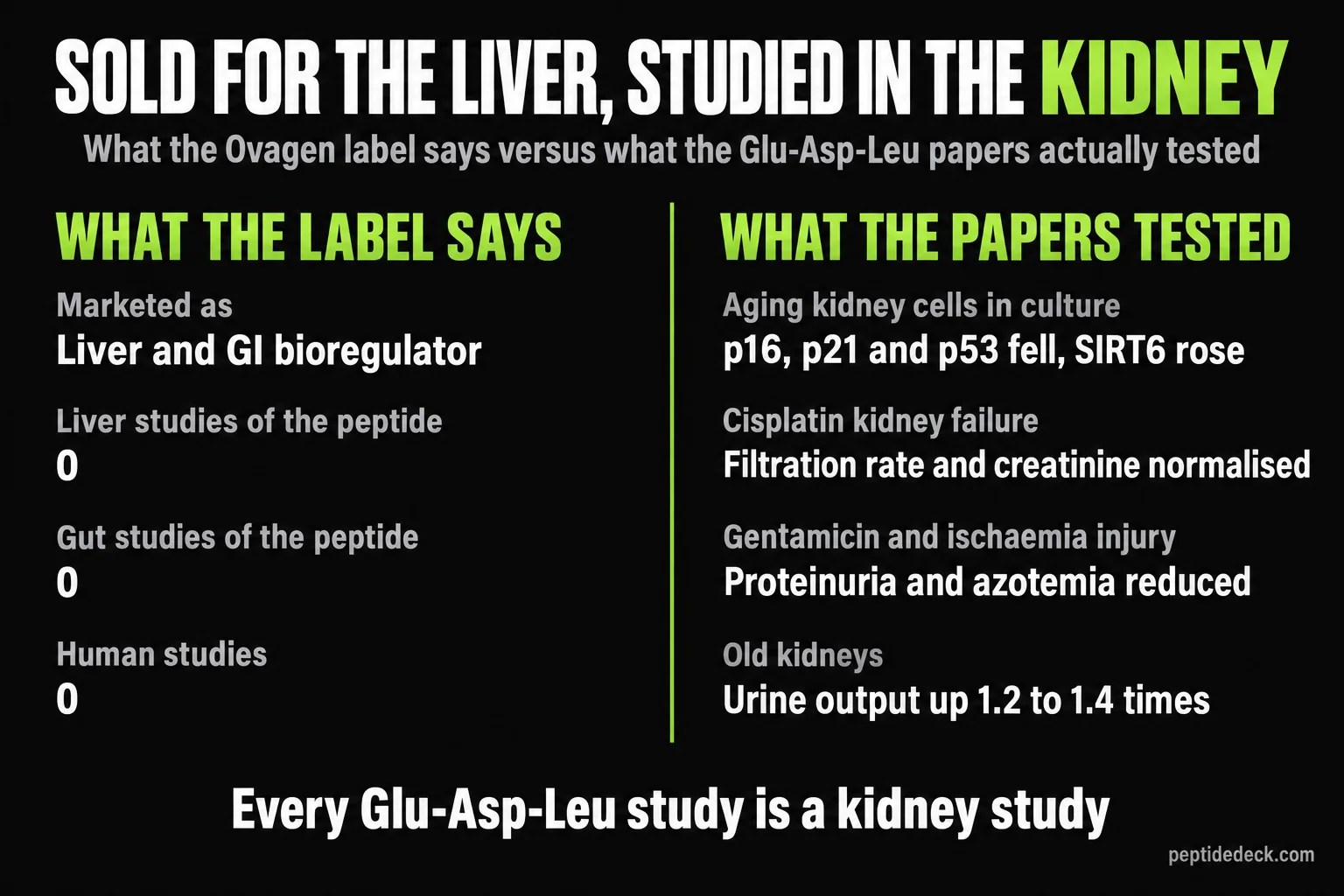
Because the name is unsearchable, you have to look the peptide up by sequence. Do that and four studies appear, all from the Khavinson school and a collaborating group in Ukraine, all about the kidney.
Aging kidney cells, 2015
In a culture of aging renal cells, EDL and its sibling AED (Cartalax) increased cell proliferation, lowered the expression of the aging markers p16, p21 and p53, and raised SIRT-6, whose decline is one driver of cell senescence. The authors then modelled how the peptides bind DNA and found the most favourable fit in the minor groove of a repeating AT sequence. This is the paper behind every "modulates aging genes" line you will read about Ovagen — and note which organ's cells it used.
Acute kidney failure, 2016
In cisplatin-induced acute renal failure, EDL normalised urine output, creatinine, glomerular filtration rate and sodium reabsorption, and reduced protein loss in the urine. The authors singled it out: EDL "produced a potent nephroprotective effect."
Two more kidney injuries, 2018
In gentamicin nephropathy and in ischaemia-reperfusion injury, EDL prevented the fall in urine output and the build-up of nitrogen waste, cut proteinuria, protected antioxidant enzymes and normalised the kidney cells' energy supply.
Old kidneys, 2019
In aged animals, EDL raised urine output by 1.2 to 1.4 times, increased distal sodium transport by 1.2 to 1.3 times and sodium excretion by 1.6 times.
That is the complete published record of Glu-Asp-Leu. It is a coherent, repeated, specific body of work — on an organ that appears nowhere on the product page.
Where the Liver Claim Comes From
A patent, cited once.
This is the part that took the longest to pin down, and it is the most useful thing on this page. In 2022 the Khavinson group published a review that tables every one of their short peptides against its function. The row for Ovagen reads, in order: nephroprotector, citing the 2018 kidney-injury paper, then hepatoprotector, citing a document titled "Peptide Stimulating Regeneration of Liver Tissue." That second citation is a patent. Their 2021 systematic review does the same: "regulation of renal cells' function" comes first, "hepatoprotection" second, and the only study reference is the kidney one.
So the developers themselves rank the kidney evidence ahead of the liver claim, and support the liver claim with a patent filing rather than a study. Every guide in the top ten inverts that: liver first, kidney as a footnote or not at all.
Where the dramatic liver numbers came from. One top-ranking guide reports an "18-fold increase in liver cell regeneration markers" and a "6-fold decrease in p53" for Ovagen, and describes clinical results in chronic hepatitis. None of it is cited. The only place p53 falls in the published Glu-Asp-Leu literature is the 2015 study — in kidney cells. If those figures have a source, it is not a study of this peptide, and the hepatitis results most closely resemble claims made for the liver extract Svetinorm, a different product.
Ovagen Dosage: From 10 Micrograms to 200 Milligrams
The top guides do not disagree about the dose. They disagree about the unit.
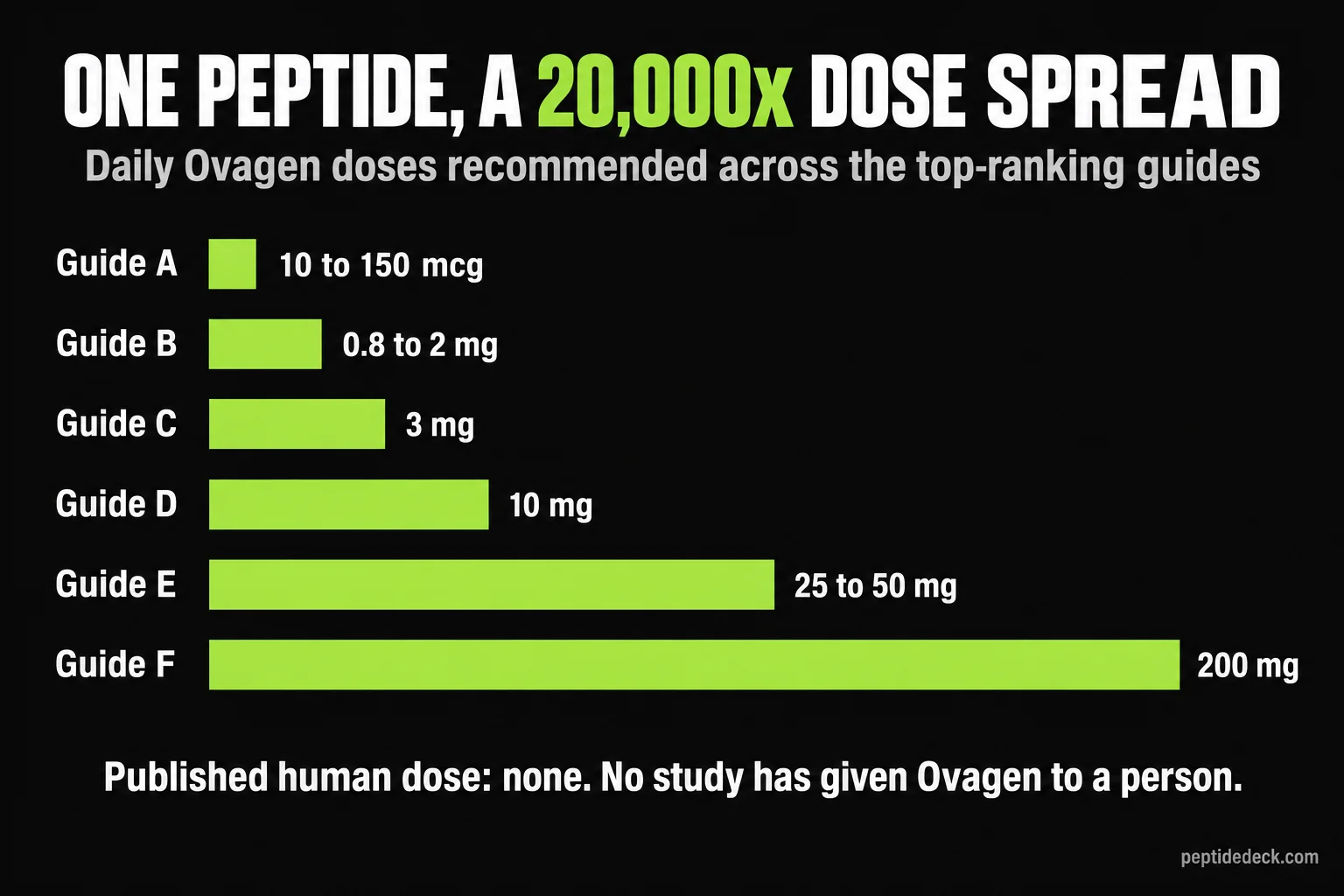
Here is the range, exactly as published:
- 10 to 150 micrograms a day, injected, titrated upward over 16 weeks
- 0.8 to 2 mg a day, injected, in one-month cycles
- 3 mg per injection, daily, for four weeks
- 10 mg a day, intramuscular, for 10 days, two or three courses a year
- 25 to 50 mg, oral, once or twice a day
- 200 mg a day as part of a three-peptide stack, for 20 to 30 days
Ten micrograms to two hundred milligrams is a factor of twenty thousand. Two of these pages supply a reconstitution table and a syringe-unit conversion, which lends the number an authority it has not earned, because no study has administered Glu-Asp-Leu to a human being. The kidney studies report animal doses that do not convert to a person, and the cell study reports concentrations in a dish.
Where the numbers actually come from is visible if you look at the shape of them. The short courses repeated two or three times a year are the Khavinson capsule pattern, borrowed from the extract products. The milligram figures are a 20 mg vial divided into something that looks reasonable. The microgram figures are a different guess about what "ultrashort peptide" implies. None of them is a measurement.
This page does not give you a dose, because there is not one to give.
What People Buy Ovagen For, and What the Evidence Says
Put the claims next to the studies and the mismatch is total.
Read the fifth row again. The one thing this peptide has repeated evidence for is the one thing no vendor page mentions. If you arrived here with a kidney question rather than a liver one, the literature is more relevant to you than it is to the people it is marketed at — and it is still animals and cells, with nothing in a person.
Side Effects and Safety
Nothing has been measured in a human, so nothing is known.
The side effects listed on the top guides — mild stomach upset, fatigue in the first days, a change in sleep — are generic peptide boilerplate. None comes from an Ovagen study, because there is none in people. There are no pharmacokinetic data by any route.
Two points are specific to this compound:
- It acts on the kidney, according to the only data there is. The studies show EDL changing urine output, sodium handling and filtration rate. Anyone with kidney disease, on diuretics, or on blood-pressure medication that works through the kidney has a specific reason to involve a doctor that a "liver peptide" label would never suggest.
- The 20 mg vial and the 10 mcg dose describe different experiments. A person following the microgram protocol and a person following the 200 mg stack are not doing similar things with a margin of error. They are doing things four orders of magnitude apart, and nobody can tell either of them what to expect.
Ovagen vs Livagen: Two Liver Peptides, One Set of Liver Studies
They sit side by side on every shelf and they are not equivalent.
Livagen, Lys-Glu-Asp-Ala, was designed from an analysis of liver extract, and its published work includes liver cell cultures, liver disease models, and an oral-dosing study showing it survives the gut. Ovagen, Glu-Asp-Leu, has no published liver work at all. If you are buying a bioregulator for the liver specifically, the evidence — thin as it is across the family — points at Livagen and not at Ovagen. Our complete bioregulator guide lays out all twenty-five on exactly this basis.
The interesting footnote is that EDL keeps turning up as the more potent kidney agent in head-to-head models, ahead of Cartalax and the kidney extract it was tested beside. Whether that ever becomes a use is a different question from whether it is a liver peptide, and the answer to the second one is that nobody has checked.
Buying Ovagen: What to Check
The standard listing is a 20 mg lyophilised vial, and prices I could verify at the time of writing ran from about $49 to $80.
Given how this compound is marketed, three checks matter:
- Which Ovagen you are buying. A vial of synthetic Glu-Asp-Leu, a capsule of liver extract, and a veterinary hormone all carry the name. If the listing does not say EDL or Glu-Asp-Leu, you do not know which one it is.
- A lot-matched certificate of analysis with the mass on it. Glu-Asp-Leu should come in near 375 daltons. How to read a peptide COA covers what a real certificate shows. Some vendors also disclose the trifluoroacetate counterion content, which matters for anyone using the material in cell work; most do not.
- What the page claims. A listing describing liver regeneration results, fibrosis reversal or hepatitis outcomes for this peptide is describing studies that do not exist. That tells you how carefully the rest of the page was written.
For a wider view of who is worth ordering from, our peptide vendor comparison covers the sources we have checked directly.
The Bottom Line on Ovagen Peptide
Ovagen is a kidney-studied tripeptide sold as a liver peptide under a name shared with a cattle hormone.
The fair version: the Glu-Asp-Leu literature is real, specific and repeated — four studies in which it protected kidney function across three kinds of injury and aging, and lowered aging markers in kidney cells. Among the smaller bioregulators, that is a respectable record.
The equally fair version: none of it concerns the liver or the gut, none of it is in a person, the developers themselves support the liver label with a patent rather than a paper, and the doses in circulation span four orders of magnitude because none of them was ever measured. If you want a liver bioregulator with actual liver studies, that is Livagen. If you want to know what Ovagen does, the honest answer is that it has only ever been shown to do something to a kidney.
Frequently Asked Questions
Medical disclaimer. This article is informational and does not replace individual medical advice. Ovagen has no approved medical use, no published study in people, and no pharmacokinetic data. Liver or kidney symptoms and abnormal blood tests need a proper diagnosis; speak to a doctor before taking anything for them, and tell your doctor about any compound you are taking alongside prescription medication.