Swap one amino acid and the effect vanishes.
That is the most useful thing anyone has published about Cortagen peptide, and no page selling it mentions it. In the one experiment where Cortagen was run side by side with Epitalon — identical except for the last of four amino acids — Epitalon restored blood counts, immunity and clotting in birds whose pituitary had been removed, and Cortagen changed nothing at all. Same lab, same animals, same forty days.
Hold that in mind, because it cuts two ways. It is the best evidence in the whole bioregulator family that these tiny peptides are genuinely specific. It is also a warning about how little you can borrow from one to another — and Cortagen's reputation is largely borrowed from Cortexin, the brain extract it was designed to imitate.
🔑 Key Takeaways
- Cortagen is a synthetic four-amino-acid peptide, Ala-Glu-Asp-Pro, built from amino acid analysis of Cortexin, a cow-brain extract that is a registered drug in Russia. Cortagen itself is registered nowhere.
- It has a real animal record: a sciatic-nerve repair study, two chronic brain-ischaemia studies, a gene-expression screen, and behavioural work in mice. All of it is animals and cells.
- The "27% and 40%" nerve figures on every guide come from one study of sixteen animals in 2000, at 10 micrograms per kilogram — about 0.8 mg for an 80 kg adult, not the 10 to 20 mg some pages recommend.
- The developers' own 2022 table lists Cortagen as a neuroprotector and cites, for that, a Vesugen blood-vessel paper and a review. Neither is a Cortagen brain study.
- Two guides quote "40 to 60 percent less neuronal death" and "30 years of clinical safety data." Neither exists in the literature.
- What the nerve, ischaemia and behaviour studies actually found, how Cortagen differs from Cortexin, and what to check before buying, below.
Start with where the molecule came from, because its evidence and its reputation come from two different places.
What Cortagen Peptide Is
Alanine, glutamic acid, aspartic acid, proline.
AEDP, 430 daltons, and in the Russian literature also "cortagene" or "Korthagen." Its origin is stated in a 2004 paper from its developers: it "was obtained by directed synthesis based on amino acid analysis of natural brain cortex peptide preparation Cortexin." Cortexin is a mixture of peptides extracted from cattle brain cortex, and it is a genuine registered medicine in Russia, used in neurology clinics for decades. Cortagen is the four-amino-acid synthetic distilled from it, and it has never been registered as a medicine anywhere. Wikipedia files it under "drugs with no legal status."
That distinction is the spine of everything that follows. Cortexin has human clinical use. Cortagen has studies in animals. When a guide describes Cortagen's "30 years of clinical use," it is describing Cortexin.
Cortagen also differs from Epitalon, Ala-Glu-Asp-Gly, by a single terminal residue — glycine swapped for proline. The two are structural twins, and as the chicken experiment below shows, the swap is not cosmetic.
The Nerve Study Everyone Quotes
Sixteen animals, one cut nerve, ten days.
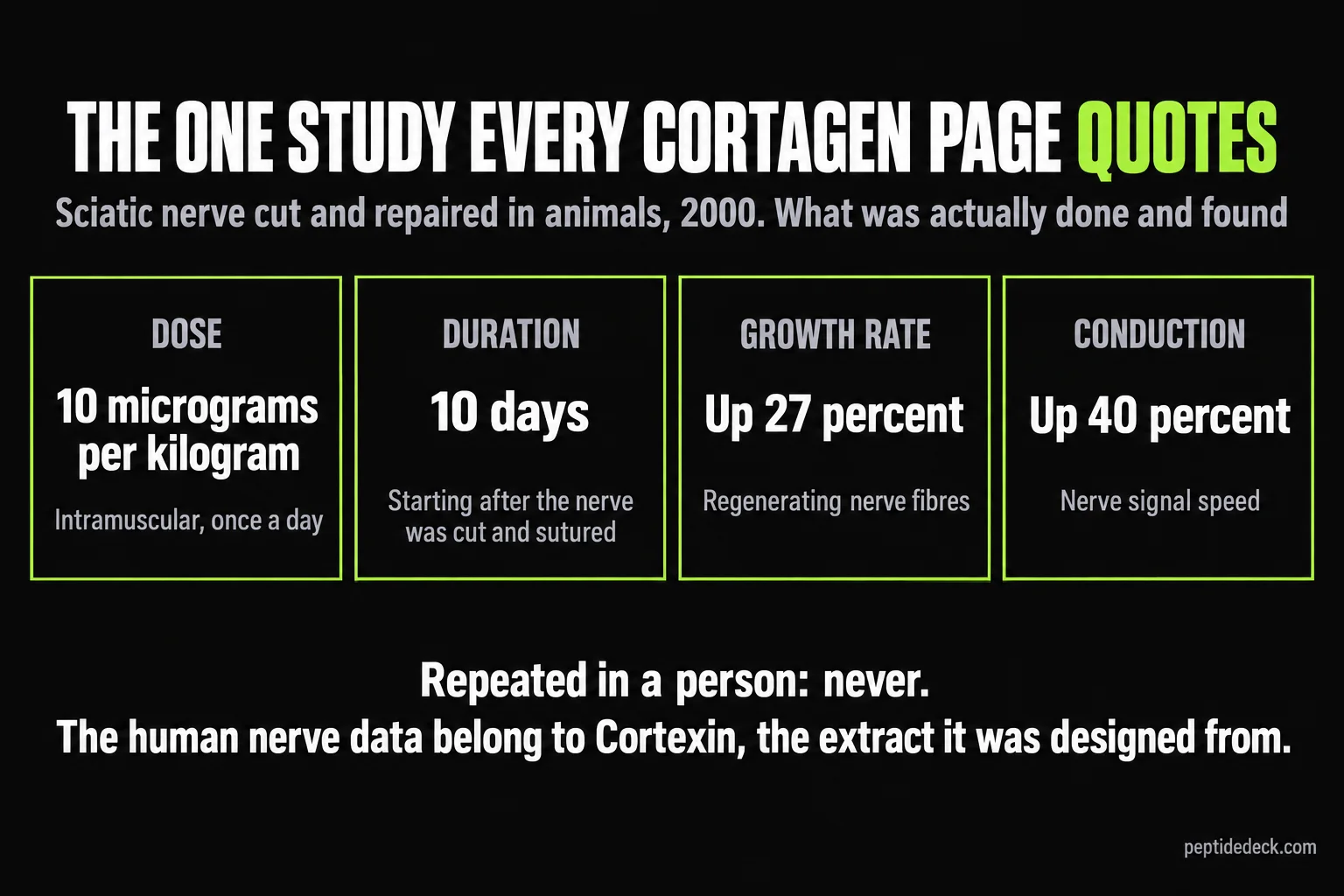
In 2000, researchers cut and sutured the sciatic nerve in animals and then injected Cortagen intramuscularly at 10 micrograms per kilogram, once a day, for ten days. Regenerating fibres grew 27% faster and conducted signals 40% faster than in untreated animals. A 2002 follow-up from the same group reported a delayed effect on the recovery of function in the injured nerve.
That is a real, specific, favourable result, and it is the single strongest thing about Cortagen. It is also one experiment on sixteen animals, never repeated by anyone else, never extended to a person. The 2004 microarray paper from the developers asserts in passing that "in humans, Cortagen demonstrated a pronounced therapeutic effect upon the structural and functional posttraumatic recovery of peripheral nerve tissue" — but cites no study for it, and none is indexed. Human nerve-injury work in this tradition was done with Cortexin.
Two numbers from the nerve study matter for buyers. The dose was 10 micrograms per kilogram, which for an 80 kg adult is about 0.8 mg — a figure several guides do convert correctly, and several inflate to 10 to 20 mg. And the route was intramuscular injection into an animal with an acute surgical injury, which is not the situation of a person taking it for "brain fog."
The Rest of the Animal Record
Brain ischaemia, gene screens, and mouse behaviour.
Chronic brain ischaemia
Two studies, in 2011 and 2016, gave Cortexin and Cortagen to animals with chronic reduced blood flow to the brain. Both compounds accelerated recovery of normal behaviour and prevented the runaway lipid peroxidation and loss of antioxidant capacity that ischaemia produces in brain tissue. The 2016 paper describes this as an antioxidant action during ischaemic preconditioning. This is the basis of the "neuroprotective" label, and it is the second-best evidence for the compound — again in animals, and again with Cortexin doing the same thing alongside.
Free radicals, with a twist
A 2007 study found that Epitalon and Cortagen injections lowered lipid-peroxidation products and oxidative protein damage in serum and cerebral cortex. The same sentence adds that this "was paralleled by suppression of antioxidant activity." The compounds reduced oxidative damage while also reducing the body's own antioxidant defences — an ambiguous result that guides summarise simply as "antioxidant."
The heart gene screen
In 2004, mice received 0.1 micrograms of Cortagen a day for five days — a fraction of a milligram per kilogram — and their heart tissue was screened across 15,247 transcripts. Expression changed in 234 of them, 110 of them known genes, with the largest rise 5.4-fold and the largest fall 2.9-fold. This is the source of the "influences over 100 genes" line. It is a description of what changed, in a heart, in a mouse, after five days; it is not evidence that any of those changes are good.
Behaviour in mice
A 2011 study in an open-access journal not indexed on PubMed gave mice Cortagen or Cortexin at 0.01, 0.03 or 0.1 mg/kg and watched them in an open field and an elevated maze. Cortagen changed locomotion dose-dependently, with 0.03 mg/kg described as the optimum, and some repeated-dose conditions produced anxiety-like behaviour. This is the origin of the "0.03 mg/kg optimal dose" that circulates — an optimum for mouse locomotion, not for anything a person would take it for.
Immune cells and chromatin
Cortagen modulated interleukin-2 gene expression in hypothalamic cells and cultured splenocytes, more weakly than Vilon or Epitalon in the same experiments, and in lymphocytes from people aged 75 to 88 it loosened age-condensed chromatin alongside Epitalon, Livagen and Vilon. That last set — cultured white blood cells from elderly donors — is the only place human tissue appears in the Cortagen literature.
One Amino Acid Apart: The Experiment That Should Be Famous
The clearest test of what Cortagen does came from testing what it does not.
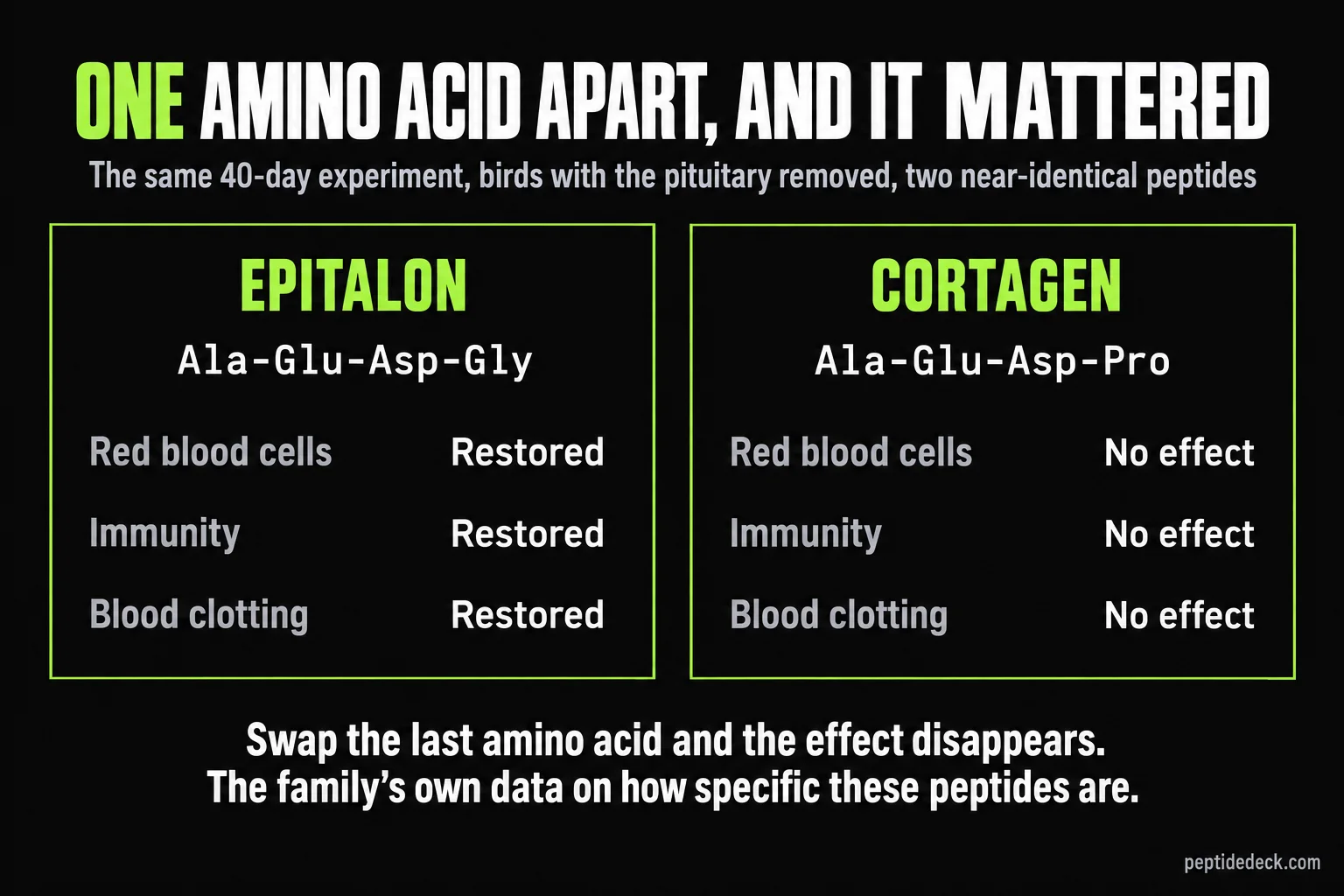
In 2008, researchers removed the pituitary gland from newly hatched chickens and from old birds. The birds developed anaemia, cellular and humoral immune deficiency, hypercoagulation and suppressed fibrinolysis. Then they were given either Epitalon or Cortagen for forty days. Epitalon "completely eliminated" the shifts in red blood cells, immunity and haemostasis. Cortagen — "distinguished from epithalon by a different terminal aminoacid" — did "not affect the parameters studied." Nothing. On any measure.
Read charitably, this is the strongest demonstration in the family that a four-letter peptide can be exquisitely specific: change one letter and a powerful effect disappears. Read as a buyer, it is a caution against every page that treats these compounds as interchangeable "bioregulators" with generic anti-aging, immune and vitality benefits. Cortagen has a nerve result and an ischaemia result. It does not have Epitalon's results, and the one time they were tested head to head on the same outcomes, it did not come close.
What the developers cite, and what they don't. The Khavinson group's 2022 review tables its peptides against function with references. The row for Korthagen, their spelling of Cortagen, reads "Neuroprotector" and cites two papers: a study of Vesugen raising Ki-67 in blood-vessel cells, and a review of peptides and cell differentiation. Neither is a Cortagen study and neither involves a brain. The nerve paper, the ischaemia papers and the chicken paper — the actual Cortagen evidence — are not the ones cited for the label.
Cortagen Dosage: From 200 Micrograms to 20 Milligrams
The animal literature gives real numbers. The guides mostly ignore them.
- 200 to 400 micrograms a day, injected
- 0.1 to 1 mg a day, injected; "10 micrograms per kilogram" cited, with 1 mg for people under 100 kg
- 1 to 2 mg a day, injected, in 10 to 20 day courses
- 1 mg to 2 mg a day, titrated over four weeks
- 1 to 10 mg a day, injected
- 10 to 20 mg a day, oral or sublingual, in 10 to 30 day cycles
The nerve study used 10 micrograms per kilogram; the behaviour study found 0.03 mg/kg optimal for mouse locomotion; the heart screen used 0.1 microgram per animal. A guide that converts 10 mcg/kg to roughly 1 mg for an adult is at least reasoning from the literature. A guide recommending 10 to 20 mg a day is recommending ten to twenty times the highest animal dose ever published, on no basis except the size of the vial. Between the smallest and largest recommendation is a factor of about 200.
None of these has been given to a human in a study. This page does not add a seventh number.
What People Take Cortagen For, and What Holds Up
Here the animal record actually lines up with some of the claims — and not with others.
The pattern is unusual for this family: the two things Cortagen is actually sold for — nerve and brain protection — are the two things it has animal data for. What it does not have is a single measurement in a person, and the generic bioregulator extras stapled onto every listing are, in Cortagen's case, contradicted by its own record.
Side Effects and Safety
No human data, and one animal signal worth knowing.
No study has given Cortagen to a person, so the headaches, dizziness and stomach discomfort on the guides are not observations of this compound, and there are no pharmacokinetic data by any route. The claim of "30 years of clinical safety data" refers to Cortexin, a different product delivered differently.
Two points specific to Cortagen:
- The mouse behaviour study found anxiety-like effects under some repeated-dose conditions. For a compound people buy to feel sharper and calmer, an anxiogenic signal at certain doses in the only behavioural work that exists is not nothing, and it is not on the vendor pages.
- "Antioxidant" came with suppressed antioxidant defences. The 2007 study is routinely summarised as protective. The full sentence is more mixed, and nobody has followed it up.
Cortagen vs Cortexin: The Extract Has the Human Record
They are sold as the same thing in two forms. They are not.
Cortexin is a registered neurological drug in Russia, given by intramuscular injection in clinics, with decades of human use and a literature of its own. Cortagen is the synthetic fragment designed from it. In the studies in animals where both were used — the ischaemia work and the mouse behaviour study — they behaved similarly but not identically, and in the behaviour study their profiles diverged. Every human claim on a Cortagen page traces to Cortexin. If you want the compound with clinical history, it is the extract, and it is a prescription medicine in the country that uses it. Our complete bioregulator guide lays out the extract-versus-synthetic split across all twenty-five compounds.
Against its sibling Pinealon, Glu-Asp-Arg, the brain peptide with the larger recent literature, Cortagen has the better nerve-injury result and Pinealon has the far better dendritic-spine and Alzheimer's-model record. Against Epitalon, the chicken experiment settles which one has systemic effects.
Buying Cortagen: What to Check
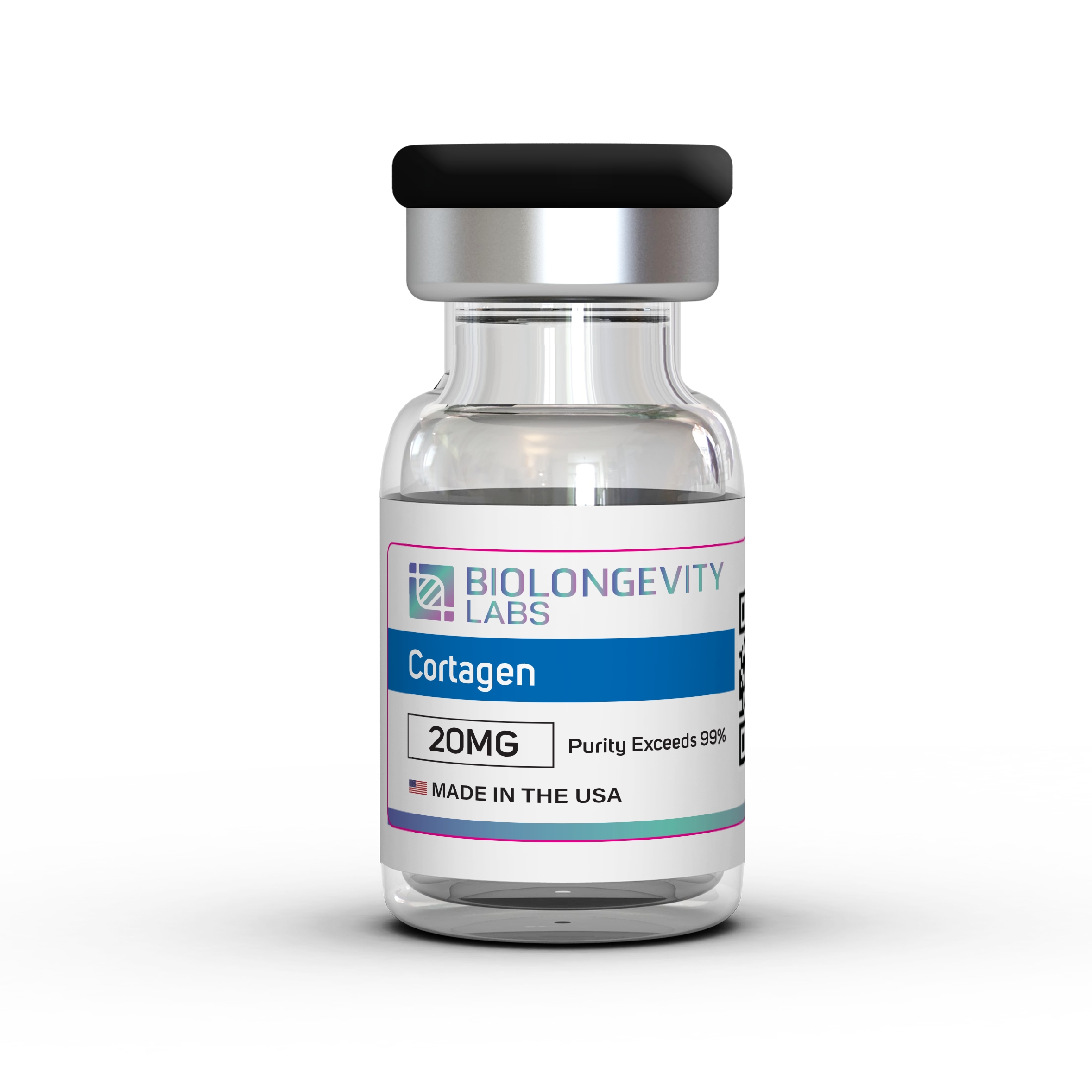
The standard listing is a 20 mg lyophilised vial, at prices I could verify from about $45 to $70.
- The sequence and the mass. Ala-Glu-Asp-Pro, about 430 daltons. It is one letter from Epitalon (Ala-Glu-Asp-Gly, 390 daltons) and easy to confuse on a label; the certificate of analysis is the only thing that distinguishes them. How to read a peptide COA covers what a real one shows.
- Cortagen or Cortexin. If a page's evidence is "clinical use," "patients," or "30 years," it is describing the extract. The synthetic peptide's evidence is sixteen animals with a cut nerve, and it should be sold as that.
- The dose logic. A page that reasons from 10 micrograms per kilogram is reading the study. A page recommending 10 to 20 mg a day is reading the vial.
- The reference list. One vendor page that ranks for this term lists seven PubMed numbers under its Cortagen studies. I looked all seven up. Two are real Cortagen papers. The other five are a 1991 paper on fat and muscle in newborn infants, a news piece on a genome-sequencing debate, a heart-imaging study in the elderly, a paper on pulmonary hypertension, and a survey of a Venezuelan tree frog. To its credit, the same page states plainly that no human trial of Cortagen has been published and that no other laboratory has replicated the work — which is more than most guides admit, and also exactly why the reference list should have been checked.
For a wider view of who is worth ordering from, our peptide vendor comparison covers the sources we have checked directly.
The Bottom Line on Cortagen Peptide
Cortagen is a brain peptide with a genuinely good nerve-injury result in animals, a reputation borrowed from the extract it came from, and a sibling that outperformed it on every shared measure.
The fair version: a 27% faster regrowth rate and 40% faster conduction after nerve repair is a real finding, the ischaemia protection was reproduced twice, and at fifteen papers Cortagen is among the better-documented compounds on the shelf. If any small bioregulator deserved a proper trial in peripheral nerve injury, this is a candidate.
The equally fair version: no person has ever received it in a published study, the developers cite other peptides' papers for its label, the "neuronal death" and "clinical safety" figures on the guides do not exist, and when it was tested beside Epitalon on blood, immunity and clotting it did nothing while its twin fixed everything. That experiment is the truest thing about how specific — and how narrow — a four-amino-acid peptide can be.
Frequently Asked Questions
Medical disclaimer. This article is informational and does not replace individual medical advice. Cortagen has no approved medical use, no published study in people, and no pharmacokinetic data; the clinical history often attributed to it belongs to Cortexin, a different product. Nerve injury, cognitive symptoms and signs of reduced blood flow to the brain need a proper diagnosis; speak to a doctor before taking anything for them, and tell your doctor about any compound you are taking alongside prescription medication.