Oral MOTS-c sounds like the obvious fix.
Nobody wants to inject something three times a week, which is why "oral MOTS-c" gets searched every month. Tablets, capsules, mouth strips and nasal sprays all promise the same thing: the mitochondrial peptide people talk about for energy and metabolic health, without the needle. We checked what each form actually contains, what the science says about swallowing or spraying a 16-amino-acid peptide, and which mouse study tried oral MOTS-c directly. The result was not close.
🔑 Key Takeaways
- Your gut is built to break peptides into pieces, and MOTS-c has at least six spots where its main enzymes typically cut.
- The one study that fed plain MOTS-c to mice found it did nothing. What the same team did next is telling.
- Nasal sprays skip the stomach, but approved nasal peptide drugs still deliver only a few percent of the dose.
- Several "tablet" and "capsule" listings don't hold up when you read the label closely.
- There is a free, needle-free way to raise MOTS-c that has actually been measured in people.
Below: why peptides get injected in the first place, the oral and nasal MOTS-c evidence (all of it), what online capsules and sprays contain and cost per milligram, how each route compares in one table, and the honest verdict.
Can You Take MOTS-c Orally? The Short Answer
Technically yes. Usefully, almost certainly not.
You can swallow anything. The question is whether enough intact MOTS-c survives your stomach and gut wall to reach your muscles, where it is thought to work. For plain MOTS-c taken by mouth, the only direct test we could find says it does not. No study in people has measured oral, sublingual or nasal MOTS-c at all.
That puts oral MOTS-c in an odd spot. The injectable form has its own big evidence gap: native MOTS-c has never been tested in a human clinical trial (our MOTS-c peptide guide covers what is and isn't known). Oral MOTS-c starts from that gap and then adds a delivery problem on top of it.
Why Peptides Like MOTS-c Get Injected
Your digestive system treats peptides as food.
If you have ever wondered why insulin, Ozempic and almost every other peptide drug comes in a pen, this is the reason. Protein in a steak and a peptide in a capsule look much the same to your gut, and your gut's job is to chop both into single amino acids. Three barriers stand in the way:
- Stomach acid and pepsin. The acid unfolds peptides and pepsin starts cutting them, especially near bulky amino acids such as phenylalanine, tyrosine, tryptophan and leucine. MOTS-c has five of those in 16 positions.
- Pancreatic enzymes in the small intestine. Trypsin cuts after arginine and lysine; chymotrypsin cuts after tryptophan, tyrosine and phenylalanine. Applying those standard rules to the MOTS-c sequence (MRWQEMGYIFYPRKLR) gives three trypsin sites, after positions 2, 13 and 14, and three chymotrypsin sites, after positions 3, 8 and 10. That is our own reading of the sequence, not a measured digestion, but it means a single pass through the gut has many ways to break the chain.
- The gut wall and the liver. Any fragment that survives still has to cross the intestinal lining, which lets through small molecules far more easily than a peptide of about 2,175 daltons. Whatever gets across goes to the liver first, which clears more before the rest reaches your circulation.
Injection skips all three. A shot under the skin puts the whole dose into tissue that drains straight into the blood. That is why the positive MOTS-c studies in mice, and the human study of its analog, used a needle.
What Studies Show About Oral MOTS-c
There is exactly one direct test.
In 2023, a team at Lanzhou and Xuzhou universities in China studied MOTS-c in mice with chemically induced colitis, an inflammatory bowel disease model. Injected into the abdomen, MOTS-c clearly helped: less weight loss, less diarrhea, longer colons and less tissue damage. Then they tried giving it by mouth. In the abstract's words, "oral administration of MOTS-c did not result in any significant improvements" (Jiang 2023, PMID 36528071).
Sit with that for a moment. Colitis is a disease of the gut itself. If plain MOTS-c can't help the very tissue it passes through when swallowed, the case for it reaching your leg muscles is weak.
What the team did next is the interesting part. They attached a cell-penetrating tag, a chain of five proline-arginine-arginine repeats written (PRR)5, to the end of MOTS-c. The new molecule, which they called MP, lasted longer in lab tests and worked when given by mouth. MP is not MOTS-c, though. It is a different molecule, nobody sells it as a supplement, and it has never been tested in people.
The same group reported something similar for the brain in 2021. Plain MOTS-c injected into the body did not cross into the brain of mice; the tagged MP version did, including when given into the nose (Jiang 2021, PMID 33861582). Again, that is a modified analog, not the peptide in a vendor's spray.
Reviews reach the same place. A 2023 review in Metabolites notes that gut enzymes and the low permeability of the intestinal lining "may make MOTS-c unable to be administered orally" (Gao 2023, PMID 36677050). And the only MOTS-c-related molecule ever tested in people, CohBar's analog CB4211, was given by injection under the skin: 25 mg once a day for four weeks in 20 people with obesity and fatty liver, with mild injection-site reactions as the main side effect (CohBar press release, August 2021).
How Much of an Oral Peptide Reaches Your Blood?
We can't answer this for MOTS-c. Nobody has measured it.
We can show what happens with peptide drugs that regulators have approved, because their labels have to report it. These numbers come from FDA and UK prescribing information, and each one is the share of the dose that reaches the bloodstream.
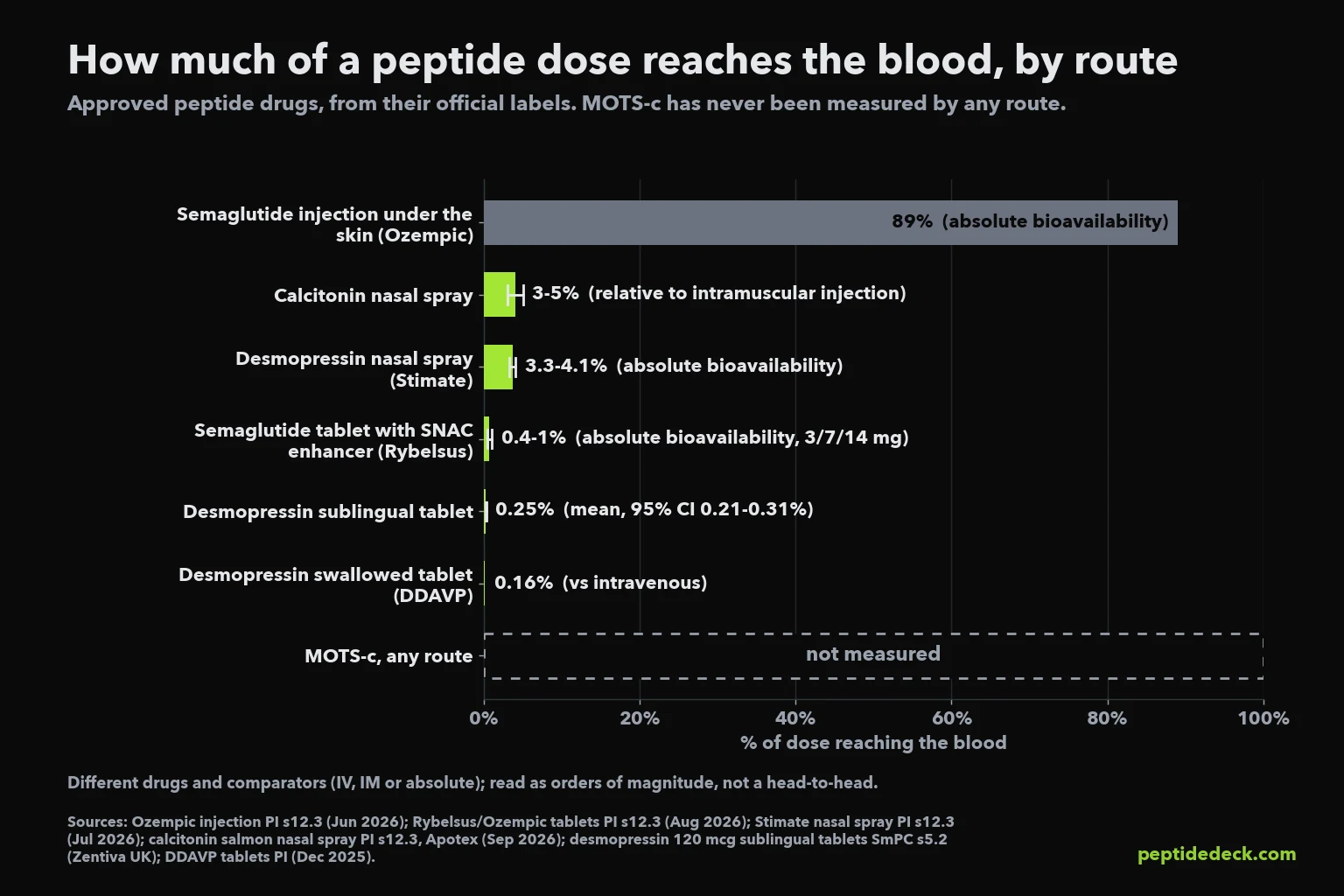
Three things jump out.
Swallowed peptides lose almost everything. A desmopressin tablet delivers about 0.16% of what the same drug delivers into a vein, per the DDAVP label. Desmopressin is only 9 amino acids long, and it was designed to resist breakdown better than the hormone it copies.
The one big oral success needed a special helper. Semaglutide tablets (Rybelsus) are co-formulated with an absorption enhancer called SNAC, and still only 0.4% to 1% gets in. That is why the tablet is taken at up to 14 mg every day, 98 mg a week, while the injection tops out at 2 mg a week. The injected version is 89% bioavailable. Semaglutide also carries a fatty-acid chain that protects it. MOTS-c capsules have neither the enhancer nor the protective chemistry. (If you're curious how that trade-off plays out, see our oral vs injectable semaglutide comparison.)
Under the tongue is no shortcut. Sublingual desmopressin tablets reach a mean 0.25%, per the UK product information. Barely better than swallowing.
What's Actually in MOTS-c Capsules, Tablets and Strips Sold Online?
Less than the search volume suggests.
"MOTS-c tablets" gets about 390 US searches a month on Google, more than any other oral term. We looked for an actual MOTS-c tablet in October 2026 and didn't find one. Search results for that phrase lead almost entirely to injectable vials. Here is what we did find for the oral and needle-free forms, with seller names left out:
Prices were checked on October 20, 2026. A few patterns are worth knowing before you buy any of these.
The capsule numbers don't add up. A bottle labelled 600 mg of MOTS-c holds as much peptide as 60 standard 10 mg vials. Either it was priced far below what every vial seller charges, or the label overstated what was inside. With no batch lab report on the listing, there was no way to tell, and the listing has since disappeared.
"Per labelled mg" is not "per mg that reaches you." A spray at $4.67 per mg looks cheaper than a vial at list price. But if only a few percent of a nasal dose gets absorbed, as with approved nasal peptide drugs, the cost per absorbed milligram is many times higher than the injection's.
Missing information is the information. No milligrams per strip, no ingredient list, no route on a spray, a lab report that disagrees with the label: each of those would be a red flag on a vial, and they are red flags here too.
MOTS-c Nasal Spray: Does It Work?
It is the most plausible needle-free option. That's a low bar.
The nose has real advantages for drug delivery. The lining is thin and full of blood vessels, there is no stomach acid, and whatever is absorbed skips the liver on its first pass. That is why several peptide drugs are sold as nasal sprays, and a 2018 review of the field found peptides up to about 6,000 daltons have been delivered this way (Al Bakri 2018, PMID 30173579). MOTS-c, at about 2,175 daltons, is well inside that range.
Size isn't the problem. Absorption is. The approved nasal peptides on the chart above get 3% to 5% of their dose into the blood, and they come in formulations that companies spent years tuning. A MOTS-c spray made from powder dissolved in saline has had none of that work, and no study has measured how much MOTS-c a person absorbs through the nose.
Here's what that means in practice. The house injection plan in our MOTS-c dosage chart is 5 mg per dose. If a MOTS-c spray absorbed as well as nasal calcitonin, 3% to 5%, you would need to spray roughly 100 to 170 mg to get 5 mg into your blood. That is 400 to 670 sprays of vendor C's 250 mcg spray, five to eight full bottles, for one dose. Real absorption could be better or worse; nobody has checked. For scale, one seller suggests 2 to 4 sprays of 250 mcg once or twice a day. That adds up to 0.5 to 2 mg sprayed a day, before any loss to absorption.
One more caution. MOTS-c contains two methionines, and the anti-doping lab that built a blood test for it found two oxidation products as well as four breakdown fragments (Knoop 2019, PMID 30394592). A peptide that sits dissolved at room temperature in a spray bottle for weeks has more time to degrade than a freeze-dried powder kept in the fridge.
Sublingual and Liposomal MOTS-c
Both are marketing words, not data.
Sublingual. One telehealth page claims sublingual peptides reach "10% to 50%" of injection levels, with no source. The best real-world benchmark we found says otherwise: sublingual desmopressin, a smaller peptide built for this route, averages 0.25% (95% confidence interval 0.21% to 0.31%) in its UK product information. We found no study of MOTS-c under the tongue in any species.
Liposomal. Wrapping a peptide in fat bubbles is a real idea in drug delivery, and plenty of supplements now carry the word. For MOTS-c, we found no published study, in people or mice, of a liposomal form taken by mouth. The one oral peptide pill that has made it through the FDA, semaglutide, works through an absorption enhancer rather than liposomes, and still only gets 1% or less into the blood. Until a seller can show blood levels from its own product, "liposomal" on a MOTS-c label is a promise without a measurement.
Oral vs Nasal vs Injectable MOTS-c: Side by Side
Here is every route in one place.
If you want the broader version of this comparison across other peptides, our guide to oral vs injectable peptides covers the general rules, and BPC-157 oral vs injection covers the one popular peptide with a real argument for oral use.
The Natural Way to Raise MOTS-c: Exercise
Your body already makes MOTS-c. Hard exercise turns it up.
This is the part most oral MOTS-c pages skip. In the 2021 Nature Communications paper that made MOTS-c famous, researchers in New Zealand had 10 sedentary, healthy young men (average age 24.5) do 10 one-minute cycling sprints at their peak power, with 75 seconds of easy pedalling between each (Reynolds 2021, PMID 33473109). Muscle biopsies and blood draws showed:
- MOTS-c in thigh muscle rose 11.9-fold right after the session, and was trending back toward baseline 4 hours later.
- MOTS-c in the blood rose 1.6-fold during exercise and 1.5-fold just after, then returned to baseline within 4 hours.
Two honest caveats. First, a Swedish study of steadier exercise, 45 minutes of cycling at 70% of estimated VO2max, found only a trend toward higher blood MOTS-c, not a significant rise, and resistance training didn't move it (von Walden 2021, PMID 34351816). Intensity may matter. Second, the blood numbers come from ELISA kits, and an anti-doping lab couldn't confirm the ELISA reference levels with mass spectrometry (Knoop 2019), so treat the exact fold-changes as rough. It's also worth knowing that two of the Reynolds authors were consultants and shareholders of CohBar, the company developing MOTS-c analogs.
Still, the comparison with oral MOTS-c is stark. Interval training raised MOTS-c in the exact tissue it acts on, in people, with a measured result. No capsule or spray can say that. If what you are after is the mitochondrial and metabolic effect people associate with MOTS-c, a hard interval session is the version with human data, and it costs nothing.
Supplements that might raise your own MOTS-c are a much thinner story. In one 2024 study, oral PQQ (pyrroloquinoline quinone) raised MOTS-c in the irradiated lungs of mice and protected them from radiation damage (Zhang 2024, PMID 39259217). That is a single mouse study in one tissue, not evidence that PQQ raises MOTS-c in your muscles.
Where to Buy MOTS-c and What It Really Costs
If you decide MOTS-c is worth trying, the vial is the cheaper route as well as the better-supported one.
Compare by the milligram, and ask for a batch-matched lab report. As of October 2026, Ascension Peptides, our affiliate partner, lists a 10 mg MOTS-c vial at $62, or $31 with code PEPTIDEDECK, which is $3.10 per mg. That beats the cheapest sale price on any spray we checked, before you even account for absorption. Our guide on where to buy MOTS-c compares sellers, lab reports and shipping, and explains what to check on a certificate of analysis.
Quick math: the standard plan in our dosage chart is 5 mg three times a week, 15 mg a week. From 10 mg vials with the code, that is $46.50 a week. Spraying the same 15 mg from vendor C's bottle would take 60 sprays, three-quarters of a $140 bottle, about $105 a week, and only a few percent of it would likely reach your blood. Disclosure: PeptideDeck earns a commission on purchases made with the code.
One limit worth stating plainly: MOTS-c has no FDA approval in any form, and an FDA advisory committee vote in July 2026 was about compounding, not approval. Our explainer on whether MOTS-c is FDA approved covers what that vote did and didn't change.
If You Still Want to Avoid the Needle
Most needle fear is about the idea, not the feeling.
MOTS-c goes under the skin with a U-100 insulin syringe, the same fine needle people with diabetes use several times a day. Our step-by-step guides on how to reconstitute MOTS-c and how to inject MOTS-c walk through mixing, units and site rotation, and the peptide calculator does the units for you. If side effects worry you more than the needle, read our breakdown of MOTS-c side effects first; the most common complaints are injection-site redness and flushing.
And if injecting is truly off the table, put the money and effort into interval training instead of a spray. You'll know exactly what you're getting.
The Verdict on Oral MOTS-c
Save your money.
Plain MOTS-c taken by mouth did nothing measurable in the only study that tried it, even for a gut disease. Approved peptide drugs, built for oral and sublingual use, deliver well under 1% of their dose that way. Nasal sprays are the least bad needle-free option, but no one has shown that MOTS-c gets absorbed through the nose, and the math says a typical spray dose is tiny. The capsule and strip listings we found either didn't state the dose or stated one that doesn't add up.
The limitation on the other side is real too: injectable MOTS-c has never been tested in a human trial either. But it is the form behind every positive mouse result, it costs less per milligram, and it comes with lab reports you can check. If you want to raise MOTS-c without any of that uncertainty, the measured option is hard interval exercise.
Frequently Asked Questions
Sources
- Lee C, Zeng J, Drew BG, et al. The mitochondrial-derived peptide MOTS-c promotes metabolic homeostasis and reduces obesity and insulin resistance. Cell Metab. 2015;21(3):443-54. PMID 25738459. PubMed
- Jiang J, Chang X, Nie Y, et al. Orally administered MOTS-c analogue ameliorates dextran sulfate sodium-induced colitis by inhibiting inflammation and apoptosis. Eur J Pharmacol. 2023;939:175469. PMID 36528071. PubMed
- Jiang J, Chang X, Nie Y, et al. Peripheral administration of a cell-penetrating MOTS-c analogue enhances memory and attenuates Aβ(1-42)- or LPS-induced memory impairment through inhibiting neuroinflammation. ACS Chem Neurosci. 2021;12(9):1506-1518. PMID 33861582. PubMed
- Gao Y, Wei X, Wei P, et al. MOTS-c functionally prevents metabolic disorders. Metabolites. 2023;13(1). PMID 36677050. PubMed
- Reynolds JC, Lai RW, Woodhead JST, et al. MOTS-c is an exercise-induced mitochondrial-encoded regulator of age-dependent physical decline and muscle homeostasis. Nat Commun. 2021;12(1):470. PMID 33473109. PubMed
- von Walden F, Fernandez-Gonzalo R, Norrbom J, et al. Acute endurance exercise stimulates circulating levels of mitochondrial-derived peptides in humans. J Appl Physiol. 2021;131(3):1035-1042. PMID 34351816. PubMed
- Knoop A, Thomas A, Thevis M. Development of a mass spectrometry based detection method for the mitochondrion-derived peptide MOTS-c in plasma samples for doping control purposes. Rapid Commun Mass Spectrom. 2019;33(4):371-380. PMID 30394592. PubMed
- Drucker DJ. Advances in oral peptide therapeutics. Nat Rev Drug Discov. 2020;19(4):277-289. PMID 31848464. PubMed
- Al Bakri W, Donovan MD, Cueto M, et al. Overview of intranasally delivered peptides: key considerations for pharmaceutical development. Expert Opin Drug Deliv. 2018;15(10):991-1005. PMID 30173579. PubMed
- Zhang Y, Huang J, Li S, et al. Pyrroloquinoline quinone alleviates mitochondria damage in radiation-induced lung injury in a MOTS-c-dependent manner. J Agric Food Chem. 2024;72(38):20944-20958. PMID 39259217. PubMed
- Rybelsus and Ozempic (semaglutide) tablets, prescribing information, section 12.3. Novo Nordisk, August 2026. DailyMed
- Ozempic (semaglutide) injection, prescribing information, section 12.3. Novo Nordisk, June 2026. DailyMed
- DDAVP (desmopressin acetate) tablets, prescribing information. Ferring Pharmaceuticals, December 2025. DailyMed
- Stimate (desmopressin acetate) nasal spray, prescribing information, section 12.3. Ferring Pharmaceuticals, July 2026. DailyMed
- Calcitonin salmon nasal spray, prescribing information, sections 12.2 and 12.3. Apotex, September 2026. DailyMed
- Desmopressin 120 micrograms sublingual tablets, Summary of Product Characteristics, section 5.2. Zentiva Pharma UK. eMC
- CohBar announces positive topline results from the phase 1a/1b study of CB4211 under development for NASH and obesity. Press release, August 2021. BioSpace
Medical Disclaimer: This content is for informational purposes only and does not constitute medical advice. MOTS-c has no FDA approval in any form and has not been tested in a human clinical trial. Always consult a qualified healthcare provider before starting any new medication or treatment. PeptideDeck may earn a commission from affiliate links at no additional cost to you.