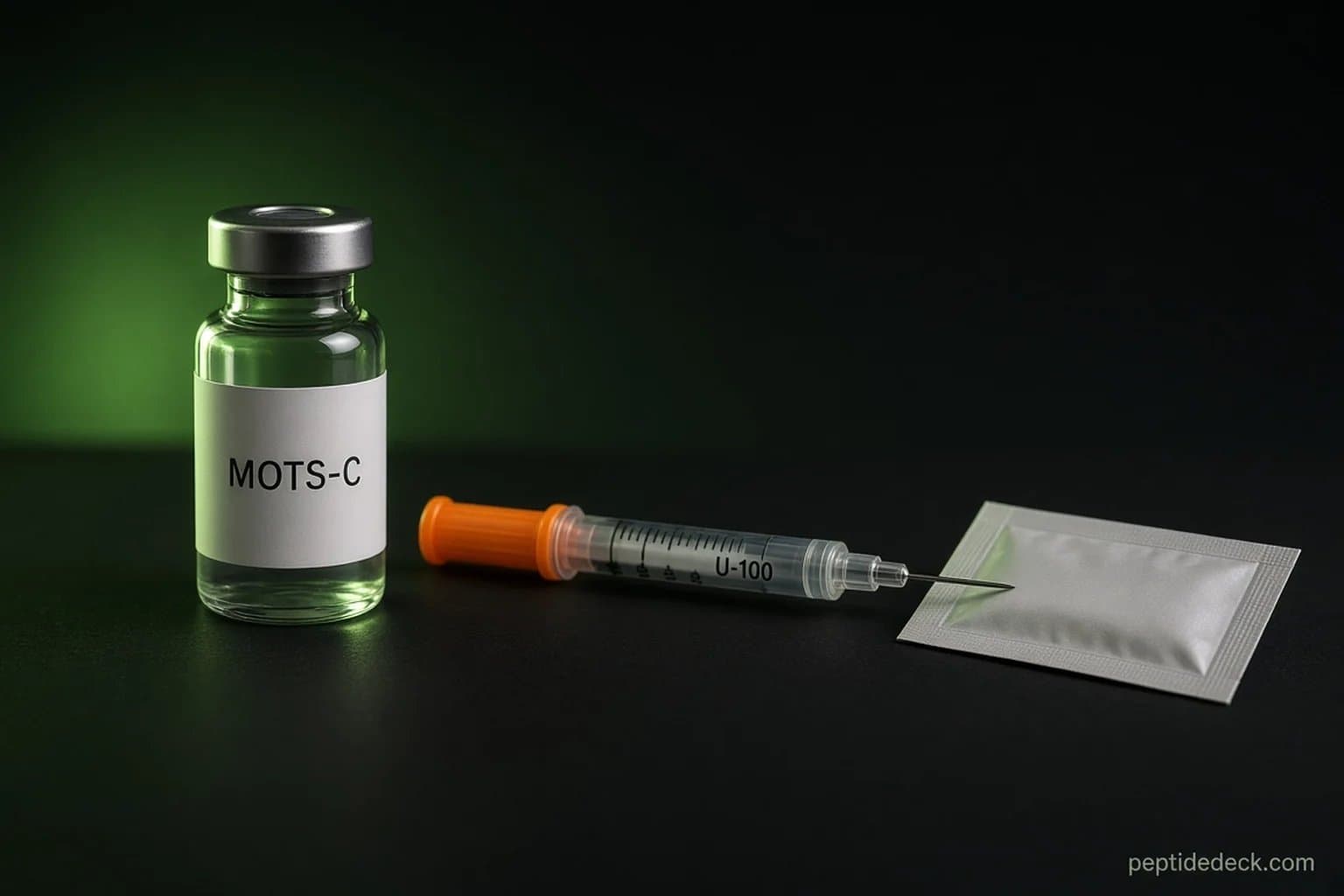
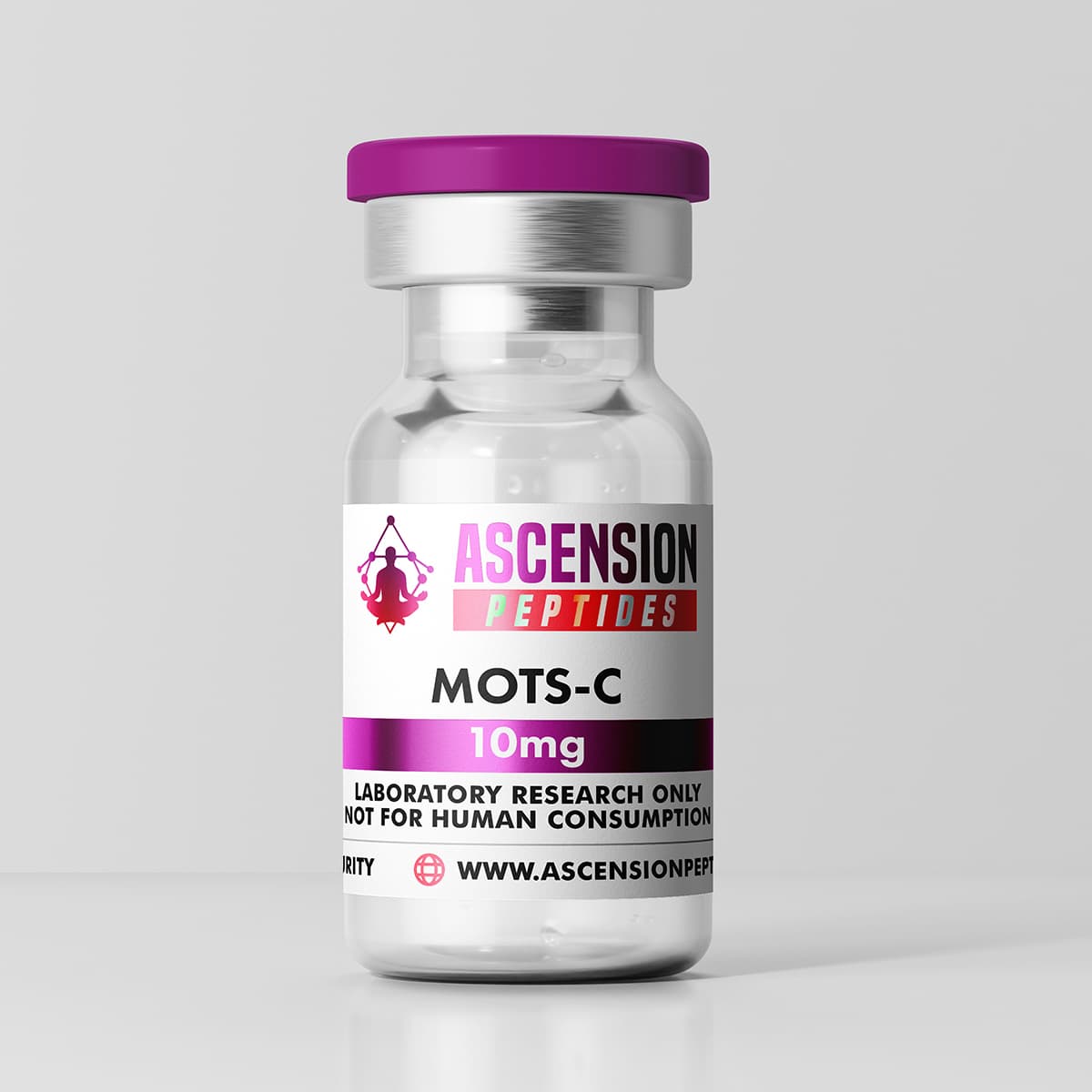
The shot takes ten seconds. The timing takes thought.
If you've just mixed your first vial of MOTS-c, you already know the basics: a small insulin syringe, a pinch of skin, a quick press. What most guides leave fuzzy is the rest. Where to inject MOTS-c, how to inject MOTS-c without wasting a dose, what time of day to take it, how often, and what that red, itchy patch after the shot means. This page answers each one, and says plainly where the answer comes from evidence and where it comes from habit.
🔑 Key Takeaways
- The belly is the easy site. One of the other two is best left to a helper.
- The biggest dosing mistake happens before the needle touches skin: reading the syringe.
- The one experiment that hints at the best time to dose had nothing to do with the clock. It had to do with training.
- Three times a week is the standard rhythm, and the reason behind it is not the one most guides give.
- Flushing after a shot is common with MOTS-c. A lump that lingers for weeks is a different story, and it once paused a human trial.
MOTS-c has no FDA approval and no official instructions for use. So we borrow the injection rules from approved drugs given the same way, under the skin, and use the MOTS-c research where it exists. Mixing and dose choice have their own pages; here they get two lines each, and the rest is about the injection itself.
How to Inject MOTS-c: The 60-Second Version
Here is the whole routine.
- Wash your hands. Take the mixed vial from the fridge and wipe the rubber top with alcohol.
- Draw your dose in units on a new U-100 insulin syringe (5 mg is 50 units at the house mix of 10 mg in 1 mL).
- Pick a site: the belly 2 inches from the navel, the front of a thigh, or the back of an upper arm if someone is helping.
- Swab the skin, let it dry, pinch a fold, and insert at 90 degrees (45 if you're lean).
- Push the plunger slowly, hold for 5 to 10 seconds, pull out, press with gauze if it bleeds.
- Drop the syringe straight into a sharps container. Log the site and the time.
Three times a week, a new spot each time, ideally on training days. The rest of this page covers the parts people get wrong.
Where to Inject MOTS-c: The 3 Sites
The target is fat, not muscle.
MOTS-c is given subcutaneously, into the layer of fat between skin and muscle. That's how the only human trial in the MOTS-c family gave its drug: CohBar's CB4211, an analog of MOTS-c, was injected under the skin in all 88 people enrolled in its phase 1a/1b study. [5] Native MOTS-c itself has never been through a human trial, and the mouse experiments behind it used injections into the belly cavity, a route nobody uses on themselves. [2]
For the sites, the approved injectable labels are the best guide. The Wegovy instructions name the thighs, the upper arms, and the lower stomach, with one detail most peptide guides skip: keep 2 inches away from your belly button. They also say the injection site can change without any change in dose. [8]
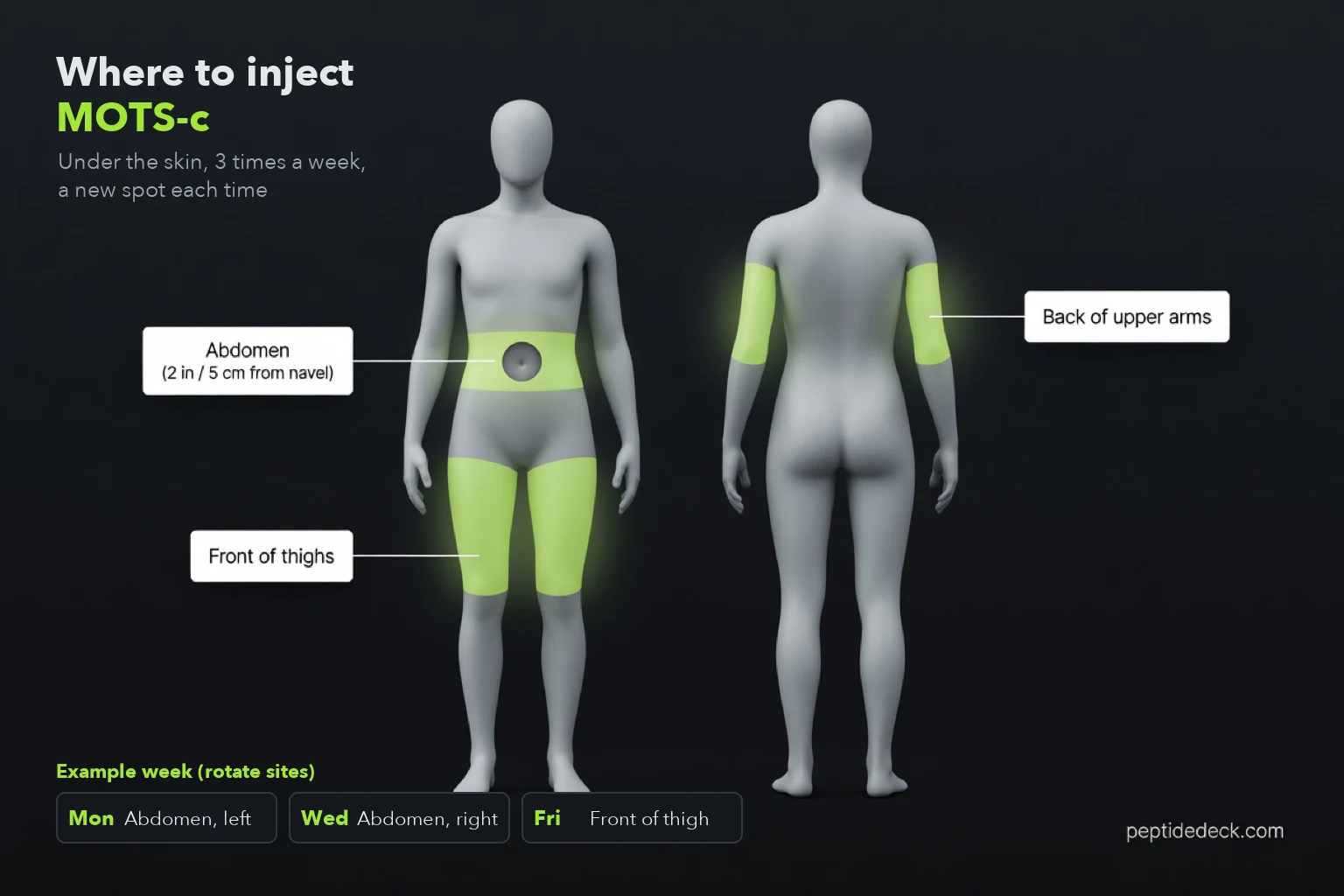
Is one site better? Nobody has compared sites for MOTS-c, and there's no reason to inject near a muscle you want to "target". Pick the site you can see and reach comfortably. For most people that's the belly.
Skip skin that's bruised, red, scarred or hard, stretch marks, moles, visible veins, and any lump left from an earlier shot. Don't inject into muscle; our guide to subcutaneous vs intramuscular injection explains why the fat layer is the standard for peptides.
Rotate, every single time
Rotation sounds fussy. It prevents a real problem.
Injecting the same patch again and again causes lipohypertrophy, thickened lumpy fat under the skin. Diabetes injection guidelines written by 183 experts from 54 countries call it a frequent complication that distorts how medicine is absorbed, and say never to inject into those lumps. [7] At three shots a week, MOTS-c gives you about 36 injections in a 12-week cycle, plenty to wear out a favorite spot.
- Split the belly into four squares around the navel: upper left, upper right, lower left, lower right.
- Move one square per shot, so each square gets a rest of more than a week at 3 shots a week.
- Stay at least an inch (2.5 cm) from your last spot in that square.
- Add the thighs if your belly is lean or tender, and note each site in your phone.
If you also inject another peptide, keep it in a separate syringe and a separate spot. That applies to stacks like retatrutide and MOTS-c too.
Drawing Your Dose: Units on a U-100 Syringe
Your syringe measures volume, not milligrams.
A U-100 insulin syringe holds 100 units in 1 mL. How many milligrams each unit carries depends on how much water went into the vial. Mixing in two lines: add bacteriostatic water slowly down the inside wall, swirl, never shake, then refrigerate. The house mix is 10 mg in 1 mL (10 mg/mL), so 10 units equals 1 mg; the full method is in how to reconstitute MOTS-c.
Dose choice in two lines: the house protocol starts at 2.5 mg twice a week for 1 to 2 weeks, then 5 mg three times a week for 8 to 12 weeks, then 4 weeks off. None of these doses has been tested in people; the MOTS-c dosage chart explains where each number comes from.
Here is what those doses look like on the syringe.
Two habits prevent most errors. Use the smallest syringe that holds your dose, because a 0.5 mL (50-unit) barrel has bigger markings than a 1 mL barrel. And redo the math every time you change vial size or water volume. Someone who switches from the 1 mL mix to a 2 mL mix and keeps drawing 50 units gets 2.5 mg, half the dose they think they're taking. For any other setup, the peptide calculator does the math.
To draw cleanly: pull air into the syringe equal to your dose, push it into the vial, turn the vial upside down, and draw slowly a little past your line. Tap out bubbles and push back to the exact mark.
Step-by-Step: Injecting MOTS-c With an Insulin Syringe
Slow is smooth here.
- Wash your hands and look at the vial. Mixed MOTS-c should be clear and colorless. Cloudy, particles, or a vial that froze: don't use it.
- Wipe the rubber stopper with an alcohol swab.
- Draw your dose using the air trick above, and check the units twice against the table.
- Let the filled syringe sit for a few minutes while you prep. Cold liquid stings more, and it saves warming the whole vial.
- Clean the site with alcohol and let it air-dry fully. Wet alcohol pushed in by the needle is a common cause of that burning feeling.
- Pinch a fold of skin between thumb and finger.
- Insert the needle in one quick motion, like a dart.
- Push the plunger slowly, over about 5 to 10 seconds for 50 units. A fast push is the other common cause of stinging and flushing.
- Hold for 5 to 10 seconds, then pull straight out and let go of the pinch. If it bleeds, press with gauze. Don't rub.
- Don't recap. The syringe goes straight into a sharps container.
A drop of liquid on the skin afterward usually means the needle came out too soon. Count to ten next time. New to injecting anything? Our step-by-step on how to inject peptides covers needle handling and skin prep for any injectable peptide.
Needle size and angle
- Gauge: 29 to 31 gauge insulin syringes. Higher numbers are thinner and hurt less.
- Length: 6 mm or 8 mm (5/16 in) suits most adults. The diabetes guidelines call the shortest needles, 6 mm for syringes, safe, effective, less painful and the first choice for every group, and say to avoid injecting into muscle. [7] 12.7 mm (1/2 in) syringes are common too; use a pinch and a 45 degree angle with those.
- Angle: 90 degrees with a 6 or 8 mm needle into a pinched fold. Go to 45 degrees if you're very lean, especially on the thigh and arm.
Best Time to Take MOTS-c: Morning, Evening or Before a Workout?
No human study has compared times. But there are clues.
Morning beats late evening
The practical reason is sleep. USADA's summary of what people report after buying MOTS-c online lists insomnia, a faster heart rate or palpitations, injection-site irritation, immune reactions and fever. [6] Those are self-reports with no denominators, so nobody knows how common the insomnia is. But people describe MOTS-c as an energy peptide, it switches on AMPK, the cell's fuel sensor, and a late-evening shot is the easiest variable to remove if your sleep gets worse. [1]
So the default is morning or early afternoon. If you dose in the evening and sleep fine, there's no evidence you need to change.
MOTS-c before a workout: the training connection
This is the clue that matters most.
In the 2021 Nature Communications study that made MOTS-c popular, the muscles of mice given MOTS-c changed their metabolism only if the mice exercised. In the authors' words, "the skeletal muscles of non-exercised mice did not show significant alterations in response to MOTS-c." They read it as MOTS-c helping the body adapt to exercise rather than working on its own. [2]
The same paper measured people. In 10 healthy young men on a stationary bike, the body's own MOTS-c in the blood rose 1.6-fold during exercise and 1.5-fold after it, then returned to baseline after 4 hours of rest. In muscle it rose 11.9-fold and was still elevated at 4 hours. [2] Your body makes more MOTS-c when you train.
That's why the house protocol puts shots on training days, in the morning or 30 to 60 minutes before a session. To be clear about the limits: nobody has tested whether a pre-workout shot works better than one taken at another time of day. It's a reasonable guess built on mouse data and on the body's own exercise response, nothing more. If you aren't training, the mouse data suggests MOTS-c may have little to work with.
Fasted or fed?
There's no rule, and there's no data.
Some people dose fasted because MOTS-c responds to energy stress: in cells starved of glucose, it moves into the nucleus and switches on stress-response genes, and that move depends on AMPK. [3] That's a lab finding in cells, not a reason to skip breakfast. The practical risk runs the other way. MOTS-c improved insulin sensitivity in mice, and the analog CB4211 lowered blood glucose in its four-week trial. [1][5] Stack a fasted shot on a fasted workout and some people feel shaky, sweaty or lightheaded.
If that happens, eat, and dose with food next time. If you take metformin, berberine, insulin or a sulfonylurea, talk to your doctor before adding MOTS-c at all. Our MOTS-c vs metformin page explains why those two pull on the same lever.
How Often to Take MOTS-c (and Why 3 Times a Week)
Three times a week. Non-consecutive days.
A common setup is Monday, Wednesday and Friday, or Tuesday, Thursday and Saturday, lined up with your training days. The tolerance phase runs twice a week, for example Monday and Thursday.
Where does the rhythm come from? Not from a human study. In the 2021 mouse paper, the short performance experiments used daily injections for two weeks. The long late-life experiment, which started in 23.5-month-old mice, switched to injections three times a week, and those mice kept more physical capacity as they aged. [2] The human protocol copied that intermittent schedule, though not its dose or route.
Many guides say three shots a week "keeps levels steady." Nobody can know that, because nobody knows how long MOTS-c stays in the blood (more below). Read it instead as pulses, like the body's own release during exercise, with rest days that let each site recover.
Frequency also drives what a cycle costs, because MOTS-c is used up fast. At 5 mg three times a week, a 10 mg vial covers two shots, under a week. An 8-week cycle takes 120 mg and a 12-week cycle 180 mg, which is 12 to 18 vials of 10 mg. Ascension, our partner, lists the 10 mg vial at $62, or $31 with code PEPTIDEDECK, so a full cycle runs about $372 to $558 with the code. If you're comparing where to buy MOTS-c, check that the vendor posts a third-party lab report for the exact batch, and use the cost per milligram rather than the vial price. PeptideDeck may earn a commission from this link.
Vial math: once mixed, a vial should be used within about 28 days. At the standard dose, a 10 mg vial is gone in under a week, and a 40 mg vial (8 shots of 5 mg) lasts about 2.7 weeks, still inside the window. At the 2.5 mg tolerance dose twice a week, a 10 mg vial lasts 2 weeks.
MOTS-c Half-Life: What "Never Measured" Means for Spacing
This is one of the most searched MOTS-c questions. The honest answer is short.
No published study has measured the half-life of injected MOTS-c in people. The "4 to 6 hours" figure that circulates online has no source behind it. FDA's own review for its July 2026 compounding committee found no human studies of MOTS-c at all; our page on whether MOTS-c is FDA approved covers that review and the committee's vote.
What we do know is limited:
- It's a bare peptide. MOTS-c is 16 amino acids with no fatty-acid chain attached. Drugs like semaglutide carry that chain on purpose so they last about a week. MOTS-c has nothing like it, so most people assume it clears in hours rather than days. That's an assumption.
- The 4-hour number is something else. In the 2021 exercise data, the body's own MOTS-c in the blood returned to baseline 4 hours after exercise. [2] That describes the body's own peptide after a workout, not how long an injected dose lasts.
For spacing, that means three things. The exact hour doesn't need to be precise, because there's no known blood level to protect. Don't add shots to "top up" levels nobody can measure. And timing a dose around training makes more sense than spacing doses evenly by the clock.
Missed a MOTS-c Dose?
This one is easy.
- Remembered the same day or the next day: take it, then keep at least one rest day before your next shot. If you miss Monday and dose Tuesday, move the rest of the week to Thursday and Saturday.
- Remembered later than that: skip it and carry on with your next planned shot.
- Never double up. At the house mix, 10 mg is already a full 100-unit syringe.
Nothing in the evidence depends on steady blood levels, and the schedule it comes from was deliberately intermittent, so one missed shot changes very little.
MOTS-c Injection Site Reactions
A little redness is expected. Some reactions aren't.
Injection-site reactions are the most common thing people report with MOTS-c, and the one human dataset in this family agrees. In CB4211's four-week phase 1b, 20 adults with obesity and fatty liver took 25 mg or placebo once daily, and the only side effects seen in more than 10% of people on the drug were "transient and generally mild to moderate injection site reactions." [5]
Flushing and itching: the histamine angle
Flushing, warmth, itch or small welts that appear within minutes are usually not a classic allergy. They look like mast cells in the skin releasing histamine.
Many peptides can trigger that directly, with no allergy involved. A 2015 Nature study identified the receptor responsible, MRGPRX2 on human mast cells, and showed that most classes of FDA-approved peptide drugs linked to allergic-type injection-site reactions activate it. [4] The receptor responds to positively charged molecules. MOTS-c carries four positively charged amino acids (three arginines and a lysine) and only one negative one, which fits that profile. To be clear: nobody has tested MOTS-c on MRGPRX2. It's a likely explanation, not a proven one.
If you have mast cell activation syndrome, chronic hives, Ehlers-Danlos syndrome or a history of strong reactions to injections, this matters more for you:
- Start at the 2.5 mg tolerance dose and stay there for two weeks.
- Inject slowly, and keep the volume small, which favors the 1 mL mix.
- Ask your doctor before the first shot whether an antihistamine beforehand makes sense for you, and have a plan for a stronger reaction.
Our MOTS-c side effects guide covers the effects beyond the skin.
The lump that paused a trial
One reaction deserves its own mention. In November 2018, CohBar temporarily suspended its CB4211 trial "to address mild injection site reactions that have been unexpectedly persistent." The company later described them as painless bumps under the skin, where some of the drug stayed at the injection site, in some cases for weeks. It changed the formulation and finished the trial. [5]
CB4211 is a different molecule, and no one knows whether native MOTS-c behaves the same way. But it's the reason the house protocol splits a 10 mg dose across two sites, and the reason a lump that lasts for days deserves a rest, not another shot in the same place.
When to Stop and See a Doctor
Most problems are local and fade. These don't.
- Signs of infection: redness that keeps spreading, heat, pus, red streaks or fever.
- A lump that grows or lasts longer than about two weeks.
- Low blood sugar you can't fix with food: confusion, vision changes, near-fainting.
- Chest pain, palpitations that don't settle, or fainting.
- A body-wide reaction: hives away from the injection site, swelling of the lips, tongue or throat, wheezing or trouble breathing. Call 911.
A few people shouldn't be injecting MOTS-c at all: anyone pregnant or breastfeeding, anyone under 18, and anyone on insulin or a sulfonylurea without medical supervision. Athletes in tested sports should avoid it: MOTS-c is prohibited at all times under WADA section S4.4.1 as an AMPK activator, and USADA says a therapeutic use exemption is highly unlikely. [6] For the bigger picture on benefits and risks, start with our MOTS-c peptide guide.
Frequently Asked Questions
Sources
- Lee C, et al. The mitochondrial-derived peptide MOTS-c promotes metabolic homeostasis and reduces obesity and insulin resistance. Cell Metab. 2015;21(3):443-454. PMID 25738459. pubmed.ncbi.nlm.nih.gov/25738459
- Reynolds JC, et al. MOTS-c is an exercise-induced mitochondrial-encoded regulator of age-dependent physical decline and muscle homeostasis. Nat Commun. 2021;12:470. PMID 33473109. Mouse experiments plus a 10-person human exercise study with no treatment arm. pmc.ncbi.nlm.nih.gov/articles/PMC7817689
- Kim KH, et al. The mitochondrial-encoded peptide MOTS-c translocates to the nucleus to regulate nuclear gene expression in response to metabolic stress. Cell Metab. 2018;28(3):516-524. PMID 29983246. The senior author disclosed a consultancy and shares in CohBar. pubmed.ncbi.nlm.nih.gov/29983246
- McNeil BD, et al. Identification of a mast-cell-specific receptor crucial for pseudo-allergic drug reactions. Nature. 2015;519:237-241. PMID 25517090. pubmed.ncbi.nlm.nih.gov/25517090
- CB4211 (MOTS-c analog) evidence: ClinicalTrials.gov NCT03998514, A Phase 1a/1b Study of CB4211, sponsor CohBar, 88 enrolled, subcutaneous injection (clinicaltrials.gov/study/NCT03998514); CohBar press release, November 5, 2018, on the temporary suspension (GlobeNewswire release, reproduced); CohBar topline results, August 10, 2021 (biospace.com). Company-reported, small groups (11 on drug, 9 on placebo in phase 1b).
- U.S. Anti-Doping Agency. What is MOTS-c peptide? usada.org
- Frid AH, et al. New Insulin Delivery Recommendations. Mayo Clin Proc. 2016;91(9):1231-1255. PMID 27594187. Three authors worked for BD, a syringe maker. pubmed.ncbi.nlm.nih.gov/27594187
- Novo Nordisk. Wegovy (semaglutide) Prescribing Information and Instructions for Use. novo-pi.com/wegovy.pdf
Medical Disclaimer: This content is for informational purposes only and does not constitute medical advice. MOTS-c has no FDA approval, has never been tested in a human clinical trial, and the injection guidance above is adapted from approved injectable drugs and general injection guidelines. Always consult a qualified healthcare provider before starting any new peptide or treatment. PeptideDeck may earn a commission from affiliate links at no additional cost to you.