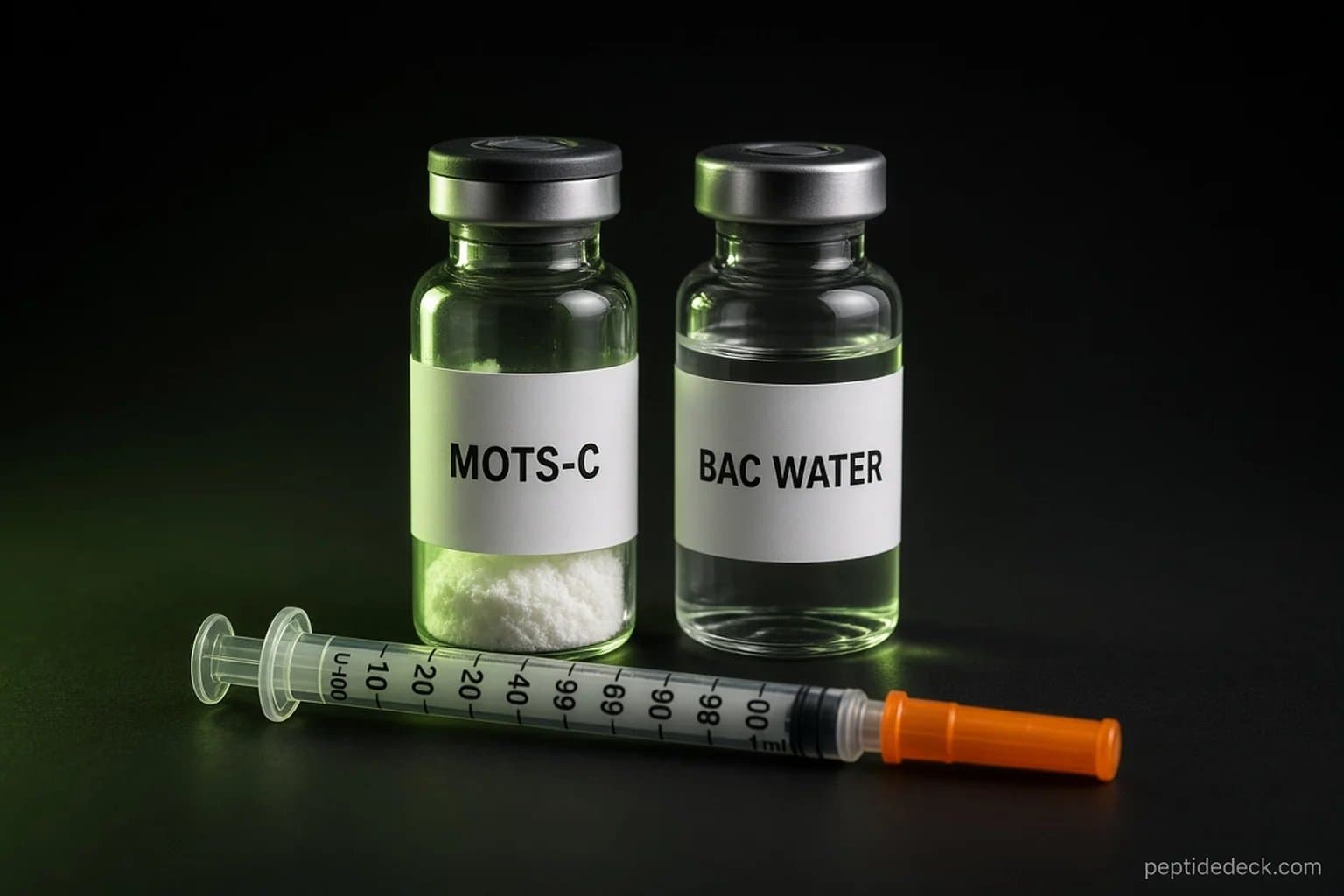
MOTS-c reconstitution takes about five minutes. The math is where people slip.
You already know the routine for most peptides: add water, swirl, draw. MOTS-c is no different in the hands. What makes it tricky is the vial sizes. It is sold as 10 mg, 20 mg and now 40 mg vials, and every size and every water volume changes how many units on the syringe make up one dose. This guide shows you how to reconstitute MOTS-c step by step, how much bacteriostatic water each vial takes, and gives you a MOTS-c reconstitution units chart you can read straight off.
🔑 Key Takeaways
- The water you add sets the strength. The strength sets the units. Change one and every number on your dose chart changes with it.
- There is one mix for each vial size that keeps the syringe math clean, and one popular mix for the 40 mg vial that physically does not fit.
- The most common dosing error with MOTS-c is not the injection. It is reading a 10 mg chart while holding a 40 mg vial.
- A 40 mg vial can outlast its own fridge window. Whether it does depends on your dose.
- A clear vial is not always a good vial, and a slightly shrunken powder cake is not always a bad one.
Below: what you need, the six mixing steps, the water for each vial, the full units table, storage, how to spot a spoiled vial, and what each dose costs. Dose levels and cycles live on our MOTS-c dosage chart; this page covers the mixing.
What You Need to Reconstitute MOTS-c
Lay everything out before you start.
- The MOTS-c vial (10 mg, 20 mg or 40 mg). Read the milligrams on the label twice. Every number below depends on it.
- Bacteriostatic water: sterile water with 0.9% benzyl alcohol, made for multiple-dose use. Not tap water, not distilled water.
- A syringe for the water: a 1 mL U-100 insulin syringe works for 1 mL. For 2 or 3 mL, use a 3 mL syringe marked in mL, or refill a fresh 1 mL syringe two or three times.
- U-100 insulin syringes for your doses: 1 mL (100 units), 0.5 mL (50 units) or 0.3 mL (30 units). Pick the smallest one that holds your dose; it is easier to read.
- Alcohol swabs and a sharps container.
- A pen to write the mix date and strength on the vial.
Not sure which water to buy? Our guide to bacteriostatic water vs sterile water vs saline covers the difference, and the bacteriostatic water guide covers sizes and storage.
How to Reconstitute MOTS-c, Step by Step
Slow hands beat fast ones here.
- Warm up and wash up. Take the MOTS-c vial out of the fridge 10 to 15 minutes early so it reaches room temperature. Wash your hands.
- Swab both stoppers. Pop the plastic caps, wipe the rubber tops of the MOTS-c vial and the water vial with alcohol, and let them air-dry for 30 seconds. Wet alcohol on a stopper gets pushed into the vial with the needle.
- Draw the water. Pull your chosen volume of bacteriostatic water (1, 2 or 3 mL, see the next section) into the syringe. Tap out any large bubbles.
- Add it down the glass. Push the needle through the MOTS-c stopper at an angle and let the water run slowly down the inside wall of the vial. Do not fire it straight onto the powder cake.
- Swirl, don't shake. Roll the vial between your palms or swirl it gently. Shaking whips air into the solution and can damage a peptide. Most vials clear within a few minutes. If a little powder clings to the glass, put the vial in the fridge and check again in 15 to 30 minutes.
- Label and refrigerate. Write the date, the milligrams and the water volume on the vial ("40 mg / 2 mL, 20 mg/mL, mixed Oct 20"). Then straight into the fridge.
About air pressure: many freeze-dried vials are sealed under a partial vacuum, so the water may get sucked in faster than you push. Keep your thumb on the plunger and let it go in slowly. If the vial has no vacuum, the pressure builds as you add 2 or 3 mL; pause, let the syringe draw back a little air, then carry on. Later, when you draw doses, push in a volume of air roughly equal to the dose first (about 50 units of air for a 50 unit dose) so the vial does not pull back against you. Don't overdo it; a vial pumped full of air sprays when you pull the needle out.
That's the whole process. The next part decides whether your doses come out right.
How Much Bacteriostatic Water for MOTS-c 10 mg, 20 mg and 40 mg
There is no single correct volume.
The water doesn't change how much MOTS-c is in the vial. It only changes how concentrated it is, and so how many units make up a dose. The goal is a mix where your usual dose is a clean, readable number on the syringe: not 6.25 units, and not 150 units that won't fit in one draw. These are the mixes that hit that goal for a 5 mg dose, the standard dose on our MOTS-c dosage chart:
Notice the pattern. 10 mg in 1 mL, 20 mg in 2 mL and 40 mg in 4 mL all make the same 10 mg/mL strength, so 50 units is 5 mg from any of them. That is why so many charts quote 4 mL for 40 mg. The catch is the vial, which we come to in a moment.
The formula behind every number on this page is short: units = dose in mg ÷ strength in mg/mL × 100. On a U-100 syringe, 100 units is 1 mL, so 1 unit is 0.01 mL.
MOTS-c Reconstitution Calculator: Units for Every Mix
This table is the calculator. Find your row, read your dose.
It covers 1, 2.5, 5 and 10 mg doses for the three vial sizes and each practical water volume, in U-100 units with the volume in mL underneath. If you dose in micrograms: at 10 mg/mL each unit is 100 mcg, at 20 mg/mL each unit is 200 mcg.
0.1 mL
0.25 mL
0.5 mL
1 mL
full syringe: split into 2 sites
0.2 mL
0.5 mL
1 mL
full syringe: split into 2 sites
2 mL
over 1 syringe: split or remix
0.3 mL
0.75 mL
1.5 mL
over 1 syringe: split or remix
3 mL
over 1 syringe: split or remix
0.05 mL
0.125 mL
0.25 mL
0.5 mL
0.1 mL
0.25 mL
0.5 mL
1 mL
full syringe: split into 2 sites
0.15 mL
0.375 mL
0.75 mL
1.5 mL
over 1 syringe: split or remix
0.025 mL
hard to read: use a 0.3 mL syringe
0.0625 mL
0.125 mL
0.25 mL
0.05 mL
0.125 mL
0.25 mL
0.5 mL
0.075 mL
0.1875 mL
0.375 mL
0.75 mL
0.1 mL
0.25 mL
0.5 mL
1 mL
full syringe: split into 2 sites
* 40 mg + 4 mL only if your vial actually holds it. Most do not; see the vial capacity section.
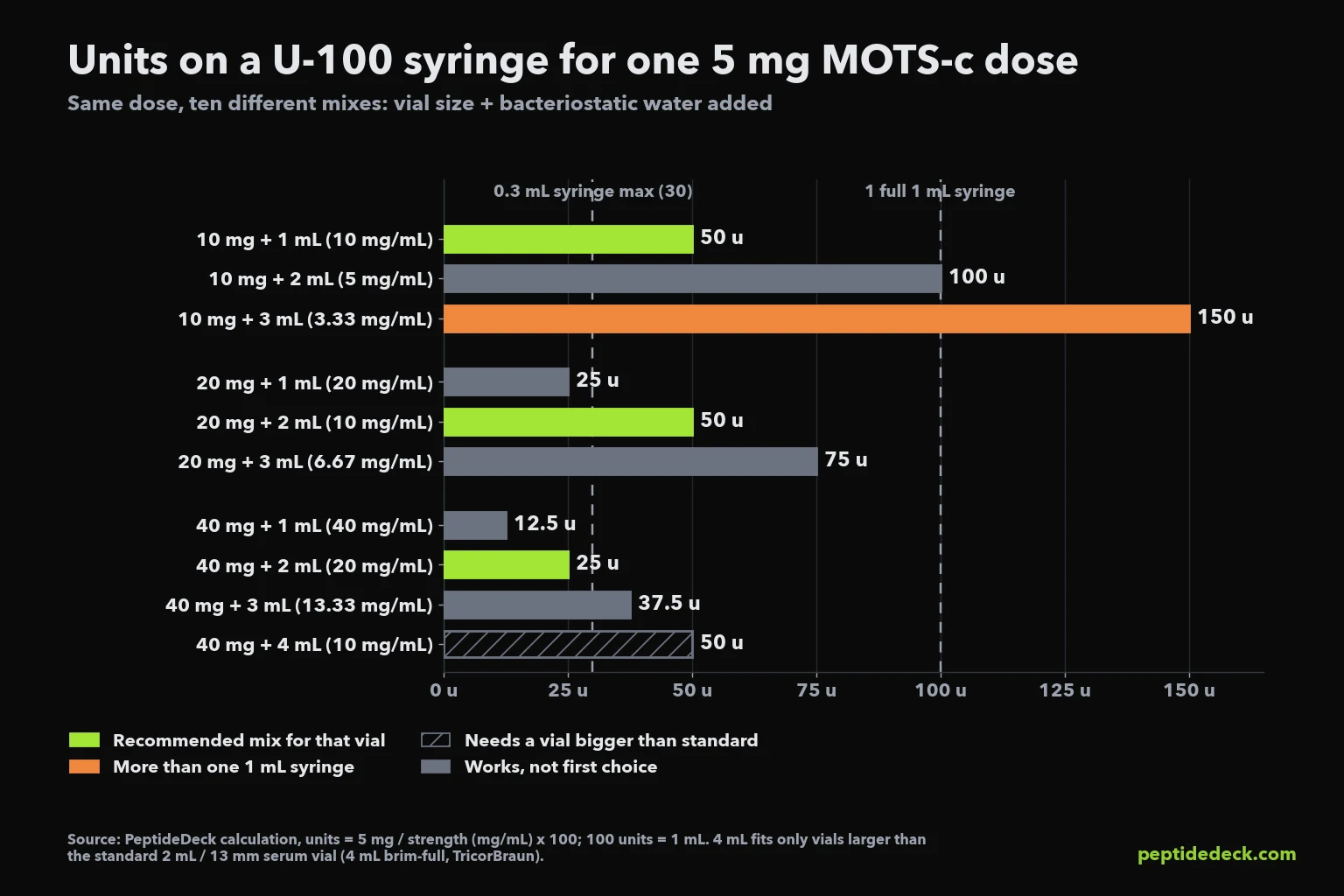
Three things jump out. A 10 mg vial mixed with 3 mL can't deliver 5 mg in one syringe. A 40 mg vial mixed with only 1 mL puts a 1 mg dose at 2.5 units, which is a hair's width on a 1 mL barrel. And the 10 mg dose fills a whole 1 mL syringe at 10 mg/mL, which is why our dosage chart splits it across two injection sites. If you want the numbers worked out for an odd vial or dose, the peptide calculator does it for any vial and water volume, and the MOTS-c dosage chart has a MOTS-c-only calculator built in.
MOTS-c 40 mg Reconstitution: Does 4 mL Fit?
Usually not. Here is why.
Most peptide vials, 40 mg ones included, are small glass serum vials with a 13 mm neck, the kind sold as 2 mL or 3 mL vials. Packaging supplier TricorBraun lists the standard 13 mm vial as a 2 mL fill with a 4 mL overfill capacity, and overfill capacity means filled to the brim. Four milliliters of water, plus the stopper pushed into the neck, plus the air space you need to work a needle, is more than that vial is built to hold. You would be fighting the pressure the whole way in.
Some sellers use larger vials. If yours is labeled 5 mL or bigger, or it is clearly taller and wider than a standard 10 mg vial, 4 mL can fit. If it is labeled 3 mL or smaller, or you can't tell, treat 3 mL of water as your ceiling.
So for a 40 mg vial, we suggest 2 mL. It gives 20 mg/mL, every 5 units is 1 mg, and a 5 mg dose is 25 units. A 0.3 mL (30 unit) syringe holds it with room to spare, and many of those are marked in half units, which makes the small numbers easier to hit. 3 mL also works if you want slightly bigger draws, at the cost of half-unit doses (37.5 units for 5 mg).
One more thing the 40 mg vial changes: how long it lasts against the fridge clock.
At the standard 5 mg three times a week, a 40 mg vial is used up in under three weeks, inside the window. At a 2.5 mg tolerance dose twice a week, the same vial would last eight weeks, so half of it is past the 28-day mark. If you're starting low, a 10 mg vial wastes less.
How to Store MOTS-c After Mixing
One rule covers it.
Before mixing: keep the powder in the fridge, or the freezer if you're holding it for months, in the box and away from light. After mixing: refrigerate at 2 to 8 °C (36 to 46 °F), keep it dark, and use it within about 28 days of the first puncture. Don't freeze the mixed solution, and don't leave it on the counter between doses.
Be clear about where that 28 days comes from. US injection safety guidance from the CDC, based on USP chapter 797, says an opened multiple-dose vial should be dated and thrown out within 28 days unless the maker says otherwise. Bacteriostatic water is sold as a multiple-dose product because its benzyl alcohol keeps bacteria from growing after repeated needle punctures. Nobody has published a stability study of mixed MOTS-c, so the 28 days is a sterility convention, not proof the peptide stays at full strength for four weeks.
Light and air matter more for MOTS-c than for some peptides. Its 16 amino acids (MRWQEMGYIFYPRKLR, Lee et al., 2015) include two methionines, a tryptophan and two tyrosines, which are among the residues most prone to oxidation, a process that light can trigger (Li et al., 1995). The freeze-dried powder is the more stable form; once it's in water, cold and dark is what you have.
How to Tell If Your MOTS-c Has Gone Bad
Look before every draw. It takes two seconds.
- Cloudy, hazy or milky solution after it had been clear. Throw it out.
- Floating flakes, threads or specks that don't swirl away. Throw it out.
- A yellow or brown tint in what should be a colorless liquid.
- Past 28 days since mixing, or left out of the fridge for hours, or frozen by accident.
- A damaged stopper that leaks or has a visible hole.
What's usually fine: a few bubbles or a little foam right after mixing (let it settle in the fridge), and an unmixed powder cake that has shrunk or pulled away from the glass, which is common with freeze-dried products. What isn't fine before mixing: powder that looks wet, sticky or melted, which means moisture got in.
And the honest limitation: a perfectly clear vial can still be underdosed or the wrong peptide. Looking can't tell you that. Only a lab report for that batch can, which is the main thing to check before you buy.
Common MOTS-c Mixing Mistakes
Most mistakes happen on paper, not in the vial.
1. Using the wrong chart for your vial or water. Every units chart assumes a specific mix. Mix one way and read another chart, and the dose is off by a factor of two or more:
The last two rows are the new problem. As 40 mg vials replace 10 mg ones, people keep drawing the "50 units = 5 mg" number they learned from a 10 mg vial. From a 40 mg vial mixed with 2 mL, 50 units is 10 mg. The fix is the label you wrote in step 6: strength on the vial, every time.
2. The wrong water. Sterile water has no preservative and is meant for single use, so a multi-dose MOTS-c vial mixed with it has no protection after the first puncture. Tap and distilled water aren't sterile at all. Use bacteriostatic water. The one exception is a known benzyl alcohol allergy, which is a question for a doctor, not a workaround.
3. Too concentrated to read. Mixing 40 mg in 1 mL to save water puts a 1 mg dose at 2.5 units. A one-unit misread on a 1 mL syringe is then a 40% dose error. More water, or a 0.3 mL syringe, fixes it.
4. Too dilute to draw. The opposite mistake: 10 mg in 3 mL makes 5 mg a 150-unit dose. That's two syringes and two injections for one dose. Use less water.
5. Shaking the vial. Swirl. Then wait.
6. Reusing needles. A needle that has been through a stopper is dull and no longer sterile. One syringe per dose. For the injection itself, sites and technique, see our guide to how to inject MOTS-c.
MOTS-c Cost per Dose
Price per vial hides what you actually spend.
Ascension Peptides, our partner, sells MOTS-c as a 10 mg vial at $62, or $31 with code PEPTIDEDECK, which is $3.10 per milligram. Here's what that means per dose:
At the standard 5 mg three times a week (a rhythm borrowed from the mouse work in Reynolds et al., 2021, not from any human trial), that's $46.50 a week with the code, and a 10 mg vial lasts two doses. The limitation is obvious: you'll be mixing a new vial every few days, and a full 12-week cycle at that dose uses 18 vials. A 40 mg vial means far fewer mixes and often a lower price per milligram, but it puts more money in one vial if the batch is bad, and it needs the tighter syringe math above. Whichever size you pick, compare sellers on price per milligram and on a lab report for the exact batch; our guide on where to buy MOTS-c compares vendors, vial sizes and testing.
PeptideDeck earns a commission if you buy through our partner links, at no extra cost to you.
One thing to know before you order: MOTS-c is not an FDA-approved drug, native MOTS-c has never been tested in a human clinical trial, and it is banned at all times for tested athletes under section S4.4.1 of the WADA Prohibited List, according to USADA. Our page on whether MOTS-c is FDA approved covers the current status, and MOTS-c side effects covers what people report.
Frequently Asked Questions
Sources
- Lee C, Zeng J, Drew BG, et al. The mitochondrial-derived peptide MOTS-c promotes metabolic homeostasis and reduces obesity and insulin resistance. Cell Metab. 2015;21(3):443-54. PMID 25738459. PubMed
- Reynolds JC, Lai RW, Woodhead JST, et al. MOTS-c is an exercise-induced mitochondrial-encoded regulator of age-dependent physical decline and muscle homeostasis. Nat Commun. 2021;12(1):470. PMID 33473109. PubMed
- Li S, Schöneich C, Borchardt RT. Chemical instability of protein pharmaceuticals: mechanisms of oxidation and strategies for stabilization. Biotechnol Bioeng. 1995;48(5):490-500. PMID 18623513. PubMed
- Hospira, Inc. Bacteriostatic Water for Injection, USP: prescribing information (0.9% benzyl alcohol, multiple-dose container, not for use in neonates). DailyMed
- Centers for Disease Control and Prevention. Preventing Unsafe Injection Practices: multi-dose vials (date and discard within 28 days of opening unless the manufacturer specifies otherwise, per USP 797). CDC
- USADA. What is the MOTS-c peptide? (prohibited at all times under WADA Prohibited List S4.4.1, AMPK activators). USADA
- TricorBraun. Glass vials: 13 mm finish vial, 2 mL fill capacity, 4 mL overfill capacity. PDF
Medical Disclaimer: This content is for informational purposes only and does not constitute medical advice. MOTS-c has no FDA approval for any use and has not been tested in human clinical trials. Always consult a qualified healthcare provider before starting any new medication or treatment. PeptideDeck may earn a commission from affiliate links at no additional cost to you.