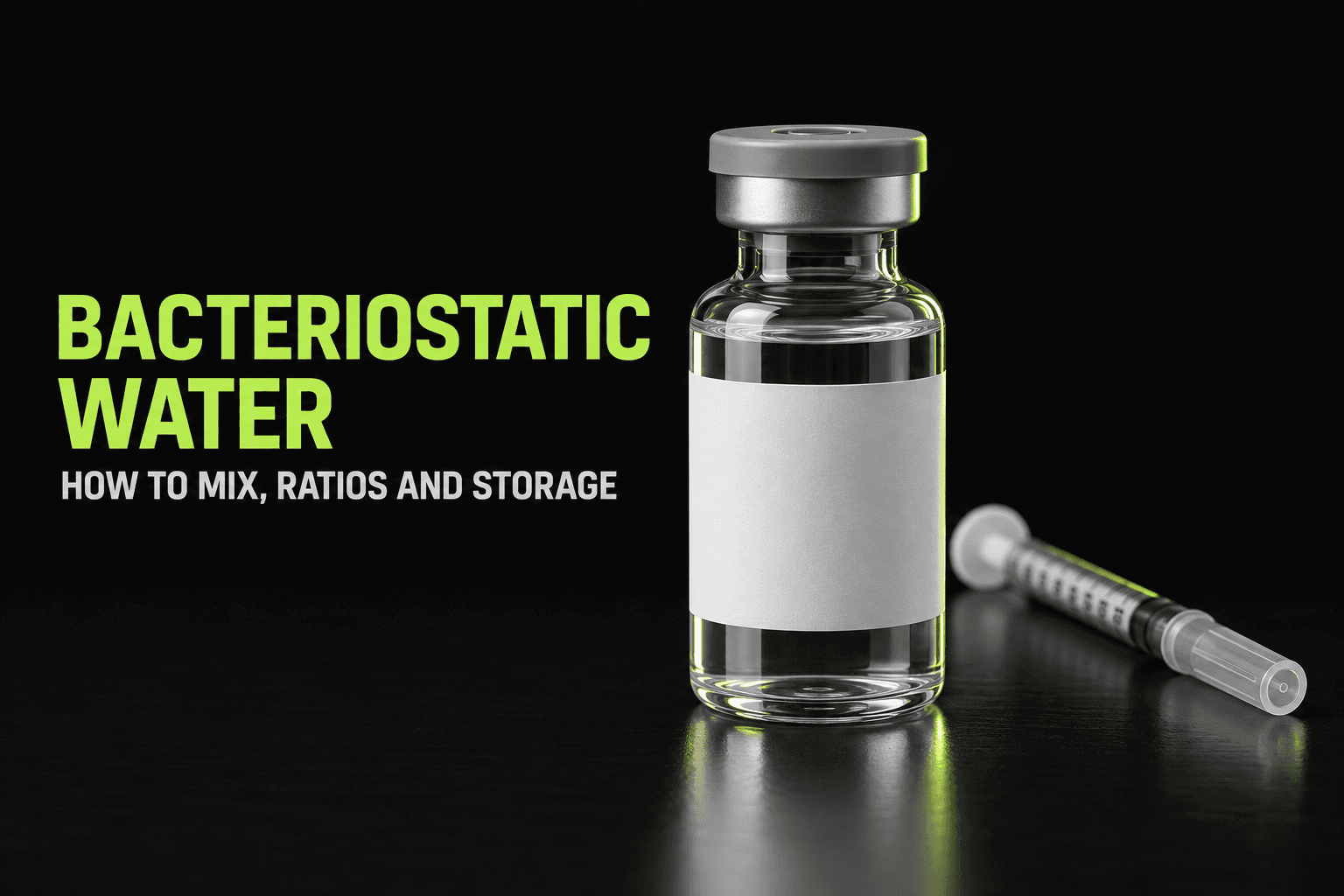
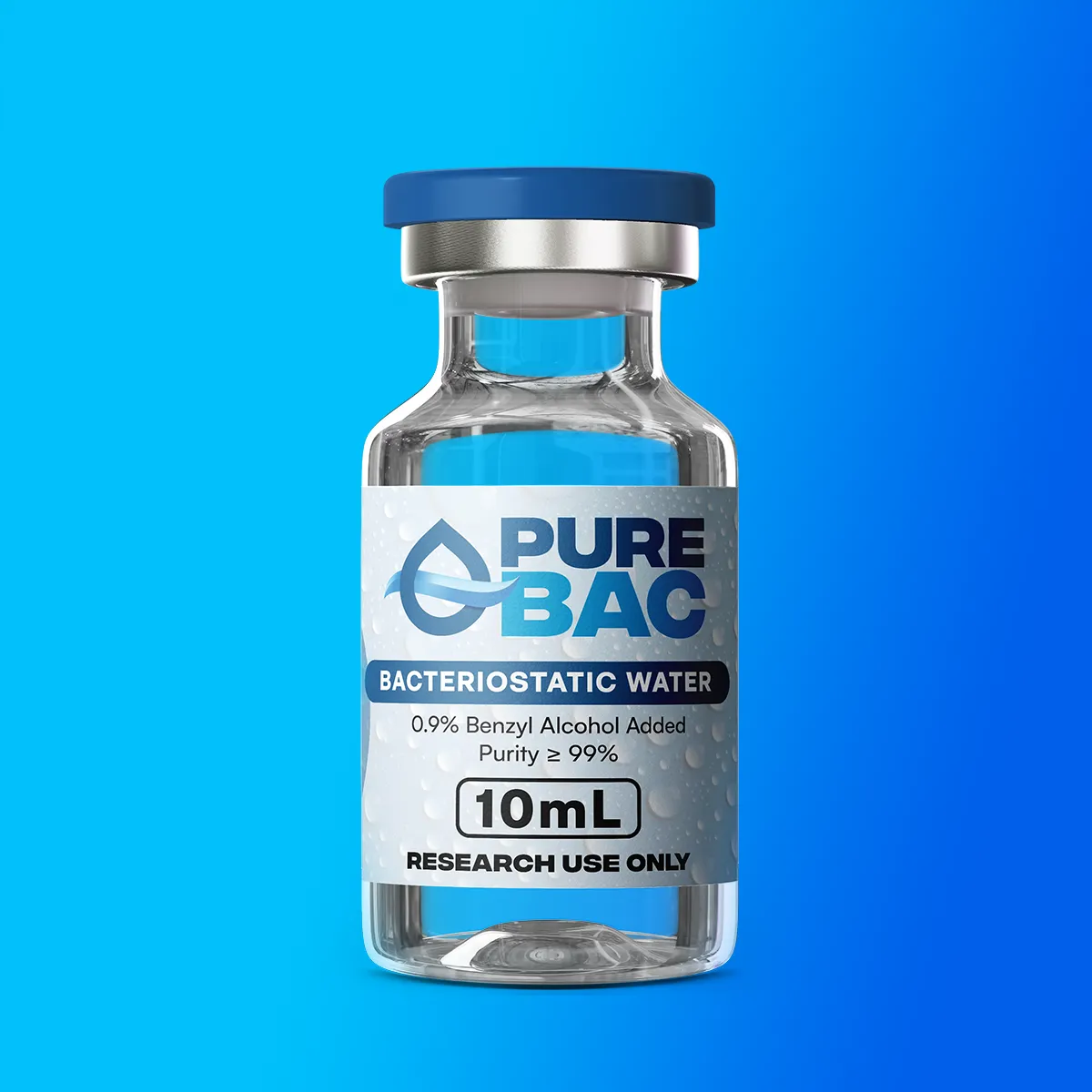
Bacteriostatic water brings dried peptides back to life. It is sterile USP Water for Injection with 0.9% benzyl alcohol added, and that one preservative lets you draw from the same multi-dose vial for about 28 days instead of tossing it after a single use. Most people land here with one real question: how much BAC water do I add to my peptide, and how do I store what is left. This page answers the math, the mixing steps, the storage rules, and the safety basics in plain language, with a reconstitution chart you can read at a glance.
Quick Answer
Bacteriostatic water (BAC water) is sterile water preserved with 0.9% benzyl alcohol, used to dissolve lyophilized peptides like retatrutide, tirzepatide, semaglutide, BPC-157, and GHK-Cu. The amount you add is a choice, not a fixed number: concentration (mg/mL) equals peptide milligrams divided by milliliters of water, so a 10 mg peptide vial plus 2 mL of BAC water gives 5 mg/mL. On a U-100 insulin syringe, 1 mL equals 100 units. Once you puncture a BAC water vial, refrigerate it and use it within about 28 days.
🔑 Key Takeaways
- It is sterile water plus a preservative. Bacteriostatic water is USP Water for Injection with 0.9% benzyl alcohol, and that alcohol holds back bacterial growth so one vial survives repeated draws.
- There is no single correct amount. The BAC water you add sets concentration. More water means smaller doses are easier to measure, less water means more concentrated, smaller injections.
- The math is one line. Concentration (mg/mL) equals peptide mg divided by mL of water, then 1 mL equals 100 units on a U-100 syringe. Our chart below does the common combinations for you.
- Storage is a 28-day clock. Sealed vials sit at room temperature; once opened, refrigerate and use within about 28 days from the first puncture.
- Not every peptide wants it. A few benzyl-alcohol-sensitive peptides, including some hCG and NAD+ preparations, do better with preservative-free sterile water used within 24 hours.
What is bacteriostatic water, exactly?
Bacteriostatic water is sterile water with a preservative. The base is USP Water for Injection, a purified, nonpyrogenic water made to United States Pharmacopeia standards. The additive is benzyl alcohol at 0.9%, which works out to 9 mg per milliliter. That preservative is the entire difference between BAC water and plain sterile water, and it is why a vial can take a needle day after day for roughly a month.
The finished product sits at a pH of about 4.5 to 7.0, carries no buffers or salts, and ships in glass multi-dose vials, commonly 10 mL, 20 mL, or 30 mL, sealed with a rubber stopper and an aluminum crimp. People also call it bac water, bacteriostatic water for injection, or BWFI. When someone asks what bac water is made of, the answer is short: USP water plus 0.9% benzyl alcohol, nothing else.
Peptides arrive as a dry, freeze-dried (lyophilized) powder because they are far more stable dry than wet. To use one, you draw bacteriostatic water into a syringe and add it to the powder vial, which dissolves the cake into a clear, stable liquid you can dose. That step is called reconstitution, and BAC water is the standard choice because the preservative protects the reconstituted peptide across the days or weeks you draw from it.
How bacteriostatic water actually works
The word bacteriostatic is the key. Bacteriostatic means it stops bacteria from multiplying, as opposed to bactericidal, which kills them outright. Benzyl alcohol slips into bacterial cell membranes and disrupts them enough that the population cannot grow. It does not sterilize a contaminated vial, but it buys you a usable multi-dose window that plain sterile water cannot offer.
That is the practical payoff. With benzyl alcohol on guard, you can puncture the same vial of reconstituted peptide many times over several weeks. Without it, anything you mix should be treated as single-use and discarded within about a day. For home peptide work, where one vial is dosed over weeks, that preservative earns its place on every single draw.
BAC water vs sterile water vs saline
People constantly ask whether bac water is the same as sterile water. It is not, and the difference matters. The table below lines up the four liquids you will see mentioned, plus 0.6% acetic acid, which shows up for a few poorly soluble peptides.
| Solution | What it is | Preservative | After opening | Best use for peptides |
|---|---|---|---|---|
| Bacteriostatic water (BAC) | Sterile USP water + 0.9% benzyl alcohol | Yes, benzyl alcohol | About 28 days, refrigerated | The default solvent for multi-dose peptide vials |
| Sterile water (SWFI) | Sterile USP water, nothing added | No | Single use, discard within about 24 hours | Single-dose vials or benzyl-alcohol-sensitive peptides |
| Normal saline (0.9% NaCl) | Sterile water with sodium chloride | No | Single use | Less common for peptides; isotonic but unpreserved |
| Bacteriostatic saline | 0.9% NaCl + benzyl alcohol | Yes, benzyl alcohol | About 28 days | Occasional use when an isotonic, preserved solvent is wanted |
| 0.6% acetic acid | Dilute acetic acid in sterile water | No | Single use | Some poorly soluble peptides, such as certain BPC-157 protocols |
For most home reconstitution, bacteriostatic water is the right pick because it is preserved and built for repeated draws. Sterile water is the backup when a peptide does not tolerate benzyl alcohol, and saline or acetic acid are situational. If you wonder whether reconstitution solution is the same as bac water, the answer is usually yes: most peptide reconstitution solutions sold for home use are simply bacteriostatic water under a different label.
How much BAC water to use
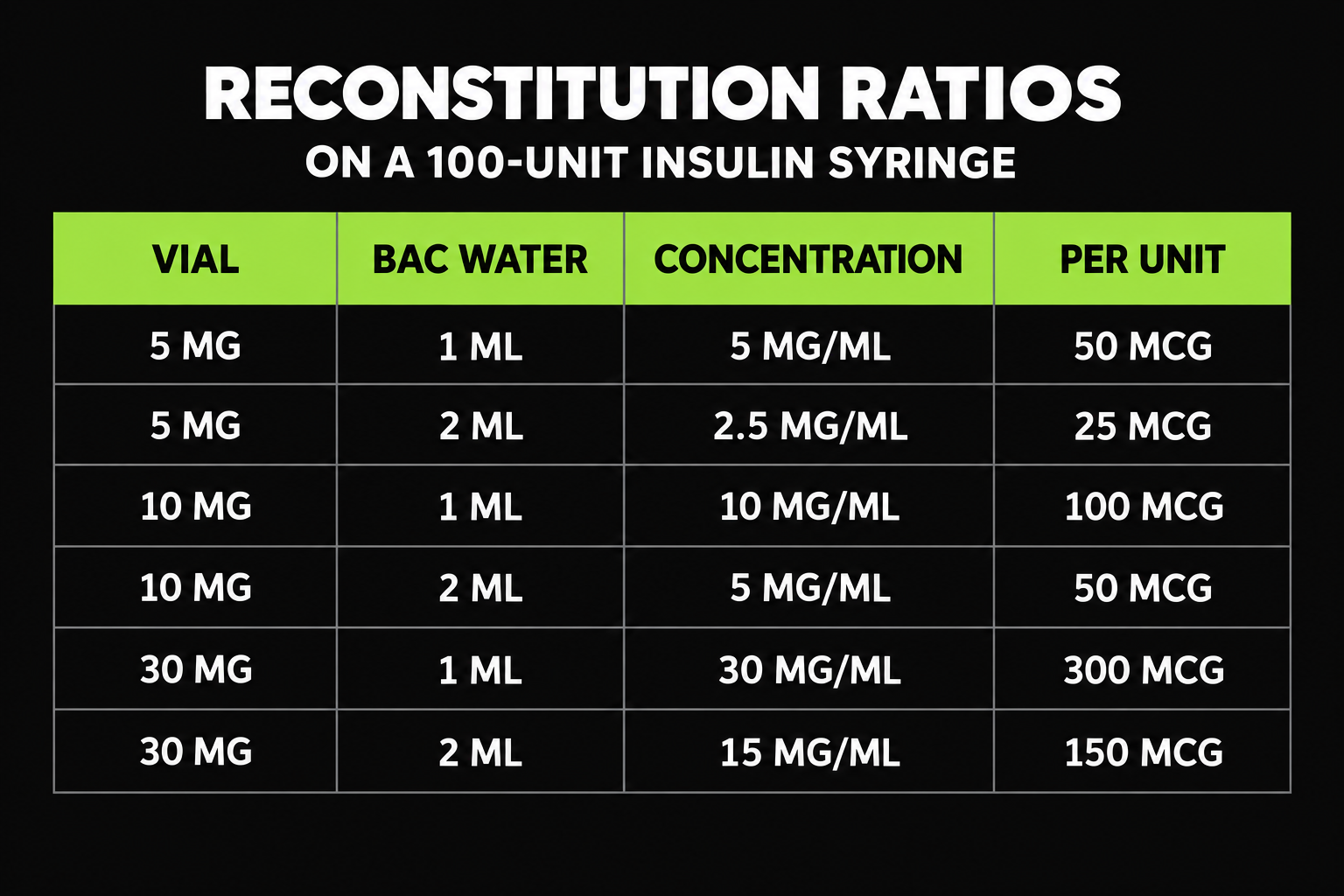
This is the question almost everyone is really here for. The honest answer is that there is no single fixed amount of BAC water for a peptide vial. The volume you add is a choice, and that choice sets your concentration. Add less water and the solution is more concentrated, so each dose is a tiny volume. Add more water and the solution is dilute, so small doses are easier to measure precisely but the vial empties faster.
Two short formulas cover everything:
- Concentration: milligrams per mL = peptide mass (mg) divided by BAC water added (mL). A 10 mg vial plus 2 mL of BAC water is 5 mg/mL.
- Dose volume: mL to draw = desired dose (mg) divided by concentration (mg/mL). On a U-100 insulin syringe, 1 mL is 100 units, so 0.1 mL is 10 units.
A handy shortcut for unit math: micrograms per unit = (peptide mg multiplied by 10) divided by BAC water mL. So 5 mg in 2 mL gives 25 mcg per unit. Best practice is to pick a water volume that makes your target dose land on a round unit count, like 250 mcg landing on exactly 10 units rather than 13.7 units.
The chart below runs the common vial sizes against the common BAC water volumes, so you can see the concentration and what a sample dose draws to on a standard U-100 insulin syringe.
| Peptide vial | BAC water added | Concentration | Per 1 unit (U-100) | Example dose draws to |
|---|---|---|---|---|
| 5 mg | 1 mL | 5 mg/mL | 50 mcg | 250 mcg = 5 units |
| 5 mg | 2 mL | 2.5 mg/mL | 25 mcg | 250 mcg = 10 units |
| 5 mg | 3 mL | 1.67 mg/mL | 16.7 mcg | 250 mcg = 15 units |
| 10 mg | 1 mL | 10 mg/mL | 100 mcg | 2 mg = 20 units |
| 10 mg | 2 mL | 5 mg/mL | 50 mcg | 2 mg = 40 units |
| 10 mg | 3 mL | 3.33 mg/mL | 33.3 mcg | 2 mg = 60 units |
| 15 mg | 1 mL | 15 mg/mL | 150 mcg | 2.5 mg = 17 units |
| 15 mg | 2 mL | 7.5 mg/mL | 75 mcg | 2.5 mg = 33 units |
| 15 mg | 3 mL | 5 mg/mL | 50 mcg | 2.5 mg = 50 units |
| 30 mg | 1 mL | 30 mg/mL | 300 mcg | 5 mg = 17 units |
| 30 mg | 2 mL | 15 mg/mL | 150 mcg | 5 mg = 33 units |
| 30 mg | 3 mL | 10 mg/mL | 100 mcg | 5 mg = 50 units |
Skip the math, use the calculator
For exact numbers on your specific vial and target dose, run it through our peptide reconstitution calculator. Enter the peptide milligrams, the BAC water volume, and your dose, and it returns the concentration and the exact units to draw. The full peptide calculator suite covers dosing and cost too. This beats guessing on questions like a tirzepatide bac water calculator or how many units 2 mL of bac water is.
Per-peptide BAC water amounts
Here are sensible starting points for the peptides people search most, framed as pick your concentration, then this is your BAC water volume.
- Retatrutide (5, 10, 12, 30 mg): For a 10 mg retatrutide vial, 2 mL of BAC water gives 5 mg/mL, so a 2 mg dose draws to 40 units. A 5 mg vial plus 1 mL is also 5 mg/mL. A 30 mg vial plus 3 mL gives 10 mg/mL, where 5 mg draws to 50 units. See our retatrutide dosing schedule for titration.
- Tirzepatide (10, 15, 30, 60 mg): A 30 mg tirzepatide vial plus 3 mL is 10 mg/mL, so a 2.5 mg dose is 25 units and 5 mg is 50 units. A 60 mg vial plus 3 mL gives 20 mg/mL. Our tirzepatide reconstitution guide walks through each strength.
- Semaglutide (5, 10 mg): A 10 mg vial plus 2 mL is 5 mg/mL, so a 0.25 mg starter dose is 5 units. Add only 1 mL for 10 mg/mL if you want 0.25 mg to land on 2.5 units.
- BPC-157 (5, 10 mg): A 5 mg vial plus 2 mL is 2.5 mg/mL, so a 250 mcg dose is exactly 10 units. A 10 mg vial plus 2 mL is 5 mg/mL, where 250 mcg is 5 units. More detail in our BPC-157 dosage guide.
- GHK-Cu (50, 100 mg): A 50 mg vial plus 5 mL is 10 mg/mL, so a 2 mg dose is 20 units. A 100 mg vial plus 5 mL is 20 mg/mL, where 2 mg is 10 units.
- Tesamorelin (10 mg): Plus 2 mL is 5 mg/mL, so a 1 mg dose is 20 units. Plus 1 mL is 10 mg/mL, where 1 mg is 10 units.
- Ipamorelin and CJC-1295 (5 mg): Plus 2 mL is 2.5 mg/mL, so 100 mcg is 4 units, 200 mcg is 8 units, and 300 mcg is 12 units.
- NAD+ (500 mg): Plus 5 mL is 100 mg/mL, so a 50 mg dose is 0.5 mL, which is 50 units. NAD+ is one of the peptides that some people reconstitute with preservative-free sterile water instead, covered in the exceptions section below.
Notice the pattern: the same vial in different water volumes changes concentration, not the total amount of peptide. A 5 mg vial holds 5 mg whether you add 1 mL or 5 mL. You are only deciding how big each injection is and how many doses you can draw before the vial runs out.
How to mix peptides with BAC water
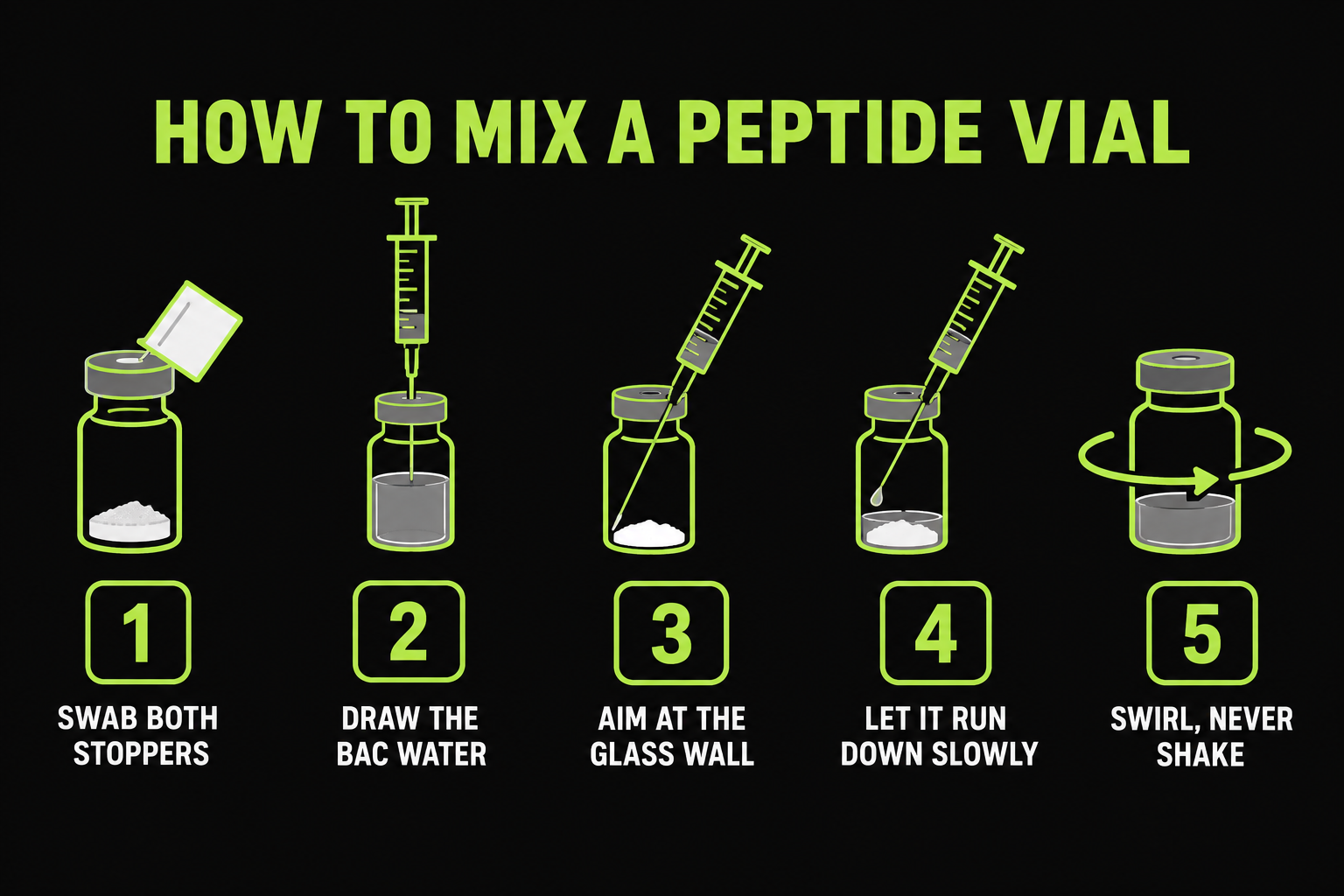
Reconstitution takes about a minute per vial once you have done it once. Here are the steps, whether you are mixing retatrutide, tirzepatide, semaglutide, or a repair peptide.
- Bring both vials to room temperature. Let the cold peptide powder and the BAC water sit out for 15 to 20 minutes so condensation does not form.
- Swab both stoppers. Wipe the rubber top of the BAC water vial and the peptide vial with a fresh alcohol pad for 10 to 15 seconds each, and let them dry.
- Draw your chosen water volume. Pull the BAC water amount you decided on into an insulin syringe, for example 2 mL for a 10 mg vial.
- Add it down the glass wall. Insert the needle and let the water run slowly down the inside of the vial rather than blasting it directly onto the powder cake. This protects the peptide.
- Swirl, do not shake. Roll the vial gently between your fingers until the solution turns fully clear. Shaking or vortexing can stress and degrade the peptide.
- Label and refrigerate. Write the peptide name, the concentration, and the date on the vial, then store it in the refrigerator at 2 to 8 C right away.
That same routine answers searches like how to mix retatrutide with bac water or how to reconstitute peptides with bac water. The technique does not change by peptide; only the water volume you chose changes the dose math.
How to store BAC water and reconstituted peptides
Storage trips people up because there are three different states with three different rules. The table puts them side by side so you are never guessing whether bac water needs to be refrigerated.
| State | Where to store it | How long | Notes |
|---|---|---|---|
| Unopened BAC water (sealed) | Room temperature, away from light | Until the labeled expiry, about 18 to 24 months | No need to refrigerate before the first puncture |
| Opened BAC water (punctured) | Refrigerate at 2 to 8 C | About 28 days from the first needle stick | Date the vial and swab the stopper every draw |
| Reconstituted peptide | Refrigerate at 2 to 8 C | About 3 to 4 weeks, varies by peptide | Freeze aliquots at -20 C for 2 to 4 months; discard if left at room temperature |
So does BAC water need to be refrigerated? Before opening, no, a sealed vial is stable at room temperature. After opening, yes, refrigerate it and treat it as a 28-day item. The same goes for your reconstituted peptide: keep it cold, and if a protocol stretches past a month, freezing aliquots at -20 C extends it to 2 to 4 months. You can freeze bacteriostatic water, but it is rarely worth it for an unopened vial that already lasts a couple of years. Avoid repeated freeze and thaw cycles, since each one degrades a slice of the peptide.
How long does BAC water last after opening?
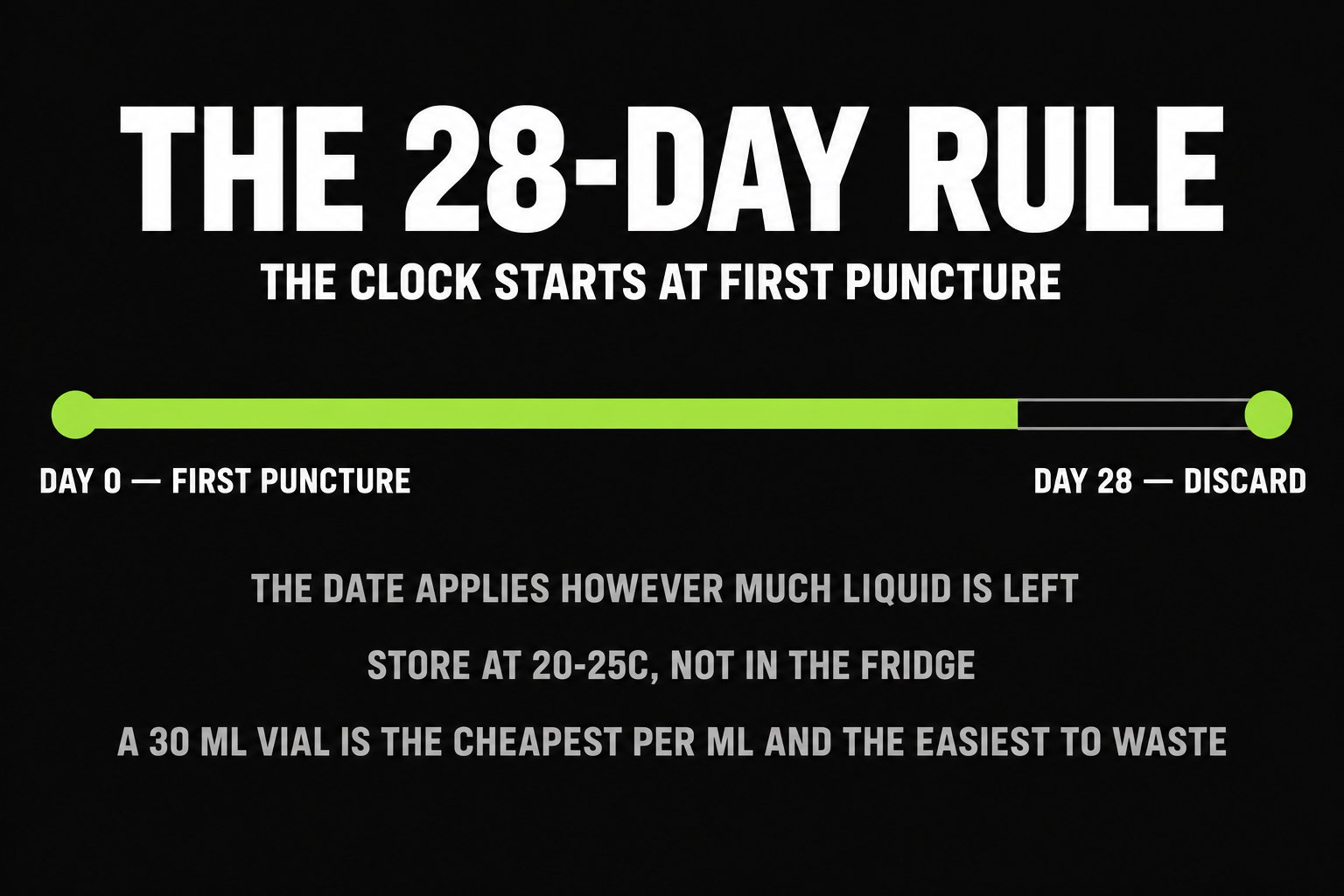
The headline number is 28 days. Once you puncture a vial of bacteriostatic water, the standard guidance from the Pfizer and Hospira prescribing information is to use it within 28 days and then discard the rest, kept refrigerated the whole time. That window is counted from the first needle puncture, not from the day you bought it or opened the box. A sealed, unopened vial is good until its printed expiration date, usually 18 to 24 months out.
Why 28 days? Benzyl alcohol slows bacterial growth but does not stop contamination forever, and every puncture is a chance to introduce something. The 28-day rule is a conservative ceiling that assumes clean technique and cold storage. Several things shorten it well below 28 days:
- Room-temperature storage. A punctured vial left out can lose its bacteriostatic protection in as little as 7 to 10 days.
- Heavy puncture counts. The rubber stopper can stop resealing reliably after roughly 15 to 20 sticks, so a vial used many times a day ages faster.
- Sub-spec product. Water made with less than the full 0.9% benzyl alcohol can fail before the 28 days are up, which is why a verified concentration matters.
- A lost first-puncture date. If you cannot remember when you opened it, you cannot trust the clock, so treat it as expired.
This is the practical answer to how long bac water is good for, in the fridge or otherwise. Refrigerated and clean, plan on 28 days. Sloppy or warm, plan on less.
Signs your BAC water has gone bad
Does bac water go bad or expire? Yes, both. Beyond the date math, your eyes are the final check. Discard a vial of bacteriostatic water, or a reconstituted peptide, if you see any of these.
Throw it out if you notice:
- Cloudiness or haze. Clear water that turns milky or foggy is a contamination signal.
- Floating particles or specks. Anything visible suspended in the liquid means it is no longer clean.
- Color change or a film. Yellowing, tint, or a surface skin are all discard triggers.
- A compromised seal. A loose crimp, a cracked vial, or a stopper that no longer reseals.
- An unknown age. Past 28 days from opening, or a vial you cannot date, goes in the bin regardless of how it looks.
Clear and colorless is the only acceptable look. When in doubt, the cost of a fresh vial is far lower than the cost of injecting something contaminated.
When not to use bacteriostatic water
BAC water is the default, but a handful of peptides do not get along with benzyl alcohol. For these, the safer solvent is preservative-free sterile water, used as a single-dose mix and discarded within about 24 hours.
| Peptide | Why BAC water is a poor fit | Use instead |
|---|---|---|
| KPV | Sensitive to benzyl alcohol, which can affect stability | Preservative-free sterile water, single use |
| NAD+ | Often reconstituted in larger volumes; some prefer it unpreserved | Sterile water, used promptly |
| Oxytocin | Can be destabilized by the preservative | Preservative-free sterile water |
| hCG (some formulations) | Certain preparations specify a non-benzyl-alcohol diluent | The supplied diluent or sterile water |
If a peptide vial or its instructions call for a specific diluent, follow that. For everything else in the GLP and repair-peptide world, bacteriostatic water is the standard solvent.
Is bacteriostatic water safe?
For the tiny volumes used to reconstitute peptides, benzyl alcohol exposure is very small, and bacteriostatic water has a long, documented safety record in clinical compounding. One important caution appears on every label: benzyl alcohol is not for use in newborns. High benzyl alcohol exposure has been linked to a serious condition in premature and newborn infants known as gasping syndrome, which is why the FDA-approved labeling warns against using benzyl-alcohol-preserved water in neonates.
A few other basics are worth stating plainly. Bacteriostatic water is hypotonic, so it is not meant to be pushed intravenously on its own without being mixed into an isotonic solution. Aseptic technique is the biggest factor in whether a vial stays safe after opening, so swab the stopper every time. Bacteriostatic water is a prescription drug product in the United States, and any decision about peptides themselves belongs with a qualified, licensed healthcare provider who knows your history.
Where to buy bacteriostatic water
Chain pharmacies rarely stock it on the shelf and Amazon delisted most listings, so for a clean, tested vial and pricing, see our dedicated guide on where to buy BAC water for peptides. If you are pairing it with a GLP protocol, our roundup of peptides for weight loss connects the dosing back to goals.
A second source worth comparing is Bacteriostatic Water US, which ships USP-grade vials at 0.9% benzyl alcohol from Tampa with a per-batch certificate of analysis, currently $14.99 for 10 mL and $7.99 for 3 mL. Whichever vendor you use, read the label before you open anything. Both 0.9% and 1.1% benzyl alcohol are sold as bacteriostatic water, and resellers rarely tell you which strength is in the box.
Related comparison: bacteriostatic water vs sterile water vs saline.
Frequently Asked Questions
References
- DailyMed (U.S. National Library of Medicine). Bacteriostatic Water for Injection, USP, label (Hospira, Inc.), including 0.9% benzyl alcohol (9 mg/mL), the 28-day discard window, USP Water for Injection base, and the neonatal benzyl alcohol caution. dailymed.nlm.nih.gov.
- DailyMed (U.S. National Library of Medicine). Sterile Water for Injection, USP, label: preservative-free, single-dose use, for comparison with bacteriostatic water. dailymed.nlm.nih.gov.
- Centers for Disease Control and Prevention. Preventing Unsafe Injection Practices: single-dose versus multi-dose vial handling, aseptic technique, and discard timing for punctured vials. cdc.gov.
- Gershanik J, Boecler B, Ensley H, McCloskey S, George W. The gasping syndrome and benzyl alcohol poisoning. N Engl J Med. 1982;307(22):1384-1388 (PMID 7133084). pubmed.ncbi.nlm.nih.gov.
- PubChem (U.S. National Library of Medicine). Benzyl Alcohol (CID 244): identity, properties, and use as an antimicrobial preservative. pubchem.ncbi.nlm.nih.gov.
- U.S. Food and Drug Administration. Inactive Ingredient Database, benzyl alcohol as an approved injectable preservative. accessdata.fda.gov.