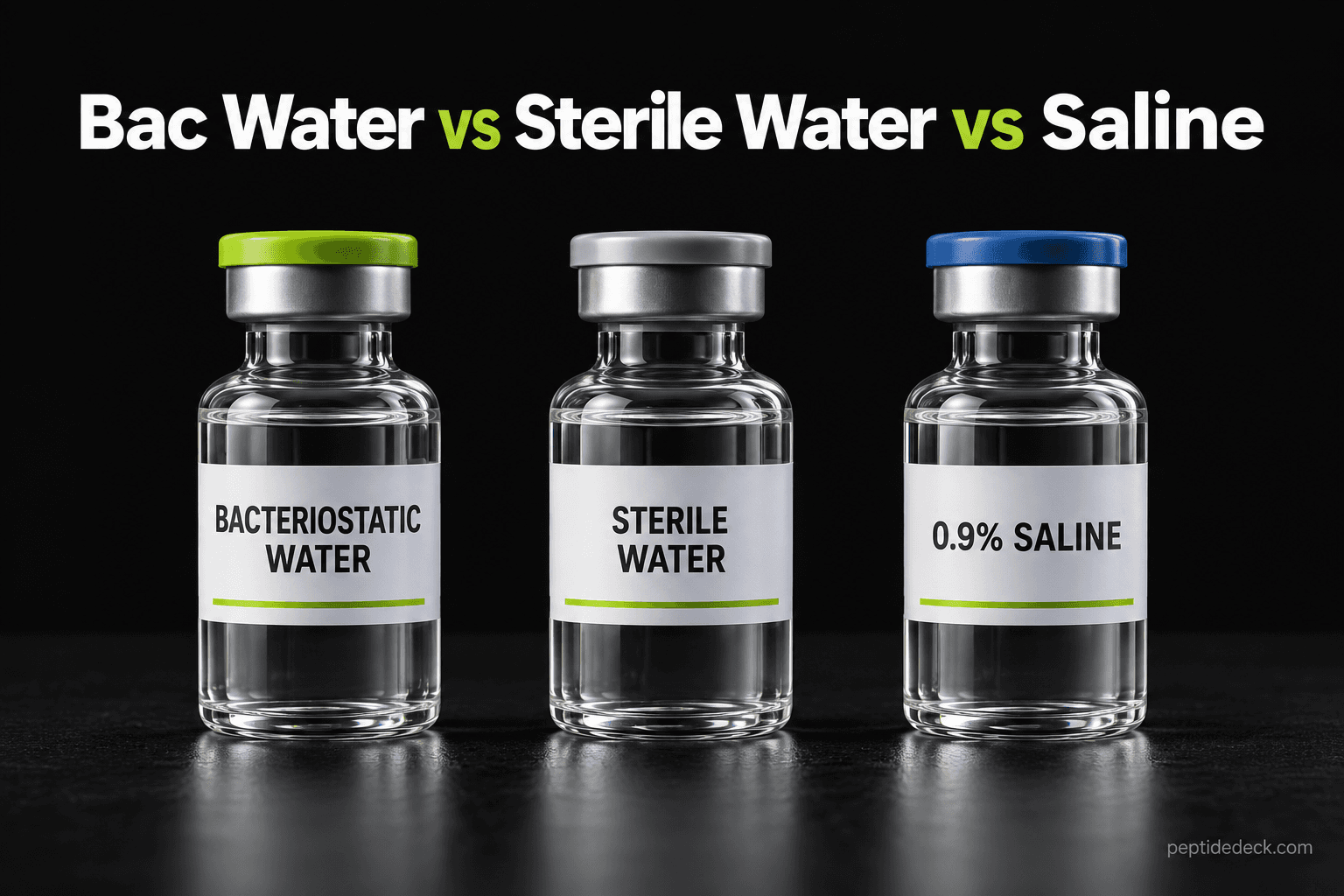
Three clear liquids. One of them costs you the vial.
Bacteriostatic water vs sterile water vs saline is the question everyone asks the night the peptides arrive and the water did not. They look identical. Two of them are chemically almost identical. And the wrong pick does not ruin the peptide on day one. It ruins it on day nine, when a multi-dose vial that was never meant to be re-entered has been re-entered eight times.
🔑 Key Takeaways
- Bacteriostatic water is sterile water plus a preservative. That preservative is the entire reason it can be used for a month.
- Sterile water and normal saline are single-use. Re-entering the vial is the mistake, not the liquid itself.
- Bacteriostatic saline exists, is multi-dose, and is the least-known option. It is the right answer for some people.
- Saline is isotonic, so it stings less. That matters for daily injections and not much otherwise.
- Which diluent your peptide actually tolerates is the question people skip. The compatibility section is the one to read before you mix.
For where to buy and what to check on the label, see the bacteriostatic water buying guide. For the reconstitution technique itself, see the bacteriostatic water and mixing guide. This page is the comparison.
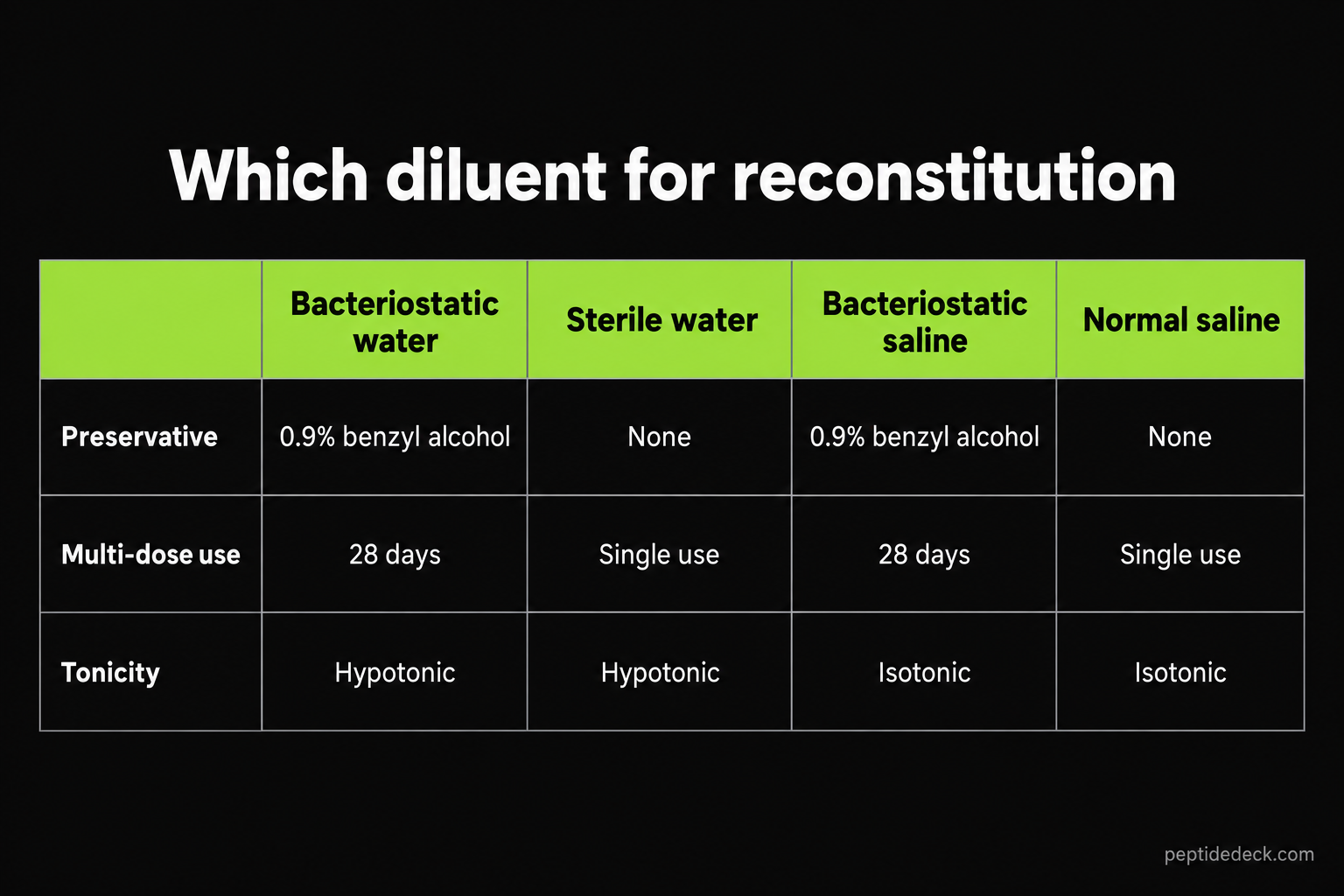
Bacteriostatic Water vs Sterile Water vs Saline at a Glance
What Each One Actually Is
Read the label and most of the confusion disappears.
Sterile Water for Injection, USP is exactly what it says. Purified water, sterilised, no additives, no preservative. It is packaged for single use because the moment a needle goes through the stopper, air and whatever is on the needle go in with it, and there is nothing in the vial to stop bacteria growing. It is also hypotonic, which means it will burst red blood cells if injected directly into a vein in any volume. That is a warning for intravenous use, not for a 0.3 mL subcutaneous peptide dose.
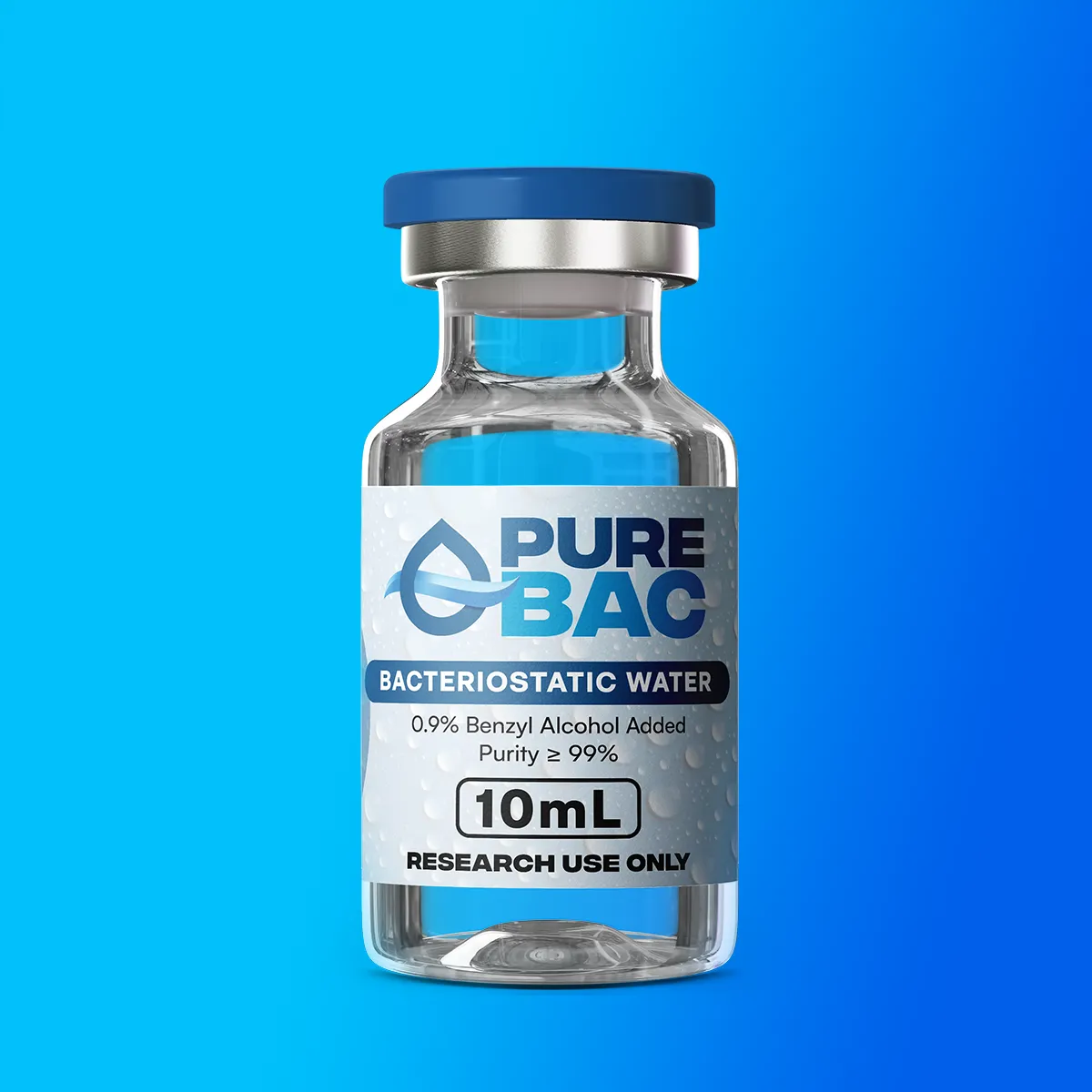
Bacteriostatic Water for Injection, USP is the same sterile water with 0.9% benzyl alcohol added. Benzyl alcohol does not sterilise anything. It stops bacteria that get into the vial from multiplying, which is what lets the vial be punctured repeatedly over 28 days. That 28-day figure comes from USP Chapter 797 and runs from the first puncture regardless of how much liquid is left. The Hospira label is stamped Rx only, which is why you cannot buy it at a pharmacy counter and why most supply comes through peptide vendors. The bacteriostatic water guide covers the two benzyl alcohol strengths the USP allows and why that matters for a resold vial.
Normal saline (0.9% Sodium Chloride Injection, USP) is water with salt at the same concentration as your blood. It is isotonic, so it does not pull water into or out of cells and it stings less. Like sterile water, the standard vials have no preservative and are single-use.
Bacteriostatic saline is normal saline with 0.9% benzyl alcohol. Multi-dose like bacteriostatic water, isotonic like saline. It is the least-known of the four and, for some people, the best one.
Why the Preservative Decides Everything
The peptide does not care. The bacteria do.
A 5 mg or 10 mg peptide vial is almost always used over days or weeks. Each dose means a fresh needle through the stopper. Without a preservative, every puncture is a chance to seed the vial, and a peptide solution at fridge temperature is a fine growth medium. That is how a clear vial turns cloudy in week two, and it is why sterile water and normal saline are the wrong choice for anything you will re-enter.
Benzyl alcohol solves that. It also has a cost: it is contraindicated in newborns, some people find it irritating, and a small number of peptides are formulated to avoid it. But for the standard use case, a multi-dose peptide vial drawn from over two to four weeks, it is the difference between a diluent and a liability.
The one situation where sterile water or plain saline is the right call is a true single-dose vial: reconstitute, draw the whole thing, inject, discard. Some larger vials of growth hormone secretagogues and some clinic-dispensed products are used that way. Most peptide vials are not.
Tonicity: Why Saline Stings Less
Salt is comfort, not chemistry.
Both waters are hypotonic. Injected under the skin, that small volume of pure water briefly draws fluid from surrounding cells, which is why some people feel a sting or a small welt with certain peptides. Saline matches the body's osmolality and avoids that. For a weekly injection nobody notices the difference. For daily injections of an irritating peptide, or for someone with sensitive skin, the difference between a hypotonic and isotonic diluent is real.
That is the case for bacteriostatic saline. You keep the 28-day multi-dose window and lose the sting. The reason it is not the default is availability: fewer suppliers stock it, and it is not the standard recommendation on most reconstitution guides, so most people never encounter it.
Peptide Compatibility
Almost everything is fine with bacteriostatic water. Almost.
The large majority of peptides sold for reconstitution, BPC-157, TB-500, GHK-Cu, the GLP-1 class, growth hormone secretagogues, melanocortins, all reconstitute cleanly in bacteriostatic water and stay stable in it for the useful life of the vial. That is why it is the default and why every dosing chart assumes it.
A few points worth knowing before you mix:
- Salt can reduce solubility for some peptides. Highly hydrophobic sequences occasionally dissolve less readily in saline than in water. If a peptide is slow to clear in saline, that is why. Bacteriostatic water is the safer first choice when you do not know.
- Some manufacturers specify a diluent. Pharmaceutical products like Scenesse or Vyleesi come pre-formulated. Vials that ship with a specific diluent or instruction should follow it.
- Acetic acid is a niche case. A handful of peptides with very poor water solubility are sometimes dissolved in dilute acetic acid first. That is unusual and never the answer for a common peptide.
- Volume choice matters more than diluent choice. Reconstituting a 5 mg vial with 1 mL versus 2 mL changes every syringe reading. The peptide calculator does the arithmetic. Get that right and the diluent question is usually already answered.
Which One Should You Use?
Match the liquid to the vial's life, not to what you have in the drawer.
Use bacteriostatic water if you will draw from the vial more than once. That is the default and covers most peptide use. Buy the 10 mL size unless you get through more than 20 mL a month, because the 28-day clock runs out before a 30 mL vial does.
Use bacteriostatic saline if you inject daily or find injections sting, and you can source it. Same 28-day window, gentler on the skin.
Use sterile water if you will reconstitute and use the entire vial in one sitting, or if a product specifically calls for it. Discard whatever is left. Do not put the stopper back and use it tomorrow.
Use normal saline if you need a single-use isotonic diluent, particularly for larger volumes or intramuscular injections. Same rule: one entry, then discard.
Never use tap water, distilled water from a bottle, contact-lens saline, or anything not labelled for injection. Sterility is the minimum requirement and none of those meet it.
Frequently Asked Questions
The Verdict
Bacteriostatic water by default. Bacteriostatic saline if it stings. The plain versions only for single-use.
The three liquids are not interchangeable, and the thing that separates them is not what they do to the peptide but what happens to the vial over the following month. Pick the one whose shelf life matches how you will use it, and the rest of the reconstitution process takes care of itself.
References
- Bacteriostatic Water for Injection, USP. Hospira prescribing information, DailyMed.
- Sterile Water for Injection, USP. Hospira prescribing information, DailyMed.
- 0.9% Sodium Chloride Injection, USP. Prescribing information, DailyMed.
- United States Pharmacopeia. General Chapter 797: Pharmaceutical Compounding, Sterile Preparations. Beyond-use dating of multiple-dose containers.
- Centers for Disease Control and Prevention. Injection Safety: Questions about Multi-dose Vials. CDC
- Gershanik J, et al. The gasping syndrome and benzyl alcohol poisoning. N Engl J Med 1982;307(22):1384-8. PubMed
Medical Disclaimer: This content is for informational purposes only and does not constitute medical advice. Always consult a qualified healthcare provider before starting any new supplement, medication, or treatment. PeptideDeck may earn a commission from affiliate links at no additional cost to you.