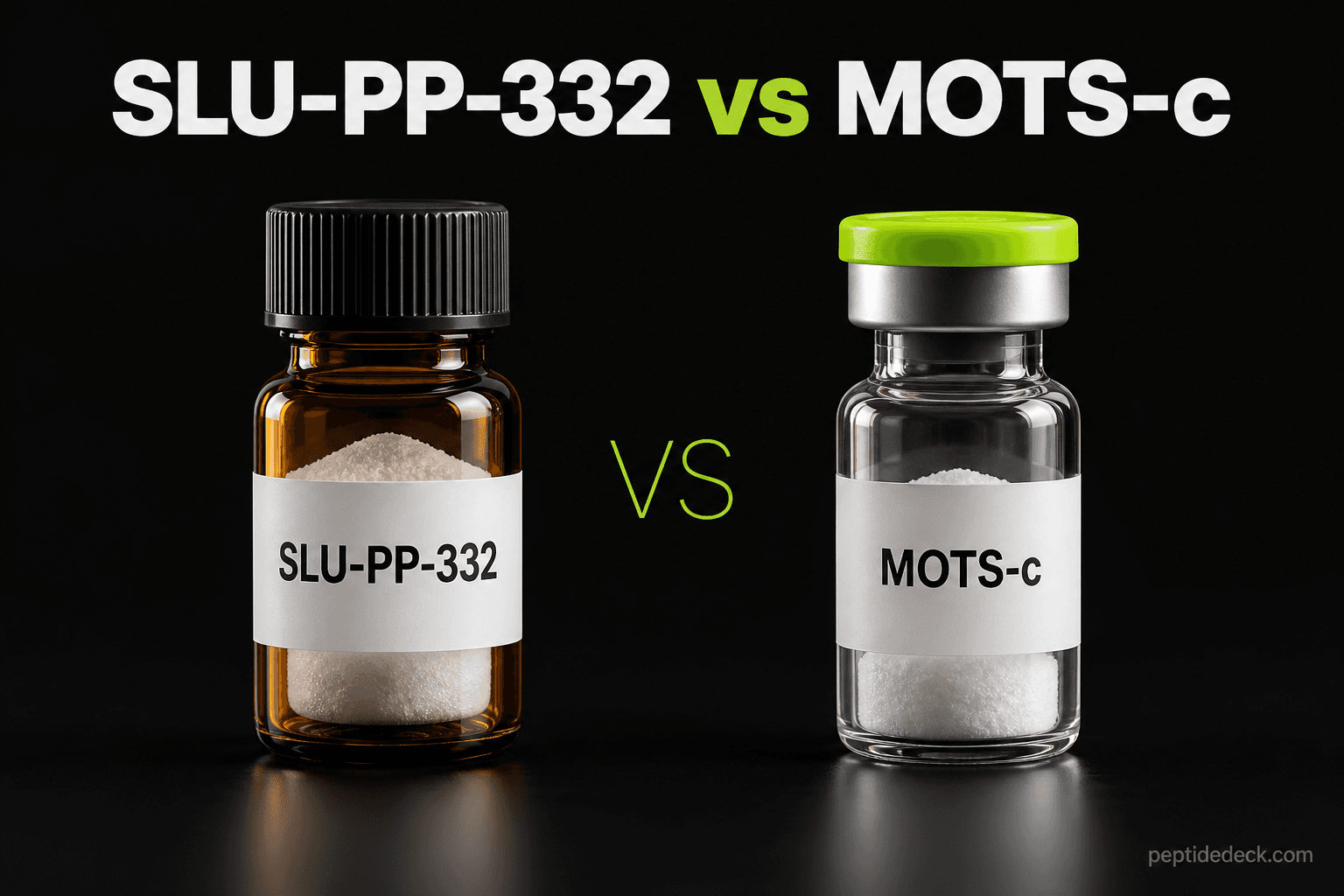
Only one of these has ever been inside a human trial.
SLU-PP-332 vs MOTS-c is the exercise-mimetic comparison, and both get sold on the same promise: some of the metabolic benefit of training without the training. They arrive there by different roads. One is a small molecule that flips on the genes endurance exercise flips on. The other is a peptide your own mitochondria make more of when you exercise. The difference in how much we know about each is larger than the difference in what they do.
🔑 Key Takeaways
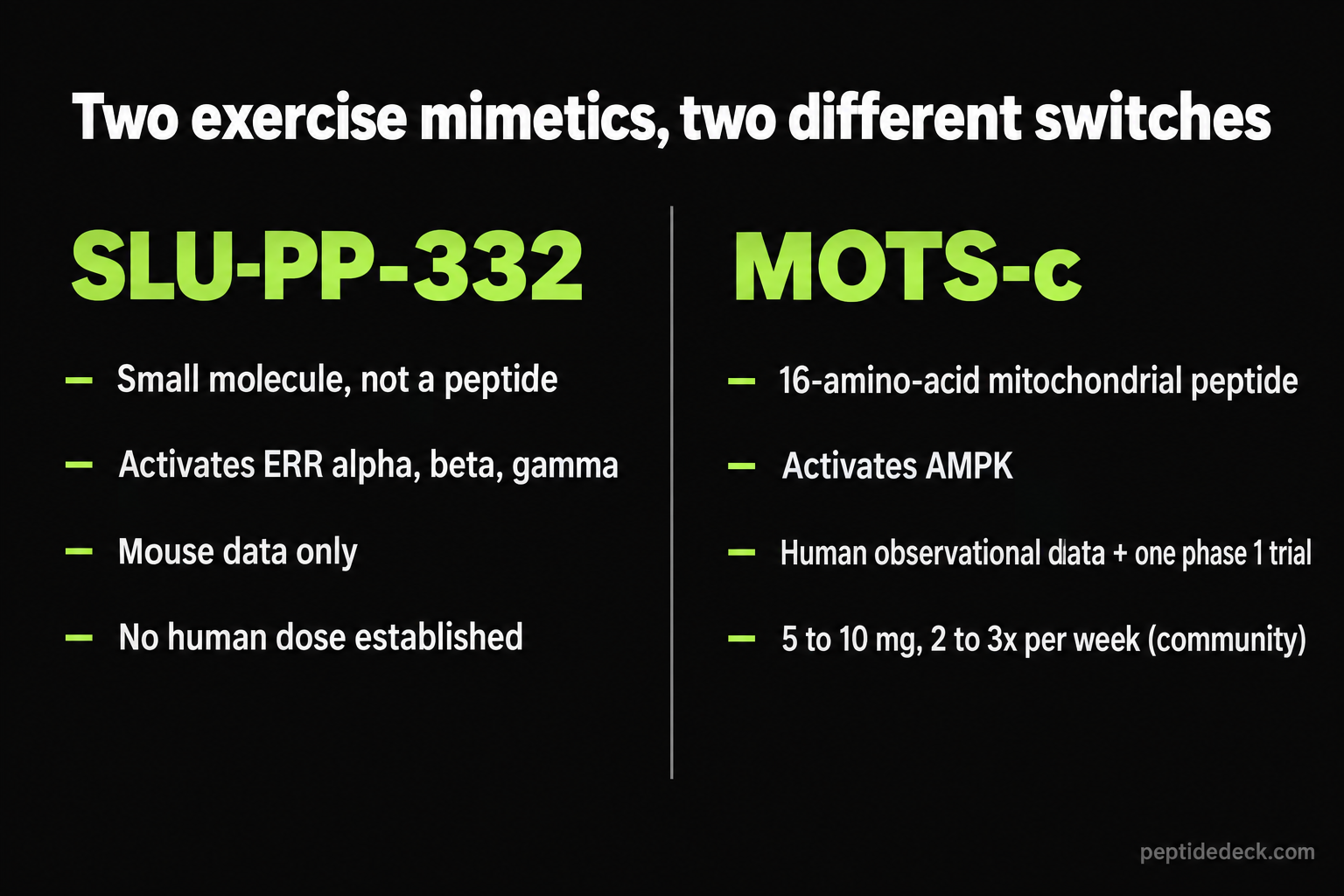
- SLU-PP-332 activates estrogen-related receptors, the transcription factors that switch on endurance-training genes. MOTS-c activates AMPK, the cell's energy sensor.
- SLU-PP-332 is a small molecule, not a peptide, despite where it is sold. MOTS-c is a real peptide with a real role in human physiology.
- The SLU-PP-332 numbers are striking and entirely from mice. MOTS-c has human observational data and one small clinical trial of an analogue.
- Neither has an established human dose. The community protocols for each come from different places and carry different levels of guesswork.
- The two mechanisms are complementary on paper. What that means in practice is covered in the stacking section.
For each compound on its own, see the SLU-PP-332 guide and the MOTS-c peptide guide. This page is the comparison.
SLU-PP-332 vs MOTS-c at a Glance
Two Ways to Fake a Workout
Exercise changes your cells in two stages.
The fast stage is energy sensing. When a muscle works, ATP falls, AMP rises, and an enzyme called AMPK switches on. AMPK tells the cell to burn fat, pull in glucose and stop building things for a while. The slow stage is gene expression. Repeated training activates transcription factors, including PGC-1 alpha and the estrogen-related receptors, that rewrite the muscle toward more mitochondria, more oxidative fibres and better endurance.
MOTS-c works on the fast stage. It is a 16-amino-acid peptide encoded in the mitochondrial genome, discovered in 2015. Under metabolic stress it moves to the nucleus and, through effects on the folate and methionine cycle, causes AICAR to accumulate and AMPK to switch on. Your body makes more of it when you exercise. Blood levels rise acutely after a session, and people who are fitter tend to carry more of it in muscle. Injected MOTS-c borrows that signal.
SLU-PP-332 works on the slow stage. It is a synthetic small molecule developed at Saint Louis University that directly activates all three estrogen-related receptors, with the strongest effect at ERR alpha. Those receptors sit at the top of the endurance gene programme. Activate them and the muscle starts behaving as if it has been training, without the training having happened.
Fast lever, slow lever. That is the whole mechanistic difference, and it is why the two get stacked.
What the Evidence Actually Shows
Here is where the comparison stops being even.
SLU-PP-332 has one body of evidence: a series of mouse studies from the Burris and Patti labs published in 2023 and 2024. Untrained mice ran about 70% longer on a treadmill after dosing. Obese mice lost around 12% of body weight over 28 days at 50 mg/kg twice daily, with no change in food intake or activity, driven by higher energy expenditure and fat oxidation. Muscle showed a shift toward oxidative fibres. The results are consistent, mechanistically coherent, and entirely in mice. No human has taken SLU-PP-332 in a trial. There is no pharmacokinetic data, no safety data and no dose that has been shown to do anything in a person.
MOTS-c has three layers. First, the mouse work: it restored exercise capacity in aged animals, doubled running time in some models, and prevented diet-induced obesity and insulin resistance. Second, human observational data: MOTS-c levels track with exercise and decline with age, and a variant of the MOTS-c gene common in East Asian populations associates with longevity and lower diabetes risk. Third, a human trial: CB4211, a MOTS-c analogue developed by CohBar, completed a phase 1b/2a study in people with obesity and fatty liver in 2021. It was safe and showed modest effects on glucose, weight and liver fat. The company later shut down for commercial reasons, not safety ones.
None of that makes MOTS-c a proven therapy. It makes it a compound with a foothold in human biology, which SLU-PP-332 does not yet have.
SLU-PP-332 vs MOTS-c for Fat Loss
On mouse data, SLU-PP-332 is the more dramatic of the two.
The 12% weight loss over four weeks without dietary change is the headline that sells it, and it came from a genuine increase in energy expenditure rather than appetite suppression. MOTS-c's mouse data on weight are more about prevention: animals on a high-fat diet gained less. In the one human trial of a MOTS-c analogue, the weight effect was modest.
The catch is that neither has been shown to cause fat loss in people. Someone using either for that purpose is extrapolating. The fat loss peptide ranking puts the compounds with human data at the top for exactly that reason, and both of these sit below them.
SLU-PP-332 vs MOTS-c for Endurance and Longevity
This is closer to a tie, with an asterisk on each.
Both increased running endurance in mice by large margins. SLU-PP-332 did it in young untrained animals; MOTS-c did it in aged animals, which is the more interesting result for anyone thinking about longevity. MOTS-c also has the human genetic association with lifespan, and its mechanism, AMPK activation, is shared with the two best-studied longevity interventions, exercise and metformin. The MOTS-c vs metformin comparison goes into that overlap.
SLU-PP-332's longevity case is theoretical: ERR activation increases mitochondrial biogenesis, and more mitochondria is generally good. It has not been tested for lifespan in any species.
Dosage Compared
Both doses are inventions. One is a better-informed invention.
MOTS-c community protocols run 5 to 10 mg subcutaneously, two to three times a week, for 4 to 8 weeks. That range is loosely derived from the mouse doses scaled by body surface area, and from the CB4211 trial's dosing logic. Smaller, more frequent doses are generally preferred because AMPK activation is a transient signal. MOTS-c also degrades faster than most peptides once in solution, so reconstitute what you will use within a couple of weeks and keep it cold. The MOTS-c dosage guide covers the reconstitution maths.
SLU-PP-332 community protocols run 1 to 5 mg daily, usually subcutaneous, for 6 to 8 weeks. Those numbers have almost no anchor. The mouse dose was 50 mg/kg twice daily by injection into the abdomen, which scaled naively to a human would be grams, not milligrams. The community dose is a fraction of that, chosen for cost and caution rather than evidence. As a small molecule it is stable in solution and could in principle be taken orally, but nobody has measured oral bioavailability in a person.
Side Effects and Safety
Absence of evidence is doing a lot of work here.
MOTS-c has a small human safety signal from the CB4211 trial, where it was well tolerated, and years of community use with few consistent complaints. Injection-site reactions and transient fatigue are the most commonly reported. Because it activates AMPK, it may blunt muscle protein synthesis at higher doses, which matters if muscle gain is a goal. The MOTS-c side effects guide covers what is known.
SLU-PP-332 has no human safety data at all. The theoretical concerns are real: estrogen-related receptors are involved in cell growth and metabolism across many tissues, not only muscle, and ERR alpha activity is linked to some cancer biology. In mice at study doses nothing alarming was reported, but mice were dosed for four weeks and the studies were not designed to look for long-term effects. Anyone using it is the first human data point in their own experiment.
Stacking SLU-PP-332 with MOTS-c
The logic is sound. The evidence is nil.
Because one works on energy sensing and the other on gene expression, stacking them mimics both stages of training at once. That is a coherent idea and it is why the combination is popular. There is no study of the two together in any species. People who run both typically dose MOTS-c on training days and SLU-PP-332 daily, and they report the combined effect as more noticeable endurance than either alone. Treat that as anecdote. The retatrutide and MOTS-c stack page covers the more common pairing of MOTS-c with an appetite drug.
Which One Should You Choose?
Choose by your tolerance for the unknown.
Choose MOTS-c if you want the option with human data, you are interested in the longevity and metabolic-health angle more than raw fat loss, or you would rather use something your body already makes.
Choose SLU-PP-332 if you are chasing the endurance and energy-expenditure effect specifically, you accept that you are working from mouse data alone, and you are comfortable with a compound that has no human safety record. Keep cycles short and doses at the low end of the community range.
Choose neither if the goal is weight loss with predictable results. The GLP-1 class has human trials measured in tens of thousands of people. These two have zero and one.
Frequently Asked Questions
The Verdict
MOTS-c is the known quantity. SLU-PP-332 is the louder promise.
If you want an exercise mimetic with a human footprint, MOTS-c is the only one of these two that has one. If you want the bigger numbers and can live with the fact that every one of them came from a mouse, SLU-PP-332 is where the bigger numbers are. The honest framing is that MOTS-c is early-stage and SLU-PP-332 is earlier still, and the gap between them is measured in whether anyone has checked what it does to a person.
References
- Billon C, et al. A synthetic ERR agonist alleviates metabolic syndrome. J Pharmacol Exp Ther 2024;388(2):232-240. PubMed
- Billon C, et al. Synthetic ERR alpha/beta/gamma agonist induces an ERR gamma-dependent acute aerobic exercise response and enhances exercise capacity. ACS Chem Biol 2023;18(4):756-771. PubMed
- Lee C, et al. The mitochondrial-derived peptide MOTS-c promotes metabolic homeostasis and reduces obesity and insulin resistance. Cell Metab 2015;21(3):443-454. PubMed
- Reynolds JC, et al. MOTS-c is an exercise-induced mitochondrial-encoded regulator of age-dependent physical decline and muscle homeostasis. Nat Commun 2021;12:470. PubMed
- Zempo H, et al. A pro-diabetogenic mtDNA polymorphism in the mitochondrial-derived peptide, MOTS-c. Aging 2021;13(2):1692-1717. PubMed
- ClinicalTrials.gov NCT03998514. A study of CB4211 in subjects with nonalcoholic fatty liver disease and obesity. ClinicalTrials.gov
Medical Disclaimer: This content is for informational purposes only and does not constitute medical advice. Always consult a qualified healthcare provider before starting any new supplement, medication, or treatment. PeptideDeck may earn a commission from affiliate links at no additional cost to you.