One works on your pituitary. The other works inside your cells.
That is the real difference in MOTS-c vs tesamorelin, and it's why the two keep turning up in the same conversations. You already know the feeling they're both sold against: a waistline that won't move however clean you eat, and energy that fades by mid-afternoon. Both peptides get pitched as the fix. Only one of them has been tested in people, and the two pull blood sugar in opposite directions, which is exactly why some people take them together.
🔑 Key Takeaways
- Tesamorelin is an FDA-approved drug for one narrow use. MOTS-c has no approval and no human trial of its own.
- For belly fat specifically, only one of the two has a result measured on a CT scan in people.
- Tesamorelin carries a blood sugar warning. MOTS-c is pitched as the answer to it, and the evidence for that is thinner than it sounds.
- The cheaper-looking peptide is not the cheaper month. The dose schedule decides the bill.
- If you stack them, when you take each one matters more than most guides say.
Below, we put the two side by side using the FDA label, the published trials and the mouse studies, then answer the stack question: why people pair them, what nobody has tested, and how to time them if you go ahead.
MOTS-c vs Tesamorelin: The Short Answer
They aren't rivals for the same job.
Tesamorelin (brand name Egrifta) is a man-made version of growth hormone releasing hormone. It tells your pituitary to release more of your own growth hormone, which raises IGF-1 and, over months, shrinks the fat packed around your organs. The FDA approved it in 2010 for one use: excess abdominal fat in adults with HIV and lipodystrophy. Our tesamorelin review covers its full clinical record.
MOTS-c is a 16-amino-acid peptide your own mitochondria make. It was found in 2015, coded inside the mitochondrial 12S rRNA gene, and it acts on AMPK, the energy sensor your muscles switch on when you exercise. In mice it improved insulin sensitivity and blocked weight gain on a high-fat diet. It has never been tested as a treatment in a human trial. Our MOTS-c peptide guide covers what it is and how people use it.
How Each One Works
Start with where the signal begins.
Tesamorelin copies the message your hypothalamus sends to the pituitary. Your body still controls the release, so growth hormone comes out in pulses rather than the flat high you'd get from injecting growth hormone itself. That growth hormone raises IGF-1 and makes fat cells, visceral ones especially, give up stored fat. In the first phase 3 trial, IGF-1 rose 81% on tesamorelin and fell 5% on placebo. The drug itself clears in minutes: the current label lists a half-life of 11 minutes.
MOTS-c skips the hormone chain entirely. In the 2015 discovery paper in Cell Metabolism, it acted mainly on skeletal muscle, slowed the folate cycle inside the cell and switched on AMPK. A 2018 follow-up found it moves into the cell nucleus under metabolic stress, such as low glucose, and changes which genes are switched on. Its half-life in people has never been measured, so any figure you see quoted is a guess.
So one changes where your body stores fat by raising a hormone. The other changes how your muscle cells handle fuel. That's why the "vs" in this comparison is a little misleading.
The Evidence Gap
This is the part that should shape your decision.
Tesamorelin went through two 26-week phase 3 trials of 412 and 404 adults, a 26-week extension, and a 12-month trial in people without HIV. MOTS-c has mouse studies, a study of the body's own MOTS-c during exercise, and a trial of a different molecule. The only human trial in its family tested CB4211, an analog made by CohBar, in a phase 1a/1b study of 88 people. That's a separate drug, dosed daily, in a study built to check safety, not results.
You may see a "phase 2 MOTS-c trial" cited on other comparison sites. The listing they point to has posted no results, and we couldn't verify it, so we don't count it.
Read that table with one caution. "In mice" results often shrink or vanish in people. That's not a reason to dismiss MOTS-c, but it is a reason not to expect tesamorelin-size results from it.
Belly Fat: Which One Actually Shrinks It?
Tesamorelin, on the evidence we have.
In its two phase 3 trials, tesamorelin 2 mg a day cut visceral fat by 18% (placebo +2%) and 14% (placebo −2%) at 26 weeks on CT scans, according to the FDA label. The NEJM paper on the first trial reported a 15.2% drop against a 5.0% rise. Waist size came down 2 to 3 cm. Body weight did not move, and the label says plainly that it is "not indicated for weight loss management as it has a weight neutral effect."
If you don't have HIV, the closest evidence is a smaller trial. Makimura and colleagues gave 2 mg a day or placebo to 60 abdominally obese adults with low growth hormone output for 12 months. Visceral fat fell 16 cm² on tesamorelin and rose 19 cm² on placebo, a 35 cm² difference. Fat under the skin didn't change significantly. Triglycerides and CRP improved too.
MOTS-c's fat data is all from mice. In the 2015 paper, mice given MOTS-c on a high-fat diet put on less weight and fat than untreated mice, and stayed more insulin sensitive. Nobody has scanned the belly of a person taking it.
The catch with tesamorelin: the result doesn't last after you stop. In the 26-week extension, people switched from tesamorelin to placebo saw visceral fat climb back 22% and 16% in the two studies, while those who stayed on it held their result. If you start it, plan for what happens when it ends.
Blood Sugar: Opposite Directions
This is why people put them together.
Growth hormone works against insulin, and tesamorelin raises growth hormone. In the phase 3 trials, 5% of people on tesamorelin developed an HbA1c of 6.5% or higher, against 1% on placebo, a hazard ratio of 3.3. The label tells doctors to check glucose before starting and keep checking during treatment.
The risk is real but modest. Average glucose didn't change significantly in the first NEJM trial or in the 12-month Makimura trial. A 12-week study of 53 people with type 2 diabetes, run by the drug's maker, found no loss of glucose control at 1 or 2 mg a day. So it's a minority who see a problem, and you won't know in advance if you're one of them.
MOTS-c points the other way, in mice. One week of it improved skeletal muscle insulin sensitivity in young and older mice, and it blocked insulin resistance caused by age and by a high-fat diet. In people, we only know that blood levels of your own MOTS-c tend to be lower in some groups with insulin resistance. That's an association, not proof that injecting it helps. Our MOTS-c vs metformin comparison goes deeper on the glucose question.
So the "balance" argument has a sound idea behind it and no human test. More on that in the stack section below.
Energy, Training and Muscle
Here MOTS-c has the more interesting story.
In a 2021 Nature Communications paper, old mice given MOTS-c ran twice as long and 2.16 times as far on a treadmill as untreated mice, and 17% of them reached the top speed stage, which none of the untreated old mice did. Muscle changes showed up only in mice that also exercised. In the same paper, 10 young men cycling on a stationary bike saw MOTS-c in their muscle rise 11.9-fold and in their blood 1.6-fold. That was their own MOTS-c. Nobody injected them with it.
If you're dealing with flat energy and slow recovery, that's the appeal: a signal your body already sends during exercise, delivered in a vial. Whether the vial does what the exercise does is the untested part. For the wider picture, see our guide to peptides for energy and mitochondrial health.
Tesamorelin has a lean mass number but no energy outcome. In the phase 3 trials, DXA scans showed lean body mass up 1.3 kg and 1.2 kg over 26 weeks, against small drops on placebo. Part of that may be water, since growth hormone causes fluid retention and DXA counts water as lean mass. Some users report deeper sleep on it, but that wasn't a trial outcome.
MOTS-c vs Tesamorelin Side Effects
The lists barely overlap.
Tesamorelin's label also rules it out in active cancer and in pregnancy, because it raises a growth factor. MOTS-c has no human safety data at all, so the column above is what people report, not what a trial measured. If you take insulin, a sulfonylurea or metformin, either peptide can shift your glucose, so talk to your doctor first. Our full guides cover tesamorelin side effects and MOTS-c side effects in more detail.
Dosing: Every Day vs Three Times a Week
The schedules are where the two feel most different.
Tesamorelin is a daily shot into the belly. The trials used 2 mg a day of the original formulation; the newer Egrifta WR reaches the same blood levels with 1.28 mg. Most people buying vials start at 1 mg a day and move to 2 mg, as our tesamorelin dosage guide explains.
MOTS-c has no tested human dose. The usual protocol, 5 mg three times a week on non-consecutive days for 8 to 12 weeks, borrows its rhythm from the 2021 mouse study and its dose from convention. Our MOTS-c dosage chart has the tolerance start, the upper range and a calculator.
Storage is the same for both vendor vials: keep the powder in the fridge, away from light. Once mixed, refrigerate at 2 to 8 °C and use within about 28 days, the convention set by the benzyl alcohol in bacteriostatic water. In practice both vials are finished within a week at these doses. If you need help mixing, our guide on how to reconstitute MOTS-c walks through it, and the peptide calculator works out the units for any vial.
Cost: What a Month of Each Costs
The per-milligram price misleads here.
At Ascension Peptides, our partner, MOTS-c 10 mg lists at $62, or $31 with code PEPTIDEDECK, which is $3.10 per mg. Tesamorelin 5 mg lists at $50, or $25 with the code, which is $5 per mg. Tesamorelin looks pricier. But MOTS-c is dosed in bigger amounts: at 5 mg three times a week you use 60 mg every four weeks, more than tesamorelin at 2 mg a day.
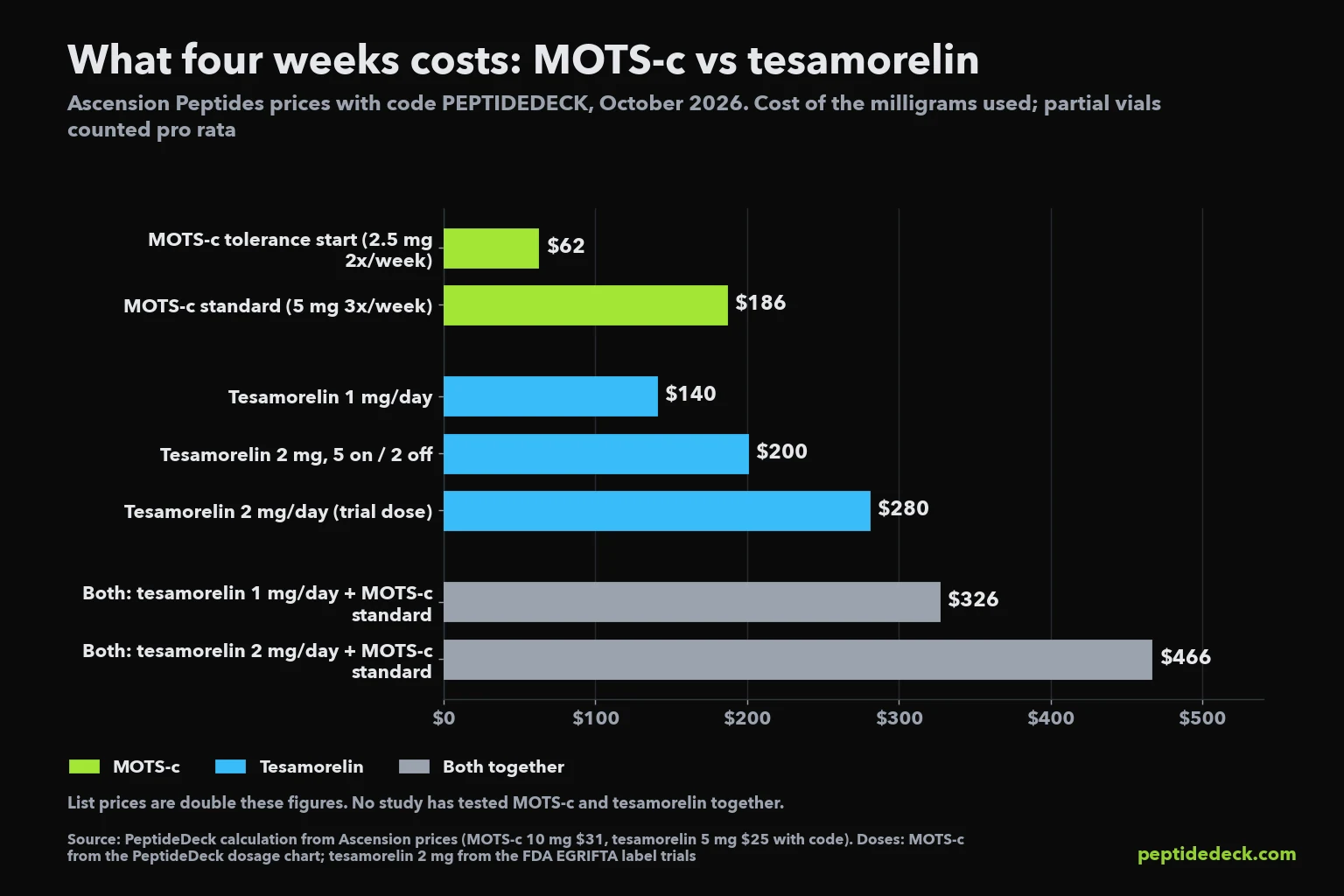
Matching the tesamorelin trials gets expensive. Twenty-six weeks at 2 mg a day is 364 mg, about 73 vials, or roughly $1,820 with the code. A 12-week MOTS-c cycle at the standard dose is 180 mg, 18 vials, about $558. Brand Egrifta costs far more: SingleCare listed one Egrifta WR kit box at about $18,200 cash in October 2026, and insurers usually cover it only for the HIV indication.
Price means nothing if the vial isn't what the label says. Before you order, check that the lab report matches your exact batch and shows purity, net content and an identity test. Our guide on where to buy MOTS-c compares vendors on that paperwork. For the other half, see where to buy tesamorelin, which explains what to look for, since cheaper peptides are sometimes sold under its name.
Can You Take MOTS-c and Tesamorelin Together?
People do. Nobody has studied it.
There is no published trial, case series or registered study of MOTS-c and tesamorelin taken together. A ClinicalTrials.gov search in October 2026 for the pair returned nothing. Everything you'll read about the stack, including vendor "protocols," is reasoning from each one alone.
The reasoning goes like this. Tesamorelin pulls fat out of visceral stores through growth hormone. MOTS-c, in theory, helps muscle burn that fuel and keeps insulin sensitivity up. And because tesamorelin can push glucose up while MOTS-c improved insulin sensitivity in mice, each is meant to cover the other's weak spot.
Does the glucose balancing argument hold up?
Partly.
The worry it addresses is real: the label's 5% vs 1% HbA1c signal. The fix it proposes isn't tested. No one has shown that injected MOTS-c improves insulin sensitivity in a person, let alone that it cancels a growth-hormone-driven rise. And if it did work, you'd want to know, because two drugs nudging glucose in opposite directions make your readings harder to interpret. The honest version: the pairing might help, might do nothing, and the only way to find out is your own blood work.
Timing if you stack them
- MOTS-c in the morning or before training, on three non-consecutive days. Its rationale is tied to exercise, and people report poor sleep when they take it late.
- Tesamorelin fasted, often at bedtime, at least two hours after your last meal. The usual reasoning is that food and the insulin it triggers blunt the growth hormone pulse.
- Separate syringes and sites. Never mix them in one syringe. Different doses and concentrations make that guesswork.
- Add one at a time. Run tesamorelin alone for two to four weeks, then add MOTS-c. If swelling, low-sugar spells or poor sleep show up, you'll know which one caused it.
- Get labs. Fasting glucose, HbA1c and IGF-1 before you start, then again at 8 to 12 weeks. The tesamorelin label suggests stopping if IGF-1 stays above 3 SDS.
Some people add a third peptide, AOD-9604, a growth hormone fragment, to make a fat-loss trio. We cover that version, and its separate evidence, in our AOD-9604, tesamorelin and MOTS-c stack guide. And if you're weighing tesamorelin against a GLP-1-type drug instead, our tesamorelin vs retatrutide comparison covers that matchup.
Which One Fits Your Goal?
Start with the problem you have today.
If your goal is a smaller waist from deep belly fat, tesamorelin is the one with evidence. One honest limitation: the trials were in people with HIV or with low growth hormone, you inject it every day, and the effect fades once you stop. It also won't lower your weight.
If your goal is energy, training capacity or blood sugar, MOTS-c is the one people reach for, but you're betting on mouse data. Start at the tolerance dose, track something measurable such as fasting glucose or a training benchmark, and stop after 8 to 12 weeks if nothing has moved.
If you want both, the stack makes more sense than its evidence suggests, and less than its marketing claims. Add one at a time, get blood work, and tell your doctor you're taking both.
If you compete in a tested sport, skip both. MOTS-c is named on the 2026 WADA Prohibited List as an AMPK activator, and tesamorelin is named among the growth hormone releasing hormone analogues.
Frequently Asked Questions
Sources
- U.S. Food and Drug Administration. EGRIFTA WR (tesamorelin for injection) prescribing information, revised March 2025. accessdata.fda.gov
- Falutz J, et al. Metabolic effects of a growth hormone-releasing factor in patients with HIV. N Engl J Med. 2007;357:2359-70. PMID 18057338. PubMed
- Makimura H, et al. Metabolic effects of a growth hormone-releasing factor in obese subjects with reduced growth hormone secretion: a randomized controlled trial. J Clin Endocrinol Metab. 2012;97:4769-79. PMID 23015655. PubMed
- Clemmons DR, et al. Safety and metabolic effects of tesamorelin in patients with type 2 diabetes: a randomized, placebo-controlled trial. PLoS One. 2017;12:e0179538. PMID 28617838 (sponsored by Theratechnologies). PubMed
- Lee C, et al. The mitochondrial-derived peptide MOTS-c promotes metabolic homeostasis and reduces obesity and insulin resistance. Cell Metab. 2015;21:443-54. PMID 25738459. PubMed
- Kim KH, et al. The mitochondrial-encoded peptide MOTS-c translocates to the nucleus to regulate nuclear gene expression in response to metabolic stress. Cell Metab. 2018;28:516-24. PMID 29983246. PubMed
- Reynolds JC, et al. MOTS-c is an exercise-induced mitochondrial-encoded regulator of age-dependent physical decline and muscle homeostasis. Nat Commun. 2021;12:470. PMID 33473109 (two authors are CohBar consultants and shareholders). PMC full text
- ClinicalTrials.gov. NCT03998514: A phase 1a/1b study of CB4211 in healthy non-obese subjects and subjects with nonalcoholic fatty liver disease (CohBar, 88 enrolled). clinicaltrials.gov
- AJMC. FDA panel backs 6 peptides for compounding, July 31, 2026. ajmc.com
- World Anti-Doping Agency Prohibited List, January 1, 2026, S4 Hormones and metabolic modulators (as reproduced by the German Sport University Cologne). dshs-koeln.de
- USADA. What is the MOTS-c peptide? usada.org
- SingleCare. Egrifta WR price page, checked October 2026. singlecare.com
Medical Disclaimer: This content is for informational purposes only and does not constitute medical advice. MOTS-c has no FDA approval and has not been tested in human clinical trials. Tesamorelin (Egrifta) is FDA-approved only to reduce excess abdominal fat in adults with HIV and lipodystrophy. No studies have tested the two together. Always consult a qualified healthcare provider before starting any new medication or treatment. PeptideDeck may earn a commission from affiliate links at no additional cost to you.