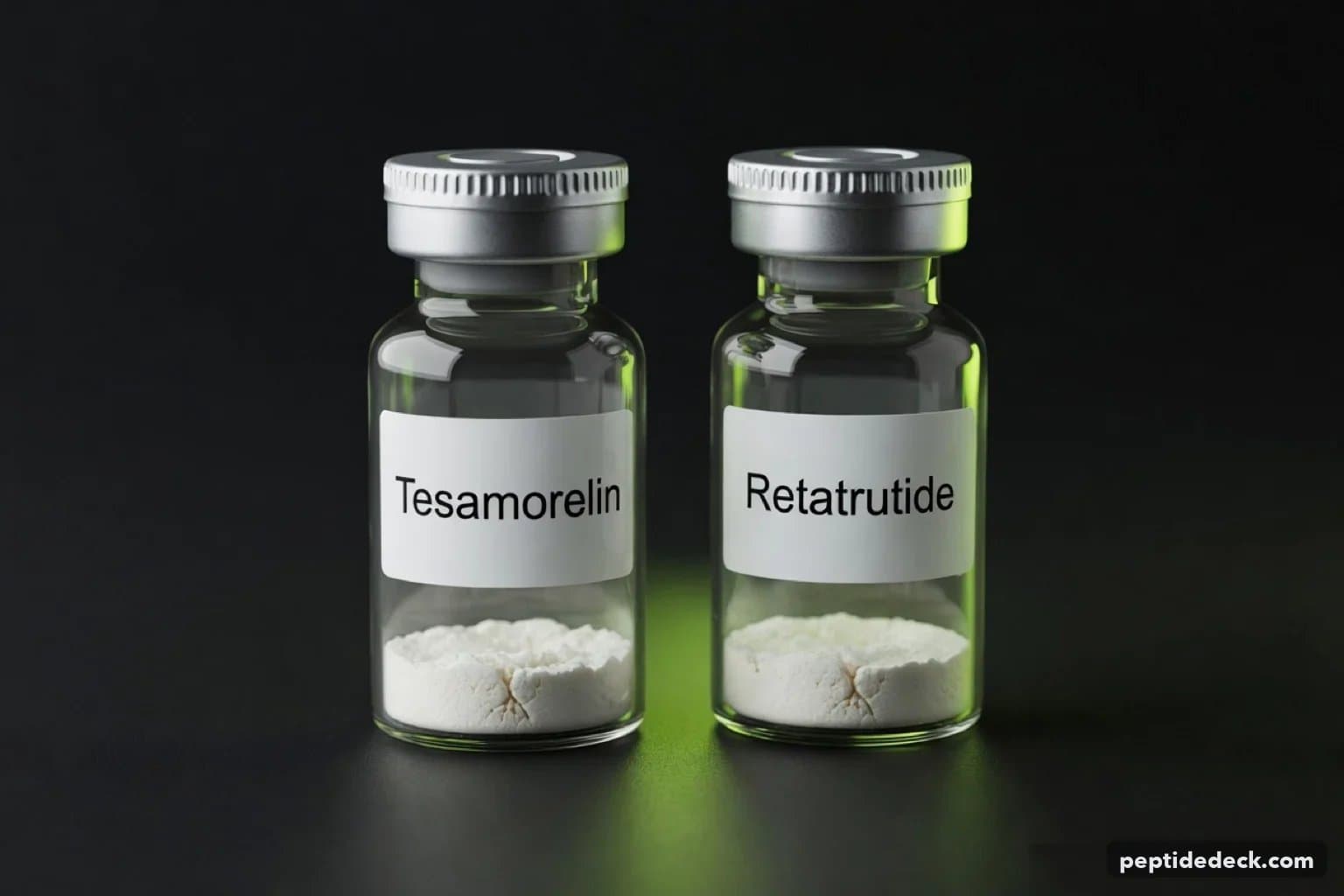
One shrinks belly fat. The other shrinks you.
That is the short answer to tesamorelin vs retatrutide, and it is why the comparison confuses so many people. Both are injected peptides, and both get talked about for the stubborn fat that sits deep around your middle. But tesamorelin barely moves the scale, while retatrutide can take a quarter of your body weight off. If you are deciding between them, or wondering whether the "tesa and reta" stack makes sense, the real question is what you are trying to change.
🔑 Key Takeaways
- Tesamorelin is an FDA-approved growth hormone releasing drug for one narrow use. Retatrutide is a triple-receptor weight loss drug with no FDA approval yet.
- Tesamorelin targets visceral fat without weight loss. Retatrutide cuts total weight, and visceral fat falls with it, by more than you might expect.
- The two push blood sugar in opposite directions. That matters more for the stack than most guides admit.
- The "it protects your muscle" argument for adding tesamorelin rests on one number from a very different group of people.
- Price surprises people: in a stack, the cheaper-sounding peptide is often the bigger monthly bill.
Below, we compare the two side by side using the FDA label and the published trials, then take the stack question head on: why people combine them, what the evidence does and does not show, and what to watch if you go ahead anyway.
Tesamorelin vs Retatrutide: The Short Version
They don't compete for the same job.
Tesamorelin (brand name Egrifta) is a man-made version of growth hormone releasing hormone. It tells your pituitary gland to release more of your own growth hormone, which raises IGF-1 and, over months, shrinks the fat packed around your organs. The FDA approved it in 2010 for one use: reducing excess abdominal fat in adults with HIV and lipodystrophy. The current label says plainly that it is "not indicated for weight loss management as it has a weight neutral effect." Our tesamorelin review covers its full clinical record.
Retatrutide, often shortened to "reta", is an Eli Lilly drug that switches on three hormone receptors at once: GLP-1, GIP and glucagon. It cuts appetite hard, slows the stomach and nudges up energy use. It is a weight loss drug first. Lilly plans to file for FDA approval in the first quarter of 2027, so for now it has no approval for any use.
How Each One Works
The difference starts in the brain.
Tesamorelin copies the signal your hypothalamus sends to the pituitary to release growth hormone. Your body still controls the release, so growth hormone comes in natural pulses rather than the flat high you get from injecting growth hormone itself. That growth hormone then raises IGF-1 and makes fat cells, especially visceral ones, give up stored fat. In the first phase 3 trial, IGF-1 rose 81% on tesamorelin and fell 5% on placebo. The drug itself is gone from your blood in minutes; the label lists a half-life of 11 minutes.
Retatrutide works on the gut-brain axis instead. The GLP-1 signal quiets hunger and slows digestion. GIP adds to the insulin and fat-tissue effects. The glucagon signal is the unusual one: paired with the other two, it mainly pushes the body to burn more energy and clear fat from the liver. A fatty acid on the molecule stretches its half-life to about six days, so one injection covers a week.
So one drug changes where your body stores fat. The other changes how much you eat and burn.
What Each Drug Actually Changes: Visceral Fat vs Total Weight
Here the numbers tell the story.
Tesamorelin was tested in two 26-week phase 3 trials of people with HIV and excess belly fat, 412 and 404 adults, at 2 mg a day. On CT scans, visceral fat fell 18% in Study 1 (placebo rose 2%) and 14% in Study 2 (placebo fell 2%), according to the FDA label. The NEJM paper on the first trial reported it as a 15.2% drop against a 5.0% rise, using a different analysis. Waist size came down 2 to 3 cm. Body weight did not move.
Retatrutide was tested for weight. In the phase 2 obesity trial in NEJM (338 adults, 48 weeks), average weight fell 17.1% on 4 mg, 22.8% on 8 mg and 24.2% on 12 mg, against 2.1% on placebo. Lilly's phase 3 TRIUMPH-1 trial has since reported 28.3% at 12 mg over 80 weeks in people without diabetes who stayed on treatment, or 25.0% counting everyone randomized (NEJM, September 2026). Our retatrutide clinical trials guide tracks every readout.
The surprise is what happened to visceral fat on retatrutide. In an MRI substudy of 98 people from the phase 2 trial who had fatty liver, visceral fat fell between 16.1% and 48.3% across the dose groups by week 48, with bigger drops at higher doses. Placebo rose 2.5%. Liver fat fell up to 82.4% at 24 weeks.
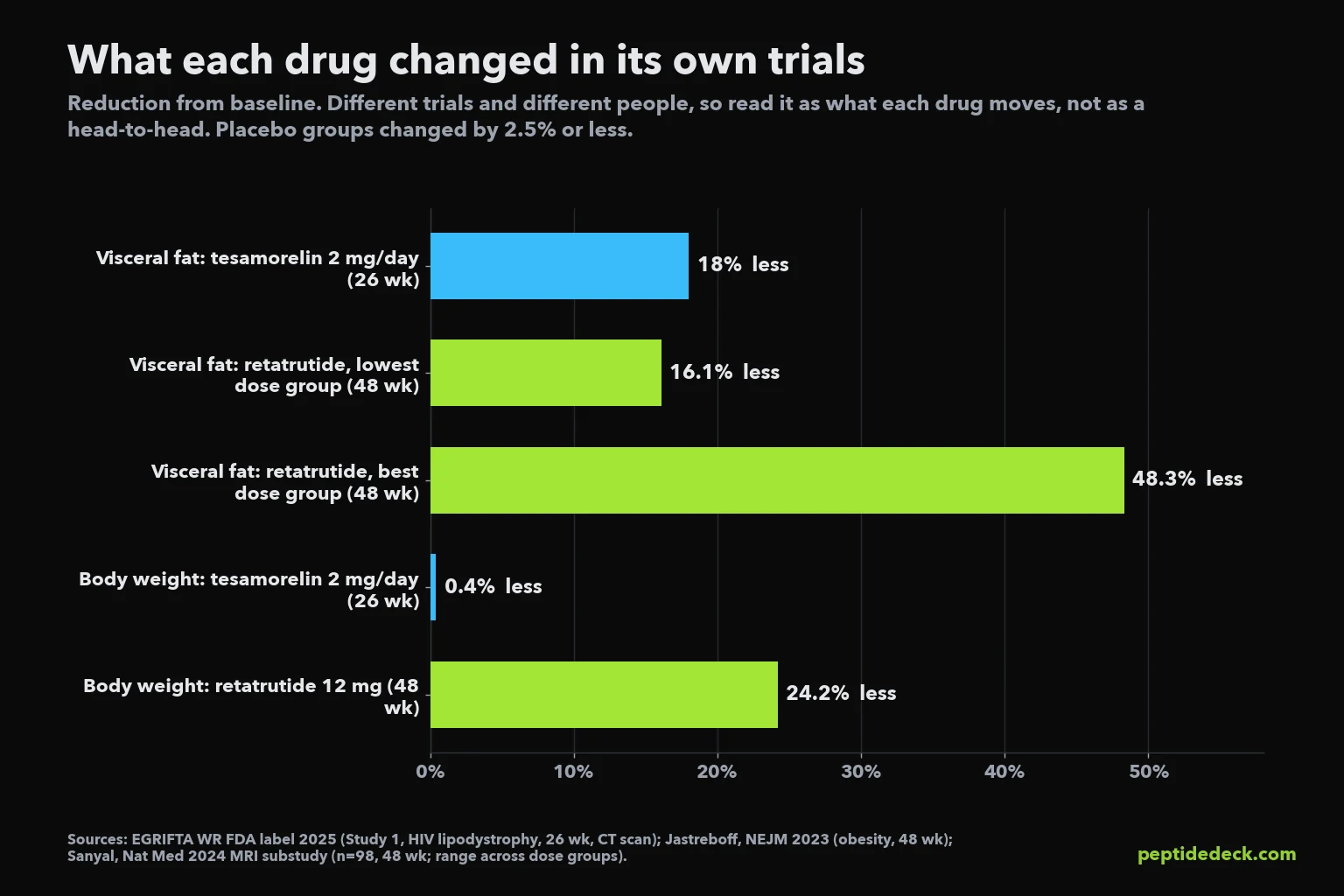
Read that chart with care. The tesamorelin trials enrolled people with HIV whose average BMI was 29. The retatrutide trials enrolled people with obesity. Scans, lengths and analyses differ. What you can fairly say is this: on retatrutide, visceral fat does not get left behind. It falls at least as fast as everything else.
Lean Mass: The Real Reason People Pair Them
Nobody wants to lose muscle on a cut.
When you lose a lot of weight quickly, part of it is lean tissue. That worry drives most of the interest in adding tesamorelin to reta. The idea is that more growth hormone will hold on to muscle while retatrutide strips fat.
Here is what the evidence actually says. On tesamorelin, DXA scans showed lean body mass rising 1.3 kg in Study 1 and 1.2 kg in Study 2 over 26 weeks, against small drops on placebo, while trunk fat fell about 1 kg. That is a real effect. But those people were not losing weight or eating less, and DXA "lean mass" counts water. Growth hormone causes fluid retention, which the label lists as a warning, so some of that gain may be water rather than muscle.
On retatrutide, a Lilly-funded DXA substudy in people with type 2 diabetes found total fat mass fell 23.2% on 12 mg and 26.1% on 8 mg at 36 weeks. The authors concluded that the share of lean mass lost was similar to other obesity drugs, not worse, despite the bigger total weight loss. Only 103 people finished both scans, so treat it as a first look.
What no one has measured is whether tesamorelin protects muscle during a large, appetite-driven calorie deficit. The tools with real evidence for keeping muscle on a GLP-1 drug are still the boring ones: enough protein and resistance training. Our guide to retatrutide for bodybuilding covers how lifters handle plateaus and lean mass on reta.
Side Effects Compared
The side effect lists barely overlap.
Tesamorelin's label also bars it in active cancer and in pregnancy, because it raises a growth factor. Retatrutide carries the cautions that apply to the whole GLP-1 class, including pancreatitis, gallbladder problems and a personal or family history of medullary thyroid cancer. For more detail, see our full guides to tesamorelin side effects and retatrutide side effects.
Dosing and Cost
The schedules could hardly be more different.
Tesamorelin is a daily shot into the belly. The trials used 2 mg a day of the original formulation; the newer Egrifta WR gives the same blood levels with 1.28 mg a day. Our tesamorelin dosage guide covers how people use it outside that label. Retatrutide is weekly: start at 2 mg and step up no faster than every four weeks, through 4 mg and 8 mg toward 12 mg. Many people stop climbing at 4 to 8 mg if results and tolerance are good. The retatrutide dosing schedule lays out each week.
Brand Egrifta is a specialty drug. SingleCare lists one Egrifta WR kit box at about $18,200 cash, or $11,000 with its discount card (checked October 2026), and insurers usually cover it only for the HIV indication. For most people asking this question, the comparison that matters is vendor pricing.
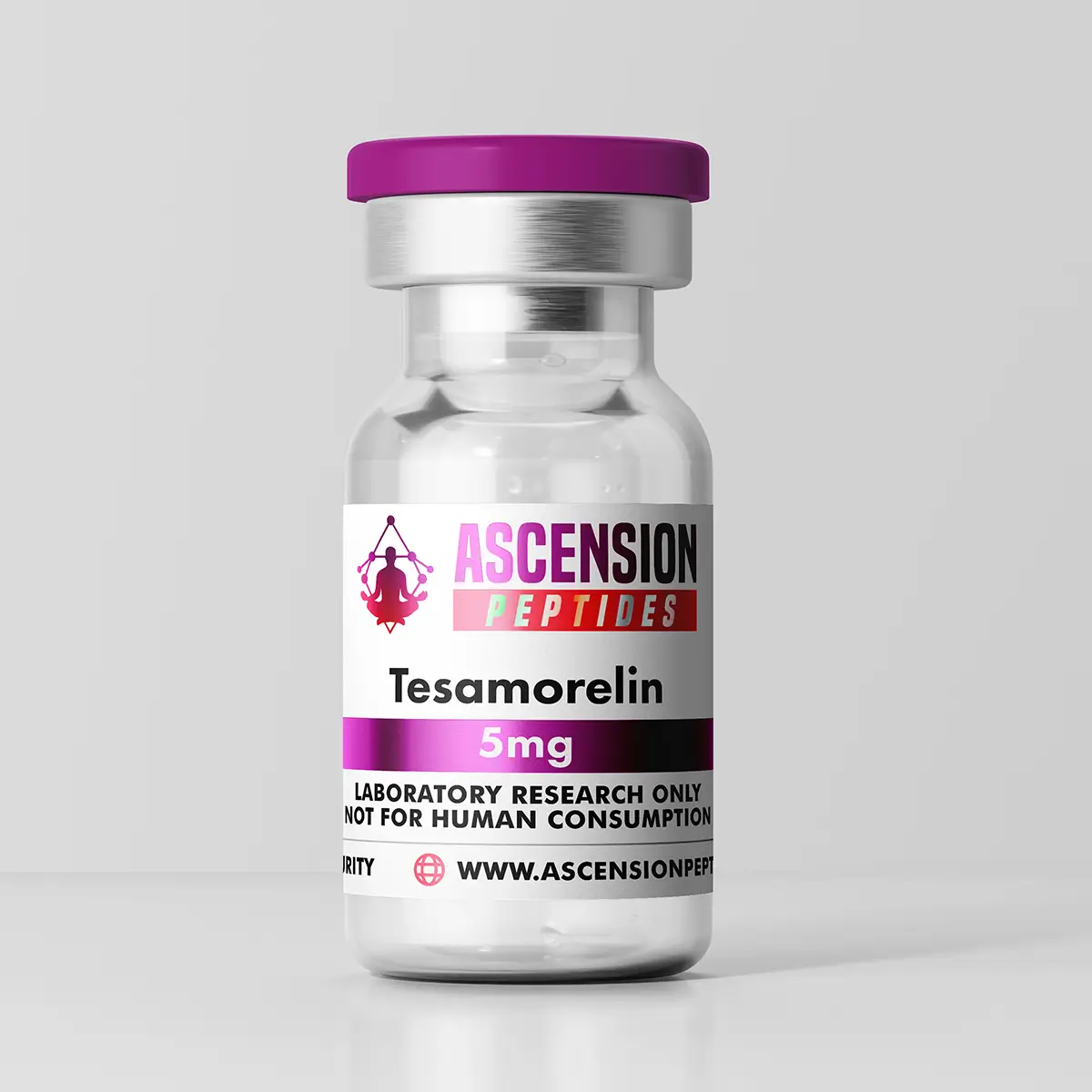
On that basis, tesamorelin is the pricier half. Ascension's 5 mg tesamorelin vial lists at $50, or $25 with code PEPTIDEDECK, which is $5 per mg. If you're comparing sellers, our guide on where to buy tesamorelin shows what a real lab report should say, because cheaper peptides such as sermorelin are sometimes sold under its name. Retatrutide works out cheaper per week: the 30 mg R-30 vial is $250, or $125 with the same code, about $4.17 per mg. Our retatrutide where to buy guide compares vendors and batch testing, and if you decide to buy retatrutide, ask for the lab report that matches your batch before you pay.
Access is the other difference. Tesamorelin has an approved brand you can get with a prescription for its labelled use. Retatrutide has none: the FDA said in June 2026 that selling it to consumers is illegal and that it cannot lawfully be compounded, and Lilly's limited expanded-access program runs through physicians for people with severe obesity complications. Our retatrutide hub covers where things stand.
The Tesa and Reta Stack: Can You Take Tesamorelin and Retatrutide Together?
People do. The evidence doesn't exist yet.
There is no published trial or case series of tesamorelin and retatrutide taken together, and a ClinicalTrials.gov search in October 2026 returned no registered study of the pair. Everything you read about the stack, including "protocols" on vendor blogs and forum threads, is reasoning from each drug alone. Nobody can tell you what the combination does to muscle, fat or side effects.
The logic people use goes like this. Retatrutide does the heavy lifting on weight. Tesamorelin is added to target belly fat and, in theory, hold on to lean mass. The first half is already covered: retatrutide alone cut visceral fat by 16% to 48% in its MRI substudy, a range that meets or beats tesamorelin's 14% to 18%. The second half, the muscle claim, is the untested part.
The blood sugar question
This is the part most stack guides skip.
Tesamorelin raises growth hormone, and growth hormone works against insulin. In the phase 3 trials, people on tesamorelin were more likely to develop diabetes-range HbA1c (6.5% or higher): 5% against 1% on placebo, a hazard ratio of 3.3. Average glucose didn't change much in the first trial, and a 12-week study in 53 people with type 2 diabetes, sponsored by the maker, found no loss of glucose control. But the label still tells doctors to check glucose before starting and to monitor it during treatment.
Retatrutide pushes hard the other way. In TRIUMPH-2, A1C fell 1.4 to 1.6 points from a starting average of 7.7% in people with type 2 diabetes. In the MRI substudy, fasting insulin fell by up to 70.9%.
So what happens together? Most likely retatrutide wins and your A1C stays low. The catch is that a low A1C could hide a growth-hormone-driven rise in glucose that would otherwise be a warning sign. If you take insulin or a sulfonylurea, adding retatrutide also brings a real risk of low blood sugar, and changing either drug shifts the balance. That is a conversation for a doctor, with numbers.
What to watch if you combine them
- Add one at a time. If both start together and you get swelling, nausea or joint pain, you won't know which drug caused it. Most people settle the retatrutide dose first.
- Get baseline labs. Fasting glucose, HbA1c and IGF-1 before starting, then again after a few months. The tesamorelin label suggests considering a stop if IGF-1 stays above 3 SDS.
- Separate syringes. They have different doses, schedules and storage needs. Mixing them in one syringe makes dosing guesswork.
- Watch for fluid. Puffy ankles, tight rings, tingling hands or new joint pain point to tesamorelin's growth hormone effects.
- Keep protein and lifting. They are the only lean-mass tools with real evidence on GLP-1 drugs.
For the broader picture on reta's safety record, see is retatrutide safe.
One more catch: tesamorelin's effect doesn't last after you stop. In the 26-week extension phase, people switched from tesamorelin to placebo saw visceral fat climb back 22% and 16% in the two studies, while those who stayed on it held steady. If you add it for a cut, plan for what happens when it ends.
Which One Fits Your Goal?
Start with the problem you have today.
If your weight is the issue, tesamorelin won't solve it. It was built to reshape fat distribution, not to lower weight, and the trials showed no weight change. Retatrutide is the tool for that, with the caveats that come with a drug still awaiting approval.
If you are near your goal weight but carry fat around your middle, tesamorelin is the drug with direct evidence for visceral fat, though that evidence comes from people with HIV lipodystrophy, not healthy adults. One honest limitation: you have to inject it every day, and the effect fades when you stop.
If you are already on retatrutide, the case for adding tesamorelin is weaker than it sounds. Your visceral fat is already falling, and the muscle benefit is unproven. If you still want to try it, go slowly and get blood work, ideally with a doctor who knows you are taking both.
Frequently Asked Questions
Sources
- U.S. Food and Drug Administration. EGRIFTA WR (tesamorelin for injection) prescribing information, revised March 2025. accessdata.fda.gov
- Falutz J, et al. Metabolic effects of a growth hormone-releasing factor in patients with HIV. N Engl J Med. 2007;357:2359-70. PMID 18057338. PubMed
- Clemmons DR, et al. Safety and metabolic effects of tesamorelin in patients with type 2 diabetes: a randomized, placebo-controlled trial. PLoS One. 2017;12:e0179538. PMID 28617838 (sponsored by Theratechnologies). PubMed
- Jastreboff AM, et al. Triple-hormone-receptor agonist retatrutide for obesity: a phase 2 trial. N Engl J Med. 2023;389:514-26. PMID 37366315 (funded by Eli Lilly). PubMed
- Sanyal AJ, et al. Triple hormone receptor agonist retatrutide for metabolic dysfunction-associated steatotic liver disease: a randomized phase 2a trial. Nat Med. 2024;30:2037-48. PMID 38858523. PMC full text
- Coskun T, et al. Effects of retatrutide on body composition in people with type 2 diabetes: a substudy of a phase 2 randomised trial. Lancet Diabetes Endocrinol. 2025;13:674-84. PMID 40609566 (funded by Eli Lilly). PubMed
- Eli Lilly and Company. TRIUMPH-2 results press release, September 29, 2026. investor.lilly.com
- BioSpace. Lilly preps FDA run for triple-G weight loss drug with phase 3 data (BLA planned Q1 2027). biospace.com
- SingleCare. Egrifta WR price page, checked October 2026. singlecare.com
- TRIUMPH-1 full results: "Retatrutide, a Triple Hormone Receptor Agonist, for Treatment of Obesity." New England Journal of Medicine, September 29, 2026. doi:10.1056/NEJMoa2604169
Medical Disclaimer: This content is for informational purposes only and does not constitute medical advice. Retatrutide has no FDA approval. Tesamorelin (Egrifta) is FDA-approved only to reduce excess abdominal fat in adults with HIV and lipodystrophy. No studies have tested the two together. Always consult a qualified healthcare provider before starting any new medication or treatment. PeptideDeck may earn a commission from affiliate links at no additional cost to you.