Is retatrutide safe? In trials, mostly yes.
You've seen the weight loss numbers, and you want to know the catch. That's the right instinct: every drug that works this well costs something. The trials give a clear picture of the first two years. They say much less about year five, and nothing about the vial most people actually inject.
🔑 Key Takeaways
- Across six trials and more than 6,000 participants, retatrutide's safety profile looks like the GLP-1 drugs already on pharmacy shelves, with two extra signals worth knowing.
- One of those signals barely registers with tirzepatide, and it rose sharply at the top dose in one trial.
- The cancer question has a real answer, and it is more reassuring than the boxed warnings on related drugs suggest.
- What nobody knows yet is how it behaves after two years. The trial that will tell us is due to finish in 2029.
- For most people the biggest danger is not the molecule. One small lab study shows why.
Below, we'll go through what the trials found, what they couldn't find, the cancer and death questions, who should stay away, and how to cut the risk that trials never measure: an unregulated vial.
Is Retatrutide Safe? What Six Trials Show
Start with what happened to real people.
Retatrutide has been tested in one phase 2 trial and five phase 3 trials that have reported. In every one, the most common problems were the stomach issues seen with semaglutide and tirzepatide, mostly mild to moderate and worst while the dose was climbing. Every side effect and its frequency is in our retatrutide side effects guide. This page sticks to the verdict: how many people quit because of the drug, and what else turned up.
(NEJM 2023)
(Lancet 2026)
(Lilly, NEJM 2026)
(Lancet 2026)
(Lilly topline)
(Lilly topline)
Three patterns stand out. The 4 mg dose was about as easy to stay on as placebo (4.1% in TRIUMPH-1 and 3.8% in TRIUMPH-2, against 4.9%). Quitting rose with the dose, peaking at 18.2% on 12 mg in TRIUMPH-4. And Lilly said those TRIUMPH-4 dropouts tracked with lower starting weight and included people who felt they were losing too much; among those starting at a BMI of 35 or higher, the 12 mg rate was 12.1%.
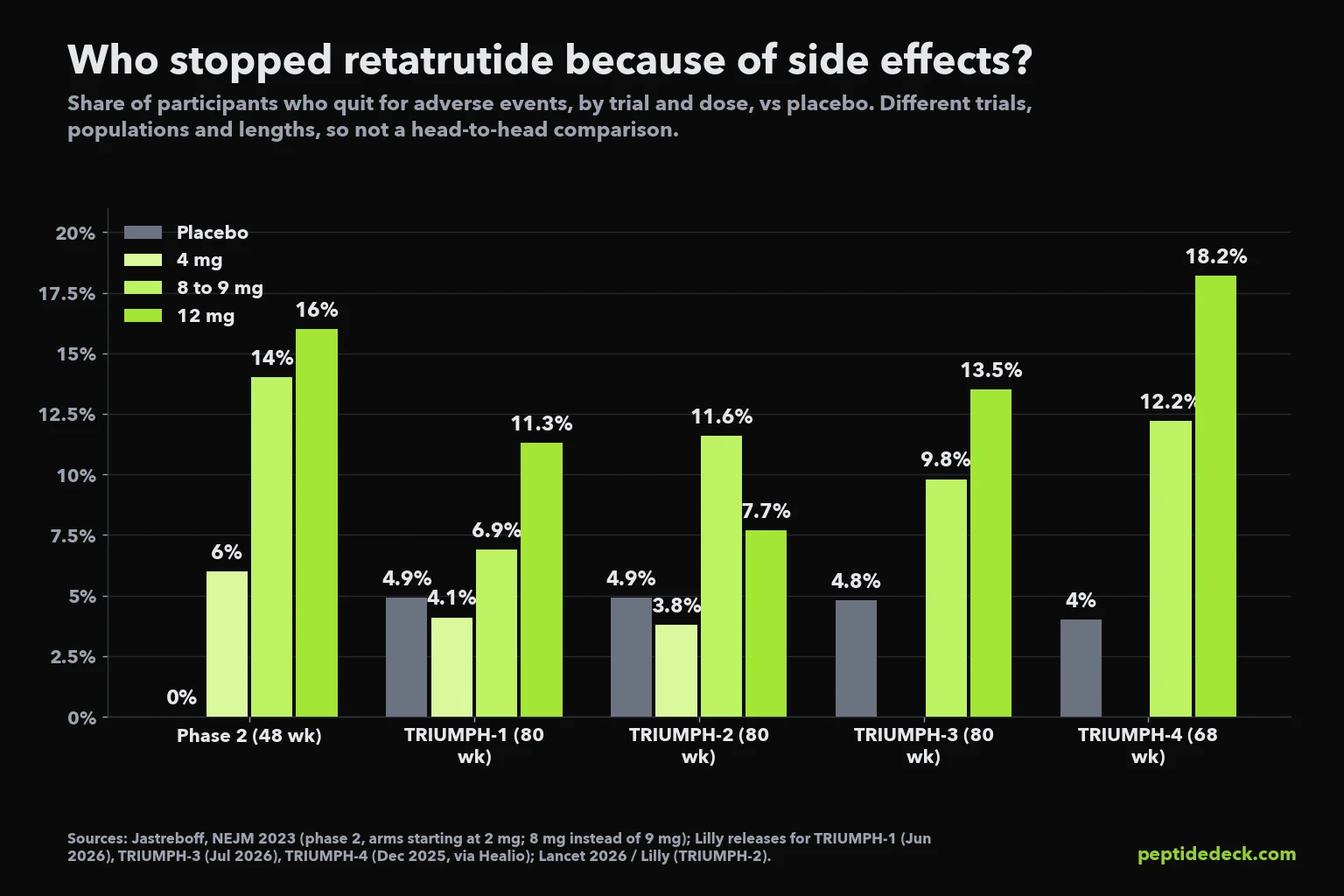
Serious adverse events, the kind that put someone in hospital, were no more common than on placebo in phase 2: 4% in both groups. There was a single case of acute pancreatitis, and no clinically significant low blood sugar.
One limitation matters here. Every one of these trials was funded by Eli Lilly, and the safety details for TRIUMPH-1, TRIUMPH-3 and TRIUMPH-4 come so far mainly from company releases, not full peer-reviewed safety tables. The published papers for phase 2, TRANSCEND-T2D-1 and TRIUMPH-2 tell the same story as the releases.
The Three Signals Doctors Are Watching
Stomach trouble isn't what keeps doctors up.
Heart rate. Glucagon and GLP-1 both nudge the heart to beat faster. In phase 2, heart rate rose with the dose, peaked around week 24 and then declined. The authors noted the rise was similar to what GLP-1 drugs cause; for comparison, the Zepbound label lists an average rise of 1 to 3 beats per minute. Phase 2 also logged more heart rhythm events at the top doses, mostly mild to moderate: 11% at 12 mg against 3% on placebo, with one severe case of a prolonged QT interval in someone taking the anti-nausea drug ondansetron.
The bigger question is people who already have heart disease. TRIUMPH-3, in 1,949 of them, is the first answer: heart attacks, strokes and heart deaths were less common than Lilly expected in both groups, 27 events on retatrutide against 23 on placebo (hazard ratio 1.12), a gap small enough to be chance. Our retatrutide heart rate guide covers what a normal rise looks like and when to call a doctor.
Dysesthesia. This is the signal that sets it apart. It means abnormal skin sensation: tingling, burning, or skin that feels sore to the touch. It barely registers with tirzepatide, 0.2 to 0.4% in Zepbound's trials. With retatrutide it ran 4.5 to 7.3% in TRIUMPH-2, 5.1 to 12.5% in TRIUMPH-1 and 20.9% at 12 mg in TRIUMPH-4. Lilly describes the cases as mostly mild to moderate, mostly resolving during treatment, and rarely a reason to stop. Phase 2 found no skin changes behind it. The cause is still unexplained, and so is how long it lasts after stopping.
Low blood pressure. Weight loss lowers blood pressure, usually a good thing. In TRIUMPH-2, people with type 2 diabetes had hypotension in 1%, 5% and 6% of the 4, 9 and 12 mg groups, against under 1% on placebo. If you take blood pressure tablets, have them reviewed as the weight comes off.
Two other worries come up a lot, and each has its own page: hair shedding in our retatrutide hair loss guide, and low energy in does retatrutide make you tired.
Has Anyone Died Taking Retatrutide?
Yes, in trials. None of the deaths were blamed on it.
Large trials in adults with obesity, diabetes and heart disease always record some deaths from ordinary causes. What matters is whether investigators link any of them to the drug. Here is everything published so far:
- Phase 2 obesity (338 people, 48 weeks): one death, from drowning, in a retatrutide group. The site investigator judged it unrelated to the drug.
- TRANSCEND-T2D-1 (537 people, 40 weeks): two deaths, both in the 4 mg group, both judged unrelated.
- TRIUMPH-2 (1,152 people, 80 weeks): seven deaths, two at 4 mg, three at 9 mg, one at 12 mg and one on placebo. All were judged unrelated to the study drug by the investigator.
- TRIUMPH-1, TRIUMPH-3 and TRIUMPH-4: the company releases did not report deaths separately. TRIUMPH-3's combined heart-event measure, which includes death from any cause, came out at 44 events on retatrutide against 52 on placebo.
The numbers are too small to prove anything either way. They are also not a signal: no pattern by dose, no deaths tied to the drug, and the broader heart outcome count leaned slightly, though not significantly, in retatrutide's favor.
Can Retatrutide Cause Cancer?
The worry comes from a warning label.
Approved injectable GLP-1 weight loss drugs such as Wegovy and Zepbound carry a boxed warning based on thyroid tumors seen in non-human studies; this has not been shown in humans. The label says it is unknown whether the drug causes medullary thyroid cancer (MTC) in people, and it bars use by anyone with a personal or family history of MTC or the inherited condition MEN 2. Retatrutide has no label yet, but expect the same warning when it gets one.
So what does the human evidence say?
- Retatrutide itself: the phase 2 trial reported no cases of medullary thyroid cancer or C-cell hyperplasia, the precursor change. That covers 48 weeks, far too short to rule out a slow cancer.
- Thyroid cancer, class data: a Scandinavian study of more than 145,000 people on GLP-1 drugs, followed for about four years on average, found no increase in thyroid cancer (hazard ratio 0.93). A French case-control study did find a higher risk after one to three years of use (hazard ratio 1.58). The evidence is mixed, which is why the warning stays.
- Pancreatic cancer, class data: a 2026 meta-analysis of 48 randomized trials and 94,245 participants found GLP-1 drugs probably have little or no effect on pancreatic cancer (odds ratio 0.84), and no clear effect on thyroid, breast or kidney cancer either. A second 2026 analysis of 60 studies and more than 4.9 million people found no increase in pancreatic cancer.
The honest summary: nothing so far suggests retatrutide causes cancer, and its parent drug class has a reassuring record in large studies. But it adds glucagon to the mix, and no study has followed people long enough to settle the question. A family history of thyroid cancer or a known thyroid nodule is a conversation to have before the first dose.
What We Still Don't Know About Retatrutide's Long-Term Side Effects
Two years is the edge of the map.
The longest data comes from the TRIUMPH-1 extension, where 532 people with a BMI of 35 or higher stayed on treatment to 104 weeks. Lilly has reported the weight loss from that extension, 30.3% at 12 mg, but no separate safety data for it yet. Here is what remains open:
- Heart and kidney outcomes. TRIUMPH-Outcomes, the trial built to answer whether retatrutide cuts or raises heart attacks, strokes and kidney failure, is still running. Its estimated completion date on ClinicalTrials.gov is February 2029.
- Rare events. A side effect that hits one person in 10,000 is unlikely to show up in trials of a few thousand. Those surface after approval.
- The skin sensation signal. Why dysesthesia happens, and whether it always fades after stopping, still needs longer follow-up.
- Muscle, bone and stopping. Losing a quarter of body weight takes some lean mass with it, and retatrutide-specific data on muscle, bone and regain after stopping is thin. Our guide to stopping retatrutide covers what is known.
- Pregnancy. There is no human pregnancy data at all.
Lilly plans to file for FDA approval in the first quarter of 2027. Our retatrutide clinical trials tracker lists every study and when it reports.
Who Should Not Use Retatrutide
Some people should rule it out entirely.
With no retatrutide label yet, the best guide is the label of its closest approved relative, tirzepatide (Zepbound), alongside what the retatrutide trials found.
Talk to a doctor first if you have a heart rhythm problem, diabetic eye disease, kidney disease or surgery coming up (slowed stomach emptying raises the risk of inhaling stomach contents under anesthesia). Under 18, the answer is no: the trials enrolled adults only.
The Biggest Real-World Risk: The Vial, Not the Molecule
Trials tested a drug made by Lilly.
Almost nobody outside a trial is injecting it. Retatrutide has no FDA approval, and the agency's guidance page says it "cannot be used in compounding under federal law" and has "not been found safe and effective for any condition." In June 2026 the FDA added that selling retatrutide to consumers is illegal. In August, Lilly sued six sellers and said it had reported more than 200 others to regulators. Everything sold online is made outside Lilly's factories, with no FDA check on what's inside.
That gap shows up in three ways.
Wrong dose in the vial. When University of Queensland researchers and an Australian drug-checking service tested three products sold as 10 mg retatrutide, all three contained the real peptide. But one held 5.1 mg, half the label, and the other two held 16.5 mg and 19.0 mg, up to almost double. The authors concluded that dose inaccuracy, more than fakes, may be the main danger. Only three vials were tested, so treat it as a warning, not a survey. But a 2 mg starting dose from that 19 mg vial would really be close to 4 mg, the fast start phase 2 linked to more stomach side effects.
Contamination nobody checked. That study did not test sterility or bacterial toxins (endotoxin), the checks that matter most for anything you inject.
Mixing and measuring errors. The FDA has logged adverse events, some needing hospital care, from people drawing the wrong amount of compounded semaglutide out of multi-dose vials. Retatrutide comes as a powder you mix yourself, which adds one more step to get wrong. A case report published in October 2026 described a woman in her mid-20s admitted to hospital after five days of vomiting that drugs could not stop, following four weekly injections of an unverified "retatrutide" product, given by a wellness coach with no medical training.
None of this shows up in the trial safety tables. For most people buying vials sold as reta, the product is the biggest unknown.
How to Lower the Risk If You Use It
You can't make an unapproved drug approved.
You can remove most of the avoidable risk, though.
- Demand a batch-matched certificate of analysis (COA). It should come from an independent lab you can contact, match your vial's batch number, and show purity by HPLC (98% or higher), identity by mass spectrometry, and the measured milligrams in the vial.
- Look for sterility and endotoxin results. If a seller can't show them, assume they weren't done.
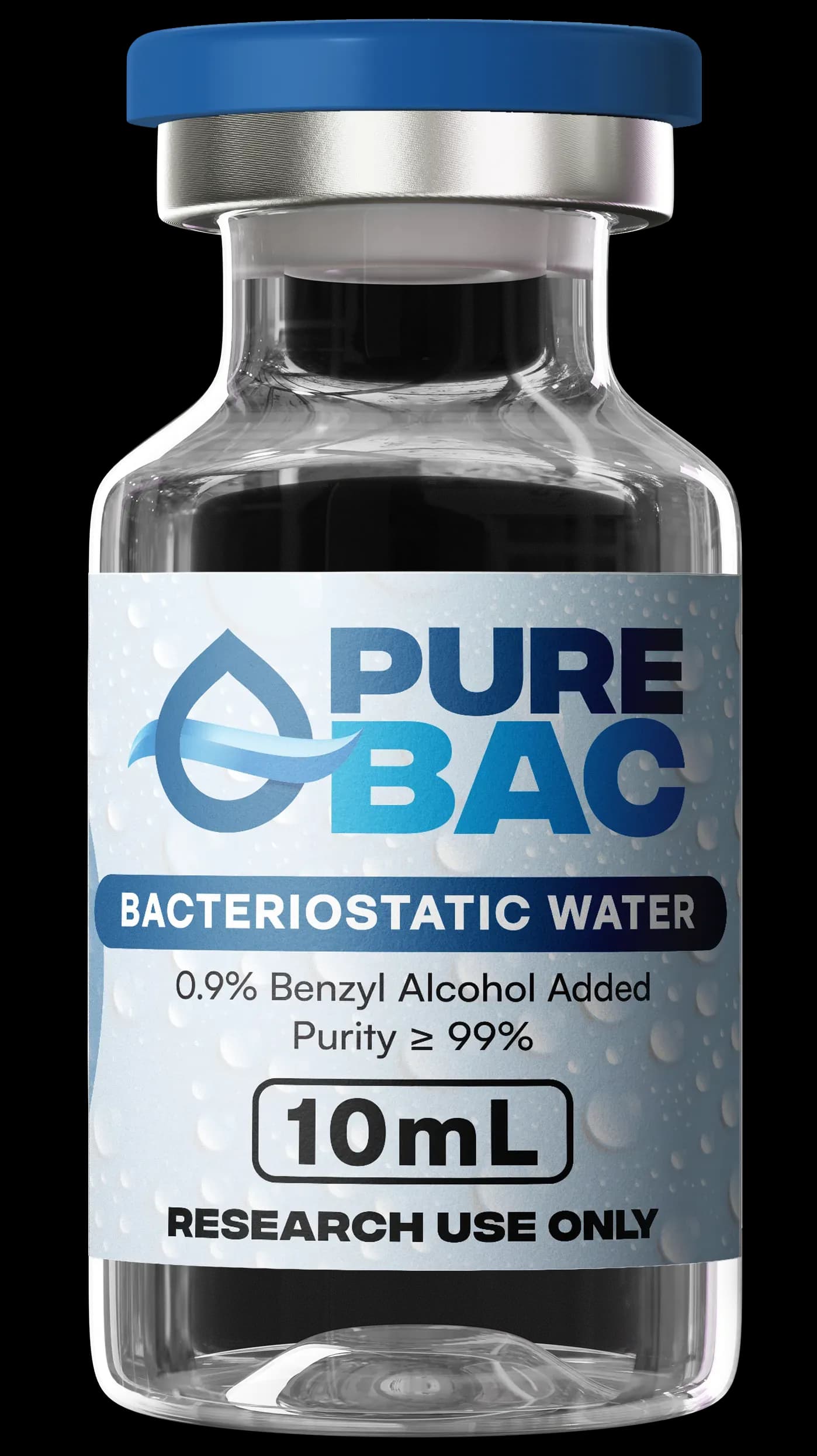
- Do the mixing math before you draw. A 10 mg vial plus 2 mL of bacteriostatic water gives 5 mg/mL, so a 2 mg dose is 0.40 mL, or 40 units on a U-100 insulin syringe. A 30 mg vial with 3 mL gives 10 mg/mL, so 2 mg is 20 units. Our reconstitution guide and retatrutide dosage calculator walk through both.
- Start low and climb slowly. Start at 2 mg and step up no faster than every four weeks. In trials, 4 mg had the lowest dropout rate, and many people stop escalating at 4 to 8 mg. The full schedule is in our retatrutide dosing schedule.
- Store it cold. Once mixed, keep it at 2–8 °C and use it within 28 days.
- Get a baseline with a doctor. Resting heart rate, blood pressure, kidney function and a review of your current medicines, especially diabetes and blood pressure drugs.
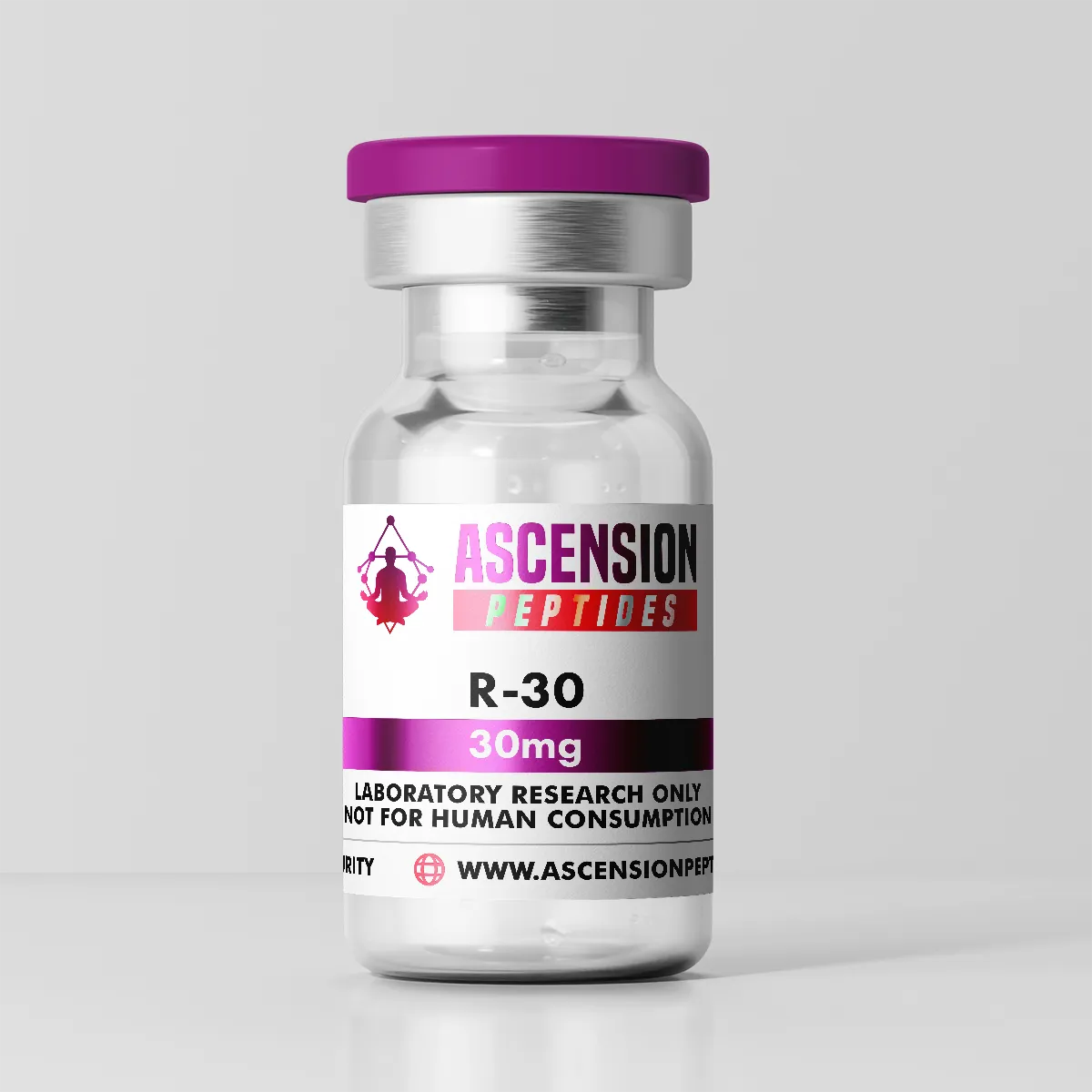
On sourcing, our guide on where to buy retatrutide compares sellers on exactly these documents, not just price. If you decide to buy retatrutide online, our partner Ascension lists the 30 mg vial (R-30) at $250, or $125 with code PEPTIDEDECK, and the 10 mg at $100, or $50 with the code; our retatrutide cost breakdown turns that into a weekly figure. PeptideDeck earns a commission on purchases through these links, at no extra cost to you. Whoever you buy from, the COA rules above apply in full.
The red flags: no batch number on the lab report, a report from a lab you can't find or contact, no sterility or endotoxin result, a price far below every other seller, or a label that says the product is not meant for people. Any one of these is a reason to walk away.
So, Is Retatrutide Safe for You?
It depends on three things.
The drug, in trials: through two years, it looks about as safe as approved GLP-1 drugs, with more stomach trouble at high doses, a skin sensation signal tirzepatide barely has, and a heart rate rise that hasn't become extra heart events. At 4 mg it was about as easy to stay on as placebo.
The person: if you have a history of MTC or MEN 2, pancreatitis, or you're pregnant or planning to be, the answer is no. If you have heart, kidney or eye disease, it's a doctor's call.
The product: outside a trial, the safety of reta depends as much on the vial as on the molecule. A batch-tested vial, correct mixing and a slow titration close most of that gap. If you'd rather wait for the approved drug, see who qualifies for Lilly's early access program, and read our TRIUMPH-2 results breakdown for the most complete safety data published so far.
Frequently Asked Questions
Sources
- Jastreboff AM, et al. Triple-Hormone-Receptor Agonist Retatrutide for Obesity: A Phase 2 Trial. N Engl J Med. 2023;389:514-526. PMID 37366315. PubMed
- Bajaj HS, et al. Efficacy and safety of retatrutide in people with type 2 diabetes (TRANSCEND-T2D-1). Lancet. 2026;407:2402-2413. PMID 42250575. PubMed
- Bellido V, et al. Retatrutide in adults with obesity and type 2 diabetes (TRIUMPH-2). Lancet. 2026;408:1455-1472. PMID 42810372. PubMed
- Jastreboff AM, et al. Retatrutide, a Triple Hormone Receptor Agonist, for Treatment of Obesity (TRIUMPH-1). N Engl J Med. 2026. PMID 42814954. PubMed
- Eli Lilly. TRIUMPH-1 results presented at ADA, June 6, 2026 (via BioSpace). Press release
- Eli Lilly. Retatrutide successful in two additional phase 3 obesity trials (TRIUMPH-2 and TRIUMPH-3), July 23, 2026 (via BioSpace). Press release
- Healio. Retatrutide confers up to 28.7% weight loss, reduction in knee osteoarthritis pain (TRIUMPH-4). Healio
- ClinicalTrials.gov. TRIUMPH-Outcomes, NCT06383390. Record
- Zepbound (tirzepatide) prescribing information, FDA label, August 2026. DailyMed
- Wegovy (semaglutide) prescribing information, FDA label. DailyMed
- Pasternak B, et al. GLP-1 receptor agonist use and risk of thyroid cancer: Scandinavian cohort study. BMJ. 2024;385:e078225. PMID 38683947. PubMed
- Bezin J, et al. GLP-1 Receptor Agonists and the Risk of Thyroid Cancer. Diabetes Care. 2023;46:384-390. PMID 36356111. PubMed
- Ko A, et al. Risk for Cancer With GLP-1 Receptor Agonists and Dual Agonists: A Systematic Review and Meta-analysis. Ann Intern Med. 2026;179:216-229. PMID 41359966. PubMed
- Lauri G, et al. GLP-1 receptor agonists are not associated with increased risk of pancreatic cancer. Pancreatology. 2026;26:854-862. PMID 41991368. PubMed
- Piatkowski T, et al. Composition and Labelling Accuracy of Products Sold as Retatrutide in Australia. Drug Alcohol Rev. 2026;45:e70231. PMID 42559975. PMC
- Buzzi RM, Huber LC. Refractory nausea associated with peptide injections reported to contain retatrutide. BMJ Case Rep. 2026;19:e276106. PMID 42843917. PubMed
- U.S. Food and Drug Administration. FDA's Concerns with Unapproved GLP-1 Drugs Used for Weight Loss (content current as of Oct 1, 2026). FDA
- Healio. Eli Lilly files lawsuits against six companies for allegedly selling retatrutide, Aug 14, 2026. Healio
Medical Disclaimer: This content is for informational purposes only and does not constitute medical advice. Retatrutide has no FDA approval. Always consult a qualified healthcare provider before starting any new medication or treatment. PeptideDeck may earn a commission from affiliate links at no additional cost to you.