Everyone wants to know what retatrutide costs. It's the obvious question — especially after the trial data dropped and people saw 24% body weight loss in under a year. That number changes things. It makes you wonder whether this peptide is actually accessible, or whether it's some elite pharmaceutical locked behind a six-figure price tag.
Here's the honest breakdown: in 2026, you're looking at $100–$250 per vial from a research vendor. That's it. There's no prescription to fill. No insurance plan covering it. No compounding pharmacy mixing it up in their back room. Retatrutide is not FDA-approved, which means the normal access routes don't exist — yet.
Let's go through every cost scenario clearly, so you know exactly what you're looking at.
Key Takeaways
- Retatrutide is NOT FDA-approved — no prescription or insurance access in 2026
- Compounding pharmacies cannot legally produce it in the US right now
- Research-grade retatrutide costs $100 (10mg) to $250 (30mg) per vial
- R-30 offers better value at ~$8.33/mg vs R-10 at ~$10/mg
- Typical monthly cost: $75–$200 based on a 2–4mg/week protocol
- Lilly plans to file with the FDA in Q1 2027, so approval is unlikely before late 2027; expect a list price around $800–$1,500+/month once approved, though Lilly's self-pay prices run far lower (Zepbound is $299–$449 a month on LillyDirect, October 2026)
Cost Scenario 1: Clinical Trials (Free — But You Have to Qualify)
If you were lucky enough to enroll in a retatrutide phase 3 trial, the drug was free. Eli Lilly covered everything — the peptide, the monitoring, the labs. Participants didn't pay a dime.
The catch: trials have strict inclusion criteria. BMI thresholds, medical history requirements, geographic limits. And as of October 2026, every TRIUMPH and TRANSCEND trial has stopped recruiting; the only retatrutide study still taking new volunteers is SYNERGY-Outcomes, a liver (MASH) trial. The window to get free access through clinical trials has largely closed for most people. Lilly did open a free, physician-led early access path in August 2026, but only for a narrow group of patients with severe obesity and serious complications; see our retatrutide early access guide.
Watch ClinicalTrials.gov if you're still interested — new sub-studies and extension trials do occasionally open up. But don't count on this as a cost strategy.
Cost Scenario 2: Compounding Pharmacies (Not Available — It's Complicated)
A lot of people assume they can just get their doctor to write a script and have a compounding pharmacy prepare retatrutide. This is how some people access semaglutide and tirzepatide right now. It makes logical sense.
But it doesn't work with retatrutide. Not yet.
Compounding pharmacies can only legally prepare FDA-approved drugs — typically when there's a shortage or when a patient needs a specific formulation that isn't commercially available. Retatrutide hasn't been approved. There's no approved version to reference. That means compounding it in the US would be producing an unapproved new drug, which puts the pharmacy at serious regulatory risk.
When approval does come (more on timing below), compounding access could open up relatively quickly — similar to what happened with tirzepatide during shortages. At that point, compounded retatrutide might land around $200–$400/month. Speculation, but it's a reasonable model based on how Mounjaro and Ozempic compounding shook out.
Cost Scenario 3: Research Peptide Vendors (The Current Reality)
Right now, outside a trial or Lilly's narrow early access program, retatrutide is sold through US-based research peptide vendors. These companies sell it labeled "for research use only" — not for human use. That label doesn't make it legal to buy for personal use: FDA advises consumers not to buy unapproved retatrutide products, and Lilly has sued several of these sellers.
Pricing varies. Here's what you'll typically find:
The 30mg vial wins on cost-per-mg. If you're going to run a multi-month protocol, buying R-30 makes more financial sense. The difference is small per vial, but it adds up over a 3–6 month run.
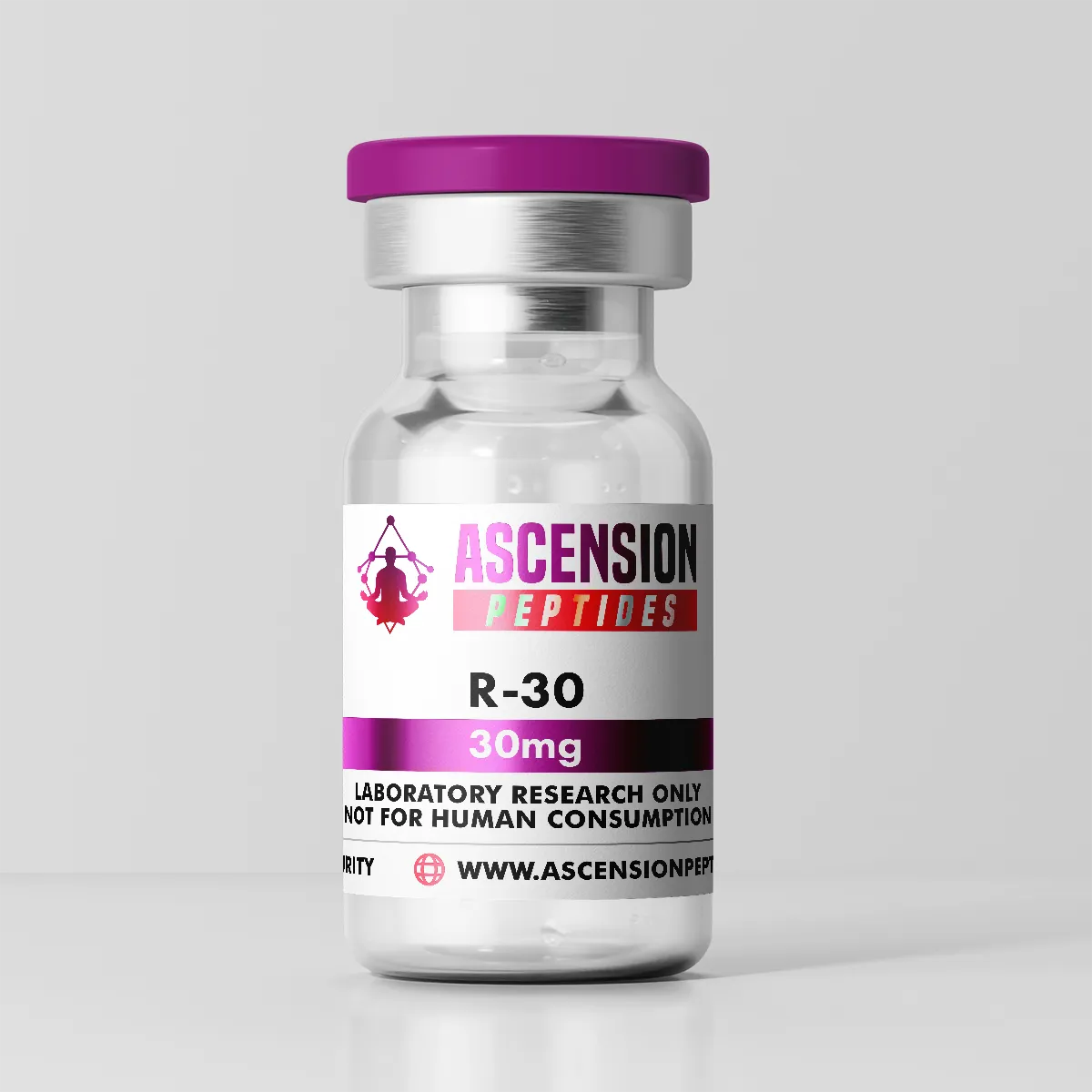
Check out R-30 on Ascension Peptides — they third-party test every batch and publish the COAs. That matters a lot in this space (more on that below).
How Much Does Retatrutide Cost Per Month?
This is where it gets practical. Let's do the math based on what the clinical protocols actually looked like.
In the phase 2 trials, doses ranged from 1mg to 12mg per week. Most researchers and users targeting meaningful weight loss work in the 2–4mg/week range to start, titrating up gradually.
At 2mg/week: 8mg/month → roughly 1 vial of R-10 (10mg) every 5–6 weeks → ~$75–$85/month
At 4mg/week: 16mg/month → about 1.5–2 vials of R-10 per month → ~$150–$200/month
Higher dose (6mg+/week): 24mg+/month → approaching 1 vial of R-30 per month → ~$250/month
So realistically, you're looking at $75–$250 per month at list price depending on where you land in your protocol, or about half that with code PEPTIDEDECK (50% off at Ascension). That's a wide range, but most people starting out will be closer to the lower end for the first 8–12 weeks.
For the full dosing breakdown and titration schedule, see our Retatrutide Dosing Guide.
Retatrutide vs. Competitors: Full Cost Comparison
How does retatrutide actually stack up against the alternatives in terms of cost and accessibility?
The big takeaway: research-grade retatrutide is dramatically cheaper than branded prescription GLP-1s, and roughly on par with research-grade semaglutide and tirzepatide. Given that retatrutide's trials showed more weight loss than either drug's own trials (no head-to-head trial has reported yet), it's punching above its weight on value.
Want to know where to source it safely? See our guide on where to buy retatrutide in 2026.
When Will Retatrutide Be FDA Approved — And What Will It Cost?
Eli Lilly hasn't filed yet. The drug is called LY3437943 internally. In July 2026 Lilly said it plans to submit its application to the FDA in the first quarter of 2027, later than first signalled because the manufacturing package needed more time. FDA reviews usually take 10–12 months, so approval in late 2027 is the earliest realistic date, and 2028 is more likely.
What will it cost? Look at Eli Lilly's pricing history for Mounjaro (tirzepatide) — it launched at roughly $1,000/month list price. Ozempic and Wegovy from Novo Nordisk came in even higher. GLP-1s are priced aggressively in the US market. Expect retatrutide's list price to land somewhere in the $900–$1,500/month range at launch, with insurance coverage being hit-or-miss depending on your plan and diagnosis.
With insurance covering obesity treatment (which more plans are starting to do post-2025), some patients may get it for $25–$100/month copay. Without insurance, list price isn't necessarily what you'd pay: Lilly sells Zepbound self-pay for $299–$449 a month and Mounjaro from $499 through LillyDirect (October 2026), so a retatrutide cash program is plausible but not announced.
A compounding market could only open after approval, and only if FDA declares a shortage, which is what created legal space for compounders with semaglutide and tirzepatide. Based on the semaglutide and tirzepatide playbook, compounded retatrutide might arrive around $200–$400/month within a year of approval.
Red Flags: What to Avoid When Shopping for Retatrutide
The research peptide space has legitimate vendors and sketchy ones. Retatrutide's rising profile means more low-quality suppliers are entering the market to cash in. Here's what should immediately trigger concern:
Vials priced under $40. Retatrutide is expensive to synthesize at high purity. A $20 or $30 vial of "retatrutide" is almost certainly mislabeled, underdosed, or completely fake. The raw material cost alone doesn't support that price point.
No certificate of analysis (COA). Every legitimate research vendor provides third-party HPLC or mass spec testing results. If there's no COA, you have no idea what's actually in that vial. Walk away.
Purity below 98%. Research-grade peptides should come in at 98%+ purity. Anything lower is substandard. Some unscrupulous vendors fudge purity numbers, so look for COAs from recognized labs (not in-house testing).
No physical address or contact info. Legitimate vendors are traceable. Anonymous storefronts with no contact information are a hard pass.
Unrealistic weight loss claims on the product page. Reputable vendors don't make clinical claims about their research peptides. If the product page reads like a weight loss advertisement, that's a compliance red flag that suggests the operation is cavalier about regulations in general.
Ascension Peptides publishes batch-specific COAs from independent labs. That's the standard worth holding any vendor to. See our full sourcing guide at retatrutide where to buy 2026.
Is Retatrutide Actually Worth the Price?
Let's think about this like a real investment decision.
At $75–$200/month, retatrutide costs less than a mid-tier gym membership plus a personal trainer session. It costs less than most diet programs, meal delivery services, or weight loss apps with coaching. For context: Noom charges $70/month. A single session with a registered dietitian runs $100–$200. A monthly Orangetheory membership is $159+.
The clinical data showed average weight loss of 17–24% body weight over 48 weeks. For someone at 220 lbs, that's 37–53 lbs. That kind of result through diet and exercise alone takes years for most people — and many never get there.
Now, results vary. Research peptides aren't a magic switch. Lifestyle factors still matter enormously. But on a pure cost-per-outcome basis, it's hard to argue that $75–$250/month for a triple agonist with phase 3 data is poor value — especially compared to $349–$499/month for Ozempic through NovoCare self-pay (about $1,028 list), which has a weaker efficacy profile.
The question isn't really "can I afford this?" It's "is the potential outcome worth this monthly spend?" For most people seriously considering retatrutide, the answer is yes.
For a deeper look at what this peptide actually does and how the mechanism works, check out our What Is Retatrutide explainer.
R-10 vs R-30: Which Vial Size Should You Buy?
If you're just starting out and want to test tolerance at low doses (1–2mg/week), R-10 makes sense. You'll use a vial over 5–10 weeks and it's a lower upfront commitment.
If you're experienced with GLP-1 peptides, know your tolerance, and plan to run a full 12–16 week protocol, go straight to R-30. Better cost-per-mg. Fewer reorders. Fewer shipping cycles.
- R-10 (10mg) — ~$100 — Best for beginners and low-dose starts
- R-30 (30mg) — ~$250 — Best value per mg for sustained protocols
For a step-by-step breakdown of each option, see our guide on how to get retatrutide in 2026.