Semax peptide sits between nootropic and neuropeptide.
People search for Semax when they want the broad answer, and they search for Semax peptide when they want the practical one: what it does, how it works, why nasal Semax is so common, how it compares with Selank, and what side effects or sourcing issues matter.
🔑 Key Takeaways
- Semax peptide is best understood as a brain-performance peptide. It is usually discussed for focus, learning, mental stamina, and recovery from cognitive fatigue.
- It is not just a stimulant substitute. The appeal is cleaner mental output without the same jittery profile people associate with caffeine or amphetamine-like drugs.
- Most people compare nasal Semax peptide first. Intranasal use dominates the conversation because the target is central nervous system signaling.
- The best title fit is a parent explainer. PeptideDeck already has separate Semax dosage, benefits, review, side-effects, and Selank comparison pages.
- The beginner question is fit. Semax makes more sense for focus and mental drive than for sleep, relaxation, libido, fat loss, or tissue repair.
People searching for Semax peptide usually do not want one tiny answer. They want to know what Semax is, why it keeps showing up in nootropic circles, how it differs from Selank, whether the focus claims are believable, and where the real caution points are.
This page is the parent overview. For exact amounts and timing, use the Semax dosage guide. For the deeper upside case, read Semax benefits. For tolerability, use Semax side effects. This article keeps the broader question clean: whether Semax is the right category for the problem you are trying to solve.
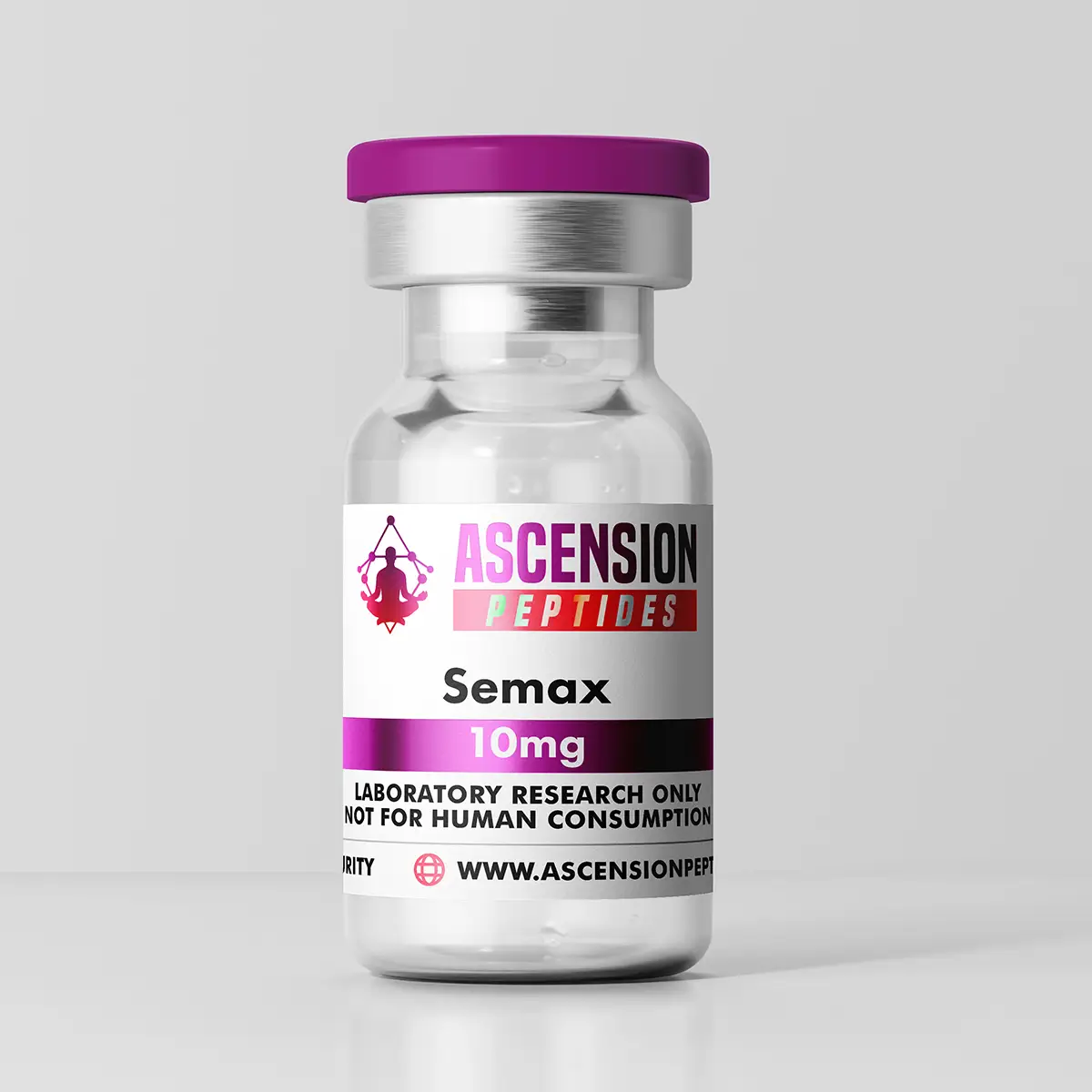
Semax is sold as a lyophilised research peptide — Ascension's 10mg vial is the format most of the protocols here are written around.
Semax Fast Answer
The short version is simple.
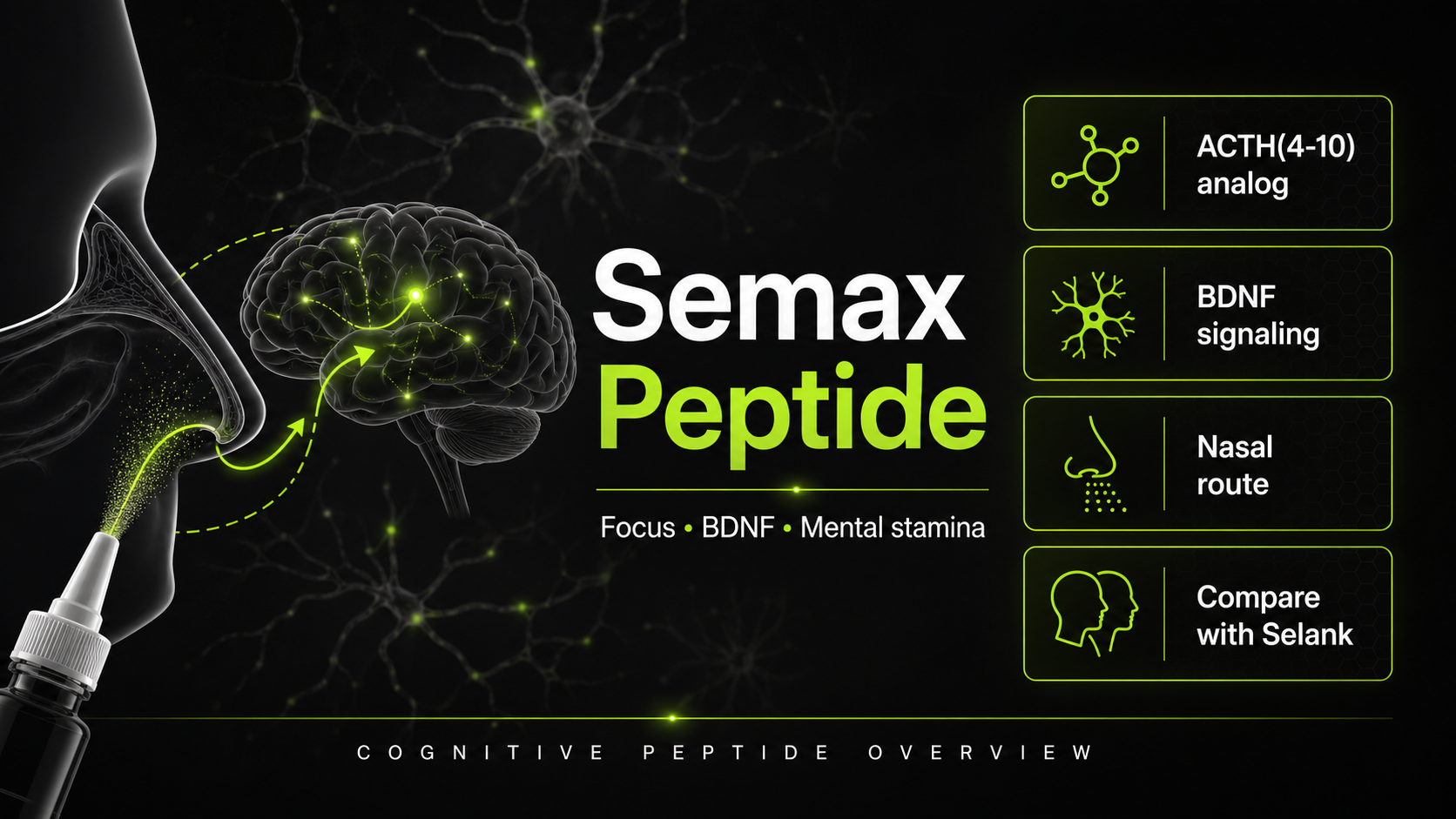
Semax peptide is a synthetic ACTH(4-10) analog, commonly written as Met-Glu-His-Phe-Pro-Gly-Pro, that is usually discussed for focus, mental stamina, memory support, and neuroprotective signaling. The strongest search intent is cognitive: readers want a practical nootropic-peptide overview, not a bodybuilding or weight-loss page.
Best-fit summary
Semax is the "cognitive push" peptide in the Semax vs Selank conversation. Selank is usually framed as calmer and more anxiety-oriented; Semax is usually framed as more activating and output-oriented.
What Is Semax Peptide?
Start with the simple definition.
Semax peptide is a synthetic heptapeptide, which means it is built from seven amino acids. Its sequence is commonly described as Met-Glu-His-Phe-Pro-Gly-Pro. It was designed from a fragment of ACTH, but its practical reputation is not about cortisol or adrenal stimulation. It is about cognition, mental energy, and nervous-system resilience.
That distinction matters. People often hear "ACTH-derived" and assume Semax acts like a hormone. The better framing is that Semax borrows part of the ACTH structure, then adds a stabilizing Pro-Gly-Pro tail that changes how the molecule behaves.
In plain English: Semax is a short synthetic peptide people compare when they want sharper focus without the feel of a conventional stimulant.
The ACTH Fragment
The origin creates confusion fast.
ACTH is a larger hormone involved in adrenal signaling. This peptide uses only a smaller fragment, which is why people discuss it for nervous-system effects rather than as a direct adrenal drug. That fragment-based design is one reason the molecule keeps showing up in cognitive peptide conversations.
The Pro-Gly-Pro Tail
The tail changes the profile.
The Pro-Gly-Pro ending is not trivia. Competitor pages repeatedly mention it because it helps explain why the molecule is treated as a deliberately engineered peptide, not just a chopped-up hormone fragment. The design goal is stability and a more useful effect window.
Why Semax Became Popular
The appeal is easy to understand.
Most nootropics fall into familiar buckets: caffeine for alertness, modafinil for wakefulness, racetams for experimentation, and adaptogens for smoother stress handling. Semax sits outside those categories. It is talked about as a cognitive peptide that may influence neurotrophic signaling, dopamine and serotonin tone, and brain stress response.
That makes it attractive to people who do mentally demanding work. Programmers, founders, students, traders, writers, and high-output professionals are often looking for more than raw stimulation. They want the feeling of being switched on without becoming scattered.
The risk is hype. Semax is often marketed like a guaranteed productivity switch. It is not. The more honest expectation is sharper task engagement for some people, subtle or inconsistent effects for others, and occasional overstimulation in sensitive users.
The Stimulant-Free Appeal
People want cleaner output.
Caffeine can work, but it can also push anxiety, urgency, and sleep debt. Prescription wakefulness drugs can be powerful, but they are a different category with different access rules. This peptide became popular because it promises a middle ground: cognitive activation without feeling like a classic stimulant.
The Russian Clinical History
The backstory matters here.
Semax has a longer non-US history than many newer peptides that trend online for a few months and disappear. That does not settle every question, but it does explain why serious pages keep mentioning stroke, ischemia, optic-nerve conditions, and neurological recovery rather than only productivity.
The Nootropic Community Angle
Online interest is more practical.
Biohackers rarely search for this peptide because they are reading neurology papers for fun. They search because they want to finish work, learn faster, feel less foggy, or compare it with Selank. The article has to meet that reality without pretending every claim is proven.
How Semax Works
Several pathways seem involved here.
Semax peptide is usually described through three main mechanisms: neurotrophin signaling, monoamine modulation, and stress-response biology. Those are technical terms, but the user-facing question is simple: does it help the brain stay clear under load?
BDNF and Neuroplasticity
BDNF is a central clue.
Brain-derived neurotrophic factor, or BDNF, helps neurons adapt, survive, and form useful connections. Semax is often discussed because published data connects it with BDNF-related signaling in brain tissue. That is why people place it in the neuroplasticity category instead of treating it like caffeine.
Dopamine and Serotonin Tone
Mood and drive overlap.
Semax is also discussed for its relationship with dopamine and serotonin systems. That does not make it a classic dopamine drug. It means its mental effects may involve motivation, task salience, emotional tone, and reward sensitivity.
Stress and Cognitive Load
Stress reveals the difference.
Some people only notice Semax when they are tired, under pressure, or pushing through a demanding work block. That fits the broader pattern: this peptide is usually more interesting when the brain is under load than when someone is already rested, calm, and productive.
Why It Is Not Just Stimulation
The mechanism feels less direct.
A stimulant usually increases alertness in a way people can feel quickly. This peptide is usually judged by output: fewer stalls, smoother task initiation, and better tolerance for demanding cognitive work. That difference is why some users love it and others think it is too subtle.
Semax Peptide Benefits and Uses
The use case is mostly cognitive.
The dominant search intent around Semax and Semax peptide is not bodybuilding, fat loss, libido, or skin quality. It is brain performance. The exact wording changes across ranking pages, but the center of gravity is focus, mental clarity, memory, fatigue resistance, neuroprotection, and comparison with Selank.
Deep Work
Deep work is the obvious use.
The best-fit scenario is a block of concentrated work where the task is clear but the mental friction is high. Writing, coding, studying, analysis, and dense reading are better tests than scrolling between tabs and hoping motivation appears.
Mental Fatigue
Fatigue is not always sleepiness.
Some people are awake but mentally slow. They can start tasks, but the effort feels sticky. This is where cognitive peptides get compared with caffeine, because the goal is not more raw energy. The goal is less resistance.
Learning Blocks
Learning demands repeated attention.
Because Semax is often discussed around BDNF and neuroplasticity, people naturally compare it for study sessions and skill acquisition. The grounded way to test that is recall, practice quality, and consistency, not just a vague feeling of being sharper.
What Semax Feels Like
Most reports are not dramatic.
When Semax works well, users often describe cleaner attention, better task initiation, less mental drag, and a more direct path from intention to action. It is not usually described as euphoric. It is closer to "my brain is online" than "I feel high."
The first day can be subtle. Some people notice a same-day effect, especially with nasal formats. Others only notice when they look back after several work sessions and realize the usual fatigue wall arrived later.
The wrong expectation creates disappointment. If someone expects a strong stimulant feel, Semax may seem underwhelming. If someone wants calm, steady output without caffeine escalation, it may fit better.
Semax vs Selank
This comparison dominates the SERP.
Semax and Selank are often grouped together because both are Russian-origin cognitive peptides, both are commonly discussed as nasal peptides, and both sit in the nootropic category. But they solve different problems.
Semax is the cognitive push. Selank is the calming stabilizer. That is the simplest useful distinction.
For the full comparison, use our Semax vs Selank guide. For the Selank side specifically, start with the Selank peptide guide.
Semax vs Common Nootropics
It is not another caffeine stack.
The biggest mistake is comparing Semax only by how hard it "hits." Caffeine and modafinil are felt through wakefulness and stimulation. Semax is usually evaluated through task quality, sustained attention, and cognitive fatigue.
Who Semax Makes Sense For
Fit matters more than hype.
Semax makes the most sense for people who already have the basics in place but still struggle with mental drag, task initiation, or sustained focus. It is more logical for a knowledge worker with a stable sleep schedule than for someone trying to patch over chronic sleep deprivation.
Good Candidate Profile
The best fit is specific.
- You want more cognitive output, not sedation.
- You tolerate caffeine but want something less jittery.
- Your main issue is focus, mental fatigue, or follow-through.
- You are willing to track response instead of guessing.
- You understand that nasal technique and product quality matter.
Poor Candidate Profile
Some people should look elsewhere.
- You are already anxious, overstimulated, or sleeping poorly.
- You want weight loss, libido, joint repair, or skin support.
- You are taking complex psychiatric medications without clinician input.
- You expect instant motivation without changing workload or recovery.
- You want a daily crutch rather than a targeted cognitive tool.
What to Expect by Timeline
Expectations should stay grounded here.
Some Semax users report same-day clarity. Others report a more cumulative pattern over several sessions. The best way to judge it is not by asking "do I feel something?" every five minutes. It is by tracking work quality, distraction, fatigue, and sleep.
Same-Day Signals
The first signal is usually subtle.
A clean first response may look like starting faster, staying with one task longer, or feeling less tempted to seek stimulation. It may not feel dramatic in the moment. The result may show up in the work block.
Week-One Signals
The pattern matters more.
By the end of several comparable sessions, the question is whether output improved without a tradeoff. If focus rose but sleep got worse, that is not a clean win.
When to Reassess
No tool should become mandatory.
If a user starts feeling unable to work without it, the experiment is already drifting. Cognitive tools should improve a system, not become the system.
Route and Format Basics
Nasal formats dominate the conversation.
Semax peptide is most often discussed as a nasal spray or nasal drops. That route makes sense because the target is cognitive effect, and nasal delivery is commonly used for peptides aimed at brain-adjacent pathways.
Injectable formats exist in some online discussions, but they are less central to the classic Semax story. Oral Semax is a harder sell because peptides are generally vulnerable to digestion and poor absorption unless specifically engineered for that route.
This is where the dedicated dosage page matters. Concentration, sprays per bottle, mcg per spray, and timing can change the protocol. If you are comparing bottles or trying to understand a label, use the Semax dosage guide rather than guessing.
Semax Peptide Dosage Context
Dosage needs its own page.
The top ranking pages all mention dosing, so this overview needs enough context to answer the intent. It should not replace the dedicated dosage guide. The useful high-level point is that Semax peptide dosing depends on route, concentration, sprays or drops per bottle, and whether the product is standard Semax or a modified version.
Nasal Spray
Sprays are easiest to compare.
The label should make the amount per spray clear. Without that, a bottle can look professional while still leaving the user guessing. Nasal congestion, technique, and formulation can also change the feel.
Nasal Drops
Drops are the older format.
Some Russian-style products use drops instead of sprays. That can work, but it makes comparison harder because drop size can vary. A user comparing sources should translate the label into actual mcg delivered.
Modified Versions
Variants complicate the category.
N-acetyl versions and amidated versions are often marketed as longer-lasting or stronger. Beginners should be cautious here. A modified version may not feel like standard Semax, and the dose assumptions may not transfer cleanly.
Common Beginner Mistakes
Most mistakes are easy to predict.
The first mistake is using Semax too late in the day. If it feels activating, late use can interfere with sleep. The second mistake is combining it with too much caffeine and then blaming Semax for the jittery result.
The third mistake is treating Semax and Selank as interchangeable. They may be stack partners, but they do not feel the same. The fourth mistake is judging it from one session instead of tracking a few comparable work blocks.
Using It Too Late
Timing can ruin sleep.
If the peptide feels activating, late-day use can turn a good work session into a poor night. That is a bad trade because sleep loss will erase most cognitive gains the next day.
Combining Too Much
Stacks create confusion fast.
Caffeine, nicotine, racetams, stimulants, and multiple peptides can all change the same work session. Add too much at once and the signal becomes unreadable.
Skipping Baseline Tracking
Memory is a poor dashboard.
People overestimate how productive they were last week. A small baseline log before using anything gives the experiment a reference point.
Simple tracking test
Pick one repeatable task: writing, coding, studying, reading dense material, or admin work. Track start friction, distractions, output, mood, and sleep. If those do not improve, Semax may not be the tool you need.
Semax Peptide Side Effects and Safety
Most caution is practical here.
Semax peptide is often described as well tolerated, but that does not mean every user gets a clean experience. The main complaints people watch for are headache, nasal irritation, restlessness, irritability, sleep disruption, and feeling too mentally activated.
The risk profile also depends on context. Someone using SSRIs, stimulants, MAOIs, migraine medications, blood-pressure drugs, or multiple nootropics should be more cautious than someone comparing one peptide in isolation.
For the full breakdown, use our Semax side effects guide. This page is only the screening layer.
Sleep Disruption
Sleep is the key warning.
A cognitive peptide that improves focus but hurts sleep is not solving the real problem. If sleep quality drops, the experiment needs to be reassessed.
Nasal Irritation
Local irritation is common enough.
Sprays and drops can irritate the nasal lining, especially with frequent use. Dryness, burning, sneezing, or congestion can also change absorption.
Medication Overlap
Interactions deserve extra care.
Because this category touches mood, drive, and neurotransmitter tone, psychiatric medications and stimulants deserve special caution. A clinician should know what else is in the stack.
Legal and Regulatory Context
The US picture is changing.
Semax has a long history of use outside the United States, especially in Russian clinical settings. In the US, the more current issue is compounding policy. FDA lists a July 23-24, 2026 Pharmacy Compounding Advisory Committee meeting, with Semax-related bulk substances scheduled for discussion on July 24, 2026 for cerebral ischemia, migraine, and trigeminal neuralgia.
That does not make Semax a casual wellness product. It means the regulatory conversation is active and indication-specific. Anyone considering clinician-directed Semax should separate three things: the molecule, the product source, and the medical reason for use.
What the FDA Meeting Means
The meeting is not marketing copy.
The scheduled discussion is about specific compounded bulk substances and specific uses. It should not be stretched into a blanket endorsement for everyday productivity use.
Why This Matters for Buyers
Regulatory nuance affects sourcing.
A peptide can have interesting data and still have product-quality concerns in the market. The buyer question is not only "does the molecule sound promising?" It is also "can I trust this exact product?"
How to Compare Semax Peptide Products
Quality checks matter a lot.
Because Semax peptide is usually used in tiny amounts, poor labeling or weak documentation can create outsized problems. A product page should make the form, amount, route, and testing clear. Vague "brain peptide" language is not enough.
- Identity: standard Semax, N-acetyl Semax, or amidated variant.
- Amount: total mg per vial or bottle.
- Route: nasal spray, nasal drops, or injectable format.
- Testing: current purity documentation and batch details.
- Storage: cold-chain expectations and expiration clarity.
- Support: clear contact, shipping, refund, and handling policies.
Batch Testing
Documentation should be current.
A clean product page should show what was tested, when it was tested, and which batch the document belongs to. A generic purity claim is weaker than a batch-specific document.
Storage Clarity
Handling can change quality.
Peptides are sensitive to heat, light, moisture, and time. A vendor should explain how the product ships and how it should be stored after arrival.
Label Clarity
Labels should answer basic questions.
The best labels make the form, amount, concentration, and suggested route easy to understand. If the label forces guesswork, the product is already creating friction.
How Semax Peptide Fits a Nootropic Stack
Stacking should stay simple first.
The most common pairing is Semax plus Selank. The logic is straightforward: Semax adds cognitive activation, while Selank smooths stress response. That can be useful for people who want output without feeling wound up.
But stacking can also hide cause and effect. If you start Semax, Selank, caffeine, nicotine, and multiple supplements at once, you will not know what helped or what caused side effects. A cleaner approach is one change at a time.
For broader category context, compare Semax with other cognitive peptides in our best nootropic peptides guide. If you are new to peptides generally, start with best peptides for beginners.
How to Read the Semax Peptide Cluster
This is the hub page.
Use this Semax peptide overview when you are still deciding whether the category fits your goal. The supporting pages go deeper once your question becomes narrower.
Choose the next article by the question you actually have:
- Semax benefits for the upside case.
- Semax dosage guide for amounts, timing, and route details.
- Semax side effects for tolerability screening.
- Semax review for the buyer-style take.
- Semax vs Selank for the closest comparison.
- Calm + Clarity review if you want a combined Semax/Selank-style stack.
Frequently Asked Questions
References
- FDA. July 23-24, 2026 Meeting of the Pharmacy Compounding Advisory Committee. FDA
- Dolotov OV, Karpenko EA, Inozemtseva LS, et al. Semax and BDNF/trkB signaling in hippocampal tissue. PubMed
- Medvedeva EV, Dmitrieva VG, Limborska SA, et al. Semax and immune-response gene expression during ischemic brain injury. PubMed
- Tsai SJ. Semax as a proposed candidate for ADHD and Rett syndrome. PubMed
- Kurysheva NI, Shpak AA, et al. Semax in glaucomatous optic neuropathy. PubMed
- Alzheimer's Drug Discovery Foundation. Cognitive Vitality Semax evidence review. ADDF PDF
The information in this article is for educational purposes only and does not constitute medical advice. Always consult a healthcare professional before starting any new supplement or compound. Results vary by individual.