🔑 Key Takeaways
- Semax is a cognitive accelerator — best for focus, memory, learning speed, and neuroprotection via BDNF upregulation
- Selank is an anxiolytic stabilizer — best for anxiety reduction, stress resilience, and calm mental clarity without sedation or dependence
- Both originated from Soviet-era research and are approved prescription drugs in Russia — Semax since 1996, Selank since 2009
- They work through entirely different mechanisms and stack well together (morning Semax for focus, evening Selank for calm)
- Na-Amidate variants are dramatically more potent — start with standard versions first
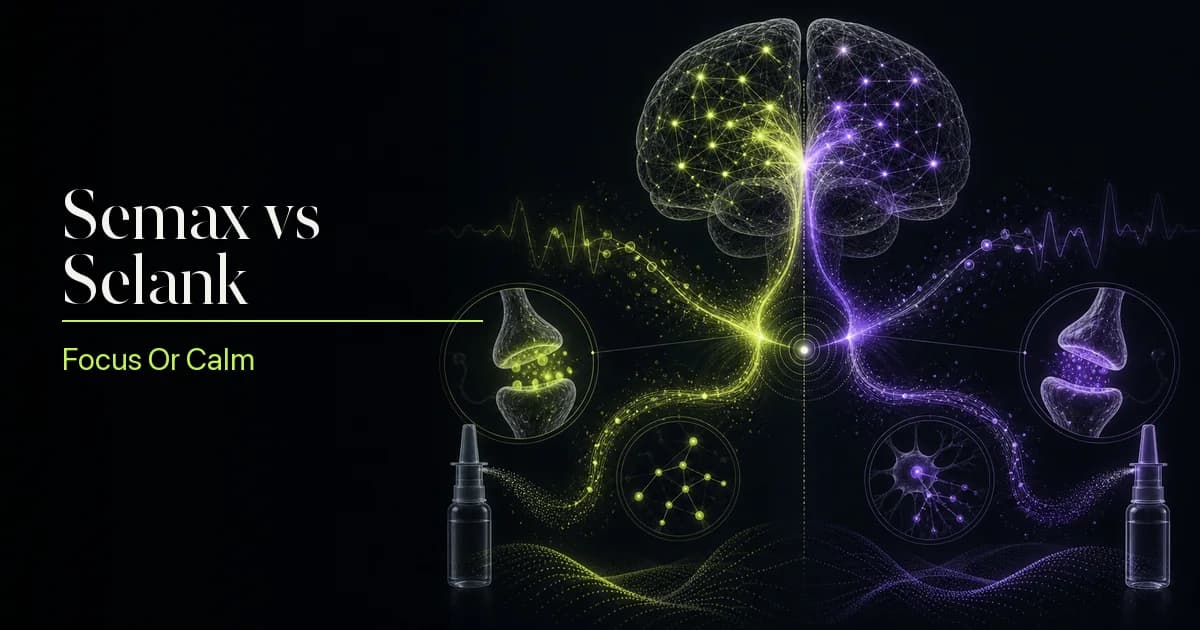
Two peptides dominate the nootropic conversation: Semax and Selank. Both came out of the same Soviet-era research program at the Russian Institute of Molecular Genetics. Both are administered as nasal sprays. Both enhance brain function. And yet they work through entirely different pathways and serve very different goals.
The short answer: Semax is a cognitive accelerator — best for focus, memory, and learning. Selank is an anxiolytic stabilizer — best for anxiety reduction, stress resilience, and calm mental clarity. Understanding the distinction is the key to getting the results you actually want.
This guide breaks down both peptides side by side — mechanisms, effects, dosing, variants, stacking, side effects, and the actual science — so you can make an informed decision. For dosing specifics on each compound individually, see our Semax dosage guide and Selank peptide guide.
What Is Semax?
Semax is a synthetic heptapeptide derived from adrenocorticotropic hormone (ACTH) — specifically the ACTH(4–7) fragment, extended with a proline-glycine-proline sequence that improves metabolic stability. It was developed in the 1980s at the Institute of Molecular Genetics of the Russian Academy of Sciences and has been an approved prescription drug in Russia since 1996 for conditions including stroke recovery, optic nerve disease, and cognitive impairment.
The key insight behind Semax: the biologically active core of ACTH — the fragment responsible for brain-enhancing effects — could be isolated, stabilized, and administered independently of the full hormone. The result is a peptide with potent nootropic and neuroprotective activity but without the hormonal side effects of ACTH itself.
Semax is most commonly delivered as a nasal spray, which allows the peptide to bypass the blood-brain barrier via the olfactory pathway and reach brain tissue rapidly.
What Is Selank?
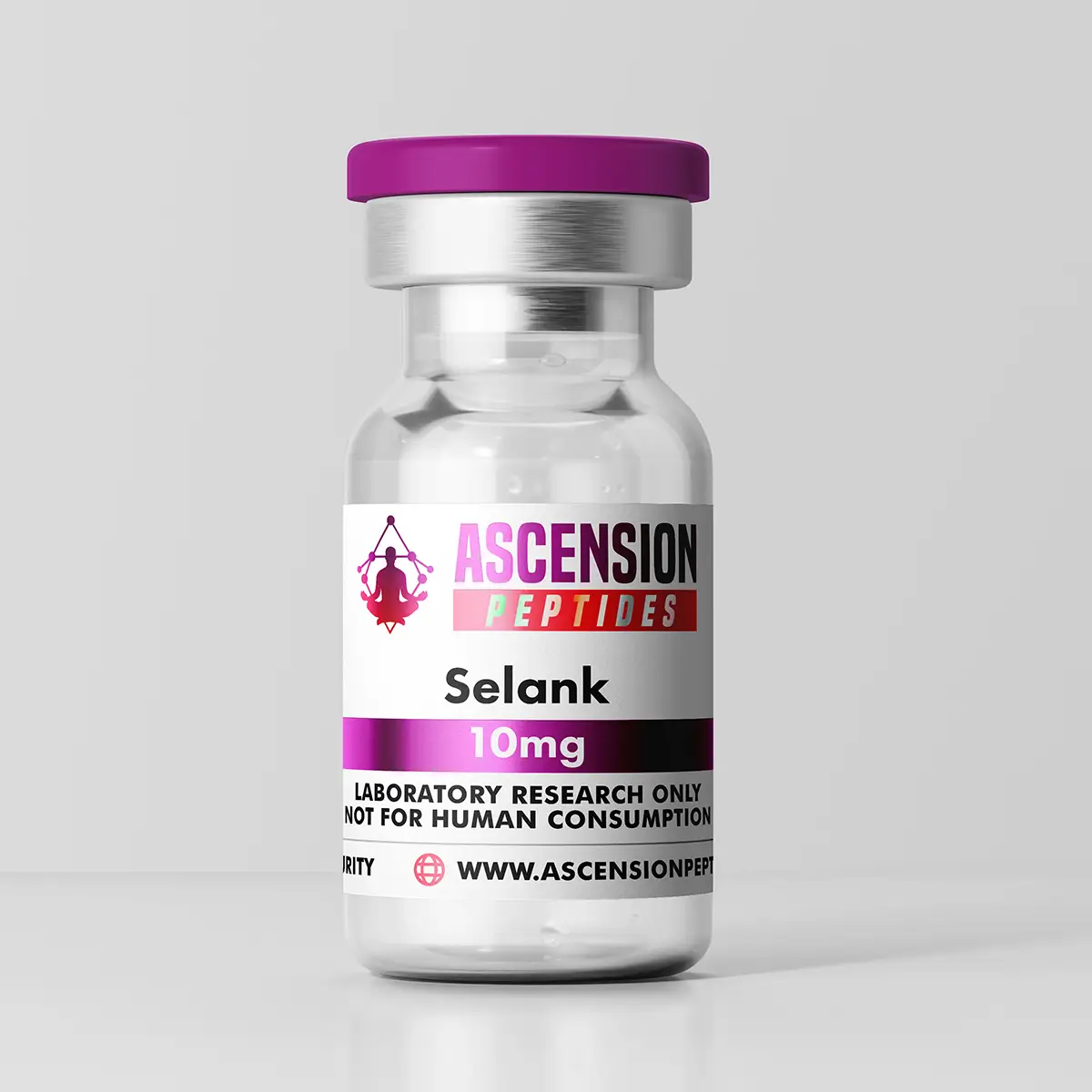
Selank is a synthetic heptapeptide analogue of tuftsin — a naturally occurring immunomodulatory tetrapeptide (Thr-Lys-Pro-Arg) produced in the spleen. Researchers at the same Russian institute added a tripeptide extension (Pro-Gly-Pro) to tuftsin to dramatically improve stability and bioavailability. The result was Selank, approved in Russia since 2009 as an anxiolytic drug.
Unlike classical anxiolytics like benzodiazepines, Selank does not cause sedation, cognitive blunting, or physical dependence. Instead, it produces a state of calm, clear-headed alertness — anxiety dissolves without mental fog. This has made it popular among researchers, clinicians, and people seeking a cleaner approach to anxiety management than pharmaceuticals offer.
Selank also has notable immunomodulatory properties — modulating interleukin-6 and other cytokine expression — which may contribute to its stress-protective effects. For the complete breakdown, see our Selank peptide guide.
How Each Peptide Works: Mechanisms of Action
Semax: BDNF Upregulation and Monoamine Modulation
Semax works through several interconnected mechanisms:
BDNF Upregulation: The most well-documented mechanism. Semax rapidly and significantly increases brain-derived neurotrophic factor (BDNF) in the hippocampus and frontal cortex (Dolotov et al., Brain Research, 2006). BDNF is often called "Miracle-Gro for the brain" — it promotes neuronal survival, synaptic plasticity, and new neural connections. Elevated BDNF translates directly to improved memory consolidation, faster learning, and enhanced cognitive flexibility.
Dopaminergic and Serotonergic Modulation: Semax fine-tunes both dopamine and serotonin systems. Dopamine enhancement drives motivation, executive function, and working memory. Serotonergic activity supports mood stabilization. This dual action explains why users report not just sharper focus but a generally elevated mood.
Cholinergic Activity: Increases acetylcholine turnover in specific brain regions, supporting memory encoding and retrieval — particularly declarative and spatial memory.
Neuroprotection: Activates pathways protecting neurons from oxidative stress and ischemic damage. This underlies its clinical use in stroke recovery and growing interest for traumatic brain injury applications.
Selank: GABAergic Modulation and Anxiety Relief
Selank operates through a fundamentally different set of mechanisms centered on emotional regulation:
GABA-A Receptor Modulation: Selank's primary anxiolytic mechanism involves positive modulation of GABA-A receptors — the brain's main inhibitory system (Volkova et al., Frontiers in Pharmacology, 2016). GABA quiets overactive neural circuits that produce anxiety, racing thoughts, and stress responses. Selank enhances GABAergic signaling without binding to the benzodiazepine site, which is why it avoids sedation, cognitive impairment, and dependence.
Serotonin and Enkephalin Systems: Modulates gene expression involved in serotonin metabolism and has effects on the enkephalin system (endogenous opioid peptides), contributing to mood stabilization and stress resilience.
BDNF Regulation (Secondary): Like Semax, Selank also increases BDNF expression — though this effect appears secondary to its primary anxiolytic action. The BDNF elevation likely explains the mild memory-enhancing effects some users report.
Immunomodulation: Modulates cytokine production (notably IL-6), reducing neuroinflammation and contributing to the stress-protective profile — a mechanism not present in Semax.
Effects Comparison: Semax vs Selank Side by Side
Semax Dosing Protocol
For the complete guide, see our Semax dosage guide.
Cycle length: 2–4 weeks on, 1–2 weeks off
Storage: Refrigerate between uses; freeze unused stock. Semax degrades rapidly at room temperature.
Selank Dosing Protocol
Cycle length: Can be used more continuously than Semax; common protocols run 2–4 weeks
Storage: Refrigerate. Moderately more stable than Semax but still degrades at room temperature over time.
Na-Semax Amidate and Na-Selank Amidate: Enhanced Variants
If standard Semax and Selank are the base models, the Na-Amidate variants are dramatically enhanced versions — structurally modified for increased potency and longer duration.
What Makes Them Different
Two modifications are applied:
- N-terminal acetylation (Na): Protects the peptide from aminopeptidase enzymes, significantly extending half-life
- C-terminal amidation (Amidate): Protects against carboxypeptidase degradation and often increases receptor binding affinity
Na-Semax Amidate
Estimated to be approximately 100–1,000× more potent per microgram than standard Semax, with substantially longer duration. Starting doses are typically 50–100mcg (compared to 200–600mcg standard). For experienced users only.
Na-Selank Amidate
Same structural modifications yield enhanced potency and duration for the anxiolytic effects. Starting doses are 50–150mcg intranasally — significantly lower than the 250–500mcg range of standard Selank.
Who Should Choose Semax?
Semax is the right choice when cognitive performance is the primary goal — when you need mental output, not emotional regulation.
Ideal for:
- Students and academics preparing for exams or absorbing large volumes of complex material — BDNF-driven memory enhancement excels here
- Knowledge workers (programmers, writers, analysts) needing sustained focus and fast information processing
- People recovering from neurological events — stroke, TBI, or post-COVID cognitive impairment — where neuroprotective effects are most relevant
- Anyone dealing with brain fog from chronic illness, poor sleep, or burnout
- People whose anxiety is low but whose focus, processing speed, or memory needs improvement
Not ideal if: You have significant anxiety that a stimulant-adjacent compound might worsen, or if you're sensitive to dopaminergic compounds.
Who Should Choose Selank?
Selank is right when anxiety, stress, or emotional dysregulation is the primary obstacle. Many people find their cognitive performance is limited not by raw brain capacity but by the mental noise of chronic stress — Selank addresses exactly that.
Ideal for:
- High-stress professionals experiencing anxiety-driven cognitive interference (burnout, performance anxiety)
- People with generalized anxiety seeking a non-habit-forming alternative to benzodiazepines or SSRIs
- Anyone with stress-impaired memory — chronic cortisol elevation degrades hippocampal function; Selank helps restore it
- People who found stimulant nootropics too activating — Selank provides clarity through calming rather than stimulation
- Those managing anxiety disorders as an adjunct under medical supervision
Not ideal if: Your primary need is raw cognitive acceleration or neuroprotection. Selank improves cognition indirectly but isn't the most direct tool for brain performance optimization.
For more options in the cognitive enhancement space, see our best peptides for brain function guide and our best nootropic peptides ranking.
Stacking Semax and Selank Together
This is one of the most popular combinations in the nootropic peptide community, and the logic is compelling: Semax provides cognitive acceleration and BDNF-driven neuroplasticity while Selank smooths out any anxiety or overstimulation that Semax might produce.
Common Stacking Approaches
💡 Pro Tip
Establish your response to each peptide individually before combining. Use Semax alone for 1–2 weeks, then Selank alone for 1–2 weeks, then combine. This way you know exactly what each compound does for you and can calibrate the stack intelligently.
Side Effects: What to Expect
Semax Side Effects
Semax has a strong safety profile across decades of clinical use in Russia. Reported side effects:
- Nasal irritation: Most common — mild burning at application site; usually diminishes with continued use
- Headache: Particularly at higher doses; usually transient
- Irritability or overstimulation: An edgy, wired feeling — most common above 400mcg or when dosed too late in the day
- Sleep disruption: Semax taken after early afternoon can delay sleep onset — always dose morning/early afternoon
- Mild fatigue after cycling: Brief dip in mental energy when stopping — likely BDNF normalization; resolves within days
No evidence of dependence, hormonal disruption, or organ toxicity at standard doses.
Selank Side Effects
Selank's side effect profile is notably mild — one of its most attractive features versus pharmaceutical anxiolytics:
- Nasal irritation: Similar to Semax — mild, transient
- Mild sedation at higher doses: Rare and dose-dependent; far less than benzodiazepines
- Emotional blunting: A small subset report feeling "too flat" — reduced anxiety but also reduced engagement; resolves with dose reduction
- Vivid dreams: Reported anecdotally, possibly related to serotonergic effects
Critically: no evidence of dependence, withdrawal, respiratory depression, or amnesia — the classic risks of benzodiazepine use. This is a meaningful safety advantage for anyone managing chronic anxiety.
Research Status and Evidence Base
Both peptides have substantial research histories rooted primarily in Russian and Eastern European clinical contexts.
Semax Research
- Clinically used in Russia since 1996 for stroke rehabilitation, optic nerve atrophy, and cognitive disorders
- Significantly upregulates BDNF expression in hippocampus and frontal cortex (Dolotov et al., Brain Research, 2006)
- Improved outcomes in ischemic stroke patients in Russian RCTs (Medvedev et al., 1997)
- Growing Western interest for TBI recovery and cognitive enhancement
Selank Research
- Approved in Russia as an anxiolytic since 2009 for generalized anxiety and neurasthenia
- GABA-A receptor modulation characterized in controlled studies (Volkova et al., Frontiers in Pharmacology, 2016)
- Comparative studies with benzodiazepines showed similar anxiolytic efficacy with dramatically fewer side effects
- Immunomodulatory properties studied for stress-related immune dysregulation (Ershov et al., Immunol Letters, 2008)
The primary limitation from a Western evidence perspective: relative lack of large, independent, double-blind placebo-controlled trials in high-impact English-language journals. The Russian clinical data is substantial but less accessible to Western practitioners.