The hair in the shower drain gets your attention.
You're down 30 pounds, your clothes fit again, and then one morning there's a clump in your brush that wasn't there last month. So you type the obvious question: does retatrutide cause hair loss? The honest answer has two parts. The retatrutide trials have not published a hair loss rate at all. But the drugs it's built on list hair loss on their FDA labels, and the reason they do points straight at the thing reta does best.
🔑 Key Takeaways
- No retatrutide trial has published an alopecia percentage yet. We checked the phase 2 tables and all four TRIUMPH announcements, and what's missing matters as much as what's there.
- The FDA labels for tirzepatide and semaglutide do list hair loss, and both tie it to weight reduction, not to the drug itself.
- One number from the semaglutide data explains why reta users should pay attention: it's about how much weight you lose, not which pen you use.
- Women are hit far harder than men in every label we checked.
- The shedding usually starts months after the trigger, and the timing tells you what to do next.
Below, we'll go through what each retatrutide trial reported, the exact label numbers for Zepbound and Wegovy, why rapid weight loss makes hair fall out, who is most at risk, what actually helps, and when the shedding stops.
Does Retatrutide Cause Hair Loss? The Short Answer
Probably, in some people. But not the way you think.
Retatrutide has no published hair loss rate. In the phase 2 obesity trial, hair loss never made the adverse event tables, which list every event that reached 5% in any dose group. Lilly's announcements for TRIUMPH-1, TRIUMPH-2, TRIUMPH-3 and TRIUMPH-4 don't mention hair loss either. The full phase 3 papers came out on September 29, 2026, but their complete side-effect tables sit behind the journals' paywalls, and neither abstract mentions hair.
That isn't the same as "no risk." Semaglutide and tirzepatide both list hair loss on their FDA labels, and both labels say the same thing: the hair loss was associated with weight reduction. Retatrutide produces more weight loss than either of them. If the cause is the weight loss, reta users are in the group most likely to see it.
So the useful answer is this. Retatrutide probably doesn't damage hair follicles directly. The fast, deep weight loss it causes can trigger a temporary shedding condition called telogen effluvium, and that is very likely what you're seeing.
What the Retatrutide Trials Actually Report
Here's every trial, checked one by one.
A note on that first row. The phase 2 dose groups were small, 33 to 70 people each. A 5% cutoff in a 33-person group means two people. So hair loss could still have happened in one or two people per group without showing up. What the data does rule out is a big, obvious signal like the one dysesthesia produced.
Scalp tingling isn't hair loss. The skin side effect that does show up in every retatrutide trial is dysesthesia: burning, tingling or oversensitive skin. In TRIUMPH-4 it reached 20.9% on 12 mg, against 0.7% on placebo. If your scalp feels sore or sensitive, that may be dysesthesia, which Lilly says was mostly mild and usually resolved during treatment. It can also be trichodynia, a scalp soreness that often comes with telogen effluvium. Neither one means your follicles are being damaged.
For the full side effect picture beyond hair, see our retatrutide side effects guide and our look at whether retatrutide is safe overall.
Hair Loss on Zepbound and Wegovy: The Label Numbers
The approved drugs give us real numbers.
Zepbound (tirzepatide) and Wegovy (semaglutide) were tested against placebo in large trials, and their FDA labels report hair loss as a measured side effect. These are the closest data we have to what reta might do.
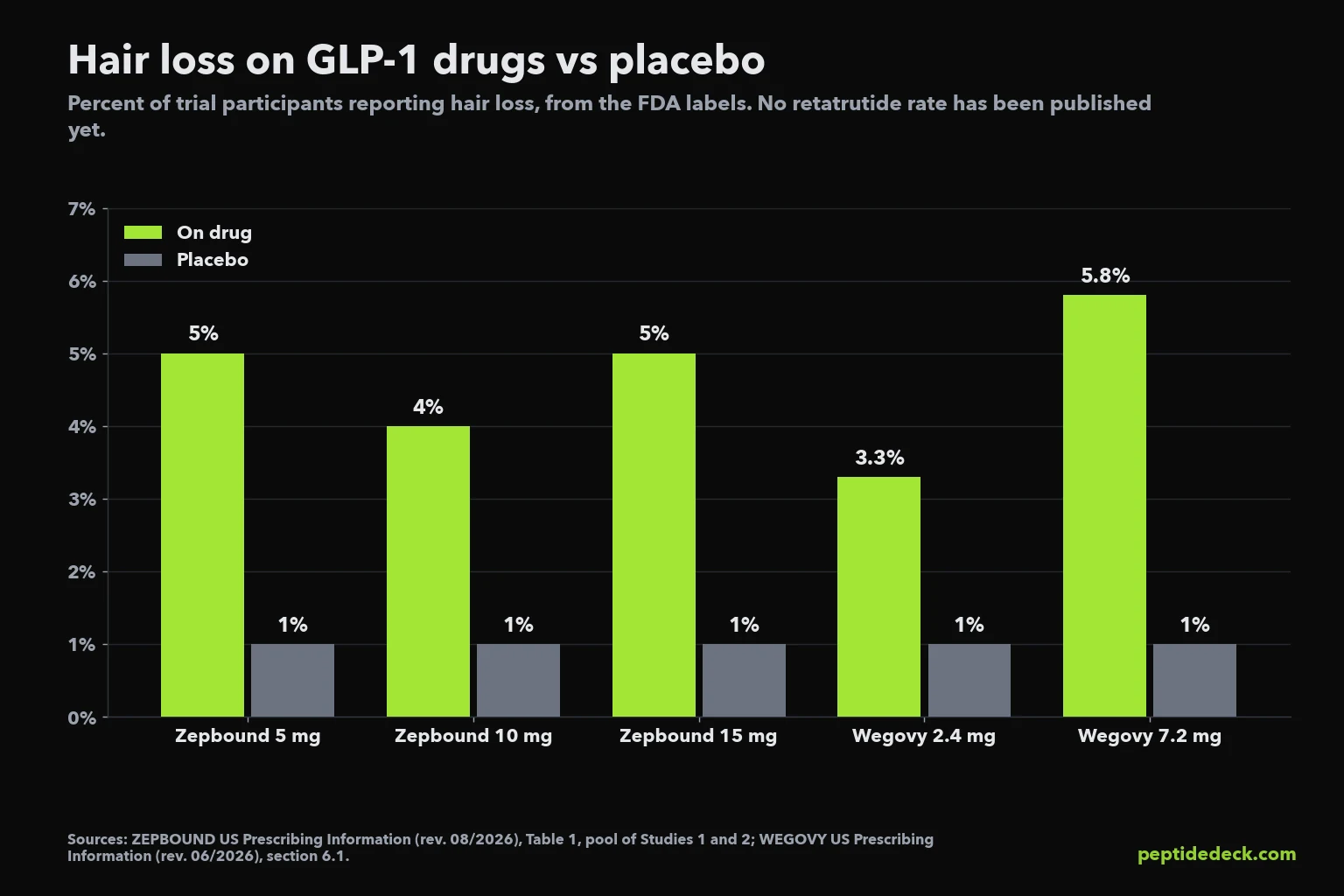
Three things stand out. First, the rates are low in absolute terms: roughly 3 to 6 people in 100 on the drug, against about 1 in 100 on placebo. Second, the gap between women and men is huge in every row. Third, hair loss almost never made people quit. No one on Zepbound stopped treatment because of it. On Wegovy 7.2 mg, one person stopped and five lowered their dose.
The fourth number is the one that matters most for reta. Health Canada's Wegovy monograph reports that alopecia was more common in people who lost at least 20% of their body weight than in those who lost less: 5.3% against 2.5%. Now compare that with retatrutide. In TRIUMPH-1, published in the New England Journal of Medicine, average weight loss at 80 weeks was 23.7% on 9 mg and 25.0% on 12 mg. The average person on the top doses is already over that 20% line.
If you've read our breakdown of whether Ozempic causes hair loss, the pattern will look familiar. Retatrutide just pushes further along the same curve.
Why Retatrutide Can Make Your Hair Fall Out
Your hair runs on a schedule.
Each follicle cycles between growing and resting. At any moment, about 10% of the hairs on your scalp are in the resting phase, called telogen. Those are the hairs you lose every day without noticing.
A major stress on the body can push many more follicles into the resting phase at once. That's telogen effluvium. Dermatology reviews list sudden weight loss, caloric restriction, severe protein or zinc deficiency, and both overactive and underactive thyroid among the triggers. The key detail is the delay: the shedding usually starts two to three months after the trigger, once those resting hairs are pushed out by new growth underneath.
That delay is why it feels so random. By the time hair starts coming out, the stressful part, your biggest calorie drop during dose escalation, may be weeks behind you.
Why would reta trigger it more than older drugs? A 2026 review of hair loss across incretin drugs, which covered semaglutide, tirzepatide and retatrutide, concluded that telogen effluvium is driven mainly by how much weight people lose and how fast, not by drug toxicity. It named female sex and weight loss above 10% as the strongest predictors. Retatrutide's whole selling point is more weight loss, faster. In the phase 2 trial, weight on the top doses was still falling at week 48, so the stress on your body can last longer than with a drug that plateaus sooner.
What about the glucagon part of retatrutide? Nobody has studied whether it affects hair either way. Any claim that it protects hair, or harms it, is a guess.
When Does Retatrutide Hair Loss Start and Stop?
Timing is the best clue you have.
If your shedding started in the first few weeks of retatrutide, the drug probably isn't the trigger. Telogen effluvium takes months to show. An illness, a crash diet or a stressful event from a few months back is a better suspect.
Who Is Most Likely to Lose Hair on Reta
Risk isn't spread evenly. These groups carry most of it.
- Women. On Zepbound, 7.1% of women reported hair loss against 0.5% of men. On Wegovy 7.2 mg it was 8.4% against 0.2%. Our guide to retatrutide for women covers this and the other side effects that differ by sex.
- Fast and heavy losers. The 20% line from the Wegovy data is the clearest marker. If you're losing more than a couple of pounds a week for weeks on end, read our guide on losing too much weight on retatrutide.
- People eating very little protein. Reta can cut appetite so hard that some days you barely eat. Protein shortfall is a known telogen effluvium trigger.
- Anyone low in iron or zinc, or with a thyroid problem. These cause shedding on their own, and eating less makes deficiencies more likely. The 2025 nutrition advisory from four US obesity and nutrition societies lists iron and zinc among the nutrients of concern for people on GLP-1 drugs.
- People with pattern hair loss. A 2026 systematic review found androgenetic alopecia (genetic pattern thinning) and telogen effluvium were the two most common types reported with these drugs. If your hairline was already thinning, extra shedding makes it more visible.
How to Reduce Hair Loss on Retatrutide
You can't control your genes. You can control these.
1. Hit a real protein number
The standard adult recommendation is 0.8 g of protein per kilogram a day. The 2025 joint advisory on nutrition for GLP-1 therapy notes that higher targets of 1.2 to 1.6 g/kg a day have been proposed during active weight loss. It adds that using your full body weight can overestimate the need, and offers a simpler fixed target of 80 to 120 g a day. On reta, that usually means planning protein first at every meal, because appetite won't do it for you.
2. Slow the dose climb
Faster weight loss means more stress on your follicles. The phase 2 trial stepped the dose up no faster than every four weeks, and many people stop at 4 to 8 mg. In TRIUMPH-1, the 4 mg dose still produced 17.6% weight loss at 80 weeks, with fewer people stopping for side effects than on placebo (4.1% against 4.9%, per Lilly). If you're shedding, holding your current dose longer is a reasonable thing to raise with your doctor. Our retatrutide dosing schedule shows each step.
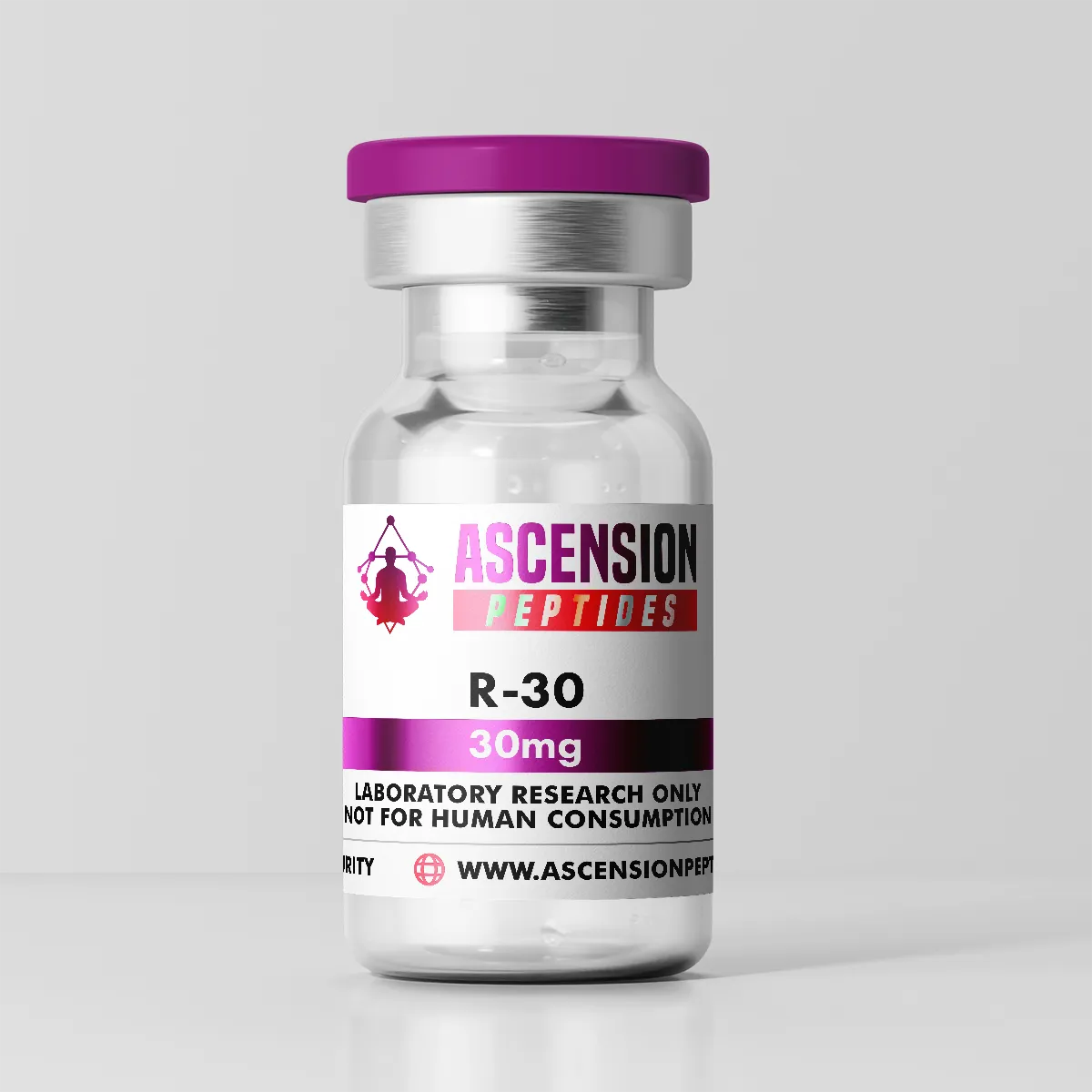
Slow titration only works if the milligrams on the label are real. An overfilled vial means you're climbing faster than you think, and an underfilled one tempts you to jump ahead. That's why the lab report for your exact batch matters more than the brand name. Our guide to the best place to buy retatrutide explains how to read one. As of October 2026, Ascension's 30 mg R-30 vial lists at $250, or $125 with code PEPTIDEDECK, and you can compare current retatrutide for sale listings and their batch reports on our product page. (PeptideDeck may earn a commission on purchases through these links.) Mixing matters too: the reconstitution guide shows how to get each dose right.
3. Ask for blood work
If shedding is heavy or lasts, a basic workup is worth asking for. A 2026 systematic review on GLP-1 drugs and hair loss suggests a complete blood count, ferritin (your iron stores), thyroid-stimulating hormone and vitamin D. A deficiency is the one cause of shedding you can fix directly.
4. Talk to a doctor about minoxidil, if it fits
Minoxidil won't stop telogen effluvium in its tracks; that shedding has to run its course. Where it helps is underlying pattern thinning. The same 2026 review says topical minoxidil may be appropriate when the pattern looks like androgenetic alopecia. Oral low-dose minoxidil is a prescription decision for a dermatologist. Don't start it on your own while you're also on a drug that can lower blood pressure.
5. Skip the biotin megadoses
Biotin only helps if you're deficient, and most people aren't. It also causes problems: the FDA has warned that biotin can make some lab tests give false results, including troponin tests used to detect heart attacks. If you take it, tell whoever orders your blood work.
Fatigue often travels with shedding, for the same reason: you're eating far less than before. Our guide on whether retatrutide makes you tired covers that side of it.
Does Hair Grow Back After Retatrutide Hair Loss?

In most cases, yes.
Telogen effluvium doesn't destroy follicles. They're resting, not gone. Reviews report that acute telogen effluvium resolves in about 95% of cases, and improvement usually shows three to six months after weight stabilizes. The first sign is short new hairs along your hairline and part, which can look frizzy for a while.
Stopping retatrutide won't make the shedding stop faster. Hairs already pushed into the resting phase will fall out anyway. Stopping does bring a high chance of weight regain, which our guide to stopping retatrutide covers. For most people, slowing the loss beats quitting.
Hair may not fully return if something else is going on underneath: pattern hair loss that the shedding unmasked, alopecia areata, or a scarring alopecia. That's what the next section is for.
When to See a Doctor About Hair Loss on Retatrutide
Most shedding is just annoying. These signs aren't.
- Round, smooth bald patches, or patches on your eyebrows or beard. That suggests alopecia areata, not telogen effluvium.
- Redness, scaling, pain or shiny skin where hair used to be, which can mean scarring alopecia.
- Shedding that lasts longer than six months. That's the definition of chronic telogen effluvium and needs a proper workup.
- Hair loss with tiredness, feeling cold, heavy periods or a racing heart, which can point to thyroid problems or iron deficiency.
- Hair loss because you can barely eat. That's a dose problem, and it usually comes with muscle loss too.
A dermatologist can do a pull test or trichogram and tell telogen effluvium apart from the other types in one visit.
Frequently Asked Questions
Sources
- Jastreboff AM, et al. Triple–hormone-receptor agonist retatrutide for obesity: a phase 2 trial. N Engl J Med 2023;389:514–526. PMID 37366315, and Supplementary Appendix Tables S10 and S14. nejm.org
- ClinicalTrials.gov NCT04881760, posted results, adverse events (5% frequency threshold). clinicaltrials.gov
- Jastreboff AM, et al. Retatrutide, a triple hormone receptor agonist, for treatment of obesity (TRIUMPH-1). N Engl J Med, published September 29, 2026. doi:10.1056/NEJMoa2604169
- Bellido V, et al. Retatrutide in adults with obesity and type 2 diabetes (TRIUMPH-2). The Lancet, published September 29, 2026. doi:10.1016/S0140-6736(26)01861-1
- Eli Lilly. TRIUMPH-1 topline results, May 21, 2026. investor.lilly.com
- Eli Lilly. TRIUMPH-2 and TRIUMPH-3 topline results, July 23, 2026. investor.lilly.com
- Eli Lilly. TRIUMPH-4 topline results, December 11, 2025. investor.lilly.com
- Lilly Medical. Was dysesthesia reported as an adverse event in the retatrutide TRIUMPH trials? medical.lilly.com
- ZEPBOUND (tirzepatide) US Prescribing Information, revised 08/2026, section 6.1 (Table 1 and "Hair Loss"). pi.lilly.com
- WEGOVY (semaglutide) US Prescribing Information, revised 06/2026, section 6.1 ("Hair Loss"). novo-pi.com
- WEGOVY Product Monograph, Health Canada ("Hair Loss/Alopecia": 5.3% vs 2.5% by weight loss of 20% or more). pdf.hres.ca
- Asghar F, et al. Telogen effluvium: a review of the literature. Cureus 2020;12(5):e8320. PMID 32607303. PMC7320655
- Chien Yin GO, et al. Telogen effluvium: a review of the science and current obstacles. J Dermatol Sci 2021;101(3):156–163. PMID 33541773. PubMed
- Gupta AK, et al. GLP-1 therapies and hair loss: a systematic review of current evidence and implications for counseling. Sci Prog 2026;109(2). PMID 41998799. PMC13100445
- Leite Júnior AC, Ribeiro Junior HL. GLP-1 receptor agonists and hair loss: adverse effect, epiphenomenon, or therapeutic paradox? Acta Diabetol, October 14, 2026. PMID 42873315. PubMed
- Mozaffarian D, et al. Nutritional priorities to support GLP-1 therapy for obesity: a joint advisory. Obesity 2025;33(8):1475–1503. PMC12304835
- US FDA. Biotin interference with troponin lab tests. fda.gov
Medical Disclaimer: This content is for informational purposes only and does not constitute medical advice. Retatrutide has no FDA approval. Always consult a qualified healthcare provider before starting any new medication or treatment, and see a doctor or dermatologist about hair loss that is patchy, painful or lasts more than six months. PeptideDeck may earn a commission from affiliate links at no additional cost to you.