Retatrutide for women starts with a surprise. Women lost more weight than men. A lot more.
If you're a woman looking into retatrutide, you've probably noticed that most of what you read was written as if sex doesn't matter. It does. The phase 2 trial split its results by sex, and in every dose group the women came out ahead. But the same body that responds harder also has to think about birth control, pregnancy timing, hair, bones and, for many readers, menopause. Those questions get one line on most pages. Here they get the whole article.
🔑 Key Takeaways
- The phase 2 trial reported weight loss by sex, and the gap between women and men reached almost 9 percentage points in one dose group.
- There is a simple reason women may get more drug per pound of body weight, and it changes how you should think about dosing.
- The birth control pill is the interaction most women never hear about. The fix takes one conversation.
- Rapid weight loss can bring ovulation back sooner than you expect, especially with PCOS.
- After menopause, what you eat and lift matters as much as the dose.
Below, we go through what the trials actually measured in women, which side effects are more likely for you, and the practical steps on contraception, pregnancy, PCOS, menopause and dosing. Where retatrutide has no data yet, we say so and show the closest evidence from semaglutide and tirzepatide, clearly labelled.
Retatrutide for Women: What the Trial Data Shows by Sex
Start with the trial everyone quotes.
The phase 2 obesity trial, published in the New England Journal of Medicine in 2023 and funded by Eli Lilly, gave 338 adults retatrutide or placebo once a week for 48 weeks. The design was deliberate about sex. Earlier GLP-1 studies had shown women losing more weight, so Lilly capped female enrollment at 60% to get a fair look at men too. Women ended up as 48% of the trial.
Sex was a prespecified subgroup, and the full split sits in Table S7 of the paper's supplement. Here it is, as least-squares mean weight change at week 48:
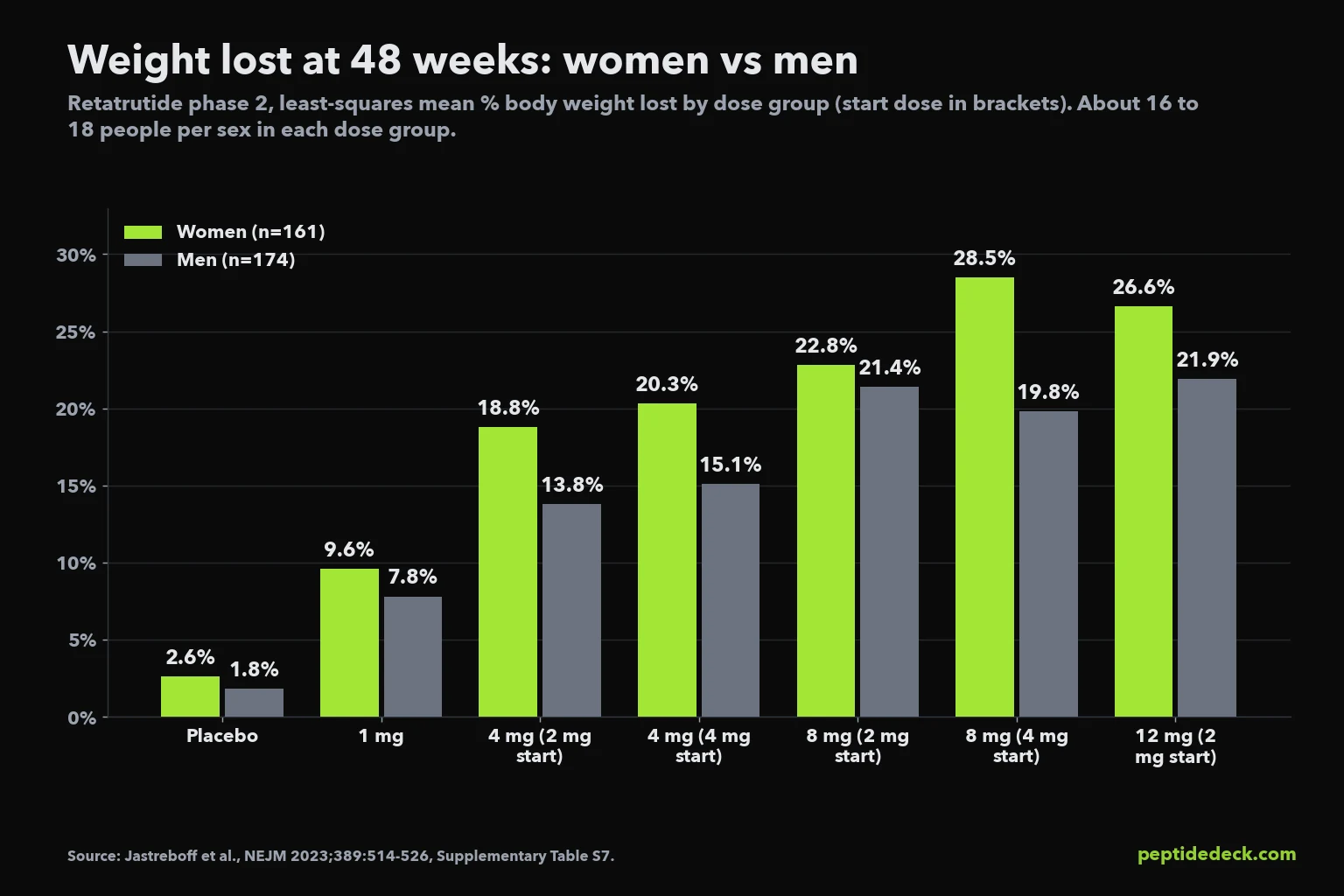
The authors called out the two top dose groups in the paper: women lost 28.5% and 26.6% on 8 mg and 12 mg, against 19.8% and 21.9% for men. They also wrote that they don't know why. Body composition, where fat is stored and hormones are all on the table.
One explanation sits in the baseline data. Women in the trial started at an average of 99.5 kg (219 lb), men at 115.4 kg (254 lb). Everyone got the same fixed dose. On 12 mg, that works out to roughly 0.12 mg per kilogram for the average woman and 0.10 mg for the average man, about 16% more drug for every kilogram of body. That alone doesn't prove anything, but it fits both halves of the story: bigger results and, as you'll see below, a likely higher chance of stomach side effects.
Read this before you get excited: each sex in each dose group was only 16 to 18 people, and subgroup results are less certain than the headline numbers. The direction is consistent, though. At the American Diabetes Association meeting in June 2026, the much larger TRIUMPH-1 phase 3 trial was reported to show the same pattern, with women losing up to 30.8% at 80 weeks against 23.2% for men, according to a Doximity summary of the presentation. We haven't seen that split in a peer-reviewed paper yet.
For the overall phase 3 numbers, our TRIUMPH-1 results breakdown covers the full 80-week data.
Retatrutide Benefits for Women Beyond the Scale
The number on the scale isn't the whole point.
In the phase 2 trial, weight loss came with smaller waists, lower blood pressure, better fasting glucose and insulin levels, and improved blood lipids, except HDL cholesterol. In a Lilly-run body composition substudy of the phase 2 diabetes trial, 56% of whose 189 participants were women, total fat mass fell 26.1% on 8 mg and 23.2% on 12 mg by week 36, against 4.5% on placebo. The authors reported that the share of weight lost as lean mass was similar to other obesity drugs.
For women, three stand out: cycles that can return with PCOS, fat loss aimed at the middle after menopause, and knee pain relief, which the TRIUMPH-4 trial in knee osteoarthritis reported alongside weight loss. Our retatrutide before and after page shows what those changes tend to look like over time.
Retatrutide Side Effects in Women
Here the honest answer starts with a gap.
The published retatrutide trials don't break side effects down by sex. What they do show is that the stomach is where trouble lives. In phase 2, nausea hit 45% of people on 12 mg against 11% on placebo, mostly mild to moderate and mostly while the dose was going up. The single most useful finding for anyone starting: in the 8 mg group, people who started at 4 mg had nausea 60% of the time, while those who started at 2 mg had it 17% of the time. Same final dose, very different first months.
Does sex change those odds? For the closest drugs, yes. A post hoc analysis of the SUSTAIN 7 trial, which compared semaglutide with dulaglutide in 1,199 people with type 2 diabetes, found gastrointestinal side effects were reported by more women than men on both drugs. Combine that with the higher drug exposure per kilogram above, and it's reasonable to expect reta to be a little rougher on women's stomachs, especially early.
Hair shedding
This one clearly hits women harder.
The current Zepbound label reports hair loss in 7.1% of women on tirzepatide against 0.5% of men. The Wegovy label shows the same split for semaglutide: 4% of women against 0.9% of men at 2.4 mg, and 8.4% of women against 0.2% of men at the newer 7.2 mg dose. Both labels tie it to weight reduction. It is usually the temporary shedding that follows any fast weight loss, not damage to the follicle. Our guide to retatrutide hair loss covers why it happens, how long it lasts and what helps.
Urinary tract infections
A newer signal, and one that matters more for women.
In TRIUMPH-1, presented at the American Diabetes Association meeting in June 2026, urinary tract infections occurred in 7.5%, 8.8% and 8.4% of people on 4, 9 and 12 mg, against 5.3% on placebo, as reported by HCPLive. Most were mild to moderate and cleared during treatment. Staying well hydrated matters doubly here, since vomiting and diarrhea can leave you dry.
Skin sensitivity
Phase 3 also turned up dysesthesia, an odd tingling or sensitive-skin feeling: 5.1%, 12.3% and 12.5% on 4, 9 and 12 mg in TRIUMPH-1 against 0.9% on placebo. No sex split has been published. For the full list with frequencies, see our retatrutide side effects guide.
Retatrutide and Birth Control: The Interaction Most Women Miss
The pill may not work as well.
Retatrutide has no label yet, so there's no official instruction. The nearest one comes from tirzepatide, which shares two of retatrutide's three receptors and also slows how fast your stomach empties. In a study on the Zepbound label, a single 5 mg dose cut peak blood levels of the hormones in a combined birth control pill by 55% to 66%, and total exposure by about 20% to 23%. The label explains it: the delay in stomach emptying is largest after the first dose and fades over time.
So the tirzepatide label tells women on the pill to switch to a non-oral method, or add a barrier method like condoms, for 4 weeks after starting and for 4 weeks after each dose increase. Retatrutide acts on the same GLP-1 receptor that drives this stomach-slowing effect, so the cautious move is to apply the same rule to every reta step-up.
What isn't affected: hormonal methods that skip the gut. The label says non-oral contraceptives should not be affected, which covers IUDs, the implant, the patch, the ring and the shot. Lilly's phase 2 trial allowed women to stay on an estrogen-progestin pill or patch if they'd been stable on it for 3 months, and allowed IUDs in place for at least 3 months.
Pregnancy, Fertility and "Ozempic Babies"
Surprise pregnancies on these drugs have a nickname for a reason.
Part of it is the pill problem above. The other part is biology. Excess weight and insulin resistance can stop ovulation, and losing weight can restart it, sometimes within months. In a 2026 study of 96 women with PCOS and a BMI over 25, six months of semaglutide cut weight by 11.3% on average, and 52.5% of the women who weren't ovulating at the start began having ovulatory cycles. A 2026 meta-analysis of seven liraglutide trials found the same direction: more regular periods. If you've been told you'd struggle to conceive, don't treat that as birth control on retatrutide.
How long to stop before trying to conceive
There's no retatrutide label, but there are two useful markers.
First, Lilly's own phase 2 protocol required women who could become pregnant to keep using contraception for 2 months after their last injection, calculated as five half-lives of the drug plus 30 days. Second, the Wegovy label tells women to stop semaglutide at least 2 months before a planned pregnancy because of its long half-life. Retatrutide's half-life is about 6 days, similar to semaglutide's. Two months off before trying is the sensible floor. Plan for some weight regain in that window; our guide to stopping retatrutide covers how to soften it.
If you get pregnant while using it, stop and tell your doctor. The tirzepatide label puts it plainly: weight loss offers no benefit during pregnancy and may harm the baby.
Breastfeeding
Breastfeeding women were excluded from the phase 2 trial, so there's no retatrutide data. For tirzepatide, a single-dose study in 11 nursing women found the drug undetectable in 164 of 171 milk samples, but the effects on a breastfed baby are unknown. With an unapproved drug, waiting until you've finished breastfeeding is the safer call.
Retatrutide and PCOS
No trial has tested retatrutide in PCOS yet.
That's worth knowing, because a lot of marketing implies otherwise. In fact, the phase 2 trial specifically excluded women taking metformin, whether for PCOS or diabetes prevention. What we have is indirect: insulin resistance drives much of PCOS, retatrutide lowered fasting insulin and weight sharply in phase 2, and the GLP-1 class has early evidence for restoring cycles. In a 2026 network meta-analysis of 29 PCOS trials, GLP-1 drugs combined with metformin lowered testosterone the most of any option studied, at the cost of more stomach side effects.
If you have PCOS and you're on metformin, don't stop it to try retatrutide, and tell your doctor about both. Both lower blood sugar and both upset the stomach. Our guide to the best peptides for women covers other options people with PCOS ask about.
Perimenopause, Menopause and HRT
Menopause moves weight to your middle.
If you've noticed your waist growing even though your diet hasn't changed, that's the shift. The good news: hormone therapy and retatrutide aren't in conflict. Lilly's phase 2 trial allowed postmenopausal women to stay on hormone replacement therapy if they had been on a stable dose for 3 months.
Some data even hints they work well together. In a Mayo Clinic study of 106 postmenopausal women on semaglutide, those also using hormone therapy lost 16% of their body weight at 12 months, against 12% for those who weren't. It was small and observational. A 2026 position statement from the Spanish Menopause Society called the link hypothesis-generating and said it shouldn't be a reason to start hormone therapy just to lose more weight. If you already use HRT, there's no reason to stop. For symptom options, see our guide to peptides for menopause.
Bone and muscle
This is where women after 50 need to pay attention.
Fast weight loss takes some muscle and bone with it. In the large SELECT heart trial, the Wegovy label reports more hip and pelvis fractures in women on semaglutide than on placebo, 1% against 0.2%. Retatrutide hasn't reported fracture data by sex yet. The same Spanish Menopause Society statement recommends resistance exercise, enough protein and monitoring of muscle function for any woman in menopause on these drugs.
In practice: lift weights two or three times a week, aim for protein at every meal even when you're not hungry, and if you're past menopause or have had a fracture, ask your doctor whether a bone density scan makes sense before you start. If the scale is dropping faster than 1% to 2% a week, our page on losing too much weight on retatrutide explains when to hold or lower the dose.
Women vs Men on Retatrutide: The Whole Picture
Here is everything above in one place.
Retatrutide Dosage for Women
There is no female dose.
No retatrutide trial has used different doses for women and men. Everyone followed the same weekly schedule: start at 2 mg, then step up to 4 mg, 8 mg and 12 mg, moving up no faster than every 4 weeks. Our retatrutide dosing schedule lays out each week, and the dosage calculator converts milligrams to syringe units.
What the data does suggest is pacing. Women in phase 2 lost 18.8% to 20.3% on 4 mg, close to what men got on 8 to 12 mg. If you're lighter, sensitive to nausea, or already losing steadily, there's no prize for climbing to 12 mg. Many women hold at 4 or 8 mg. Always start at 2 mg; the 60% versus 17% nausea gap above is the reason.
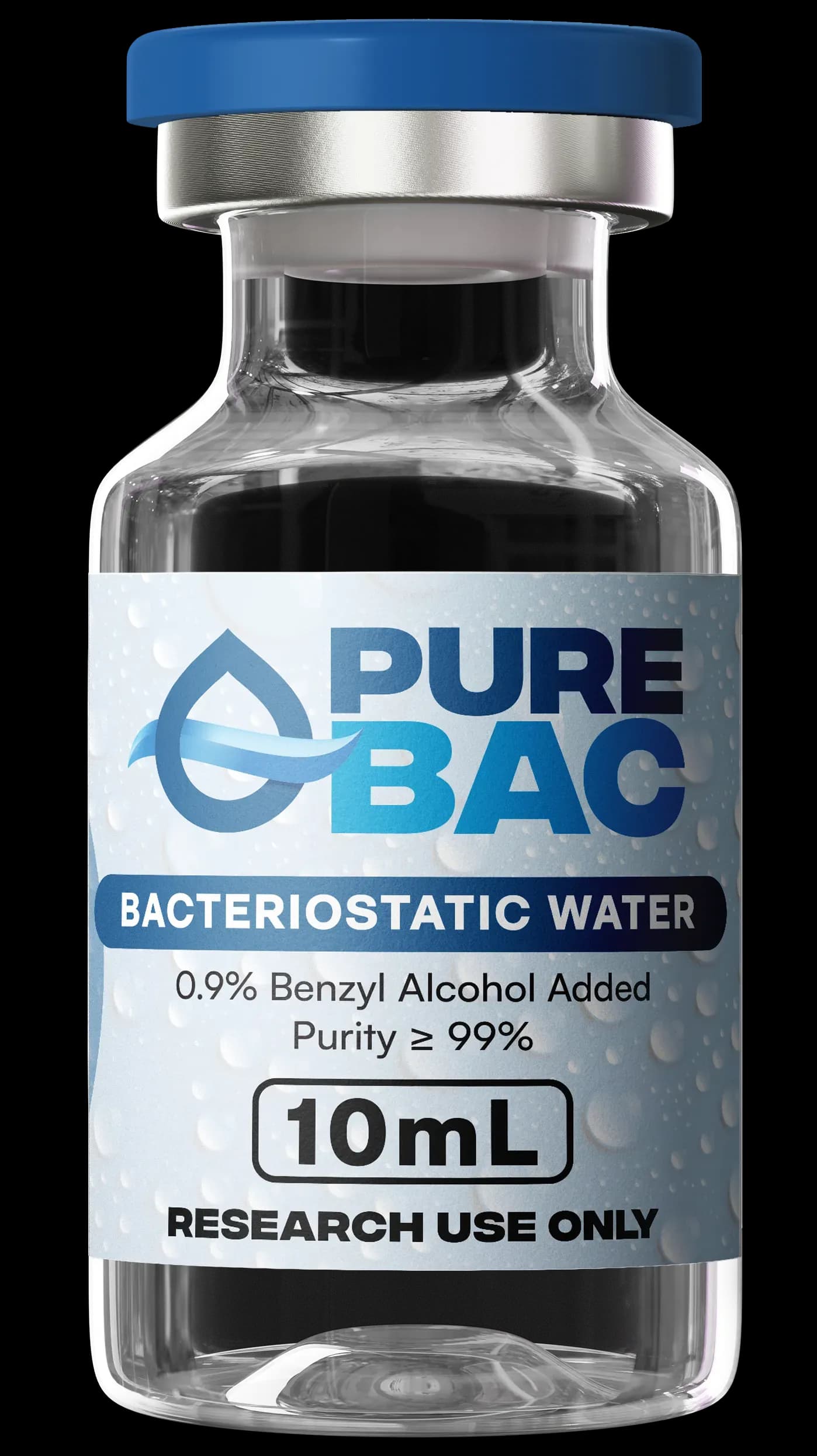
The mixing math is the same for everyone. A 10 mg vial with 2 mL of bacteriostatic water gives 5 mg per mL, so 2 mg is 40 units on a U-100 insulin syringe. A 30 mg vial with 3 mL gives 10 mg per mL, so 2 mg is 20 units. Keep it in the fridge at 2 to 8 °C and use it within 28 days.
Where Women Get Retatrutide and What It Costs
Access is the same for everyone right now.
Retatrutide has no FDA approval. Lilly plans to file for approval in the first quarter of 2027, so there's no prescription route, telehealth programs can't offer it, and it can't legally be compounded. A small expanded-access program runs through doctors for people with severe obesity and serious complications, and clinical trials are the other formal route. Our guide on how to get retatrutide walks through both.
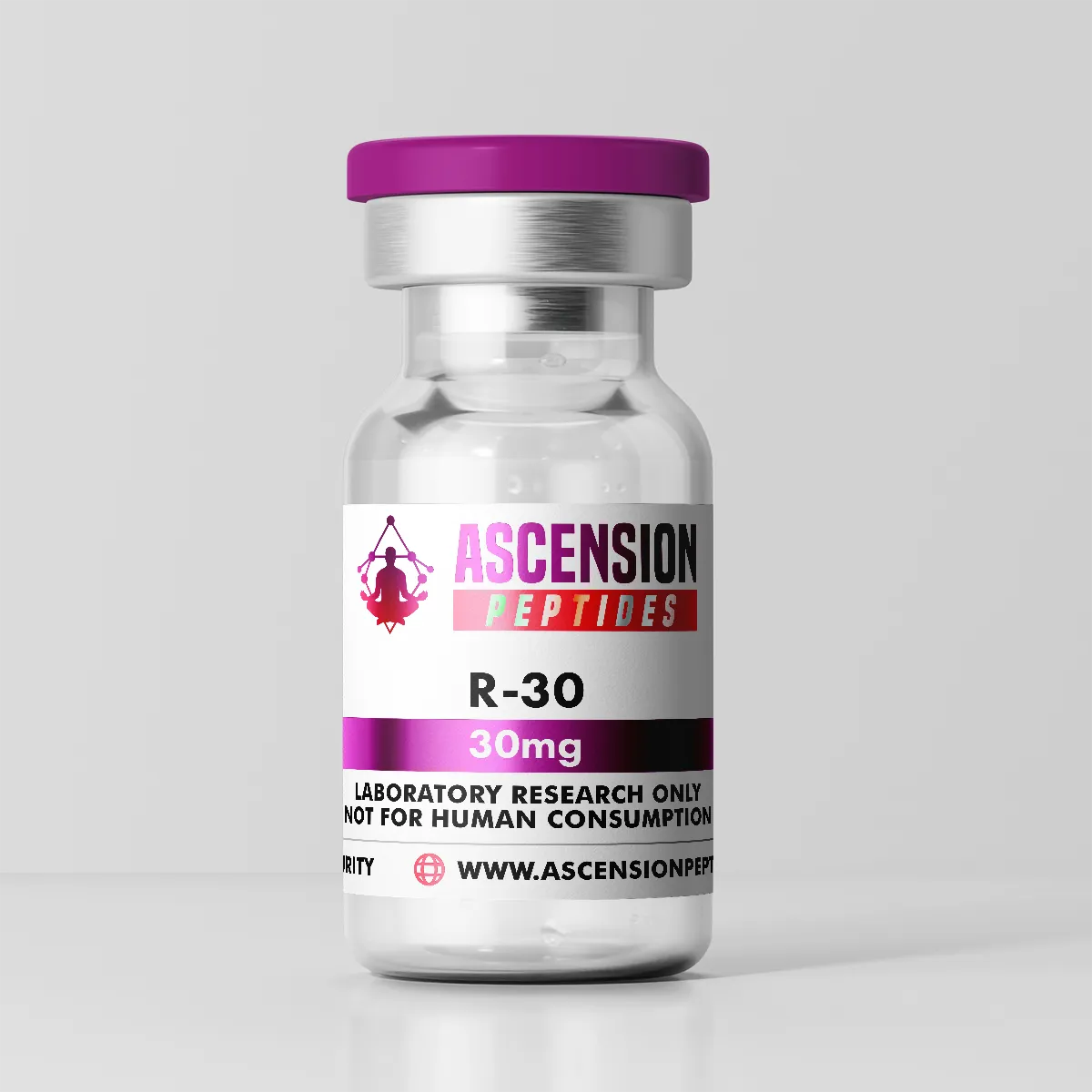
Outside those routes, people buy freeze-dried vials from online peptide vendors, where quality varies widely and checking it is on you. If you're comparing sellers, our retatrutide where to buy guide shows what a batch-matched lab report should include: purity by HPLC, the measured milligrams in the vial and an identity test. On price, our partner Ascension lists its R-30 (30 mg) vial at $250, or $125 with code PEPTIDEDECK, and the R-10 (10 mg) at $100, or $50 with the code. At 4 mg a week, a 30 mg vial lasts about 7.5 weeks. You can see current stock and lab reports if you want to buy retatrutide online (PeptideDeck earns a commission on partner links, at no cost to you).
Who Should Not Use Retatrutide
Some women should skip it entirely.
- Pregnant, trying to conceive in the next 2 months, or breastfeeding. No safety data, and weight loss offers no benefit in pregnancy.
- A personal or family history of medullary thyroid cancer or MEN2. Approved drugs in this class carry a boxed warning based on thyroid tumors seen in non-human studies; it hasn't been shown in humans.
- Past pancreatitis or gallbladder disease. Both are listed warnings for the class.
- A current or past eating disorder. A drug that removes appetite can make restriction easier to hide and harder to stop.
- Insulin or sulfonylurea use without a doctor adjusting the dose, because of the low blood sugar risk.
If you're unsure about any of these, our guide to whether retatrutide is safe goes through the full risk picture.
Frequently Asked Questions
Sources
- Jastreboff AM, et al. Triple-Hormone-Receptor Agonist Retatrutide for Obesity: A Phase 2 Trial. N Engl J Med 2023;389:514-526, including Supplementary Appendix (Tables S3 and S7; protocol inclusion and exclusion criteria). PMID 37366315. nejm.org
- Coskun T, et al. Effects of retatrutide on body composition in people with type 2 diabetes: a substudy of a phase 2 trial. Lancet Diabetes Endocrinol 2025;13(8):674-684. PMID 40609566. PubMed
- HCPLive. TRIUMPH-1: Retatrutide substantially lowers weight, BMI in patients with obesity or overweight (ADA Scientific Sessions, June 2026). hcplive.com
- Doximity Op-Med. Retatrutide reduces body weight by nearly 30% in phase 3 TRIUMPH-1 trial (June 16, 2026). doximity.com
- ZEPBOUND (tirzepatide) US Prescribing Information, Eli Lilly, revised 8/2026: sections 6.1, 7.2, 8.1-8.3, 12.3. uspl.lilly.com
- WEGOVY (semaglutide) US Prescribing Information, Novo Nordisk, revised 06/2026: sections 6.1, 8.3. novo-pi.com
- Pratley RE, et al. Impact of patient characteristics on efficacy and safety of once-weekly semaglutide versus dulaglutide: SUSTAIN 7 post hoc analyses. BMJ Open 2020;10:e037883. PMID 33199417. PubMed
- Carmina E, Longo RA. Evidence that semaglutide represents an important tool for treatment of irregular menses and chronic anovulation. J Clin Med 2026;15(13):5165. PMID 42452625. PubMed
- Lu YT, et al. Efficacy of liraglutide on metabolic and reproductive outcomes in women with polycystic ovary syndrome: a systematic review and meta-analysis. Diabetes Obes Metab 2026;28(4):2523-2535. PMID 41508932. PubMed
- Lin J, et al. The efficacy and safety of novel antidiabetic agents in polycystic ovary syndrome: a network meta-analysis. J Ovarian Res 2026;19:167. PMID 41862977. PubMed
- Hurtado MD, et al. Weight loss response to semaglutide in postmenopausal women with and without hormone therapy use. Menopause 2024;31(4):266-274. PMID 38446869. PubMed
- Sánchez-Prieto M, et al. Incretin-based therapies in peri- and postmenopausal women with obesity: an expert position statement from the Spanish Menopause Society. Maturitas 2026;213:109101. PMID 42664617. PubMed
- BioSpace. Lilly preps FDA run for triple G weight loss drug with phase 3 data (July 2026). biospace.com
Medical Disclaimer: This content is for informational purposes only and does not constitute medical advice. Retatrutide has no FDA approval. Always consult a qualified healthcare provider before starting any new medication or treatment, especially if you are pregnant, planning a pregnancy, breastfeeding or using hormonal contraception. PeptideDeck may earn a commission from affiliate links at no additional cost to you.