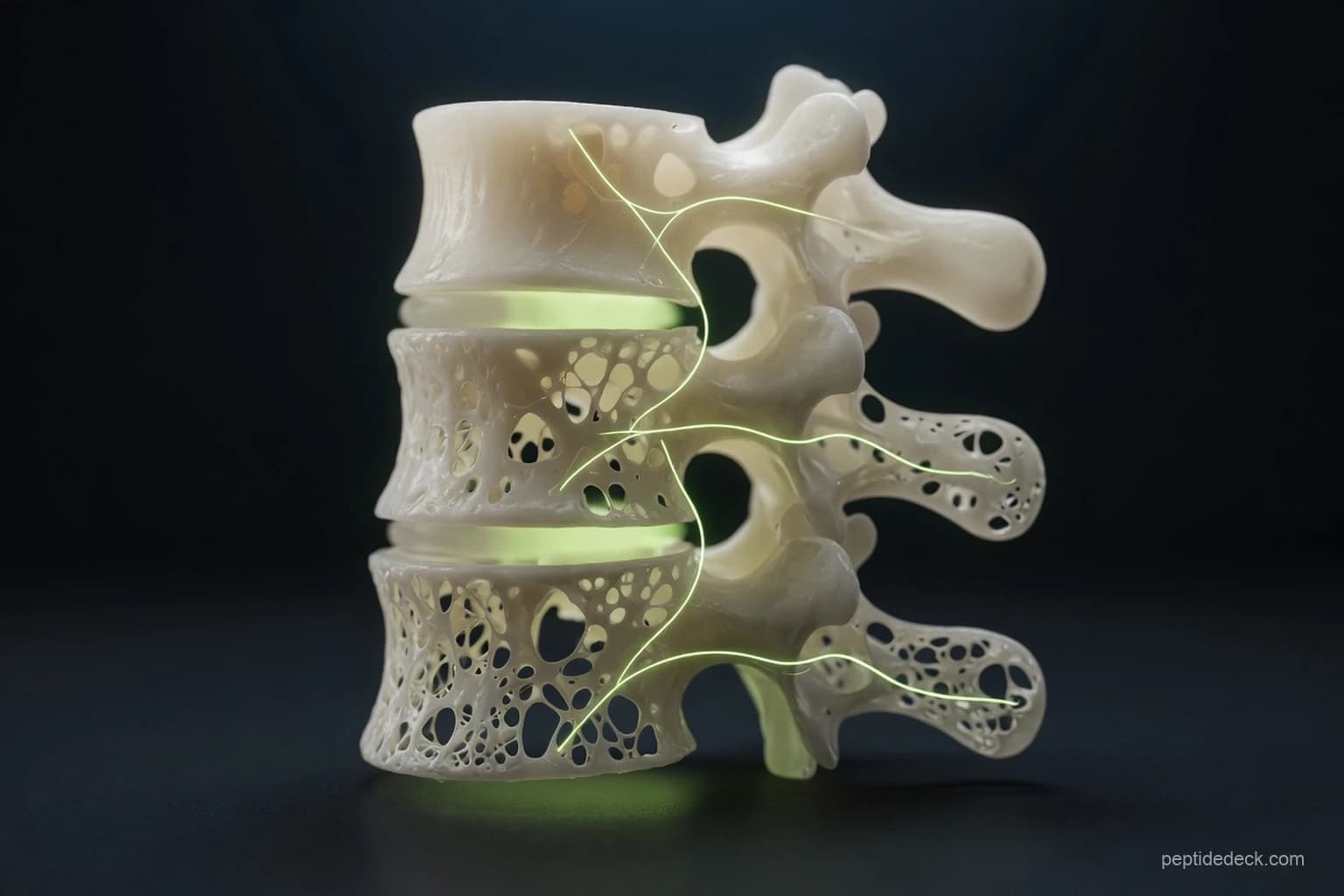
Three peptide drugs are approved for osteoporosis. Two of them, teriparatide and abaloparatide, cut new spine fractures by 65% and 86% in trials of 1,637 and 2,463 women (PMID 11346808, PMID 27533157). The third, calcitonin, carries a label line saying fracture reduction "has not been demonstrated". Every other peptide sold for bone, from collagen powder to BPC-157 vials, sits somewhere below that, and this page shows exactly where.
🔑 Key Takeaways
- Which of the three approved peptide drugs most doctors reach for first, and why the other one costs more per day.
- The single over-the-counter peptide with a placebo-controlled bone trial, and how small its effect actually is.
- The growth-hormone peptide trial where the bone gains had vanished by year five.
- A class of peptides many readers are already injecting that may push bone the wrong way.
- What we found when we searched nine vendors for the one peptide that is proven to rebuild bone.
If a DEXA scan has just put a number on something you suspected, you already know how the conversation goes: bisphosphonates, maybe an injection, calcium, vitamin D, walk more. Then you search "peptides for osteoporosis" and find pages ranking BPC-157 next to Forteo as if they belonged in the same list. They do not. The honest version of that list is below, graded by the only thing that matters for a disease defined by fractures: whether a peptide has been shown to stop them in people.
What "peptides for osteoporosis" actually means
Osteoporosis is bone that has lost density and structure until it breaks under loads it used to carry. About one in eight US adults over 50 has it by the formal definition, one in five women (CDC/NHANES), and the Bone Health and Osteoporosis Foundation counts roughly two million fractures a year (BHOF). A hip fracture after 65 carries about a 20% chance of dying within the year (PMID 12366617). That is the problem any "bone peptide" has to be measured against.
Three approved osteoporosis drugs are peptides. Teriparatide (Forteo and generics) is the first 34 amino acids of human parathyroid hormone. Abaloparatide (Tymlos) is a 34-amino-acid analogue of the related hormone PTHrP. Calcitonin salmon is a 32-amino-acid hormone given as a nasal spray or injection. Two drugs people often file alongside them are not peptides at all: romosozumab (Evenity) and denosumab (Prolia) are monoclonal antibodies, and bisphosphonates are small molecules.
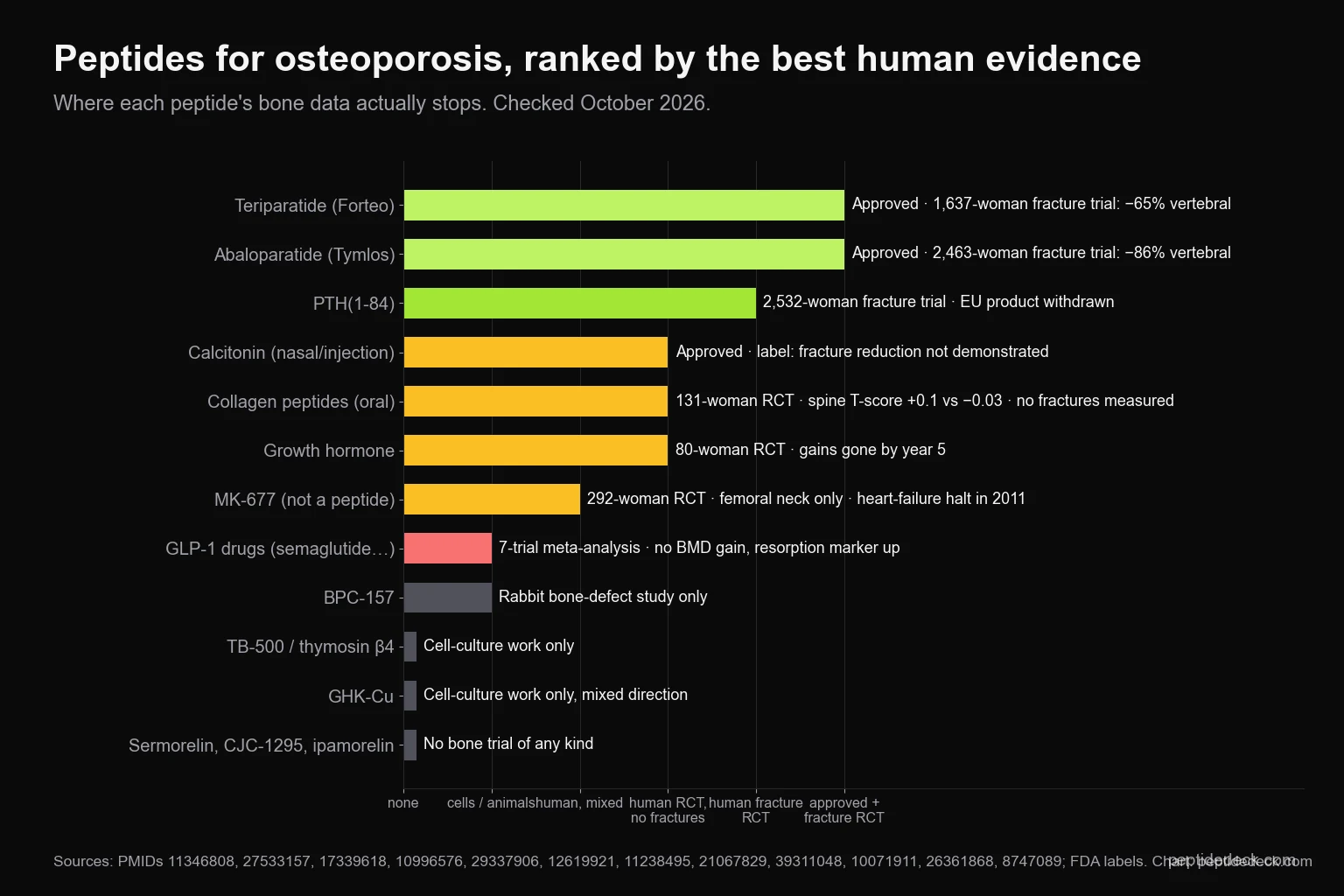
Then there is everything sold as a "peptide for bone" on supplement and vendor sites: collagen peptides, growth-hormone secretagogues (sermorelin, CJC-1295, ipamorelin, MK-677), BPC-157, TB-500 and GHK-Cu. None of them is approved for bone, and only one has a controlled human trial. The table grades them all.
The evidence table: every peptide graded
Grades run from "approved with a fracture trial" down to "cell-culture only". A fracture trial counts for more than a bone-density trial because density can rise while fracture risk does not fall, which is exactly what happened with growth hormone.
Teriparatide and abaloparatide: the injections that rebuild bone
Most osteoporosis drugs slow bone loss. These two build bone, which is why guidelines reserve them for people at high risk: a prior fracture, a very low T-score, or failure on other therapy. Both are a once-daily injection under the skin, both come in a pre-filled pen, and both are time-limited courses followed by an anti-resorptive drug to lock in the gain.
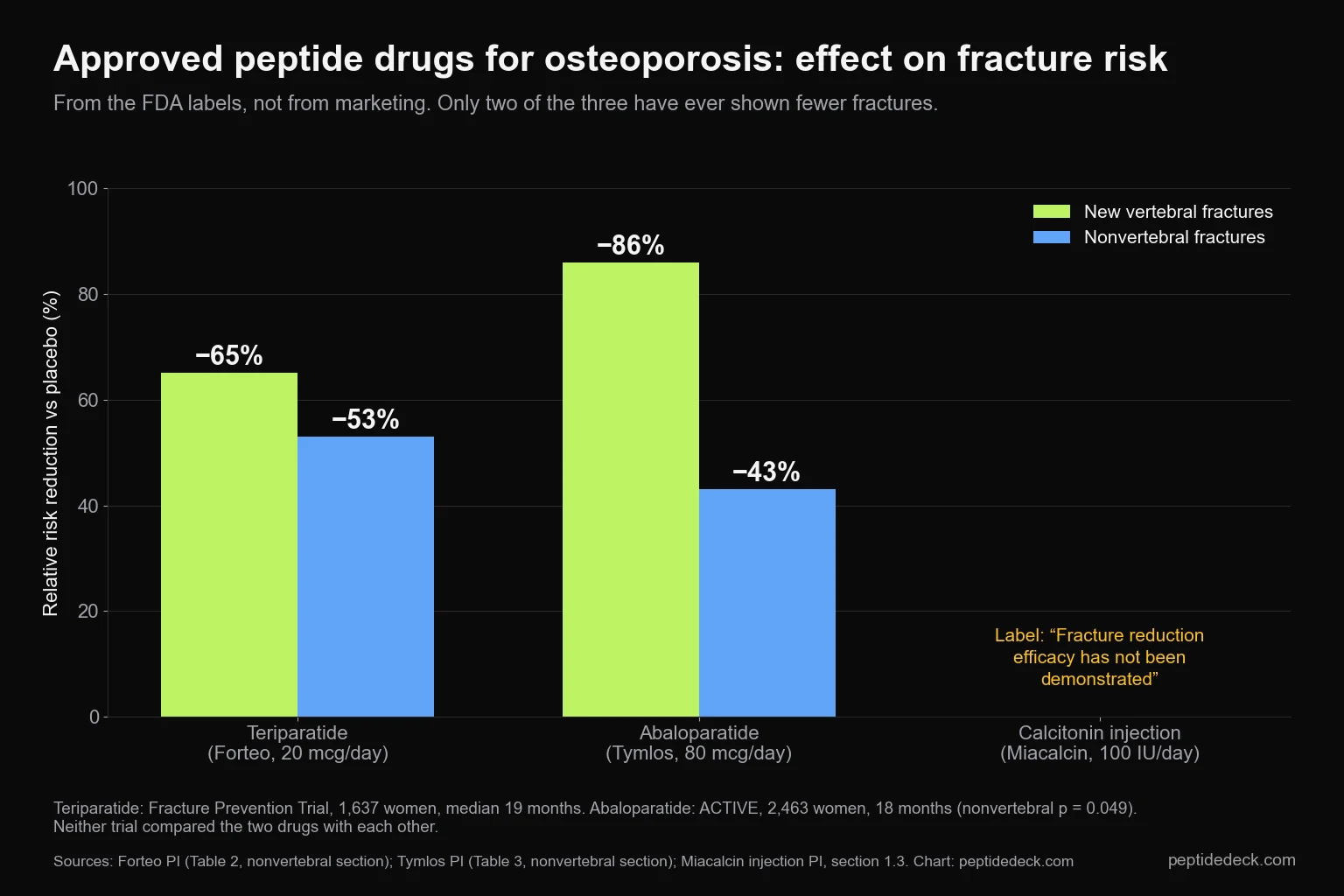
Teriparatide, 20 mcg a day, is the older of the two. In the Fracture Prevention Trial, 1,637 postmenopausal women with prior vertebral fractures were followed for a median of 21 months: new vertebral fractures fell from 14% to 5% and nonvertebral fragility fractures from 6% to 3% (PMID 11346808). Spine density rose 9.7% from baseline against 1.1% on placebo (Forteo PI). For 18 years the label carried a boxed warning about osteosarcoma, a bone cancer seen in laboratory animals given high doses for most of their lives. On November 16, 2020 the FDA removed the box after a 15-year surveillance study found three cases where 4.17 were expected (FDA approval letter S-054; PMID 32990990). The hard two-year lifetime cap went at the same time; the current label says longer use "should only be considered if a patient remains at or has returned to having a high risk for fracture".
Abaloparatide, 80 mcg a day, was approved in 2017. In ACTIVE, 2,463 women were randomised to abaloparatide, placebo or open-label teriparatide for 18 months: new vertebral fractures were 0.6% on abaloparatide against 4.2% on placebo, an 86% relative reduction, and nonvertebral fractures fell 43% (PMID 27533157; Tymlos PI). Hypercalcaemia was less common than on teriparatide (3.4% vs 6.4%). The trial was not powered to compare the two drugs on fractures, so "abaloparatide beats teriparatide" is a reading of a secondary comparison, not a result. Men got the indication in December 2022 on a density-only trial (PMID 36190391). Its boxed warning was dropped in December 2021, but unlike Forteo the Tymlos label still says use beyond two years in a lifetime is not recommended.
What they cost is the usual objection. Here is a day of each at the lowest coupon price and at retail from GoodRx's newest archived price pages, with the pack price divided by the doses in it.
Per-day figures are the pack price divided by the doses in the pack, worked out by PeptideDeck. GoodRx blocks visitors from outside the US, so these are the newest Internet Archive captures of its price pages (dates in the Source column), read on October 10, 2026; a live read of the same pages early on October 10, 2026, just before GoodRx closed them to non-US visitors, showed Forteo $1,035.57, teriparatide $1,146.04 and Tymlos $3,076.86, within $50 of the captures, so the per-day figures hold. Lilly's own Colorado price disclosure lists Forteo's wholesale acquisition cost at $4,289.89 a pen, $153.21 a day. Lilly's own Forteo list-price page was behind a bot check when we tried it. Calcitonin is included only because it is the third approved peptide; its label says fracture reduction has not been demonstrated.
Our teriparatide guide and abaloparatide guide cover injection technique, side effects and what happens when the course ends.
Calcitonin: approved, and nearly retired
Calcitonin was the first peptide osteoporosis drug and it is now the last resort. The five-year PROOF trial of 1,255 women found 33% fewer new vertebral fractures at the 200 IU nasal dose, but no effect at 100 or 400 IU, which is not how a real drug effect usually behaves (PMID 10996576). In 2012 the European Medicines Agency withdrew nasal calcitonin for osteoporosis after long-term trials showed cancer 0.7 to 2.4 percentage points more often than placebo (EMA, July 2012), and in 2013 an FDA advisory committee voted 12 to 9 that the benefit did not justify the risk. The US labels today read "when alternative treatments are not suitable" and "fracture reduction efficacy has not been demonstrated", with the 21-trial malignancy figures printed in the warnings (Miacalcin PI). It is cheap, around a dollar a day, and that is the only argument left for it.
EB613: the PTH pill that is coming, not here
The anabolic injections work and most eligible patients never get them, largely because of the daily needle. Entera Bio's EB613 is teriparatide in a once-daily tablet. In its six-month Phase 2 trial of 161 women, the 2.5 mg dose raised spine density 2.7%, total hip 1.8% and femoral neck 2.8% over placebo, with nausea and dizziness common enough that the dose has to be stepped up (PMID 38578978). The FDA accepted a 750-woman Phase 3 design in June 2026, the company raised $275 million in July to run it, and topline results are guided for the second half of 2028. It cannot be bought from anyone. Our EB613 guide tracks every milestone with dates from the SEC filings.
Collagen peptides: the only supplement with a controlled bone trial
This is the one non-prescription peptide where "studied in people" is true. In a 12-month trial, 131 postmenopausal women with low bone density took 5 g a day of specific collagen peptides or placebo. The spine T-score rose 0.10 on collagen and fell 0.03 on placebo (p = 0.030); the femoral neck rose 0.09 against a 0.01 fall (p = 0.003), and the bone-formation marker P1NP went up (PMID 29337906).
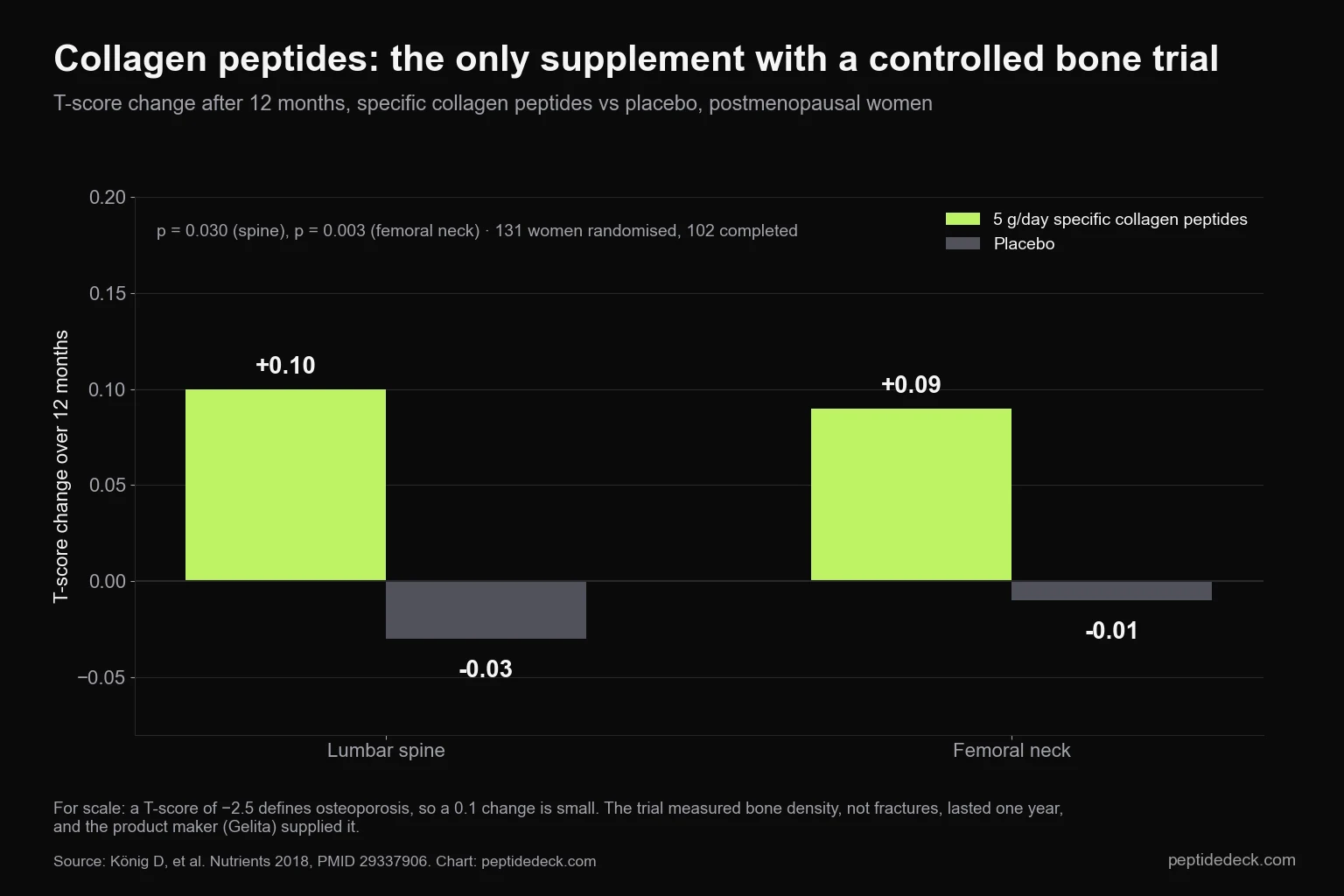
Now the scale. Osteoporosis is defined at a T-score of −2.5, so a 0.1 shift is real but small, and the trial measured density, not fractures. It was a single study of one branded product (Fortibone, made by Gelita), and the four-year follow-up that gets quoted as confirmation was open-label with 31 women left at the end (PMID 34520654). The fair summary: collagen peptides are the only supplement peptide with placebo-controlled bone data, the effect is modest, and nobody has shown they prevent a fracture. Our collagen peptides guide covers doses and types.
Growth-hormone peptides: a bone signal that never became fewer fractures
Sermorelin, CJC-1295 and ipamorelin make the pituitary release growth hormone, and growth hormone does act on bone. So the fair test is what growth hormone itself did in osteoporosis. In an 80-woman trial, 18 months of blinded GH on top of HRT raised spine bone mineral content 14% by year four, and by year five the difference from placebo was gone, with three fractures in the low-dose arm (PMID 12619921). In adults who are actually GH-deficient, replacement adds about 0.04 g/cm² at the spine over a year, significant in men only (PMID 24423364).
MK-677, an oral ghrelin mimetic sold on the same shelves (it is not a peptide), has the most direct data. In 292 postmenopausal women over 18 months, MK-677 plus alendronate raised femoral neck density 4.2% against 2.5% on alendronate alone, with no benefit at the spine, total hip or whole body, and MK-677 alone raised the resorption marker NTx by 41% (PMID 11238495). A two-year trial in 65 older adults found a kilo of lean mass, higher fasting glucose and "changes consistent with increased bone remodelling", not more bone (PMID 18981485). A trial in 123 hip-fracture patients was stopped early for a heart-failure safety signal (PMID 21067829). For sermorelin, CJC-1295 and ipamorelin themselves there is no bone trial at all. Anyone running a secretagogue for sleep or recovery should know it is not doing anything measurable for their fracture risk; our MK-677 results guide has the rest.
BPC-157, TB-500 and GHK-Cu: no human bone data
These three are the peptides most often sold with bone in the description. BPC-157 has one bone study, in rabbits with a 0.8 cm forearm defect, where it healed the gap about as well as a bone graft did (PMID 10071911). That is fracture repair in an animal, not osteoporosis in a person, and a 2026 review confirms no Phase 2 trial of BPC-157 for anything has been completed (PMID 42198317). Thymosin beta-4 (TB-500) has pushed periodontal ligament cells toward bone-forming behaviour in a dish (PMID 26361868); we found no bone study in a living animal. GHK-Cu increased osteoblast attachment in culture but slightly inhibited alkaline phosphatase and osteocalcin, the markers of mineralisation, so even the dish result points both ways (PMID 8747089). Our peptides for arthritis page grades the same three for joints, where the story is similar.
The peptides that may push bone the wrong way
If you are losing weight on semaglutide or tirzepatide, this section is for you. A 2024 meta-analysis of seven randomised trials found GLP-1 drugs produced no change in bone density at the spine, hip or femoral neck, while the resorption marker CTX rose significantly (PMID 39311048). Rapid weight loss itself costs bone, and the drugs do not appear to protect against it. That is not a reason to stop a GLP-1; it is a reason to ask for a DEXA scan if you are postmenopausal and have lost a lot of weight, and to keep resistance training and protein in the plan.

What you can actually get
The peptides that stop fractures are prescription drugs. A doctor, a DEXA scan and, usually, a prior fracture or a failed first-line drug are the route to teriparatide or abaloparatide, and insurance decides the price far more than the sticker does. There is no legitimate way to buy either outside a pharmacy.
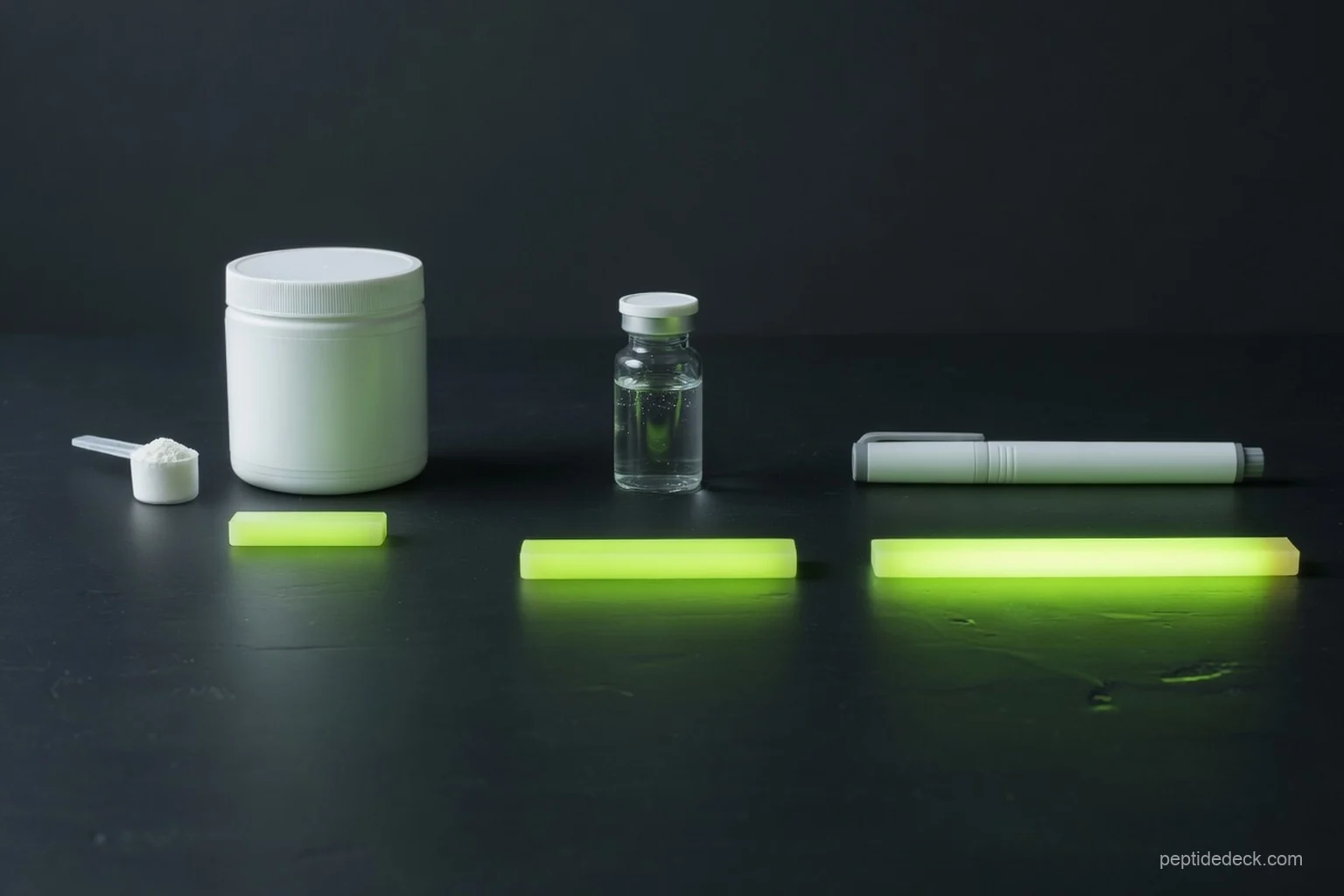
We checked the gray market anyway. On October 9 and 10, 2026 we searched nine peptide vendors, including the ones we work with, for teriparatide, PTH(1-34) and EB613: none of them lists any. The EB613 page shows the screenshots. A few chemical-reagent sites do sell PTH(1-34) powder by the milligram; it is the injectable molecule with no certificate of analysis, no sterility assurance and none of the surveillance that let the FDA drop the osteosarcoma warning. If you are browsing peptides for sale for bone density, the honest answer is that the only one on those shelves with human data is collagen, and it is sold in the supplement aisle.
What to ask your doctor
- What is my fracture risk (FRAX score), and does it put me in the group where an anabolic drug comes first?
- If I start teriparatide or abaloparatide, what do I take afterwards to keep the bone I gain?
- I am on a GLP-1 for weight loss: should I have a DEXA scan, and what should I change?
- Is there a reason I should not take a PTH drug (Paget's disease, raised alkaline phosphatase, past skeletal radiation, bone metastases)?
- Do not stop or change any prescribed osteoporosis drug because of something you read online, including this page.
Safety: what can go wrong with bone peptides
The PTH drugs raise blood calcium for a few hours after each dose; the Tymlos trial recorded hypercalcaemia in 3% of women, and both labels warn of dizziness on standing after the first injections. Both still exclude people at higher baseline risk of osteosarcoma. Calcitonin carries the malignancy signal above. Collagen peptides are food-grade and the main risk is paying for a product that is not the one studied. For vendor-sold peptides the hazards are the usual ones: unverified identity and purity, non-sterile injections, and, for a bone reader specifically, the false reassurance that something is being done about fracture risk when nothing measurable is.
Frequently Asked Questions
Sources
- Neer RM, et al. Effect of parathyroid hormone (1-34) on fractures and bone mineral density in postmenopausal women with osteoporosis. N Engl J Med. 2001;344:1434-1441. PMID 11346808
- Miller PD, et al. Effect of abaloparatide vs placebo on new vertebral fractures in postmenopausal women with osteoporosis: the ACTIVE randomized clinical trial. JAMA. 2016;316:722-733. PMID 27533157
- Czerwinski E, et al. The efficacy and safety of abaloparatide-SC in men with osteoporosis: a randomized clinical trial. J Bone Miner Res. 2022;37:2435-2442. PMID 36190391
- Greenspan SL, et al. Effect of recombinant human parathyroid hormone (1-84) on vertebral fracture and bone mineral density in postmenopausal women with osteoporosis. Ann Intern Med. 2007;146:326-339. PMID 17339618
- Chesnut CH, et al. A randomized trial of nasal spray salmon calcitonin in postmenopausal women with established osteoporosis (PROOF). Am J Med. 2000;109:267-276. PMID 10996576
- Tripto-Shkolnik L, et al. Oral daily PTH(1-34) tablets (EB613) in postmenopausal women with low BMD or osteoporosis: a randomized, placebo-controlled, 6-month, phase 2 study. J Bone Miner Res. 2024;39:672-682. PMID 38578978
- König D, et al. Specific collagen peptides improve bone mineral density and bone markers in postmenopausal women: a randomized controlled study. Nutrients. 2018;10:97. PMID 29337906
- Zdzieblik D, et al. Specific bioactive collagen peptides in osteopenia and osteoporosis: long-term observation in postmenopausal women. J Bone Metab. 2021;28:207-213. PMID 34520654
- Landin-Wilhelmsen K, et al. Growth hormone increases bone mineral content in postmenopausal osteoporosis: a randomized placebo-controlled trial. J Bone Miner Res. 2003;18:393-405. PMID 12619921
- Barake M, et al. Effects of recombinant human growth hormone therapy on bone mineral density in adults with growth hormone deficiency: a meta-analysis. J Clin Endocrinol Metab. 2014;99:852-860. PMID 24423364
- Murphy MG, et al. Effect of alendronate and MK-677, individually and in combination, on markers of bone turnover and bone mineral density in postmenopausal osteoporotic women. J Clin Endocrinol Metab. 2001;86:1116-1125. PMID 11238495
- Nass R, et al. Effects of an oral ghrelin mimetic on body composition and clinical outcomes in healthy older adults. Ann Intern Med. 2008;149:601-611. PMID 18981485
- Adunsky A, et al. MK-0677 (ibutamoren mesylate) for the treatment of patients recovering from hip fracture: a multicenter, randomized, placebo-controlled phase IIb study. Arch Gerontol Geriatr. 2011;53:183-189. PMID 21067829
- Kim JY, et al. Effects of glucagon-like peptide-1 receptor agonist on bone mineral density and bone turnover markers: a meta-analysis. Diabetes Metab Res Rev. 2024;40:e3843. PMID 39311048
- Sebečić B, et al. Osteogenic effect of a gastric pentadecapeptide, BPC-157, on the healing of segmental bone defect in rabbits. Bone. 1999;24:195-202. PMID 10071911
- Lee SI, et al. Expression of thymosin beta-4 in human periodontal ligament cells and mouse periodontal tissue and its role in osteoblastic/cementoblastic differentiation. Differentiation. 2015;90:16-26. PMID 26361868
- Godet D, Marie PJ. Effects of the tripeptide glycyl-L-histidyl-L-lysine copper complex on osteoblastic cell spreading, attachment and phenotype. Cell Mol Biol. 1995;41:1081-1091. PMID 8747089
- Gilsenan A, et al. Teriparatide did not increase adult osteosarcoma incidence in a 15-year US postmarketing surveillance study. J Bone Miner Res. 2021;36:244-251. PMID 32990990
- Leibson CL, et al. Mortality, disability, and nursing home use for persons with and without hip fracture: a population-based study. J Am Geriatr Soc. 2002;50:1644-1650. PMID 12366617
- FDA approval letter, NDA 021318/S-054 (Forteo), November 16, 2020: removal of the boxed warning and treatment-duration change. accessdata.fda.gov
- Forteo, Tymlos and Miacalcin prescribing information, current labels via DailyMed. Forteo · Tymlos · Miacalcin
- European Medicines Agency. EMA recommends limiting long-term use of calcitonin medicines. July 20, 2012. ema.europa.eu
- Sarafrazi N, et al. Osteoporosis or low bone mass in older adults: United States, 2017–2018. NCHS Data Brief 405. cdc.gov
- Bone Health and Osteoporosis Foundation. General facts. bonehealthandosteoporosis.org
- GoodRx price pages for Forteo, Bonsity, Tymlos and Miacalcin, Internet Archive captures of May 17, July 12, April 19 and May 10, 2026 (GoodRx is not reachable from outside the US). forteo · bonsity · tymlos · miacalcin
Medical Disclaimer: This article is for educational purposes only and is not medical advice. Osteoporosis needs a diagnosis, a fracture-risk assessment and a treatment plan from a qualified clinician. Peptides sold online are not approved to diagnose, treat or prevent any disease. Do not start, stop or change any prescribed medication because of this page, and seek care promptly after any fall or new back pain.