You cannot buy EB613 yet. Not from a pharmacy, not from a peptide vendor, not from anyone. EB613 is Entera Bio's once-daily tablet of PTH(1-34), the same bone-building molecule as the Forteo injection, and as of October 10, 2026 it has finished one 161-woman Phase 2 trial, cleared its Phase 3 design with the FDA, raised the money to run it, and not yet dosed a single Phase 3 patient (Entera 8-K, Aug 7 2026).
🔑 Key Takeaways
- Why a tablet needs 125 times the drug of the injection, and what that does to the price.
- The one way the oral version behaved differently from Forteo in the trial, and why Entera calls it a feature.
- What we found when we searched nine peptide vendors for "EB613" and "PTH 1-34" (with screenshots).
- The realistic earliest date you could be prescribed it, worked from the SEC filings rather than the press release.
- What to ask your doctor if you are on daily Forteo injections right now.
If you are injecting teriparatide every morning, you already know the two things nobody warns you about: the fridge logistics and the day you start skipping doses. A once-a-day pill that does the same job is the obvious fix. That is the whole bet behind EB613, and this page is about how far that bet has actually got.
What EB613 is, and what it is not
EB613 is teriparatide in a tablet. Teriparatide is the first 34 amino acids of human parathyroid hormone, PTH(1-34), and in a once-daily pulse it tells bone to build rather than resorb. Injected under the skin as Forteo, it has been prescribed for osteoporosis since 2002, and in its pivotal trial of 1,637 women it cut new vertebral fractures by 65% (Neer 2001, PMID 11346808). Our teriparatide guide covers the injection and our abaloparatide guide covers its newer cousin; this page covers the pill.
Entera Bio, a Tel Aviv company listed on Nasdaq, wraps the peptide in a carrier it calls N-Tab that protects it through the stomach and helps it cross the gut wall. Because the pathway relies on Forteo's 20-year safety record, Entera is filing under the FDA's 505(b)(2) route and asking for the same indications Forteo has (8-K, Mar 4 2026).
Three things EB613 is not:
- It is not approved anywhere, and no doctor can prescribe it.
- It is not a product any vendor sells. Anything labelled "oral PTH" or "EB613" on a peptide site is something else (see the vendor check below).
- It is not a new molecule. The efficacy case rests on Forteo's fracture data; the trial question is whether the tablet delivers enough of it.
The Phase 2 trial: what 161 women showed in six months
The published trial is small and short, so read the numbers with that in mind. From June 2019 to April 2021, 161 postmenopausal women with low bone density or osteoporosis were randomised to daily tablets of 0.5, 1.0, 1.5 or 2.5 mg of oral PTH(1-34), or placebo, for six months (NCT04003467). The results were published in the Journal of Bone and Mineral Research in 2024 (PMID 38578978). Entera funded and ran the study.
The two lowest doses did almost nothing. At 2.5 mg, bone density at six months beat placebo by 2.7% at the lumbar spine, 1.8% at the total hip and 2.8% at the femoral neck, all P ≤ .01. One detail worth knowing: Entera's 2022 press release quoted a 3.78% placebo-adjusted spine gain; the peer-reviewed paper reports 2.73% for the pooled 2.5 mg group, and that is the number to use.
The side effects were not trivial. Among women who started straight on 2.5 mg, 36.8% reported nausea, 26.3% dizziness and 15.8% headache, against 2.3%, 4.7% and 4.7% on placebo, and 7 of the 19 (36.8%) stopped the tablets because of side effects. In the arm that stepped up to 2.5 mg over two months, nausea fell to 29.4%, dizziness to 5.9% and side-effect discontinuations to 2 of 17 (11.8%), against 3 of 43 on placebo (PMID 38578978; counts from the published paper's safety section, PDF). There were no drug-related serious adverse events. Titration is therefore not a footnote; it is how the dose becomes usable, and it will be part of the Phase 3 protocol.
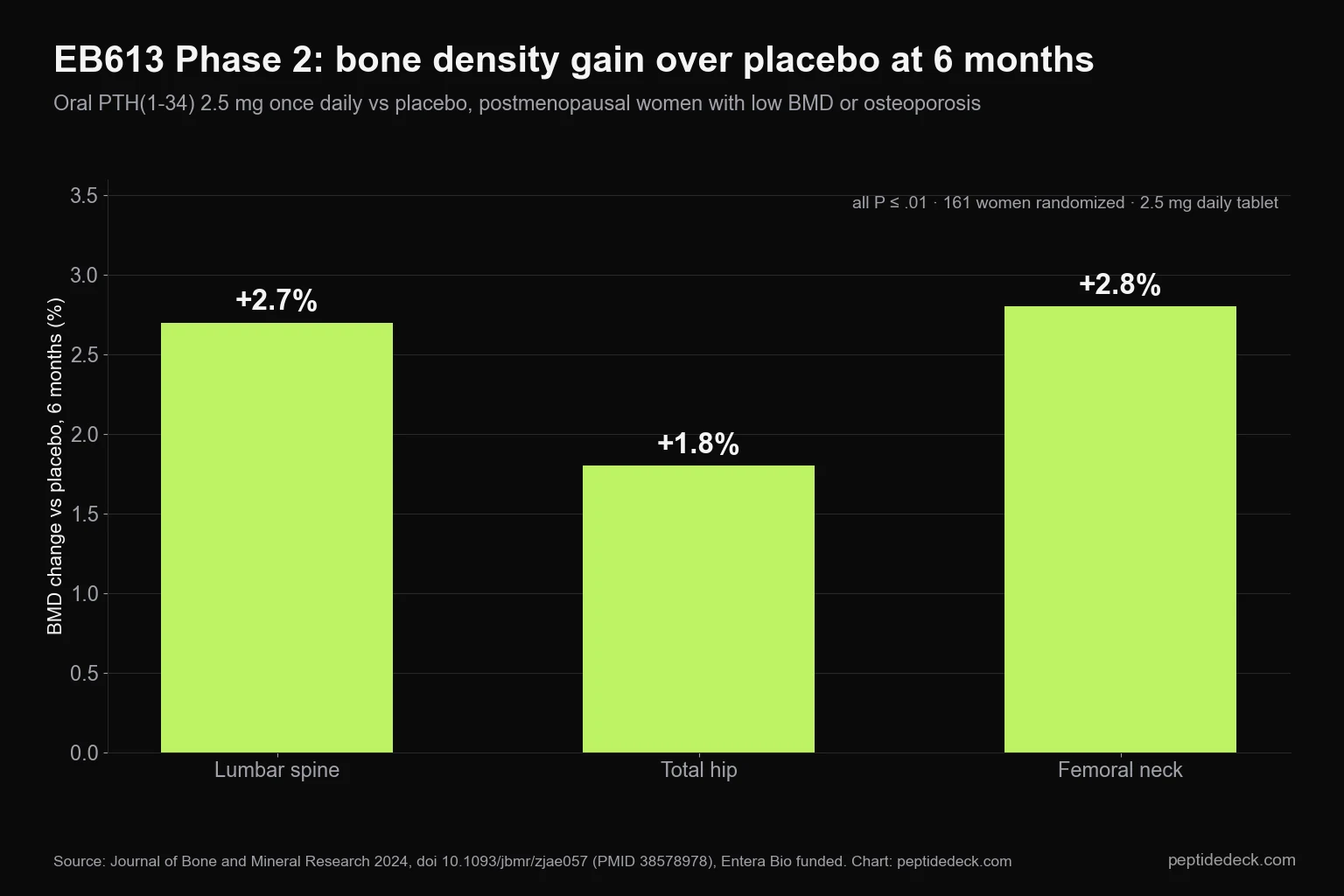
For scale: Forteo's label reports a 9.7% lumbar spine gain from baseline against 1.1% on placebo after a median of 19 months, and 2.8% at the femoral neck against a 0.7% loss (Forteo PI, Table 3). A 2.7% spine gap at six months is on the same trajectory, not ahead of it. Entera's March 2026 filing says the Phase 2 hip gains were "comparable" to Forteo's at six months, and that comparison, not a head-to-head trial, is what the FDA accepted as the bridge (8-K, Mar 4 2026).
The part that did not look like Forteo
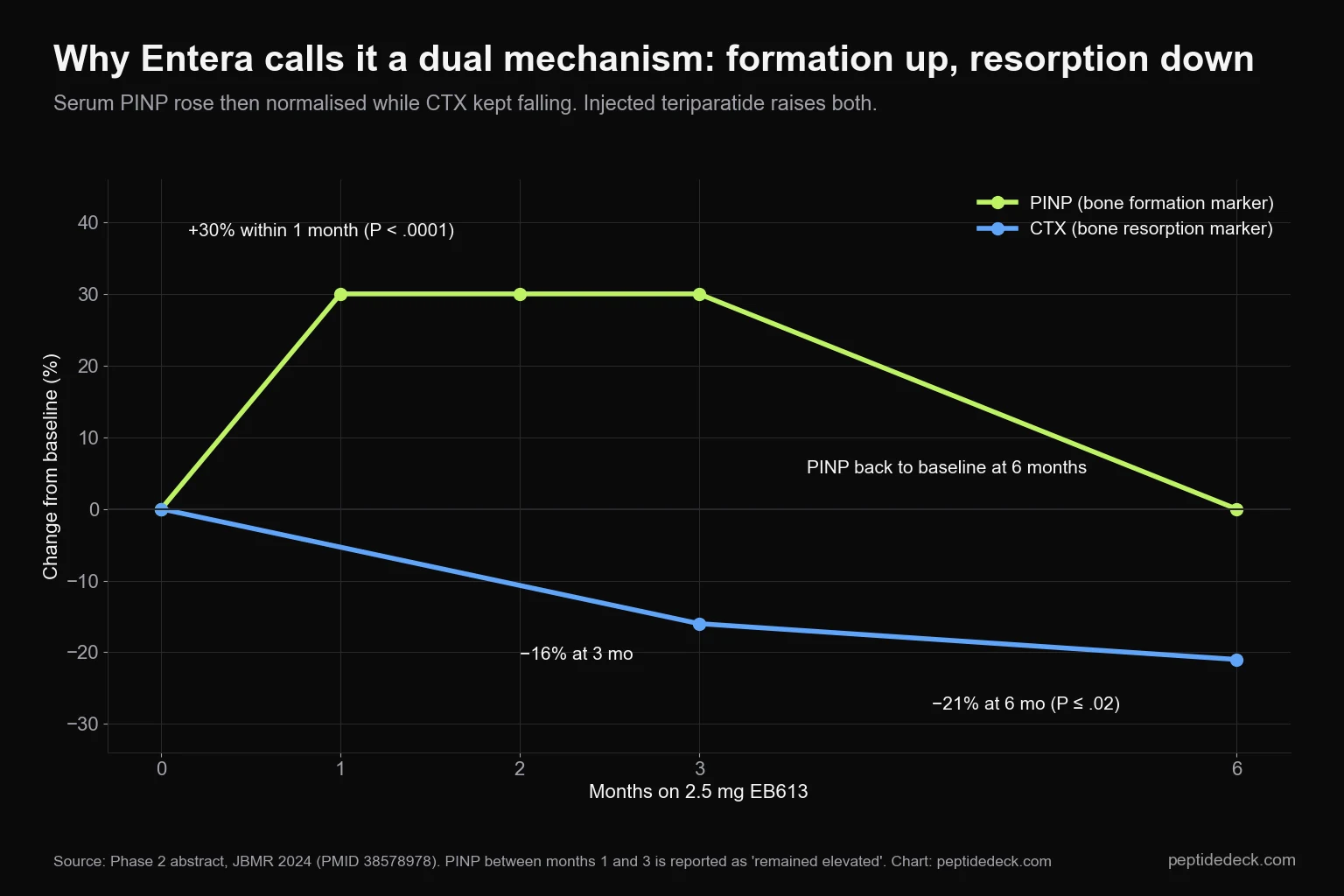
Injected teriparatide raises both bone-formation and bone-resorption markers. The tablet did something else. Serum PINP, a formation marker, rose about 30% within the first month and was back to baseline by month six. CTX, a resorption marker, kept falling: 16% below baseline at three months and 21% at six (PMID 38578978). Entera calls this a dual mechanism, formation up and resorption down, and credits the tablet's short, sharp blood peak. Whether that pattern holds over 12 months, and whether it translates into fewer fractures, is exactly what Phase 3 has to show.
Why the tablet carries 125 times the injected dose
Forteo delivers 20 micrograms a day. The EB613 tablet carries 2,500 micrograms. The gut digests most of a swallowed peptide and only a small fraction of what survives crosses into the blood, so an oral peptide has to start with far more drug to end up with the same exposure. The same arithmetic is why oral semaglutide (Rybelsus) uses milligram doses where the injection uses less than one; our guide to oral peptides explains the carrier chemistry.
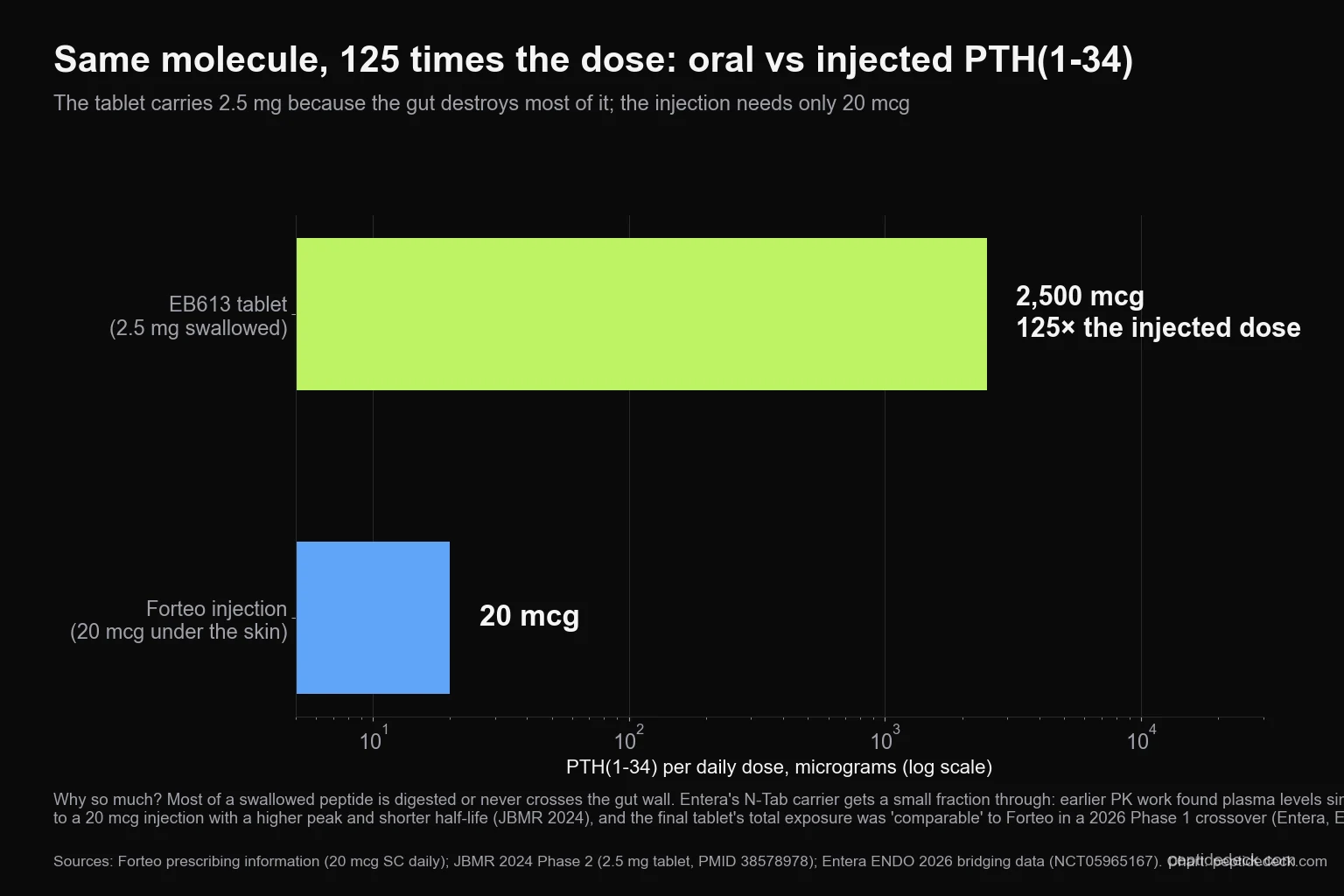
How much of the 2.5 mg reaches the blood is not published as a percentage anywhere we could find. What the Phase 2 paper says is that earlier PK work showed the tablets "produced plasma hPTH(1-34) levels similar to those seen after subcutaneous 20 µg injection of teriparatide, with a higher Cmax and shorter elimination half-life" (PMID 38578978). Entera then ran a Phase 1 crossover study in 45 healthy men to show its final single-tablet formulation matches the multi-tablet version used in Phase 2 and Forteo itself (NCT05965167). The company reported at ENDO 2026 that total exposure (AUC) was comparable to Forteo with a slightly shorter duration, and that all 15 participants in the comparative cohort preferred a daily pill to a daily injection (8-K, Aug 7 2026). Those are company-presented results; the peer-reviewed PK paper has not appeared yet.
Two practical consequences follow. First, 2.5 mg of PTH(1-34) per tablet is a lot of expensive peptide, which is the main reason an oral version will not be cheap. Second, the pill's absorption depends on an empty stomach and the carrier working as designed, so dosing instructions will matter more than they do for the injection.
Where EB613 stands today (checked October 10, 2026)
Here is the status, built from Entera's filings with the SEC rather than from news summaries. The FDA conversation is older than it looks: a Type C meeting in October 2022 first agreed that one placebo-controlled Phase 3 with a total-hip bone density endpoint could support an NDA, a July 2025 written response confirmed it, and the March 2026 filing shortened the primary endpoint from 24 months to 12. We will update the dates below as the company files.
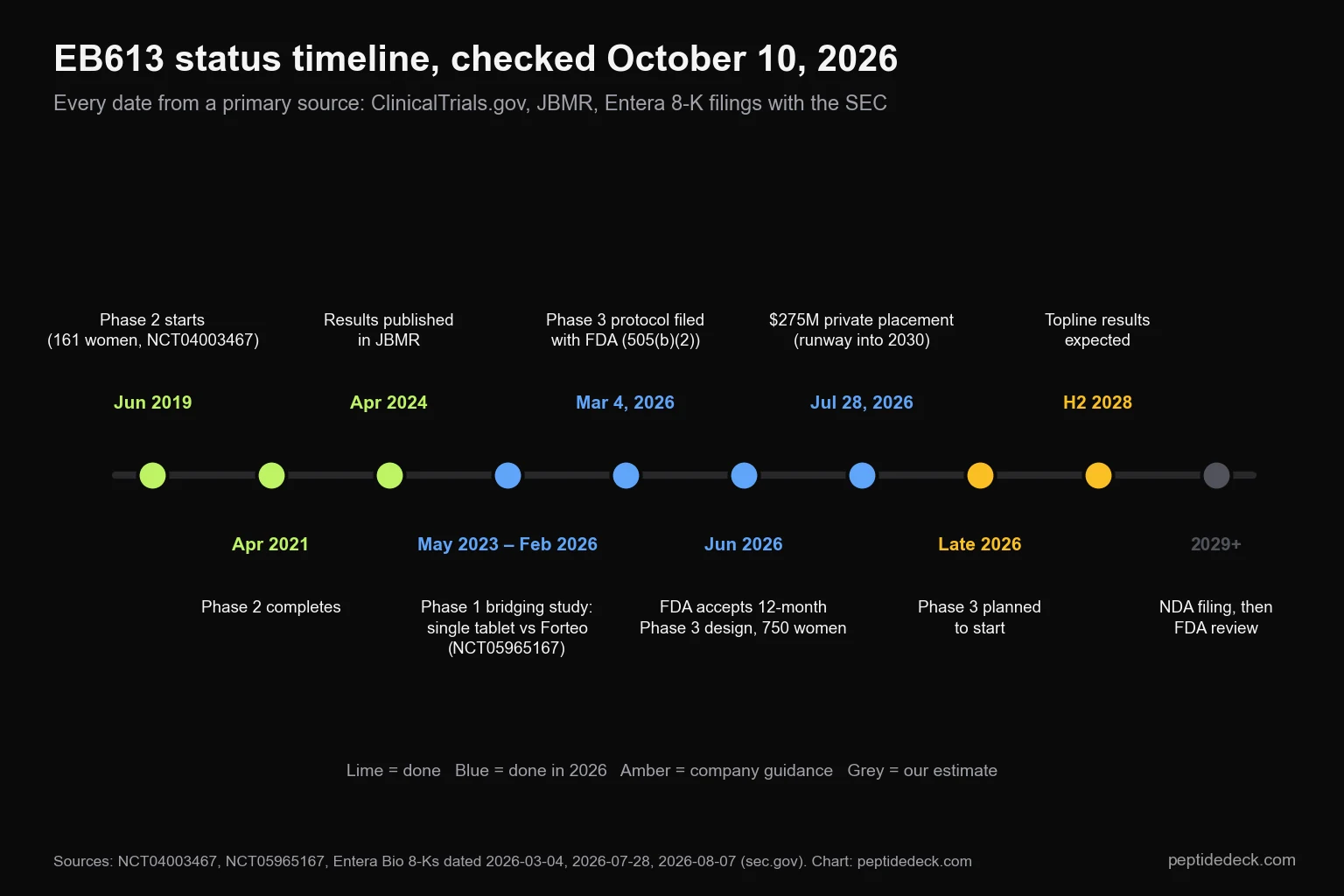
Status as filed, October 10, 2026
- Phase 3 design accepted by the FDA (June 2026): one randomised, double-blind, placebo-controlled trial in about 750 postmenopausal women with osteoporosis. Primary endpoint: percent change in total hip bone density at 12 months. A 12-month open-label extension runs alongside, testing 24 months of EB613 or 12 months followed by an anti-resorptive drug (8-K, Aug 7 2026).
- Funded: a $275 million private placement led by BVF Partners closed on July 28, 2026 at $2.04 a share. Entera's 10-Q says the cash lasts into 2030 and the "going concern" warning that sat in earlier filings has been removed (8-K, Jul 28 2026; 10-Q, Aug 7 2026).
- Team: a chief medical officer with Phase 3 experience was hired on August 18, 2026 "ahead of planned EB613 Phase 3 initiation" (8-K, Aug 18 2026).
- Latest: on October 8, 2026 Entera said the Phase 3 design would be shown as a late-breaking poster at ASBMR 2026 on October 11, alongside a Phase 2 post-hoc analysis in women with a T-score of −2.5 or lower; no new numbers were released with either announcement.
- Start: Phase 3 planned for late 2026. Topline: second half of 2028. Not yet filed: a Phase 3 registration on ClinicalTrials.gov as of our check (every Entera study listed there is completed).
Work the dates forward and the earliest realistic path is topline in late 2028, an NDA in 2029 and, if the FDA takes a standard ten-month review, a decision in 2030. Trials slip. If you are being treated for osteoporosis now, plan around the drugs that exist, not this one.
Can you buy EB613? We searched nine vendors
No, and we checked. On October 9 and 10, 2026 we searched the product catalogues of nine peptide sellers, including the vendors we work with, for "EB613", "PTH 1-34" and "teriparatide": Ascension Peptides, BioLongevity Labs, Nurapeptide, Limitless Life, Peptide Sciences, Core Peptides, Amino Asylum, Biotech Peptides and Swisschems. Result: zero product listings on every site. Three of the result pages are below, unedited apart from cropping.
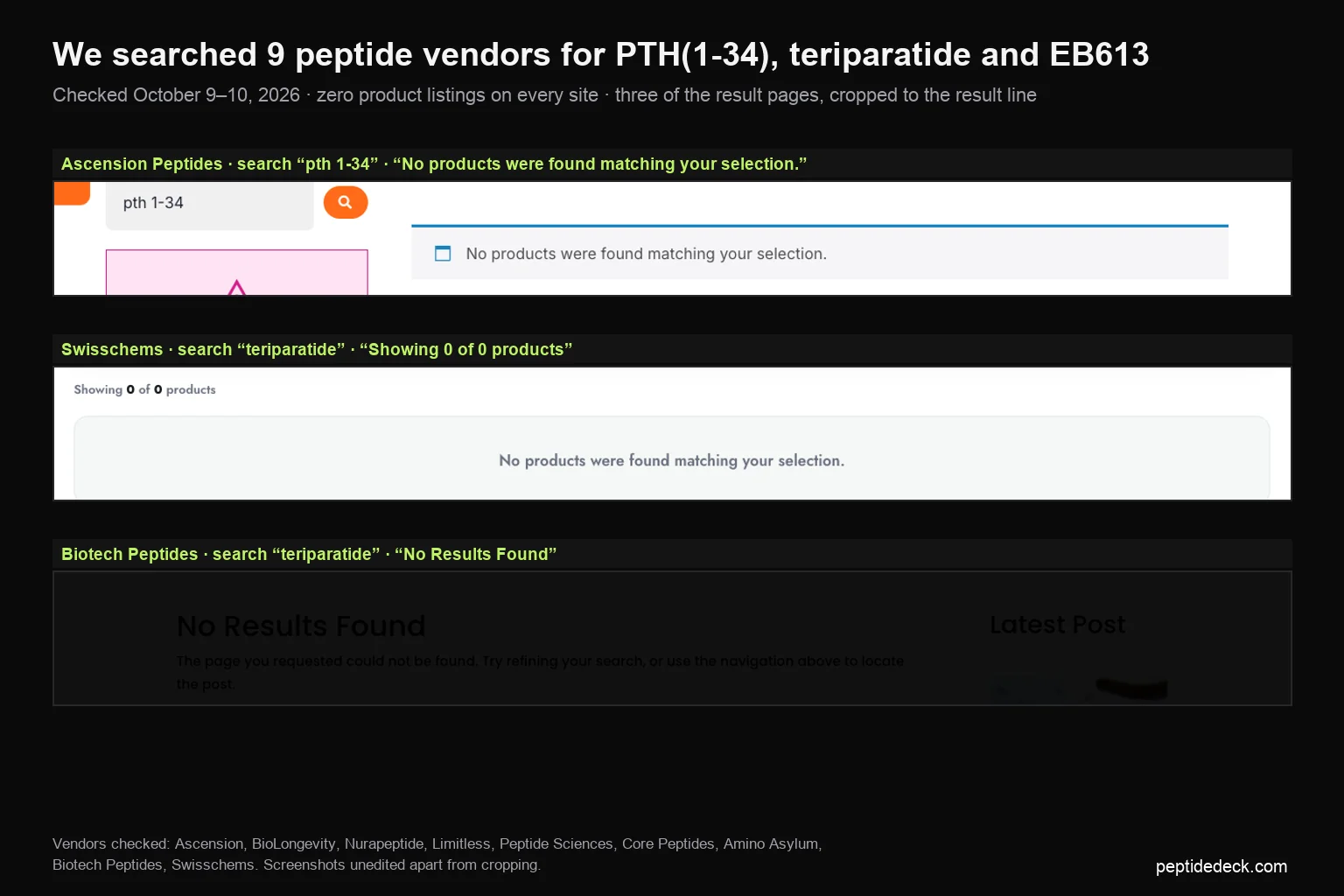
That is the honest state of the market and it matters for two reasons. Any listing that calls itself "oral PTH" or "EB613" cannot be Entera's tablet, because the formulation is proprietary and the only supply is inside clinical trials. And a bare PTH(1-34) powder, if you ever find one, is the injectable molecule with none of the N-Tab carrier, so swallowing it would simply digest it. For the record, a handful of chemical-reagent suppliers and two gray-market sites do list PTH(1-34) powder: Peptide Shop at $130 for 5 mg and Atomik Labz at $130 for 1 mg on October 10, 2026, neither mentioning a certificate of analysis. On paper that is $0.52 to $2.60 per 20 mcg dose; in practice it is an unverified powder you would have to weigh, reconstitute and inject daily for months from a vial that is only stable for weeks once mixed, with none of the surveillance that sits behind the 2020 label change.
The bone peptides vendors do stock, mostly growth-hormone secretagogues like sermorelin and CJC-1295, have no fracture data at all, which our peptides for osteoporosis guide grades one by one. If you are browsing peptides for sale for bone density, that guide is the page to read first.
What a daily dose costs today, and what the pill would have to beat
EB613 has no price. Its competition does, and the table below is what a day of each approved anabolic costs, using the lowest GoodRx coupon price and the undiscounted retail figure from GoodRx's newest archived pages, dated in the table. Insurance changes everything, so treat these as the ceiling you would pay without coverage.
Per-day figures are the pack price divided by the doses in the pack, worked out by PeptideDeck. GoodRx blocks visitors from outside the US, so these are the newest Internet Archive captures of its price pages (dates in the Source column), read on October 10, 2026; a live read of the same pages early on October 10, 2026, just before GoodRx closed them to non-US visitors, showed Forteo $1,035.57, teriparatide $1,146.04 and Tymlos $3,076.86, within $50 of the captures, so the per-day figures hold. Lilly's own Colorado price disclosure lists Forteo's wholesale acquisition cost at $4,289.89 a pen, $153.21 a day. Lilly's own Forteo list-price page was behind a bot check when we tried it. Calcitonin is included only because it is the third approved peptide; its label says fracture reduction has not been demonstrated.
Two things stand out. With a coupon, a day of injected PTH(1-34) costs about $37 to $41 whether the pen says Forteo or teriparatide, roughly a third of the retail figure, so the price EB613 has to beat is the discounted pen, not the $3,000 sticker. And because EB613 carries 125 times the peptide per dose, its cost of goods is structurally higher than a pen's. Entera's answer is the treatment gap: by its own account, anabolic drugs reach a minority of the patients guidelines say should get them, largely because of the injections. A pill that gets prescribed is worth more than a cheaper injection that sits in the fridge.
If you are on Forteo now: three questions, answered
Can I switch to the pill? Not now, and not for several years. If you are in the United States and meet the criteria, the only way to take EB613 before approval is to enrol in the Phase 3 trial once it opens. Watch ClinicalTrials.gov for an Entera Bio listing in late 2026, and ask your prescriber whether a site near you is recruiting. Trial participants get placebo half the time.
Should I wait for it instead of starting an injection? No. Bone you lose while waiting does not come back on its own, and the drugs that exist today have fracture data this tablet does not. Teriparatide, abaloparatide and romosozumab are all time-limited courses; starting one now does not stop you taking something better later.
Will insurance cover it? Nobody knows, because there is no price or label. With a generic teriparatide pen available, expect payers to ask why the tablet is worth more. Do not stop or change a prescribed medication on the strength of a pipeline drug.
What to ask your doctor
- Am I a candidate for an anabolic (bone-building) drug now, or is an anti-resorptive the right first step?
- If I am on teriparatide or abaloparatide, how long is my course, and what comes after it?
- Is there an EB613 Phase 3 site near me, and would I qualify?
- Can I get a generic teriparatide pen instead of Forteo, and what would it cost me?

Safety: what the tablet inherits from the injection
In Phase 2 the problems were nausea, dizziness and headache, common enough at the full dose to make titration mandatory, with no drug-related serious events (PMID 38578978). Beyond that, EB613 inherits teriparatide's history. The injection carried a boxed warning about osteosarcoma for its first 18 years, based on bone tumours in laboratory animals given high doses for most of their lives. The FDA removed the boxed warning in 2020 after years of surveillance in people did not show the signal, and the hard two-year limit became a judgement call: the current label says use beyond two years "should only be considered if a patient remains at or has returned to having a high risk for fracture", and it still rules out patients at increased baseline risk of osteosarcoma (Forteo PI, current). Any oral PTH will carry the same language. Transient high blood calcium, dizziness on standing and leg cramps are the day-to-day issues to know about, and anyone with Paget's disease, unexplained raised alkaline phosphatase, prior skeletal radiation or bone metastases should not be on PTH in any form.
Frequently Asked Questions
Sources
- Kostenuik PJ, et al. Oral daily PTH(1-34) tablets (EB613) in postmenopausal women with low BMD or osteoporosis: a randomized, placebo-controlled, 6-month, phase 2 study. J Bone Miner Res. 2024;39(6):672-682. PMID 38578978 · doi 10.1093/jbmr/zjae057
- Phase 2 trial registration: A six-month phase 2 study of oral hPTH(1-34) (EBP05) in postmenopausal women with low bone mass. ClinicalTrials.gov NCT04003467
- Phase 1 bridging study registration: Assess safety and compare PK of new oral hPTH(1-34) tablet formulations vs. EBP05 tablets and subcutaneous Forteo. ClinicalTrials.gov NCT05965167
- Entera Bio Ltd. Form 8-K, Exhibit 99.1, March 4, 2026: Entera Bio submits streamlined Phase 3 protocol to initiate registrational program for EB613. sec.gov
- Entera Bio Ltd. Form 8-K, July 28, 2026: Securities Purchase Agreement, $275.0 million private placement at $2.04 per share. sec.gov
- Entera Bio Ltd. Form 8-K, Exhibit 99.1, August 7, 2026: Second quarter 2026 financial results and business updates (FDA alignment on 12-month Phase 3, ENDO 2026 bridging data). sec.gov
- Entera Bio Ltd. Form 10-Q for the quarter ended June 30, 2026 (cash runway into 2030; going-concern language removed). sec.gov
- Entera Bio Ltd. Form 8-K, Exhibit 99.1, August 18, 2026: Appointment of Chief Medical Officer ahead of planned EB613 Phase 3 initiation. sec.gov
- Forteo (teriparatide injection) prescribing information, Eli Lilly, revised November 2020. accessdata.fda.gov
- GoodRx price pages for Forteo, Bonsity, Tymlos and Miacalcin, Internet Archive captures of May 17, July 12, April 19 and May 10, 2026 (GoodRx is not reachable from outside the US). forteo · bonsity · tymlos · miacalcin
Medical Disclaimer: This article is for educational purposes only and is not medical advice. EB613 is an investigational drug that is not approved for any use. Osteoporosis needs a diagnosis and a treatment plan from a qualified clinician. Do not start, stop or change any prescribed osteoporosis medication because of information on this page. Peptides sold online are not approved to diagnose, treat or prevent any disease.