Most joint pain advice skips the evidence. If you are looking at peptides for arthritis, start here: one peptide hormone, repository corticotropin (Acthar Gel), is FDA-approved as an add-on for rheumatoid arthritis, and the largest peptide trial in knee osteoarthritis tested semaglutide in 407 people (PMID 39476339). The BPC-157 and TB-500 vials sold online rest on a phone survey of 16 patients.
🔑 Key Takeaways
- The peptide with the best knee-pain data is not the one most forums talk about.
- Why the placebo group in the biggest trial also improved by 27.5 points, and what that means for every testimonial you read.
- The 70-year-old peptide drug rheumatologists can already prescribe for flares.
- What the 16-person BPC-157 knee study actually measured (and what it never checked).
- The one injection mistake that can turn a sore joint into an emergency.
If your knees complain on the stairs, or your hands feel locked every morning, you already know how slow the usual options are. Painkillers take the edge off for a few hours. The idea of an injection that rebuilds the joint is hard to ignore. So it is worth knowing which peptides have been tested in people with arthritis, what happened, and which ones have never been tried in a human joint at all.
What peptides for arthritis actually means
Arthritis is not one disease. Osteoarthritis (OA) is wear, cartilage loss and low-grade inflammation, mostly in knees, hips and hands. Rheumatoid arthritis (RA) is an autoimmune disease in which the immune system attacks the joint lining. A peptide that helps one has no reason to help the other, so this page grades them separately.
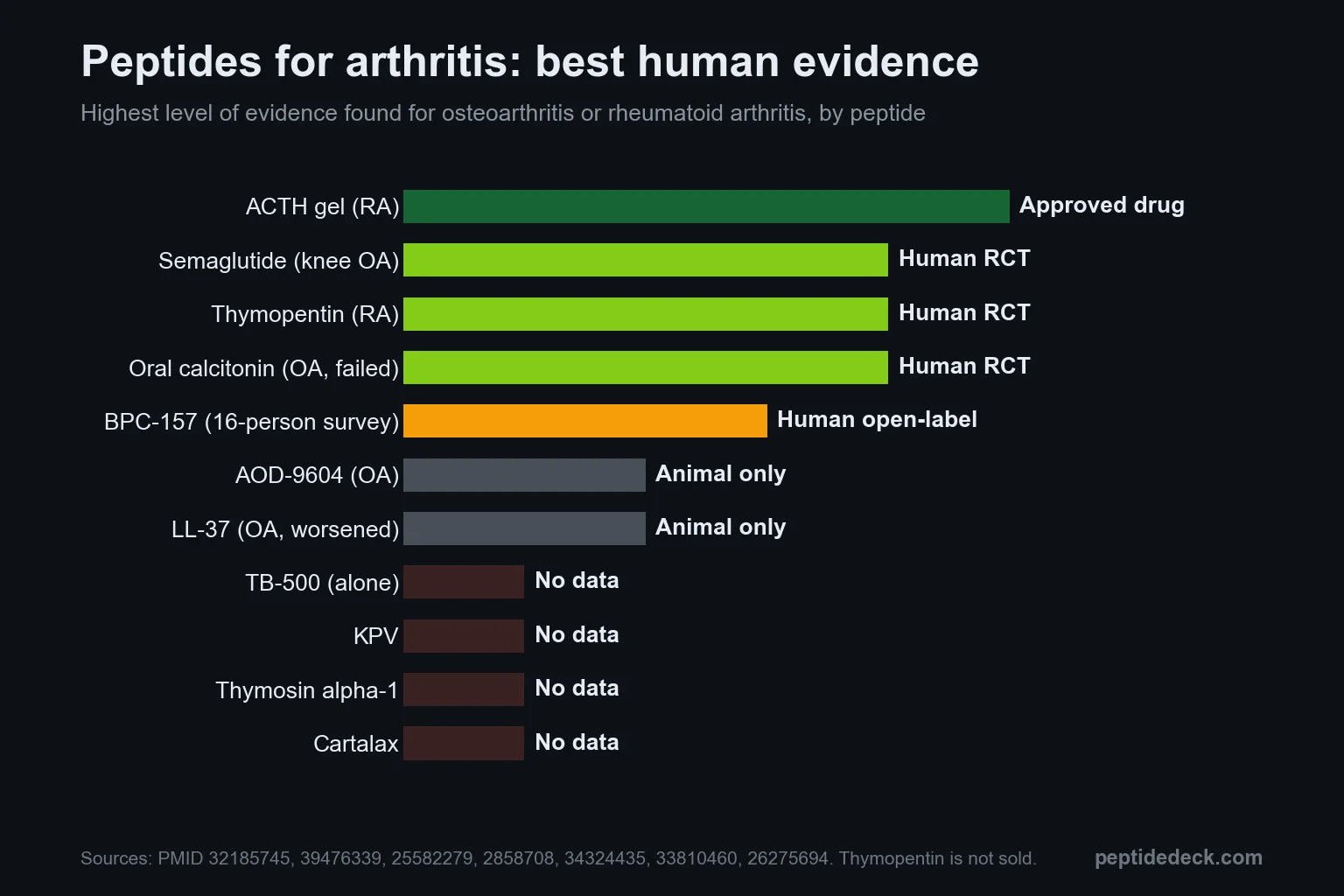
Here is what exists in each camp. For RA, repository corticotropin (a 39-amino-acid ACTH peptide) carries an FDA label as short-term add-on therapy. For OA, no peptide is approved. Oral salmon calcitonin, a 32-amino-acid peptide, was tested in two phase 3 trials of 1,176 and 1,030 people and did not slow joint-space narrowing over 24 months (PMID 25582279). Semaglutide is approved for weight loss, not for OA, but it now has a positive knee-OA trial.
Everything else people search for, including BPC-157, TB-500, KPV, thymosin alpha-1 and Cartalax, sits further down the ladder.
The evidence table: every peptide graded
One row per peptide, one source per row. "Evidence in people" means the best human study we could find for OA or RA, not for another condition.
Semaglutide and knee osteoarthritis: the STEP 9 trial
This is the strongest peptide data in OA. STEP 9 randomized 407 adults with obesity (average BMI 40.3) and moderate knee OA to weekly semaglutide 2.4 mg or placebo, both with diet and activity counselling, for 68 weeks (PMID 39476339, NCT05064735). Average starting pain was 70.9 out of 100.
By week 68, WOMAC pain fell 41.7 points on semaglutide and 27.5 on placebo. Weight fell 13.7% vs 3.2%. Physical function on the SF-36 rose 12.0 vs 6.5 points. That is a gap of about 14 points on a 100-point scale, on top of a large placebo effect.
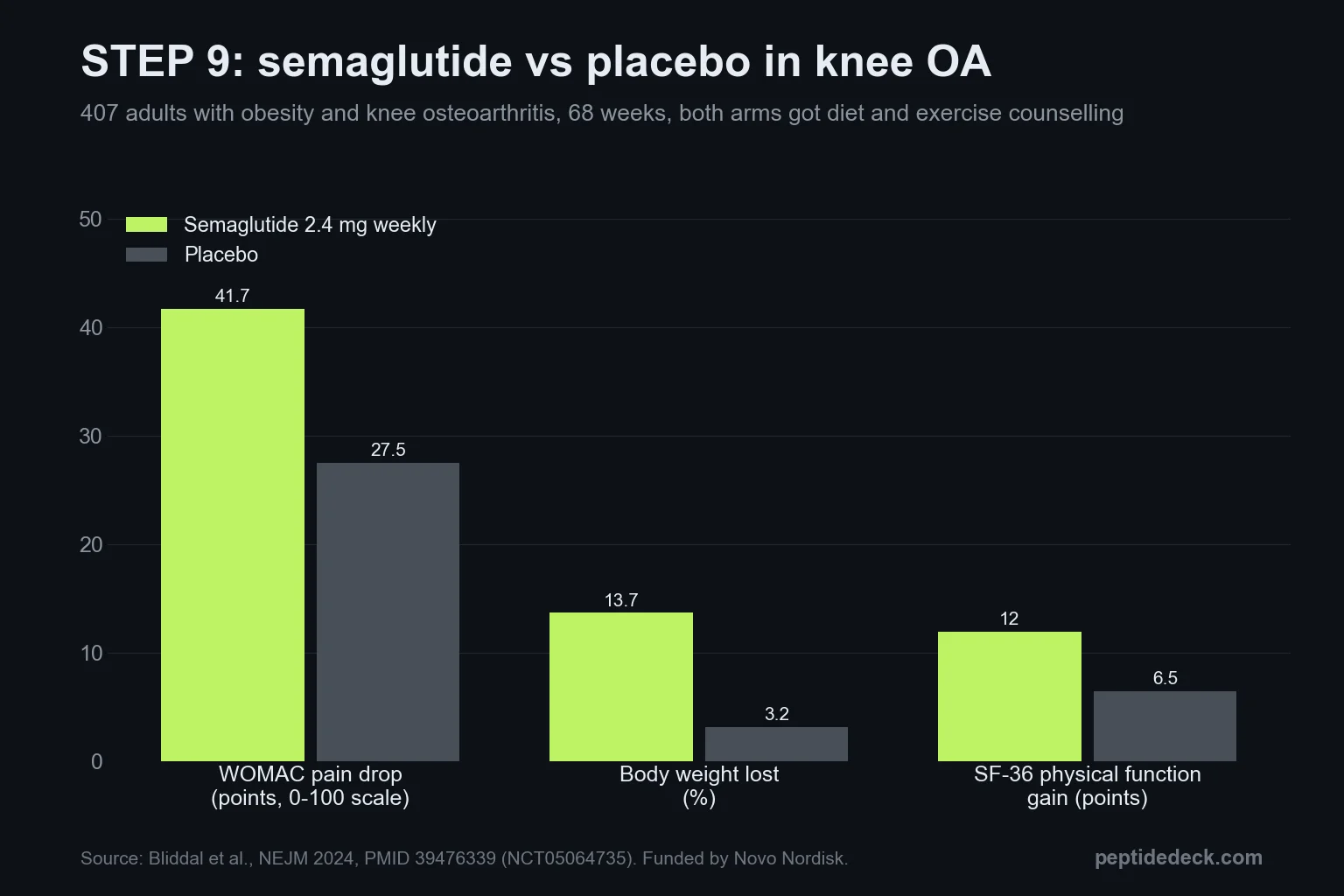
Three limits matter. Novo Nordisk, which sells semaglutide, funded the trial. Most of the benefit probably comes from carrying less weight through the knee, so it tells you little about people with arthritis who are not overweight. And the placebo group improved by 27.5 points on counselling alone, a reminder of how far knee pain moves without any drug.
A real-world Italian cohort of 93 people saw similar direction: weight down 10.9 kg, VAS pain down 2.47 points and CRP down 2.67 mg/L at six months (PMID 42589980). With no comparison group, the authors say it cannot prove cause.
Peptides for rheumatoid arthritis: ACTH gel and GLP-1s
RA has the only approved peptide drug here. In a 2020 trial, 259 people with active RA despite steroids and DMARDs took repository corticotropin 80 units twice weekly for 12 weeks; those who reached low disease activity were randomized to keep going or switch to placebo (PMID 32185745, NCT02919761). At week 24, 61.0% stayed in low disease activity on the drug vs 42.1% on placebo.
Mallinckrodt, the manufacturer, employed three of the six authors. A 2022 JAMA Internal Medicine review found that placebo-controlled RCTs of the drug in RA "were generally small and did not consistently demonstrate" benefit over placebo (PMID 34902005). The same review notes it is an expensive medication.
GLP-1 drugs are the newer signal. A UCLA chart review of 215 people with RA and a BMI of 27 or more found that those who took semaglutide or tirzepatide had larger drops in disease activity, pain and weight than 42 people who were prescribed one but never started (PMID 40932015). Nearly a third stopped, mostly for stomach side effects. Retrospective data like this hints; it does not prove.
The closest thing to a "thymic peptide" trial in RA is thymopentin, which is not sold. Given as 50 mg IV three times a week, it beat placebo for tenderness, swelling and morning pain in 41 people (PMID 2858708), and on 5 of 9 measures in a 119-person German trial, with the benefit fading within four weeks of stopping (PMID 3276492).
BPC-157 for arthritis: one 16-person survey
The whole human file is one phone survey. Two authors at the Institute for Hormonal Balance, a hormone and peptide clinic in Orlando, reviewed a year of charts and phoned 16 people who had received BPC-157 knee injections, 12 alone and 4 combined with TB-500 (PMID 34324435). Eleven of 12 and 3 of 4 said their pain was significantly better, 14 of 16 overall.
The causes of knee pain were mixed: OA, meniscus tears, ligament injuries and RA. No validated pain scale, no imaging and no control group were used, and most people were asked 6 to 12 months after the injection. The authors' own introduction notes that BPC-157 and TB-4 "has not been studied in the treatment of knee pain."
Every published human BPC-157 report comes from the same clinic-run author group in Alternative Therapies in Health and Medicine, including an interstitial cystitis pilot (PMID 39325560) and an IV safety pilot (PMID 40131143). None has a control arm. No human study has measured cartilage. Registered BPC-157 "trials" from one sponsor on ClinicalTrials.gov have posted no results, and a sister record from the same sponsor describes itself as fictional.
See the full BPC-157 guide for what it was studied for outside joints.
TB-500 and the cartilage repair claim
No one has tested TB-500 alone in arthritis. The four people in the knee survey above got it mixed with BPC-157, so their result cannot be split. What does exist is a blood marker finding: thymosin beta-4 levels in serum and joint fluid rise with knee OA severity (PMID 23816466), and serum levels track RA disease activity (PMID 22653616). A marker rising with disease says nothing about whether injecting more of it helps.
Those studies measured the body's own protein, not the synthetic TB-500 sold online. If you are still comparing TB-500 for sale after reading this, price per vial matters less than a batch-specific certificate showing purity and sterility (Ascension pays us a commission at no extra cost to you). The TB-500 dossier covers what it was studied for elsewhere.
KPV, LL-37 and the leaky gut theory
This idea spreads fast in RA forums. The claim: a leaky gut drives RA, so gut-sealing peptides such as BPC-157, KPV or larazotide calm the joints. In one 2021 study, people with RA did show raised blood markers of gut permeability, and blocking permeability with larazotide reduced arthritis in mice (PMID 34296202). That human link is correlation only, and no gut-sealing peptide has been tried in people with RA.
KPV has no human arthritis data at all. LL-37, often sold in the same "immune" stacks, looks like the wrong direction: its mouse version made experimental OA worse when injected into the knee (PMID 33810460), and antibodies against a modified form of LL-37 promote bone erosion in RA (PMID 34594331). For the wider picture, see our peptides for inflammation guide.
Thymosin alpha-1 and Cartalax: no human arthritis data

Both show up in "joint stack" lists. A PubMed search turns up no human arthritis trial for either. Thymosin alpha-1 is an immune stimulant, which raises a fair question for anyone with RA: could it work against the drugs keeping their immune system in check? No interaction data exist either way.
Cartalax is a short bioregulator peptide marketed for cartilage. Russian observational reports of OA pain relief circulate online, but its PubMed record is cell-culture work on aging tissue, with no controlled trial in people. If joint pain is part of a wider pain picture, our peptides for chronic pain review grades those claims the same way.
Safety: what can go wrong with joint peptides
The biggest risk is the needle, not the molecule. Injecting an unregulated, non-sterile vial into a knee can cause septic arthritis, a joint infection that needs urgent drainage and IV antibiotics. People with RA on methotrexate, JAK inhibitors or biologics carry extra infection risk, so this matters more for them.
- BPC-157: not approved anywhere. FDA lists it among bulk substances with safety concerns for compounding (Category 2), and WADA bans it in sport.
- Mast cells: injected peptides can trigger mast cells directly through the MRGPRX2 receptor, the cause of pseudo-allergic injection reactions to approved peptide drugs (PMID 25517090). People with RA, other autoimmune disease or reactive skin may be more prone.
- Semaglutide: 6.7% stopped for side effects in STEP 9 vs 3.0% on placebo, mostly stomach issues (PMID 39476339). Rare case reports describe vasculitis (PMID 39072425) and drug-induced lupus (PMID 38559525).
- ACTH gel: steroid-like effects on blood sugar, infection risk and bone.
- Masking pain: a joint that suddenly swells or runs hot can be infection, gout or a fracture; self-treating can delay the diagnosis.
What to ask your doctor
1. Is my pain osteoarthritis, rheumatoid arthritis or something else, and has that been confirmed with an exam, blood tests or imaging?
2. If I am carrying extra weight, would a GLP-1 drug like semaglutide be reasonable for my knees, given the STEP 9 results?
3. For RA: if my current DMARD is not enough, is repository corticotropin or another add-on worth discussing?
4. Would any peptide I am considering interact with methotrexate, a biologic or a JAK inhibitor?
5. What signs of joint infection should send me to urgent care?
Do not stop or reduce prescribed medication (DMARDs, biologics, steroids or pain relief) to try a peptide. Stopping an RA drug can trigger a flare that damages the joint for good.
Frequently Asked Questions
Sources
- Bliddal H, et al. Once-weekly semaglutide in persons with obesity and knee osteoarthritis (STEP 9). N Engl J Med. 2024;391:1573-1583. PMID 39476339
- Fleischmann R, et al. Repository corticotropin injection for active rheumatoid arthritis despite aggressive treatment: a randomized controlled withdrawal trial. Rheumatol Ther. 2020;7:327-344. PMID 32185745
- Tran KA, et al. Characterization of the clinical evidence supporting repository corticotropin injection for FDA-approved indications: a scoping review. JAMA Intern Med. 2022;182:206-217. PMID 34902005
- Kellner DA, et al. Effect of glucagon-like peptide 1 receptor agonists on patients with rheumatoid arthritis. ACR Open Rheumatol. 2025;7:e70103. PMID 40932015
- Conforti A, et al. Changes in pain, physical function (WOMAC) and low-grade inflammation following semaglutide in knee osteoarthritis: six-month real-world cohort. J Clin Med. 2026;15:5876. PMID 42589980
- Karsdal MA, et al. Treatment of symptomatic knee osteoarthritis with oral salmon calcitonin: results from two phase 3 trials. Osteoarthritis Cartilage. 2015;23:532-543. PMID 25582279
- Malaise MG, et al. Treatment of active rheumatoid arthritis with slow intravenous injections of thymopentin. Lancet. 1985;1:832-836. PMID 2858708
- Lemmel EM, et al. Immunomodulating therapy in chronic polyarthritis with thymopentin: a multicenter placebo-controlled study of 119 patients. Dtsch Med Wochenschr. 1988;113:172-176. PMID 3276492
- Lee E, Padgett B. Intra-articular injection of BPC 157 for multiple types of knee pain. Altern Ther Health Med. 2021;27(4):8-13. PMID 34324435
- Lee E, et al. Effect of BPC-157 on symptoms in patients with interstitial cystitis: a pilot study. Altern Ther Health Med. 2024. PMID 39325560
- Lee E, et al. Safety of intravenous infusion of BPC157 in humans: a pilot study. Altern Ther Health Med. 2025. PMID 40131143
- Wei M, et al. Increased thymosin beta-4 levels in the serum and synovial fluid of knee osteoarthritis patients correlate with disease severity. Regul Pept. 2013. PMID 23816466
- Song R, et al. Association between serum thymosin beta-4 levels of rheumatoid arthritis patients and disease activity and response to therapy. Clin Rheumatol. 2012. PMID 22653616
- Choi MC, et al. Intra-articular administration of Cramp into mouse knee joint exacerbates experimental osteoarthritis progression. Int J Mol Sci. 2021;22:3429. PMID 33810460
- Kwon DR, et al. Effect of intra-articular injection of AOD9604 with or without hyaluronic acid in rabbit osteoarthritis model. Ann Clin Lab Sci. 2015. PMID 26275694
- Matei DE, et al. Intestinal barrier dysfunction plays an integral role in arthritis pathology and can be targeted to ameliorate disease. Med. 2021;2:864-883. PMID 34296202
- O'Neil LJ, et al. Anti-carbamylated LL37 antibodies promote pathogenic bone resorption in rheumatoid arthritis. Front Immunol. 2021. PMID 34594331
- McNeil BD, et al. Identification of a mast-cell-specific receptor crucial for pseudo-allergic drug reactions. Nature. 2015. PMID 25517090
- Pinheiro MM, et al. The first report of leukocytoclastic vasculitis induced by once-weekly subcutaneous semaglutide. Curr Med Res Opin. 2024. PMID 39072425
- Castellanos V, et al. Semaglutide-induced lupus erythematosus with multiorgan involvement. Cureus. 2024. PMID 38559525
- STEP 9 trial registration. ClinicalTrials.gov NCT05064735
- Repository corticotropin RA withdrawal trial registration. ClinicalTrials.gov NCT02919761
Medical Disclaimer: This article is for educational purposes only and is not medical advice. Arthritis needs a diagnosis from a qualified clinician. Peptides sold online are not approved to diagnose, treat or prevent any disease. Talk to your doctor or rheumatologist before starting, stopping or changing any medication, and seek urgent care for a hot, swollen joint or fever.