Your body already has a repair signal built in. Thymosin beta-4 is a protein present in virtually every cell in the body, concentrated heavily in platelets and wound fluid. When tissue gets damaged, thymosin beta-4 floods the site. TB-500 is a synthetic fragment of that protein, engineered to be injectable and systemically active, delivering the same cell-migration and repair signals your body already relies on, just amplified.
🔑 Key Takeaways
- TB-500 is a synthetic analog of the Ac-LKKTETQ fragment of thymosin beta-4, a naturally occurring repair protein found throughout the body
- It works systemically, not just at the injection site, by binding to actin and driving cell migration to sites of injury
- Primary uses: tendon and ligament repair, muscle healing, joint recovery, post-surgical healing, and hair regrowth
- Most commonly stacked with BPC-157, which targets complementary repair mechanisms (angiogenesis vs. cell migration)
- Side effects are generally mild: headache, fatigue, and nausea most common; serious side effects rare
This guide covers how TB-500 works at the molecular level, what it actually does for injury recovery, a breakdown of the most common use cases, realistic results by timeline, how it compares to BPC-157, and what to know before using it.
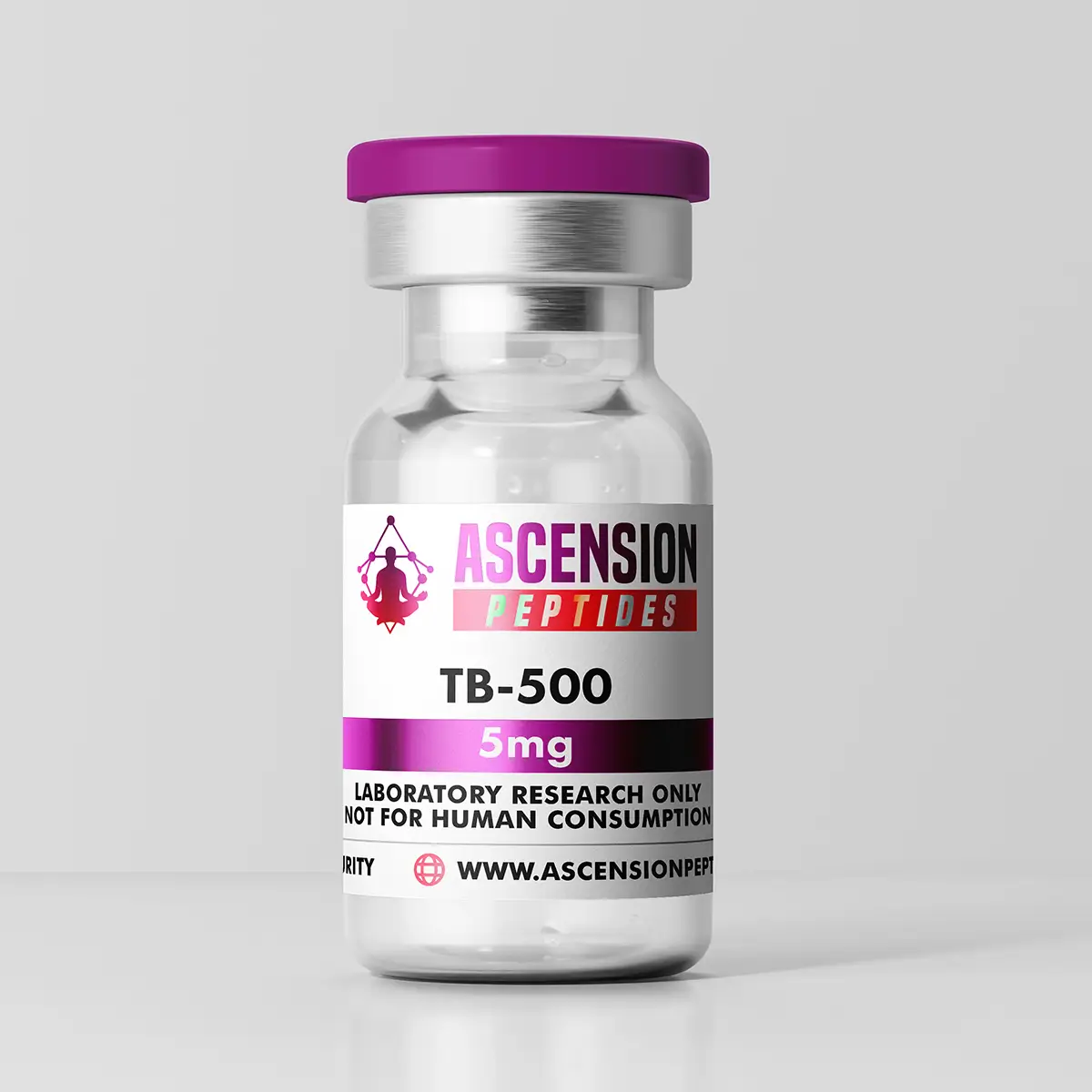
TB-500 is sold as a lyophilised powder — Ascension's 5mg vial ships from the US with a batch COA, which is the one variable worth controlling before you start.
What Is TB-500?
TB-500 is a synthetic peptide corresponding to amino acids 17-23 of thymosin beta-4 (the Ac-LKKTETQ fragment), a 43-amino acid protein naturally found in high concentrations in blood platelets, wound fluid, and virtually all nucleated cells.
Thymosin beta-4 was first isolated from thymic tissue in the 1960s. Decades of research established its central role in wound healing, tissue repair, and cell survival. The challenge with using full thymosin beta-4 therapeutically is its large size and poor bioavailability when injected systemically. TB-500 isolates the most biologically active fragment, the heptapeptide Ac-SDKP that drives most of thymosin beta-4's downstream effects, in a form that distributes systemically after subcutaneous injection.
The name TB-500 comes from the original research compound designation. It is also sometimes called "thymosin beta-4 fragment" or simply "Tβ4 fragment," though the exact fragment used varies slightly between manufacturers.
How TB-500 Works
TB-500's primary mechanism centers on actin regulation. Actin is a structural protein that forms the cytoskeleton of cells and is directly involved in cell movement. TB-500 binds to G-actin (the monomeric, unpolymerized form), which has two important effects:
- Cell migration acceleration, by modulating actin dynamics, TB-500 increases the motility of repair cells (fibroblasts, keratinocytes, endothelial cells), allowing them to reach injury sites faster than would occur naturally
- Angiogenesis promotion, TB-500 upregulates vascular endothelial growth factor (VEGF), driving the formation of new blood vessels at the site of injury, which is essential for delivering oxygen and nutrients during the healing cascade
Beyond actin and VEGF, TB-500 also activates anti-apoptotic pathways (reducing cell death at injury sites), modulates inflammatory signaling to reduce excessive inflammation without suppressing the necessary acute response, and promotes the differentiation of stem cells at injury sites toward repair-relevant cell types.
What makes TB-500 particularly useful compared to many peptides is its systemic distribution. It doesn't need to be injected near the injury to be effective. A subcutaneous injection in the abdomen will reach a tendon injury in the shoulder. This makes it substantially more practical for injuries in difficult-to-reach locations.
TB-500 Benefits
Tendon and Ligament Repair
The most consistent and well-documented use case. Tendon injuries are notoriously slow to heal due to poor vascularization. TB-500 addresses both sides of this problem: it drives cell migration to the injury site and promotes new blood vessel formation that the tendon desperately needs. Users with chronic tendon issues, including Achilles tendinopathy, rotator cuff injuries, and lateral epicondylitis, report meaningful improvement in pain and function that standard rest and physiotherapy hadn't produced.
Muscle Injury Recovery
Muscle tears and strains respond well to TB-500. The accelerated cell migration and anti-inflammatory modulation translate to faster resolution of acute injury and reduced scar tissue formation. Less fibrotic scar tissue means better functional recovery, not just pain relief. Athletes using TB-500 after muscle tears typically report returning to full training capacity faster and with less residual restriction.
Joint Recovery
Cartilage has essentially no blood supply and almost no intrinsic healing capacity. TB-500 can't regenerate cartilage from scratch, but it can promote healing in the surrounding synovial tissue, reduce inflammatory burden in the joint capsule, and support the connective tissue around joints. For joint injuries where cartilage damage is mild-to-moderate, TB-500 consistently produces reported improvements in pain, stiffness, and functional range of motion.
Post-Surgical Healing
The same mechanisms that accelerate injury healing make TB-500 relevant in post-operative recovery contexts. Faster wound closure, reduced inflammation, and accelerated tissue remodeling are all relevant to surgical recovery. Some clinicians use thymosin beta-4 analogs in wound care precisely for these properties.
Hair Regrowth
A less-discussed but increasingly reported benefit. TB-500 activates hair follicle stem cells and promotes angiogenesis in the scalp. Anecdotal reports and some preclinical data suggest benefits for hair thinning related to miniaturization and follicle dormancy. This is not a replacement for finasteride or minoxidil in androgenic alopecia, but users with diffuse thinning or telogen effluvium have reported noticeable improvements on cycle.
Cardiac and Neurological Applications
Preclinical research has shown TB-500 promotes cardiac muscle repair after ischemic injury and exhibits neuroprotective effects. These remain research-stage findings, but they reflect the breadth of thymosin beta-4's biological role. Some users explore TB-500 for general tissue resilience and anti-aging purposes based on this broader profile.
TB-500 Dosage Protocol
Standard cycle: 6-8 weeks for acute injuries, up to 12 weeks for chronic or severe injuries. Follow with a 4-week break before repeating. Inject subcutaneously into abdominal fat. TB-500 is not highly timing-sensitive and can be taken at any time of day, with or without food.
Reconstitution guide
Add 1-2 mL of bacteriostatic water to a 5 mg vial. At 1 mL: 1 mg per 0.2 mL (20 units on an insulin syringe). At 2 mL: 0.5 mg per 0.2 mL. Store reconstituted vials refrigerated, use within 28 days. Inject slowly into subcutaneous fat, rotating sites.
TB-500 vs. BPC-157
These two peptides are frequently compared because they're often stacked together and both target injury recovery. They work through different mechanisms and excel in different contexts.
| Factor | TB-500 | BPC-157 |
|---|---|---|
| Primary mechanism | Actin binding, cell migration, VEGF upregulation | FAK-paxillin pathway, angiogenesis, NO synthesis |
| Distribution | Systemic (reaches any injury site) | More localized (works best injected near injury) |
| Best for | Tendons, ligaments, systemic recovery, hair | Gut healing, muscles, nerves, deeper tissue repair |
| Gut benefits | Minimal | Strong (protective and restorative) |
| Half-life | ~24-48 hours (active metabolites longer) | Under 30 minutes (downstream effects persist) |
| Injection timing sensitivity | Low (take anytime) | Low to moderate |
| Stacked together? | Yes, frequently, they address complementary healing pathways | |
The Wolverine Stack (BPC-157 + TB-500) is the most popular combination for this reason. BPC-157 builds the blood supply at the injury site while TB-500 mobilizes the cellular workforce to get there. Solo TB-500 is the better choice when the injury is tendon-dominant, distant from a practical injection site, or when gut benefits are not part of the goal.
TB-500 Results: What to Expect and When
TB-500 is a cumulative compound. Cell migration and angiogenesis are biological processes rather than pharmaceutical switches, which is why the reported results cluster around full 6-8 week protocols. The mechanism requires time to accumulate, cell migration and angiogenesis are biological processes, not pharmaceutical switches. Consistent dosing over a full 6-8 week loading phase is what produces the results most users report.
For completeness: TB-500 is not FDA-approved, is prohibited in tested sport by WADA, and carries an unresolved theoretical question around angiogenesis in cancer contexts — each covered in detail below.

TB-500 Side Effects
Generally well-tolerated. Most reported side effects are mild and transient.
- Headache, the most commonly reported side effect, typically in the first 1-2 weeks. Usually mild and resolves without intervention.
- Fatigue or lethargy, some users feel unusually tired in the first week, likely related to the physiological changes being driven. Typically resolves.
- Nausea, occasional, particularly if injected too rapidly. Slow injection technique minimizes this.
- Injection site redness or swelling, minor local reactions. Rotating injection sites each time reduces occurrence.
- Flushing or warmth, occasionally reported; linked to the vasodilatory effects of VEGF upregulation. Usually brief.
The angiogenesis and cancer question
TB-500 promotes angiogenesis, the formation of new blood vessels. This is essential for healing, but it is the same process that tumors exploit to establish their own blood supply. Anyone with an active cancer diagnosis, a history of cancer, or a strong family history of cancer should not use TB-500 without explicit oncology guidance. This is a theoretical concern, not a documented clinical risk at standard doses, but it is a real mechanistic consideration that deserves a straight answer rather than being glossed over.
Who Should Not Use TB-500
- Active cancer or history of cancer, angiogenesis promotion is contraindicated; see the note above
- Pregnancy or breastfeeding, no safety data; avoid
- Competitive athletes in tested sports, TB-500 is explicitly banned by WADA and most sports governing bodies
- Autoimmune conditions, TB-500's immune-modulating effects may interact unpredictably with autoimmune pathology; consult a physician first
- Pediatric use, insufficient safety data; not appropriate