If you came here looking for MOTS-c before and after photos, the honest answer is that they do not really exist, and the ones you will find are not measuring what you think they are.
MOTS-c is a metabolic peptide. Its effects are cumulative, internal, and mostly invisible in a mirror. A genuine MOTS-c before and after is a set of trend lines — fasting glucose, waist measurement, a repeatable workout benchmark — tracked across a full cycle. That is less exciting than a photo, and considerably more useful.
🔑 What to Expect
- No dramatic visual transformation. MOTS-c is metabolic, not cosmetic — expect trend lines, not a mirror change
- Weeks 6–8 is when you judge it, not week 2. Effects build and then level off at a new baseline
- Track three markers from day one — fasting glucose, weekly waist, one fixed workout test. Without a baseline you cannot separate signal from placebo
- A meaningful number of people notice very little, and that is a normal outcome rather than a failed protocol
- The human evidence is thin. Most MOTS-c data is from mice and cells; no completed human efficacy trial exists
Set the Baseline Before You Start
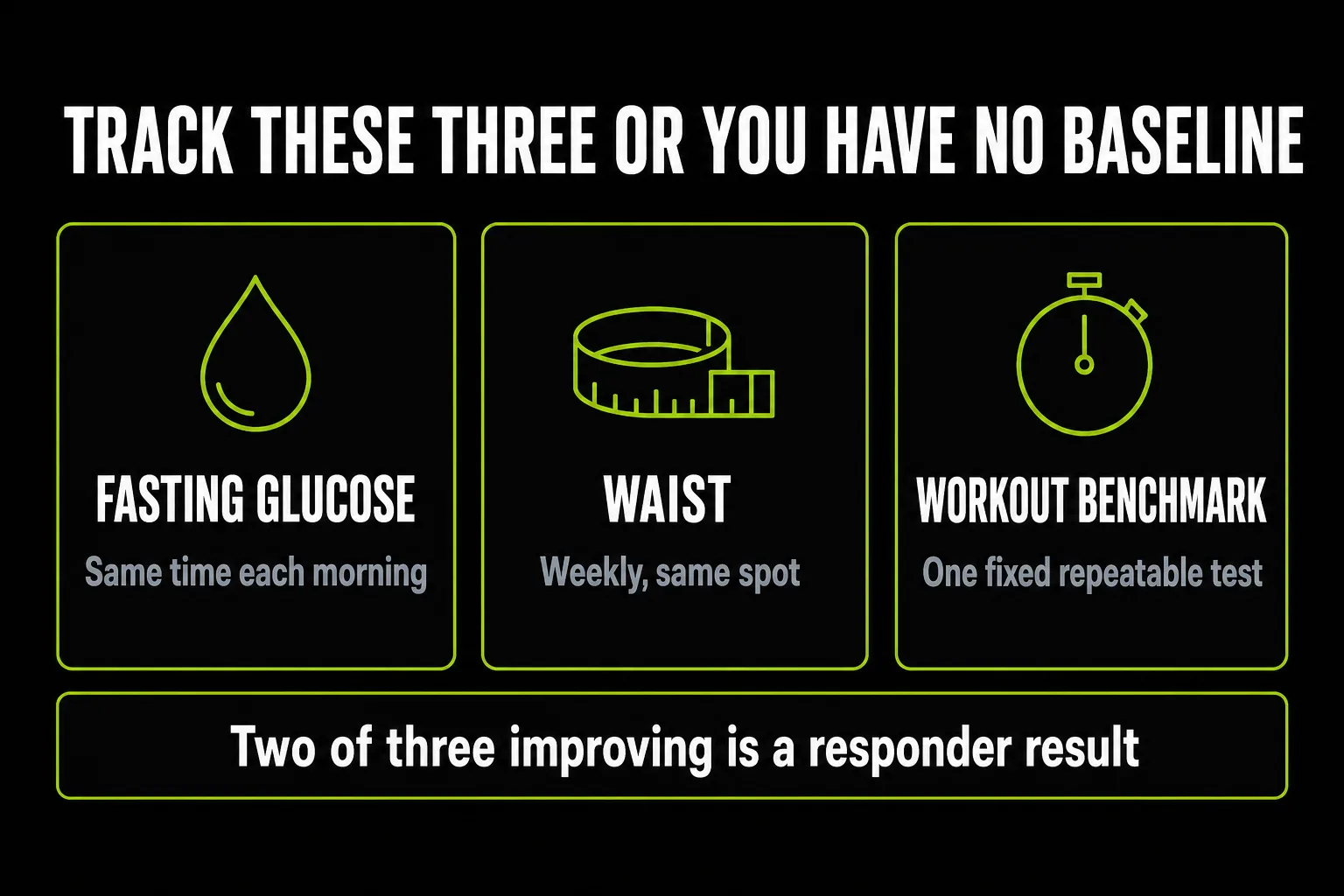
This is the step almost everyone skips, and skipping it is why so many MOTS-c reports are useless. Three markers, logged for at least a week before your first dose:
- Morning fasting glucose. Same time, same conditions, before food or coffee.
- Waist measurement. Weekly, same spot, same time of day, same tension on the tape.
- One fixed workout benchmark. Time to fatigue at a set pace, or a set distance at a set effort. It has to be repeatable.
The rule of thumb at the end: if two of those three have moved meaningfully against your baseline, you probably have a responder result. If none has moved after six to eight consistent weeks, the peptide is not doing anything for you — or the material was degraded, which is a common enough problem with MOTS-c that it deserves its own consideration below.
A Realistic Week-by-Week Timeline
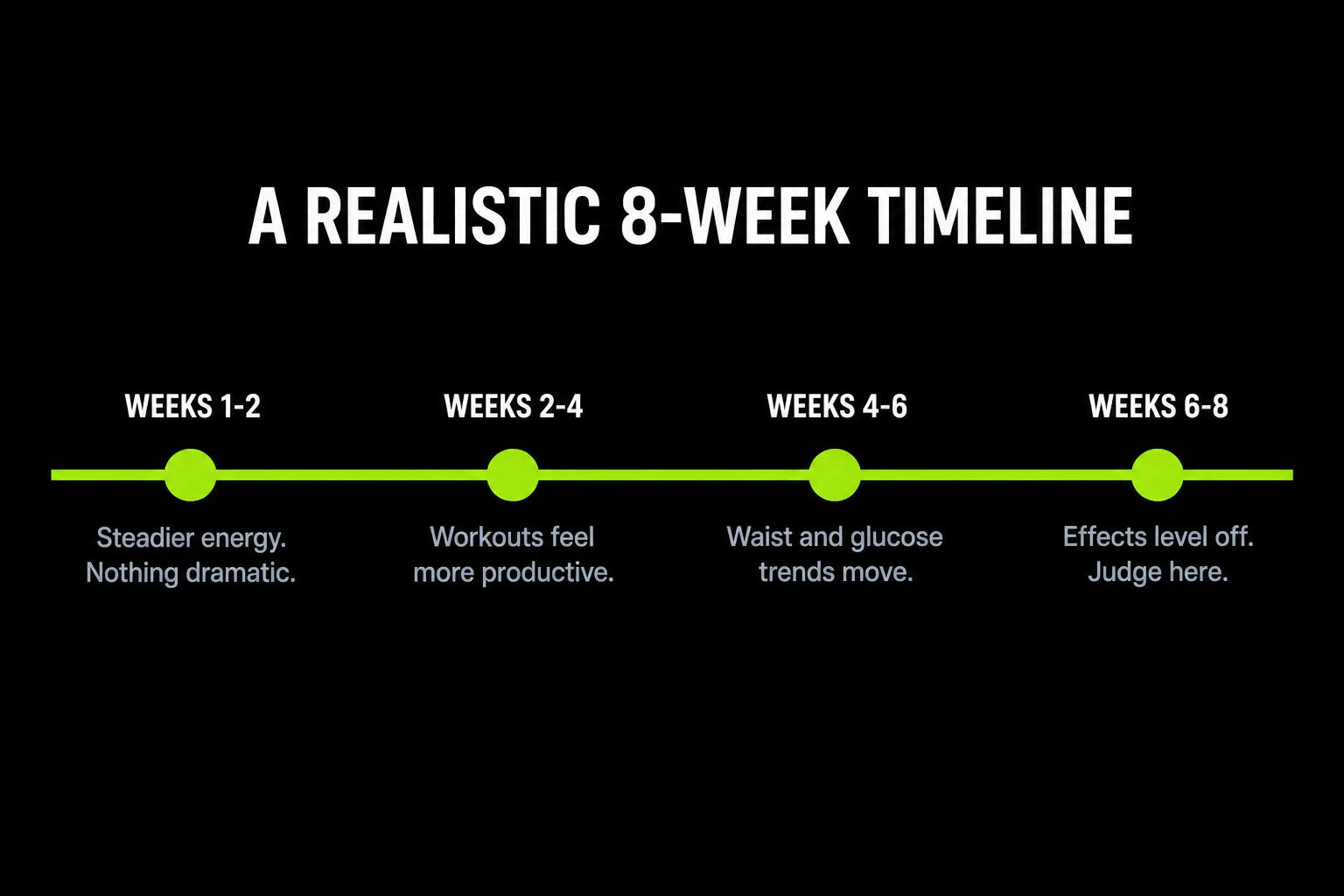
Two things worth stressing about that table. It describes the pattern that tends to emerge across user reports, not a clinical finding — nobody has run the trial that would turn it into one. And the variance is wide: a meaningful number of people run a full cycle and notice very little.
The levelling-off at weeks 6–8 is the most practically useful part. MOTS-c does not appear to keep compounding indefinitely, which is why cycles are usually structured around that window. Protocol detail is in the MOTS-c dosage guide.
What the Evidence Actually Supports
It would be dishonest to publish a results page without being clear about how thin the human data is.
The best-known work — that MOTS-c improves insulin sensitivity and reduces diet-induced obesity — comes from mouse and cell studies rather than human trials. The age-related findings follow the same pattern: in mice, MOTS-c improved running capacity, grip strength and walking ability into late life, while the human portion of that work was exercise-physiology association rather than treatment.
What has been measured in people is suggestive but different from what you are asking about. In healthy young men, skeletal-muscle MOTS-c rose roughly 12-fold after cycling, with circulating levels climbing during exercise. A human genetic variant in the MOTS-c sequence tracks with muscle-fibre composition and physical performance. Both findings say MOTS-c is a real exercise-responsive signal in humans. Neither says that injecting it reproduces those outcomes.
There are no completed human efficacy trials for MOTS-c. Treat any before and after — including yours — as personal data, not an established result. Regulatory status is covered separately in is MOTS-c FDA approved.
Who Tends to See the Most
That last row matters more than it looks. MOTS-c is not a bodybuilding peptide, and people who approach it expecting a mass or strength transformation are reliably disappointed. The MOTS-c peptide guide covers the anti-anabolic trade-off in detail, and our review covers what the experience actually feels like.
If Nothing Happened
Before concluding MOTS-c does not work for you, check the material. MOTS-c is a comparatively fragile peptide, and a flat cycle is often a sourcing or storage problem rather than a physiological one.
- Was it stored correctly? Lyophilised in the fridge, reconstituted material used within its window rather than sitting for weeks.
- Was there a batch-matched COA? Purity above 98%, lot number matching your vial, from a named independent lab.
- Was the price plausible? Material at $1–$2 per milligram is not a bargain; it is a signal.
- Was the dose consistent? Intermittent dosing across eight weeks is not the same test as consistent dosing.
What to check before buying, and the vendor comparison, is in where to buy MOTS-c. If the material checked out and you dosed consistently for eight weeks with nothing to show, the honest conclusion is that you are a non-responder — which is a legitimate and reasonably common result.
Photos, and Why They Mislead
The before and after images circulating for MOTS-c almost always show one of three things: someone who changed their diet and training at the same time, someone running MOTS-c inside a stack where another compound is doing the visible work, or a lighting and posing difference.
None of those isolate the peptide. This is not unique to MOTS-c, but it bites harder here because the honest expected outcome is a trend line rather than a silhouette change. If you want a visual record, photograph your logbook rather than your midsection.
For how it compares against the other compounds people run for the same goals, see MOTS-c vs NAD+ and MOTS-c vs SS-31. Tolerability, including the flushing response, is in MOTS-c side effects.
Frequently Asked Questions
This article is for research and educational purposes and is not medical advice. MOTS-c is not FDA approved, has no completed human efficacy trial, and is sold as research material not intended for human consumption. Any before and after described here is user-reported experience, not a clinical result.