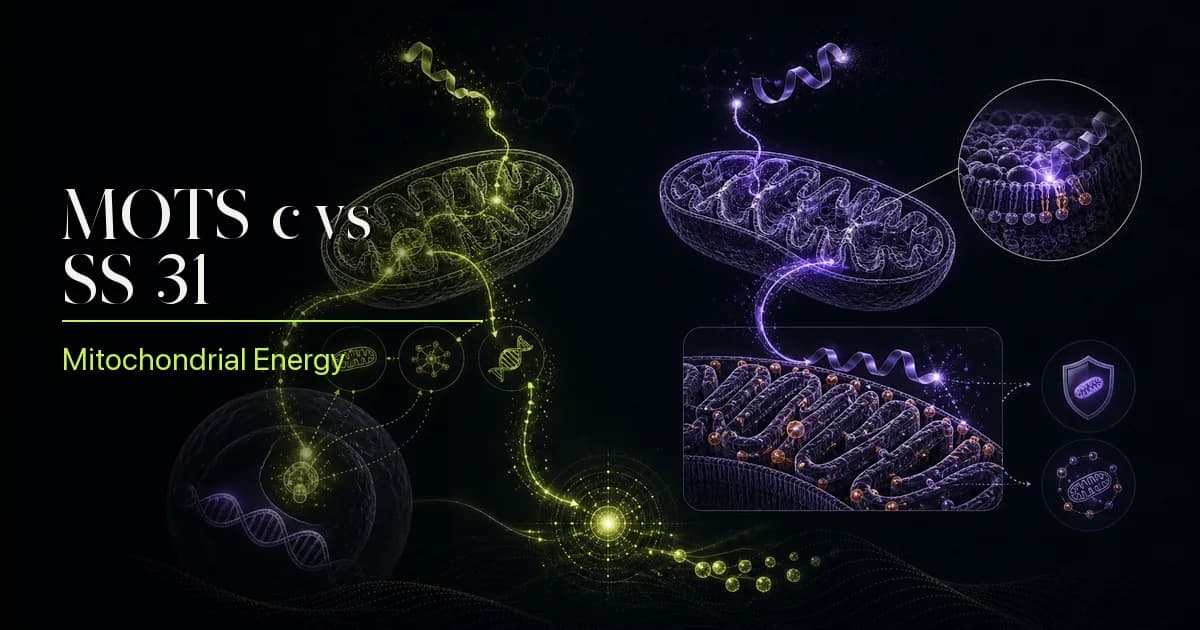
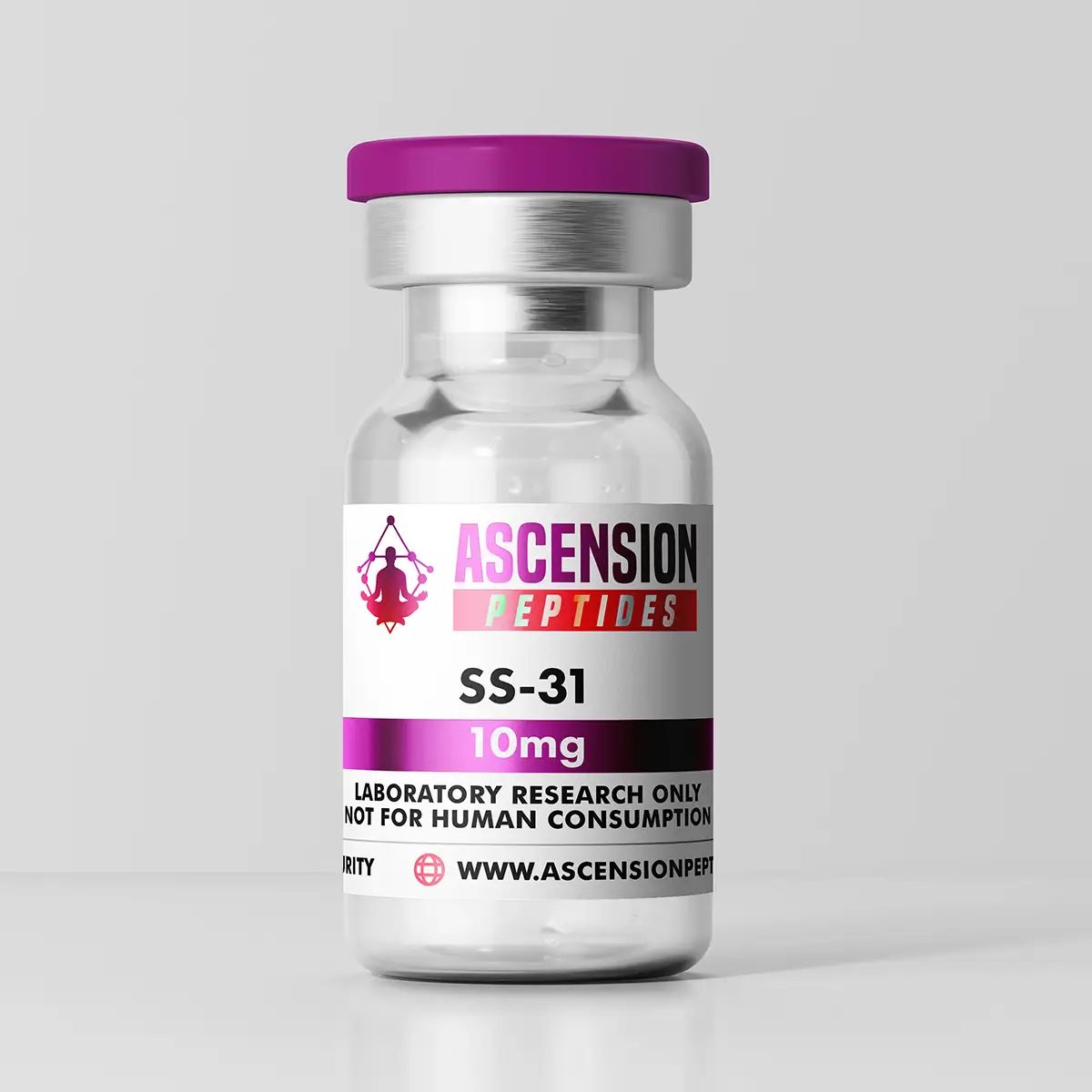
MOTS-c and SS-31 are both called "mitochondrial peptides," and both are marketed for energy, performance, and longevity. That shared label hides the fact that they do almost opposite things at the cellular level. MOTS-c is a metabolic signaling peptide that switches on the AMPK energy-sensing pathway and behaves like a partial exercise mimetic, while SS-31 (elamipretide) is a structural repair peptide that docks onto the inner mitochondrial membrane and stabilizes the machinery that makes ATP.[1][5] Understanding that difference is the entire point of choosing between them. This guide breaks down the mots-c vs ss-31 question by mechanism, evidence quality, dosing, safety, and the specific goals each peptide is actually suited for, including the landmark September 2025 FDA approval of elamipretide that separates these two molecules in a way most comparisons miss.[8]
🔑 Key Takeaways
- MOTS-c is a 16-amino-acid mitochondrial-derived peptide that activates AMPK and mimics some exercise adaptations; SS-31 (elamipretide) is a 4-amino-acid peptide that binds cardiolipin and structurally repairs the inner mitochondrial membrane.[1][5]
- SS-31 is the first mitochondria-targeted drug ever approved by the FDA, granted accelerated approval as FORZINITY for Barth syndrome on September 19, 2025; MOTS-c remains an unapproved research peptide.[8][9]
- Choose MOTS-c thinking when the goal is metabolic flexibility, insulin sensitivity, and exercise-style adaptation; choose SS-31 thinking when the goal is repairing damaged or aging mitochondria and restoring ATP output.[2][7]
- Human evidence is limited for both: MOTS-c has small correlational and single-dose data, while SS-31 has multiple controlled trials, some positive (Barth syndrome) and several that missed primary endpoints (heart failure, dry AMD).[4][6]
- The two peptides are not redundant. Because their mechanisms are complementary (signaling vs structural repair), some protocols stack them rather than pick one, though no human stacking trial exists.
MOTS-c vs SS-31 at a Glance
Before the mechanism deep-dive, here is the synthesized side-by-side. This table groups the load-bearing differences that actually change a buying or protocol decision, not just trivia.
What Is MOTS-c?
MOTS-c (Mitochondrial Open reading frame of the Twelve S rRNA type-c) is a 16-amino-acid peptide that is unusual in biology because it is encoded inside the mitochondrial genome rather than the nuclear genome. It was identified in 2015 by Lee, Cohen and colleagues at the University of Southern California, who showed it travels out of the mitochondria, into the cytoplasm, and even into the cell nucleus where it can regulate nuclear gene expression in response to metabolic stress.[1]
Its defining trick is activating AMP-activated protein kinase (AMPK), the cell's master fuel gauge. MOTS-c does this in part by interfering with the folate-methionine cycle and de novo purine synthesis, which raises intracellular AICAR, a classic AMPK activator.[1] When AMPK turns on, cells increase glucose uptake, burn fatty acids, and ramp up mitochondrial biogenesis, the same broad program that aerobic exercise triggers. In high-fat-diet mice, MOTS-c administration reduced obesity and reversed diet-induced and age-dependent insulin resistance.[1]
The headline performance finding came in 2021, when Reynolds and colleagues reported that MOTS-c treatment improved running capacity in young, middle-aged, and old mice, and that late-life intermittent dosing (three times per week) increased physical capacity and healthspan. Crucially, they also showed that in humans a single bout of exercise raises MOTS-c levels in skeletal muscle and circulation, which is why MOTS-c is described as an exercise-induced, exercise-mimetic peptide.[3] For a fuller breakdown, see our MOTS-c peptide guide and the MOTS-c dosage guide.
What Is SS-31 (Elamipretide)?
SS-31 is a synthetic tetrapeptide originally developed in the Szeto-Schiller lab, later advanced clinically under the name elamipretide. Its sequence, D-Arg-Dmt-Lys-Phe-NH2, alternates positively charged residues with aromatic ones, a design that lets it concentrate hundreds to thousands of times more inside mitochondria than in the surrounding cytoplasm.[5]
Once inside, SS-31 binds cardiolipin, the signature phospholipid of the inner mitochondrial membrane. Biophysical work shows it binds cardiolipin-rich membranes with a dissociation constant in the low micromolar range (roughly 2 to 3 micromolar) and modulates the membrane's surface electrostatics, which helps stabilize cristae architecture and the assembly of the electron transport chain.[5] The practical result is steadier ATP production and lower oxidative stress in mitochondria that are damaged or aging, rather than a metabolic command to behave like an exercising cell.
This structural-repair angle is why SS-31 has been tested in conditions defined by failing mitochondria: heart failure, primary mitochondrial myopathy, dry age-related macular degeneration, and Barth syndrome.[6] Our SS-31 (elamipretide) review covers the molecule in depth.
The one-line distinction that matters
MOTS-c tells the cell to act like it is exercising. SS-31 fixes the part of the cell that does the work. One is a signal; the other is a structural patch. That is why pairing them is biologically logical even though no human trial has tested the combination.
Mechanism Compared: Signaling vs Structural Repair
MOTS-c works upstream, through pathways
MOTS-c does not physically reinforce the mitochondrion. It changes which genes and enzymes are active. By activating AMPK and translocating to the nucleus under metabolic stress, it shifts the cell toward fat oxidation, glucose uptake, antioxidant defense, and the building of new mitochondria.[1][2] Think of it as adjusting the thermostat and wiring of the house. This is also why its benefits track so closely with the adaptations exercise produces, and why it is studied as a tool for metabolic flexibility and age-related decline rather than acute organ rescue.[3]
SS-31 works at the membrane, mechanically
SS-31 does the opposite. It accumulates on the inner membrane and physically stabilizes cardiolipin-dependent structures, improving electron transport efficiency and reducing the leak of reactive oxygen species.[5] In a randomized trial in older adults, a single dose of elamipretide improved in vivo mitochondrial ATP production in skeletal muscle, a direct readout of the energetic machinery being made to run better.[7] That is repairing the furnace, not changing the thermostat. To understand where each fits in the broader category, our overview of the best peptides for energy and mitochondrial health places them alongside NAD+ and other options.
The Evidence: How Strong Is Each, Really?
This is where the two peptides diverge most sharply, and where honest comparison matters for a YMYL decision.
MOTS-c evidence
MOTS-c has compelling preclinical data and meaningful human signals, but no completed efficacy trials. The rodent metabolism and performance work is robust.[1][3] Human data is thin and mostly observational: a 2023 preliminary study in 20 physically active adults found that higher serum MOTS-c correlated with greater lower-body force, power, and muscle mass, but notably did not correlate with peak oxygen uptake (VO2max), suggesting a strength-and-power association rather than an endurance one.[4] Reviews emphasize that human therapeutic use remains exploratory.[2]
SS-31 (elamipretide) evidence
SS-31 has the deeper clinical record, with results that cut both ways. Large trials in heart failure with preserved or reduced ejection fraction (the PROGRESS-HF program) and in dry AMD (ReCLAIM-2) missed their primary endpoints.[6] But the TAZPOWER program in Barth syndrome showed durable, multi-year improvements in knee extensor muscle strength and cardiac biomarkers, and that body of work supported the September 2025 FDA accelerated approval of FORZINITY, the first mitochondria-targeted therapy the agency has ever cleared.[6][8][10] The honest read: SS-31 is not a guaranteed fix for every mitochondrial problem, but it has crossed the bar of regulatory proof for at least one disease, which MOTS-c has not.
Why the FDA approval changes the comparison
Until late 2025, both MOTS-c and SS-31 were "research peptides" in the public imagination. The FORZINITY approval moved elamipretide into the category of an actual pharmaceutical with a known label, dose, and adverse-event profile, while MOTS-c remains a gray-market research compound. That is a material difference in evidence quality, manufacturing oversight, and accountability, even though the approved indication (ultra-rare Barth syndrome) is far narrower than how either peptide is marketed.[8]
Effect-Size-in-Real-Terms: What Each Has Actually Shown
Numbers stripped of context are useless. Here is what each peptide has demonstrably done, in the populations actually studied, so you can judge the gap between hype and data.
Dosing and Administration

Both peptides are given by subcutaneous injection. The dosing philosophies differ because the mechanisms differ.
MOTS-c: Research and clinic protocols typically use intermittent dosing, often in the range of 5 to 10 mg (5,000 to 10,000 mcg) subcutaneously several times per week, mirroring the three-times-weekly schedule that worked in aged mice, since its short half-life and signaling role favor pulses over constant exposure.[3] See the MOTS-c dosage guide for protocol detail.
SS-31: The FDA-approved FORZINITY label uses a once-daily subcutaneous regimen with a maximum daily dose of 40 mg (40,000 mcg) for Barth syndrome patients weighing at least 30 kg (about 66 lb), reflecting its longer ~4-hour plasma half-life and prolonged mitochondrial retention.[6][8] Research-grade SS-31 protocols vary widely and are not standardized.
For both, reconstitution accuracy matters. If you are new to mixing lyophilized peptides, our guide on how to reconstitute peptides walks through the dosing math, and remember to convert between mg, mcg, and mL carefully (1 mg equals 1,000 mcg).
Safety and Side Effects
The most common adverse events reported for elamipretide across its trials and on the FORZINITY label are injection-site reactions; the approval was supported by an acceptable safety profile in the studied population.[6][8] Because SS-31 is now an approved drug, its safety data are the most rigorous of any mitochondrial peptide.
MOTS-c, by contrast, has no formal human safety database. Reported effects from research and clinic use are generally mild (injection-site irritation, transient fatigue, occasional GI upset), but the absence of controlled long-term human safety data is a real limitation, not a clean bill of health.[2] Our MOTS-c side effects page covers what users report. As with any injectable peptide, sourcing from a vendor that publishes a verifiable certificate of analysis is non-negotiable.
A note on theoretical caution
AMPK activators like MOTS-c and mitochondrial-protective agents like SS-31 both improve cell survival under stress, which is overwhelmingly beneficial in normal tissue but is a reason researchers urge caution in anyone with active cancer, where you do not want to make stressed cells more resilient. Neither peptide has established human cancer-risk data, so this is precaution, not proven harm. Discuss with a clinician before use.
Who Should Consider Which: A Decision Flow
Use this as a starting framework, not medical advice. The right answer depends on your goal, your risk tolerance, and a clinician's input.
Can You Stack MOTS-c and SS-31?
Mechanistically, yes, the rationale is clean: MOTS-c signals the cell to upregulate mitochondrial capacity while SS-31 keeps the existing membranes structurally sound and efficient. Signaling plus structural support is the kind of complementary pairing that, in theory, could do more than either alone. However, there is no human trial of the combination, no validated stacking protocol, and no safety data for co-administration. If you explore this, do it under clinician supervision and read our general guidance on how to stack peptides first.
Cost and Sourcing
SS-31 as the branded drug FORZINITY is a specialty pharmaceutical priced for an ultra-rare disease and accessed by prescription, so it is not a like-for-like comparison with a research vial. Research-grade SS-31 and MOTS-c are sold by peptide vendors at very different price points, and quality varies enormously. Whichever you choose, demand a third-party certificate of analysis and verify purity before use. Our buyer guides cover current options for where to buy MOTS-c and where to buy SS-31.
SS-31 is not the only comparison worth making. MOTS-c vs NAD+ covers the other one people ask about most.
Frequently Asked Questions
The Bottom Line
The mots-c vs ss-31 decision comes down to signal versus structure. MOTS-c is the metabolic, exercise-mimetic option with strong animal data and promising but thin human evidence, best matched to metabolic flexibility and performance goals. SS-31 is the structural-repair option with the deepest clinical record of any mitochondrial peptide, including the first-ever FDA approval in this class, best matched to repairing damaged or aging mitochondria. They are not interchangeable, and for many longevity-minded protocols they are arguably complementary rather than competing. Whichever direction you lean, evidence quality and sourcing should drive the choice, and a knowledgeable clinician should be in the loop.
References
- Lee C, et al. The mitochondrial-derived peptide MOTS-c promotes metabolic homeostasis and reduces obesity and insulin resistance. Cell Metabolism, 2015. PMID 25738459.
- MOTS-c: A promising mitochondrial-derived peptide for therapeutic exploitation. PMC9905433.
- Reynolds JC, et al. MOTS-c is an exercise-induced mitochondrial-encoded regulator of age-dependent physical decline and muscle homeostasis. Nature Communications, 2021. PMC7817689.
- MOTS-c serum concentration positively correlates with lower-body muscle strength and is not related to maximal oxygen uptake: a preliminary study. PMC10573682.
- Mitochelli/Szeto-Schiller mechanism: The mitochondria-targeted peptide SS-31 binds lipid bilayers and modulates surface electrostatics. PMC7247319.
- Elamipretide: A Review of Its Structure, Mechanism of Action, and Therapeutic Potential. Int J Mol Sci, 2025. PMC11816484.
- In vivo mitochondrial ATP production is improved in older adult skeletal muscle after a single dose of elamipretide in a randomized trial. PMC8282018.
- FORZINITY (elamipretide) injection, full prescribing information. FDA, NDA 215244, 2025.
- FDA Approves First Medication for Barth Syndrome. Barth Syndrome Foundation, Sept 19, 2025.
- Stealth BioTherapeutics announces FDA accelerated approval of FORZINITY (elamipretide). Sept 2025.