🔑 Key Takeaways
- SS-31 (Elamipretide) is the only mitochondrial peptide with significant human clinical trial data — Phase 2/3 trials across multiple conditions
- It targets cardiolipin in the inner mitochondrial membrane with 1,000–5,000x concentration specificity — remarkably precise for a peptide
- Clinical trials show improvements in exercise capacity, cardiac function, and skeletal muscle energetics in older adults
- SS-31 and MOTS-c work through completely different mechanisms and complement each other for comprehensive mitochondrial support
- Unlike NAD+ or CoQ10 (which provide substrates), SS-31 protects the physical structures that make energy production possible
Most longevity peptides have compelling theories and animal data. SS-31 has something rarer: actual human clinical trials. Multiple Phase 2 and Phase 3 studies, in real patients, with measured outcomes. That distinction matters more than people realize, because the graveyard of compounds that worked brilliantly in mice but failed in humans is vast.
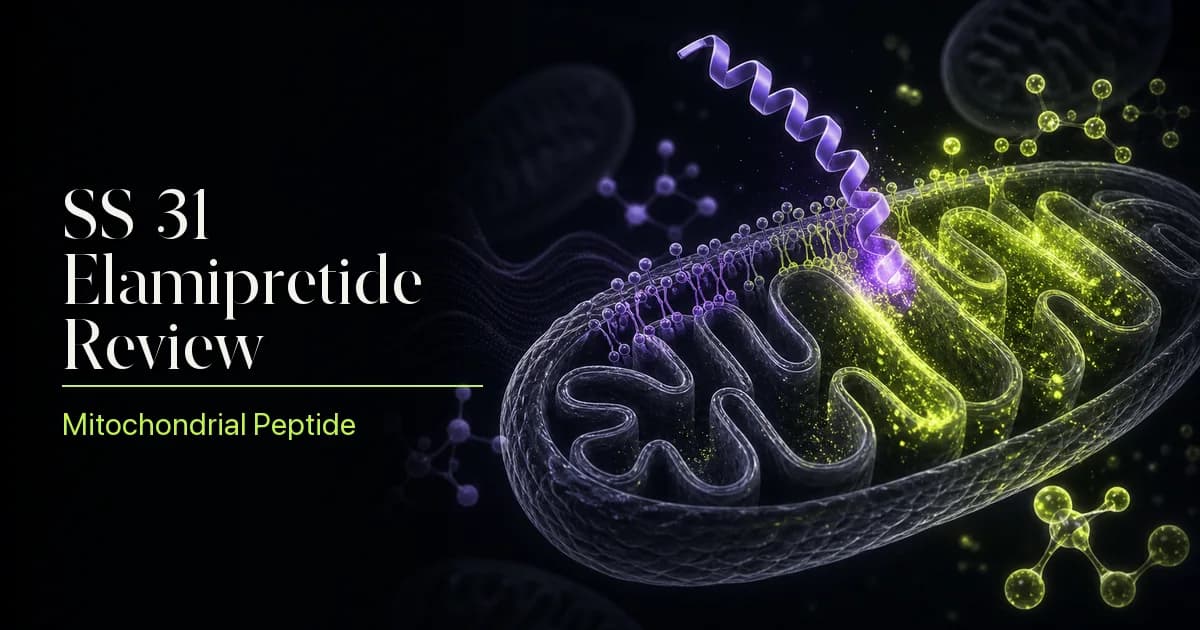
SS-31 — also known as Elamipretide, MTP-131, or Bendavia — is a tetrapeptide engineered to embed itself in the inner mitochondrial membrane and stabilize cardiolipin, the phospholipid that holds the entire electron transport chain together. When cardiolipin degrades (as it does with aging), ATP production drops, reactive oxygen species spike, and cells begin a slow descent into dysfunction. SS-31 reverses that process at the membrane level.
For the broader picture of mitochondrial peptides, see our best peptides for energy and mitochondrial health guide. This article focuses specifically on SS-31 — its mechanism, the clinical evidence, practical dosing, and how it fits into a longevity protocol.
What Is SS-31 and How Was It Developed?
SS-31 belongs to the Szeto-Schiller (SS) peptide family, developed by Dr. Hazel Szeto at Cornell University's Weill Medical College. The design is elegant: alternating aromatic and basic amino acid residues (D-Arg-Dmt-Lys-Phe-NH2) create a structure with extraordinarily high affinity for cardiolipin — a phospholipid found almost exclusively in the inner mitochondrial membrane.
What makes SS-31 unusual among research peptides is that it was developed through a pharmaceutical pipeline — Stealth BioTherapeutics held the IP and advanced it through multiple clinical trials. When some cardiac trial results came back mixed commercially, the compound's pharmaceutical trajectory became complicated. But the basic science remained strong, which is why it's now available as a research peptide with a depth of human data that most longevity compounds can't match.
Why Cardiolipin Is the Key to Mitochondrial Health
To understand SS-31, you need to understand cardiolipin. This phospholipid is found nowhere else in the cell — only in the inner mitochondrial membrane. It serves several critical functions:
- Electron Transport Chain scaffolding: Cardiolipin organizes the respiratory complexes (I, II, III, IV) and ATP synthase into supercomplexes. Without proper cardiolipin structure, these complexes drift apart and electron transfer becomes inefficient
- Cytochrome c anchoring: Cardiolipin binds cytochrome c to the membrane. When cardiolipin oxidizes, cytochrome c detaches — this is actually an early signal in programmed cell death (apoptosis)
- Proton gradient maintenance: Acts as a proton trap, helping maintain the electrochemical gradient that drives ATP synthesis
- Membrane fluidity: Cardiolipin's unique four-tail structure gives the inner membrane the flexibility it needs for cristae formation and dynamic reshaping
Here's what happens with aging: cardiolipin becomes progressively oxidized by the very reactive oxygen species (ROS) that mitochondria produce during normal operation. Oxidized cardiolipin loses its structural properties. The ETC supercomplexes destabilize. ATP production drops while ROS production increases — a vicious cycle that accelerates mitochondrial deterioration.
How SS-31 Works at the Molecular Level
SS-31 concentrates in mitochondria at 1,000–5,000 times its concentration in the surrounding cytoplasm. That specificity is remarkable for any compound, let alone a small peptide. Once embedded in the inner membrane, it:
Stabilizes Cardiolipin-Cytochrome c Interactions
By binding to cardiolipin, SS-31 prevents oxidation-driven structural changes that would otherwise release cytochrome c. This keeps the electron transport chain organized and functioning efficiently, maintaining ATP output while preventing the apoptotic signaling that occurs when cytochrome c enters the cytoplasm.
Reduces Mitochondrial ROS at the Source
Rather than scavenging ROS after they're produced (the approach of most antioxidants), SS-31 reduces ROS generation in the first place — by maintaining efficient electron flow through the transport chain. Electrons that "leak" from disorganized complexes are the primary source of mitochondrial ROS. Keep the complexes organized, and leakage drops.
Improves ATP Synthesis Efficiency
With stabilized supercomplexes and maintained proton gradients, ATP synthesis runs more efficiently. Studies show measurable increases in ATP production and improvement in the P/O ratio (phosphorylation efficiency) following SS-31 treatment (Birk et al., JASN, 2013).
Supports Mitochondrial Biogenesis Signaling
Improved mitochondrial function sends positive signals for mitochondrial biogenesis — the creation of new mitochondria. Healthy mitochondria beget more healthy mitochondria, potentially reversing the decline in mitochondrial density that characterizes aging tissue.
Human Clinical Trial Data
This is where SS-31 separates itself from nearly every other longevity peptide on the market.
The Barth Syndrome results deserve special attention. Barth Syndrome is a genetic disease caused specifically by mutations affecting cardiolipin metabolism. The fact that SS-31 improved outcomes in patients with inherent cardiolipin dysfunction is strong mechanistic validation — it confirms that cardiolipin stabilization in humans produces measurable functional benefits.
The aging muscle study is equally important for the longevity community. Older adults receiving SS-31 showed improved mitochondrial respiration and reduced oxidative stress — their muscle mitochondria moved measurably toward younger adult profiles. That's as close to "anti-aging at the cellular level" as any compound has demonstrated in a controlled human study.
SS-31 vs Other Mitochondrial Compounds
These aren't competing approaches — they're complementary layers. NAD+ provides the raw material mitochondria need. CoQ10 carries electrons through the transport chain. SS-31 protects the membrane structures that make the whole process work. And MOTS-c activates the metabolic signaling that drives it all. For a comparison of MOTS-c specifically, see our MOTS-c review.

Dosing Protocols for SS-31
Administration Notes
- Route: Subcutaneous injection is the standard for non-clinical settings. Clinical trials used both SubQ and IV infusion
- Timing: No specific timing requirements — SS-31 is not affected by food intake
- Reconstitution: Standard bacteriostatic water reconstitution. SS-31 dissolves readily
- Storage: Refrigerate reconstituted solution; use within 3–4 weeks. Lyophilized powder stable at -20°C
What to Expect: Realistic Timeline
Research Applications
SS-31's specificity makes it relevant across multiple domains:
Cardiac Health
Heart tissue is extraordinarily mitochondria-dense — cardiac cells contain more mitochondria than almost any other cell type. SS-31's cardiolipin stabilization directly supports cardiac energy production and has shown benefits in heart failure models. The ischemia-reperfusion data is particularly strong.
Skeletal Muscle Aging
Sarcopenia (age-related muscle loss) is driven partly by mitochondrial dysfunction in muscle fibers. SS-31's ability to restore mitochondrial respiration in aging muscle has direct implications for maintaining strength, mobility, and functional independence.
Neuroprotection
Neurons are among the most metabolically demanding cells in the body. Mitochondrial dysfunction is central to Alzheimer's, Parkinson's, and ALS pathology. SS-31's ability to protect mitochondrial function in high-demand cells makes it a compound of significant interest in neurodegeneration research.
Kidney Protection
The kidneys have the second-highest mitochondrial density after the heart. SS-31 has extensive data in acute kidney injury models showing protective effects during ischemia-reperfusion — a common surgical complication.
Building a Longevity Stack with SS-31
SS-31 pairs logically with other longevity-focused compounds:
SS-31 + MOTS-c: Complete Mitochondrial Support
SS-31 protects mitochondrial membrane structure while MOTS-c activates metabolic signaling (AMPK pathway). One maintains the hardware; the other runs the software. This combination addresses mitochondrial health from two completely independent angles.
SS-31 + Epithalon: Two Hallmarks of Aging
SS-31 targets mitochondrial dysfunction while Epithalon targets telomere shortening. These are two of the nine recognized hallmarks of aging — addressing both simultaneously provides broader anti-aging coverage than either alone.
SS-31 + NAD+ Precursor: Substrate + Structure
NAD+ precursors (NMN or NR) replenish the coenzyme that mitochondria need for electron transport. SS-31 protects the membrane structures where that transport occurs. Together, they ensure both the fuel and the engine are optimized. See our NAD+ benefits and dosing guide for details.
SS-31 + FOXO4-DRI: Energy + Senescence
For the most comprehensive longevity approach: SS-31 optimizes cellular energy production while FOXO4-DRI clears senescent "zombie cells" that secrete inflammatory factors damaging nearby healthy cells. Addresses both energy decline and inflammatory aging. For an overview of all anti-aging peptides, see our best anti-aging peptides for 2026 guide.
Side Effects and Safety Profile
SS-31's clinical trial data provides a safety profile that most research peptides lack:
Reported Side Effects (from clinical trials)
- Injection site reactions: Mild redness or discomfort — the most common report, typically transient
- Headache: Reported in some trial participants, usually mild
- Gastrointestinal effects: Occasional nausea, typically at higher doses
- Dizziness: Rare, usually related to IV administration rather than SubQ
No serious adverse events attributable to SS-31 were reported in published clinical trials at therapeutic doses. The peptide's high specificity for mitochondrial membranes means it has minimal interaction with other cellular systems — which contributes to its clean safety profile.