Mitochondrial Peptides
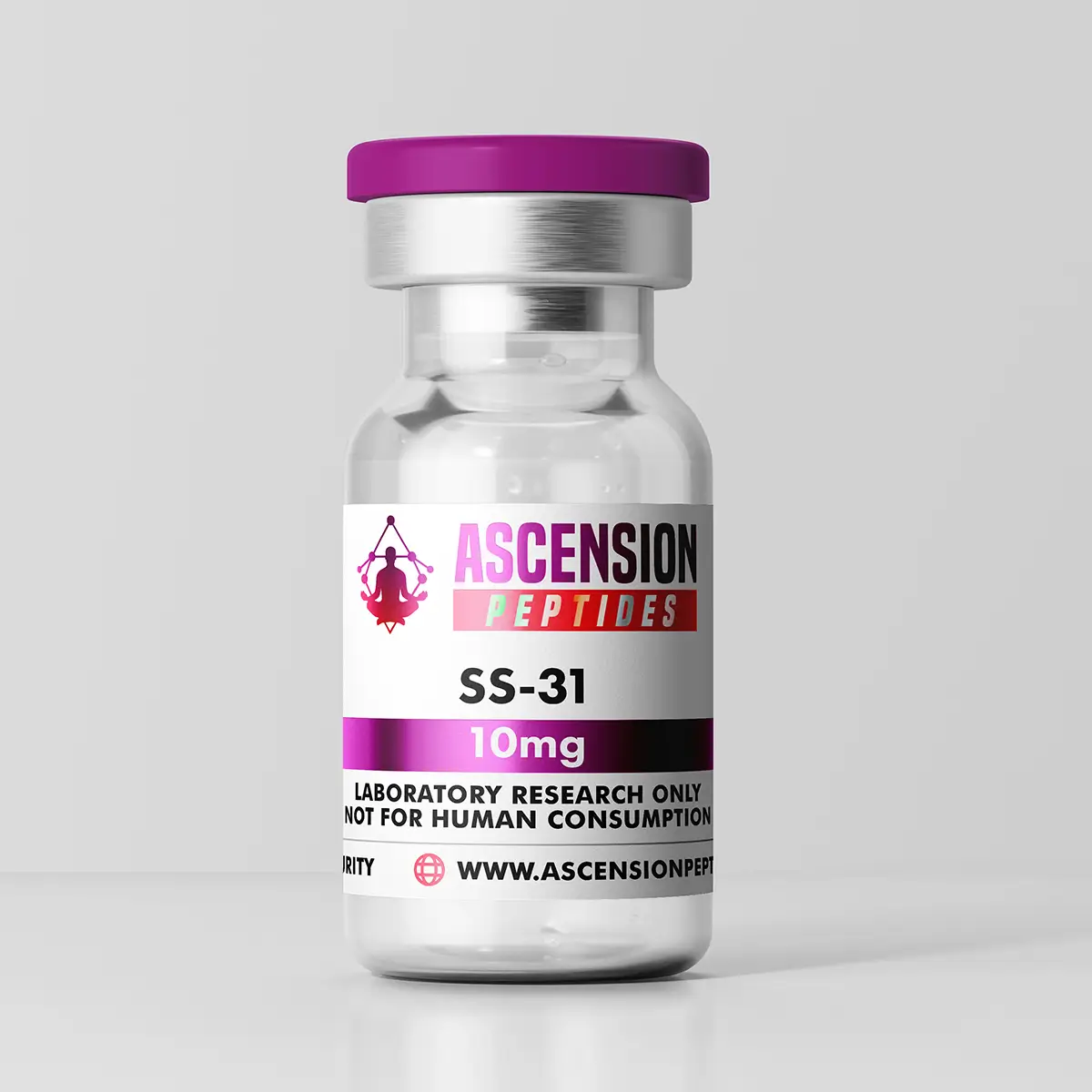
SS-31 (Elamipretide)
with codePEPTIDEDECKat checkout· list $79.99
- Purity
- 99%+
- Vial
- 10mg
- Form
- Lyophilized powder in vial
- Half-life
- Not published
Buy SS-31 (Elamipretide) 10mg at PeptideDeck -- a mitochondria-targeting tetrapeptide (D-Arg-dmTyr-Lys-Phe-NH2) that selectively accumulates in the inner mitochondrial membrane, binds cardiolipin, and is studied in oxidative stress, bioenergetics, and mitochondrial dysfunction research. Research-grade, 99%+ HPLC-verified lyophilized powder. Ships same-day from the USA.
About SS-31 (Elamipretide)
Looking to buy SS-31 for a mitochondrial biology or cardiolipin-targeting study? PeptideDeck lists SS-31 (Elamipretide) 10mg vials for sale from a vetted US research supplier at 99%+ HPLC-verified purity, with same-day US shipping and a Certificate of Analysis available on request. The SS-31 price on this listing is $79.99 per 10mg vial. SS-31 for sale in 10mg format is the standard working quantity for in-vitro mitochondrial function assays, reactive oxygen species (ROS) scavenging experiments, and ex-vivo tissue preparations where investigators need to purchase SS-31 Elamipretide in a quantity sufficient for multi-arm dose-response protocols without excessive cost per experiment.
SS-31, designated Elamipretide in clinical development and also known in the research literature as MTP-131 and Bendavia, is a cell-permeable, mitochondria-targeted tetrapeptide with the sequence D-Arg-dmTyr-Lys-Phe-NH2 (2',6'-dimethyltyrosine at position 2). The alternating cationic and aromatic residue design -- initially characterized by Hazel Szeto and colleagues at Cornell University -- allows SS-31 to traverse cell membranes without requiring a driving electrical potential, a key advantage over earlier mitochondria-targeted antioxidants such as MitoQ that depend on the mitochondrial membrane potential for their selective accumulation. Once inside the cell, SS-31 localizes preferentially to the inner mitochondrial membrane (IMM) through electrostatic and pi-pi stacking interactions with the IMM-specific phospholipid cardiolipin, achieving mitochondrial matrix concentrations estimated at several hundred-fold above cytoplasmic levels.
Where to Buy SS-31 (Elamipretide)
PeptideDeck lists SS-31 for sale from a vetted US research supplier that publishes batch-level analytical quality data. When research teams ask us where to buy SS-31 or where to buy Elamipretide with confidence in peptide identity, purity, and fast US delivery, this is the listing we point them to. The SS-31 price at $79.99 per 10mg vial is competitive with US research peptide vendors supplying HPLC and mass-spec verified material. Shipping is same-day from a US warehouse with tracked delivery and discreet packaging. Checkout resolves directly through the partner vendor's live inventory system.
Researchers evaluating SS-31 price across sources should verify whether purity is reported as HPLC-net-peptide or gross peptide including counterion salts, and whether the listed molecular weight refers to the free base or the acetate salt. The 99%+ purity at this listing is HPLC-determined for the peptide fraction. For multi-vial bulk orders, contact the supplier directly through the checkout portal. Buy SS-31 Elamipretide for research use only.
Quality Assurance and COA
Every SS-31 vial at this listing undergoes batch-level analytical testing before release. Identity is confirmed by ESI-MS against the expected molecular weight of the SS-31 free base (approximately 639.78 g/mol). Purity is quantified by reverse-phase HPLC with UV detection. The Certificate of Analysis documents lot number, synthesis date, analytical method, HPLC purity result, and MS confirmation data. COA documents are available on request -- contact the supplier with your order number. Vials are sealed under inert gas in borosilicate glass with a butyl rubber stopper and aluminum crimp seal. The cGMP-aligned manufacturing, sterile glass packaging, and lot-level analytical verification are the quality standards that distinguish this SS-31 Elamipretide listing from unverified commodity sources.
Mechanism of Action
The mechanistic core of SS-31 biology is its interaction with cardiolipin, a dimeric phospholipid uniquely enriched in the inner mitochondrial membrane where it plays structural and functional roles in organizing the electron transport chain (ETC) respiratory supercomplexes. During cellular stress -- ischemia, aging-related mitochondrial damage, or elevated ROS -- cardiolipin becomes peroxidized by cytochrome c, which then dissociates from the IMM and triggers apoptotic signaling. SS-31 binds cardiolipin through a combination of electrostatic interactions (the D-Arg and Lys cationic groups) and aromatic pi-electron interactions (the dmTyr and Phe aromatic rings) and has been shown to inhibit cardiolipin peroxidation, prevent cytochrome c dissociation from the IMM, and maintain respiratory supercomplex architecture under conditions that would otherwise cause complex disassembly.
The downstream functional consequences documented in preclinical research include: restoration of ATP production in oxygen-glucose deprived cells; reduction in mitochondrial ROS generation measured by MitoSOX and CM-H2DCFDA fluorescence assays; normalization of mitochondrial membrane potential (measured by JC-1 or TMRE); prevention of mitochondrial permeability transition pore (mPTP) opening under calcium overload conditions; and attenuation of apoptotic cytochrome c release and downstream caspase activation. These effects have been characterized in a wide range of cell types including cardiomyocytes, renal tubular epithelial cells, neurons, skeletal muscle fibers, and retinal ganglion cells.
The respiratory supercomplex stabilization mechanism is particularly well documented. SS-31 has been shown by blue-native polyacrylamide gel electrophoresis (BN-PAGE) to preserve the assembly of Complex I-III-IV supercomplexes (respirasomes) that form along the curved cristae of the IMM -- structural features whose maintenance depends critically on intact cardiolipin. In aged tissues where cardiolipin content declines and cardiolipin acyl chain remodeling is disrupted, SS-31 treatment partially restores supercomplex assembly and improves State 3 mitochondrial oxygen consumption. This aging-associated mitochondrial decline application is one of the primary reasons research teams continue to purchase SS-31 Elamipretide for preclinical aging and bioenergetics studies.
In ischemia-reperfusion (IR) research, SS-31 has been characterized in cardiac, renal, cerebral, and hepatic IR models. The compound is added either before ischemia (preconditioning), at the time of reperfusion, or after reperfusion, and in all three experimental windows it has demonstrated attenuation of IR-associated mitochondrial damage endpoints. The reperfusion-window application is particularly mechanistically interesting because SS-31 accumulation is not membrane-potential-dependent; the peptide can reach the IMM even when the membrane potential collapses during ischemia and re-establishes during reperfusion, which is the window when other mitochondria-targeted compounds fail to accumulate.
Chemical Profile
SS-31 (Elamipretide) has the formal chemical name D-Arg-2',6'-dimethyltyrosyl-Lys-Phe-NH2 acetate salt. The molecular formula of the free base is C₃₂H₄₉N₇O₅ with a molecular weight of approximately 639.78 g/mol; as the acetate salt form typically supplied in research-grade preparations, the formula is C₃₂H₄₉N₇O₅ · xCH₃COOH. The CAS registry number for the acetate salt form is 736992-21-5. The sequence contains a D-configuration arginine at position 1 (providing protease resistance), a non-proteinogenic 2',6'-dimethyltyrosine (dmTyr) at position 2 (enhancing membrane partitioning and ROS scavenging), a standard L-lysine at position 3, a standard L-phenylalanine at position 4, and a C-terminal amide rather than a free carboxylate.
This research-grade SS-31 is supplied as a lyophilized white amorphous powder in a sealed borosilicate glass vial. Purity is 99%+ by HPLC; identity is confirmed by mass spectrometry. The 10mg vial at this purity corresponds to approximately 15.6 micromoles of SS-31 free base. The lyophilized powder is stable during ambient-temperature US transit (2 to 4 business days); transfer to minus 20 degrees Celsius on receipt for long-term storage.
Research Applications
SS-31 is one of the most extensively characterized mitochondria-targeted peptides in the preclinical pharmacology literature. Documented research applications include:
Cardiac ischemia-reperfusion protection: SS-31 was initially characterized in cardiac IR models where it preserved mitochondrial function, reduced infarct size, and maintained contractile recovery in isolated perfused heart preparations and in-vivo rodent ligation models. The Szeto group's foundational studies remain the most-cited SS-31 publications and define cardiac IR as the primary application domain.
Renal ischemia and acute kidney injury: SS-31 has been characterized in rodent models of ischemic AKI, cisplatin-induced nephrotoxicity, and contrast nephropathy, consistently reducing tubular cell apoptosis, preserving GFR, and restoring mitochondrial morphology in proximal tubular cells.
Skeletal muscle aging and sarcopenia: Several groups have characterized SS-31 in aged rodent skeletal muscle models, showing improvements in mitochondrial respiration, reduction in fiber atrophy markers, and partial restoration of exercise capacity in aged mice. This application area is closely related to the MOTS-c exercise-mimetic research domain.
Neurodegenerative model research: SS-31 has been investigated in Alzheimer's, Parkinson's, and ALS cell and animal models, with reported reductions in oxidative stress markers, preservation of mitochondrial morphology, and attenuation of apoptosis. Retinal ganglion cell research in glaucoma and optic nerve injury models is another documented application.
Cardiomyopathy and heart failure models: The clinical-stage Elamipretide program (MMAD trial, PROGRESS-HF) investigated SS-31 in human heart failure; the preclinical cardiomyopathy literature that supported this program is the most extensive translational dataset available for SS-31. All applications summarized here are documented in preclinical literature or in-vitro systems only. PeptideDeck supplies SS-31 strictly for laboratory research.
Reconstitution and Dosing Reference
For a 10mg SS-31 vial, a standard research reconstitution is 2mL of sterile water for injection or bacteriostatic water, yielding a concentration of 5mg/mL. For in-vitro applications requiring lower working concentrations, prepare the primary stock in sterile water and dilute to working concentration in the assay buffer, PBS, or culture media. SS-31 is highly water-soluble due to its cationic residues; it dissolves readily and does not require organic co-solvents. Add the diluent slowly to the lyophilized powder, allow 2 to 3 minutes for dissolution, and gently swirl rather than vortex.
Published in-vitro working concentrations for SS-31 range from 10 nanomolar to 10 micromolar depending on the cell type and endpoint; the cardiolipin-binding affinity of the peptide is high enough that sub-micromolar concentrations achieve measurable mitochondrial ROS reduction in most cell models. For in-vivo rodent studies, intravenous, subcutaneous, and intraperitoneal routes have all been used; consult the Szeto group publications for species- and model-appropriate dose levels. These figures are research reference only. PeptideDeck does not publish human dosing guidance. The 10mg SS-31 vial supports between 20 and 200 in-vitro research preparations depending on working concentration and assay volume.
Storage and Handling
Store unopened SS-31 vials at minus 20 degrees Celsius for long-term stability. Short-term storage at refrigerator temperature (2 to 8 degrees Celsius) for up to two weeks is acceptable provided the vial is sealed. Once reconstituted with sterile or bacteriostatic water, refrigerate the solution at 2 to 8 degrees Celsius and use within 30 days. SS-31 solutions are sensitive to prolonged UV exposure due to the aromatic dmTyr and Phe residues; protect reconstituted solutions from direct light. Avoid freeze-thaw cycling of reconstituted stock; prepare single-use aliquots at reconstitution if multi-session use is anticipated. Wipe the stopper with 70% isopropyl alcohol before each draw. Document the lot number and receipt date in a laboratory logbook for traceability.
Research Benefits
Mitochondria-targeting tetrapeptide with cell-permeable design
99%+ HPLC-verified purity, 10mg lyophilized vial
Selectively binds cardiolipin in the inner mitochondrial membrane
Studied in respiratory supercomplex stabilization and ATP production
Used in ischemia-reperfusion protection research models
Investigated in ROS scavenging and mitochondrial membrane potential studies
Characterized in aging skeletal muscle and cardiomyopathy models
Research tool in neurodegenerative and renal injury biology
Product Specifications
| Molecular Weight | 639.78 g/mol (C₃₂H₄₉N₇O₅, free base) |
| Sequence | D-Arg-dmTyr-Lys-Phe-NH₂ (4 aa) |
| Half-Life | Not published |
| Purity | 99%+ |
| Form | Lyophilized powder in vial |
| Storage | Store lyophilized at -20°C. Once reconstituted, refrigerate and use within 30 days. |
Frequently Asked Questions
You May Also Like
View all →
Mitochondrial Peptides
MOTS-c
Mitochondrial-Derived Peptide, 10mg Research Vial For Sale
Growth Factor Peptides
IGF-1 LR3
Long R3 Insulin-like Growth Factor-1, 1mg vial
Growth Hormone Releasing Hormone (GHRH) Analogues
CJC-1295 (No DAC)
Modified GRF (1-29) GHRH Analogue, 5mg Lyophilized Vial
Copper Peptides
GHK-Cu
GHK-Cu For Sale: 50mg 99%+ Purity Copper Tripeptide
Research Use Only. All products sold by PeptideDeck are strictly for in-vitro laboratory research and are not intended for human or veterinary use, diagnosis, or treatment. Not for resale.