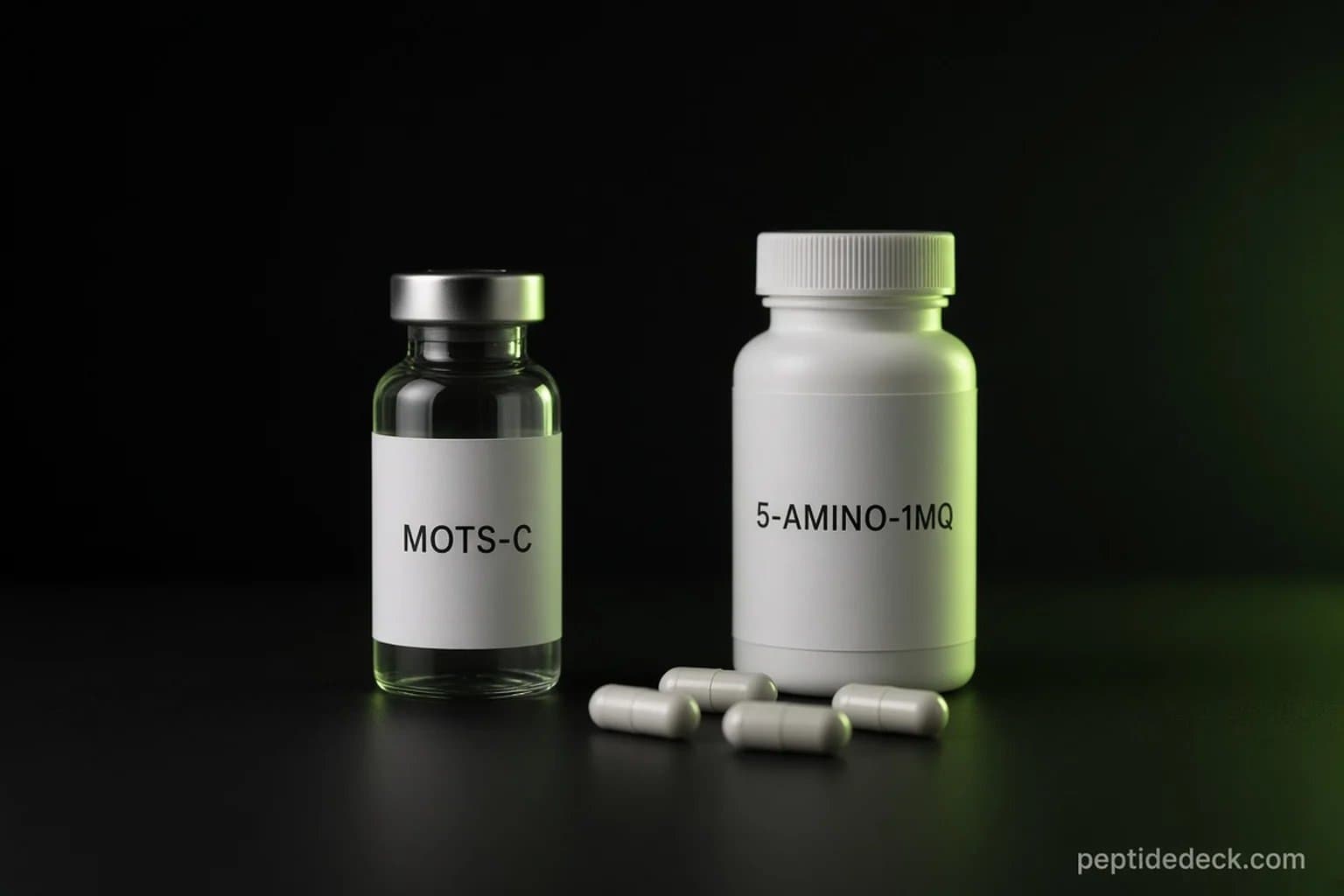
One is a capsule. The other is a shot.
That is usually where the 5-Amino-1MQ vs MOTS-c question starts. You want to lose fat, keep the muscle you have and stop feeling flat by mid-afternoon, and two names keep coming up as the "metabolic" picks. They sound alike and get stacked together so often that most people assume they do the same job. They don't. One blocks an enzyme inside your fat cells. The other is a signal your own mitochondria send when energy runs low. Which one fits you depends on your goal, your tolerance for needles, and how much you trust results that so far come from mice.
🔑 Key Takeaways
- 5-Amino-1MQ is not a peptide. It is a small molecule that blocks an enzyme called NNMT. MOTS-c is a 16-amino-acid peptide that switches on AMPK.
- For fat loss, 5-Amino-1MQ has the more direct mouse data. For endurance and blood sugar control, MOTS-c does. The muscle story is closer than you'd think.
- Every 5-Amino-1MQ result so far came from injections. What that means for capsules is the part most comparison pages skip.
- The doses that worked in mice and the doses people take are far apart, and not in the same direction for both compounds.
- At the usual doses they cost almost exactly the same per week. Stacking them doubles it, and no study has tested the pair.
Below, we compare what each one is, what the studies actually measured, how each is taken, side effects, weekly cost and whether stacking them makes sense, with every number traced to its source.
5-Amino-1MQ vs MOTS-c at a Glance
Start with the short version.
The rest of this page explains each row, starting with the one that trips people up most: what these two things actually are.
What Is 5-Amino-1MQ?
It's sold next to peptides. It isn't one.
5-Amino-1MQ (5-amino-1-methylquinolinium) is a small, flat ring molecule designed by a team at the University of Texas Medical Branch to block nicotinamide N-methyltransferase, or NNMT. NNMT is an enzyme that sits mostly in fat tissue and muscle, and it gets busier with obesity and with age.
Here is why that matters. NNMT takes nicotinamide, a form of vitamin B3 your cells recycle into NAD+, and tags it with a methyl group borrowed from SAM, your body's main methyl donor. The tagged product, 1-MNA, is waste. So every turn of NNMT costs you a little NAD+ raw material and a little SAM. In fat cells, block NNMT and both pile back up: in the first published 5-Amino-1MQ study, treated fat cells showed higher NAD+ and SAM and made less new fat.
That NAD+ angle is why 5-Amino-1MQ gets lumped in with NAD+ boosters. It doesn't add NAD+. It stops one leak. Our 5-Amino-1MQ guide covers the chemistry in more depth, and our MOTS-c vs NAD+ comparison explains where direct NAD+ fits.
What Is MOTS-c?
Your mitochondria make it themselves.
MOTS-c is a 16-amino-acid peptide coded inside the mitochondrial 12S rRNA gene, discovered at the University of Southern California and published in Cell Metabolism in 2015. It acts mostly on skeletal muscle. Inside the cell it slows the folate cycle, which builds up a molecule called AICAR, and that switches on AMPK, the master sensor that tells a cell energy is running low and it should burn fuel and take up glucose.
A 2018 follow-up from the same lab showed that under stress, such as low glucose, MOTS-c moves into the cell nucleus and helps turn on protective genes, in an AMPK-dependent way. Your own levels rise when you exercise. That is the source of its "exercise in a vial" reputation, and our MOTS-c peptide guide covers the full background.
So the mechanisms touch, but they don't overlap. 5-Amino-1MQ changes how much NAD+ and SAM a fat or muscle cell keeps. MOTS-c changes how hard a muscle cell burns fuel. Both end up near the same pathways (AMPK and the NAD+-dependent sirtuins talk to each other), which is the whole theory behind stacking them.
The Evidence: What Each One Has Actually Shown
Every result in this section, bar one, is from mice.
5-Amino-1MQ and fat loss
The first in-body test came in 2018. Mice made obese on a high-fat diet for 16 weeks got 5-Amino-1MQ injected under the skin, 20 mg/kg three times a day, for 11 days (9 mice per group). Treated mice lost 5.1% of their body weight while controls gained 1.4%. Their main fat pad shrank by about 35%, fat cells got more than 30% smaller and total cholesterol fell about 30%. Food intake didn't change, which is the detail that makes this interesting: they ate the same and still lost fat.
The 2024 follow-up is the one to read closely. Obese mice got a daily injection for 30 days at either 10 or 32 mg/kg (8 per group). On 32 mg/kg, mice gained 1.3 g of fat against 4.7 g on placebo, glucose tolerance improved, and liver fat (microvesicular steatosis) dropped 73%. On 10 mg/kg, fat gain was 4.7 g, identical to placebo. Lean mass didn't change in either group. In short, it worked at the high dose and failed at the low one.
A 2021 study added a diet switch. Obese mice moved to a lean diet lost more weight and fat with 5-Amino-1MQ than with the diet alone, and reached the body composition of mice that had never been obese.
5-Amino-1MQ and muscle
This is where the compound surprised people. In 24-month-old mice with an injured leg muscle, 5 or 10 mg/kg roughly doubled the size of regenerating muscle fibers and raised the muscle's peak force by about 70% against controls (2019).
Then a 2024 study gave 22-month-old female mice 10 mg/kg a day for eight weeks, with or without a weighted running wheel. Sedentary mice on 5-Amino-1MQ ended with about 40% more grip strength than sedentary controls. Exercise alone added 20%. Both together added 60%. The effects stacked rather than overlapped.
MOTS-c and metabolism, endurance and aging
In the 2015 discovery paper, mice on a high-fat diet got 0.5 mg/kg of MOTS-c a day for eight weeks (10 per group). It prevented diet-induced obesity and insulin resistance while they ate the same number of calories. A separate one-week course at 5 mg/kg a day brought insulin sensitivity in middle-aged mice back to the level of young ones.
The 2021 Nature Communications study moved to fitness. After two weeks of 15 mg/kg a day, old mice (22 months) ran about twice as long and 2.16 times as far on a treadmill as untreated mice. When treatment began very late in life (23.5 months) at 15 mg/kg three times a week, grip strength, stride length and walking test scores improved. Median lifespan rose 6.4%, but that difference was not statistically significant.
The same paper is also where the one human finding comes from. In 10 sedentary young men, a single bout of exercise raised MOTS-c about 11.9-fold in muscle and about 1.6-fold in the blood. That shows your body makes more MOTS-c when you train. It doesn't show that injecting it does anything.
The human data, honestly
For 5-Amino-1MQ: none. We searched PubMed and ClinicalTrials.gov in October 2026 and found no published human study and no registered trial. Most of the data comes from one academic group and Ridgeline Therapeutics, a company its lead scientist founded; the papers disclose that. The 2024 paper says the molecule is still being optimized, partly because of an off-target effect on MAO-A (more below).
For MOTS-c: native MOTS-c has never been through a published human clinical trial. CohBar ran a phase 1a/1b with CB4211, a MOTS-c analog and a different molecule. In the four-week part, 25 mg once daily in people with obesity and fatty liver lowered liver enzymes (ALT −21% vs +4% on placebo) and glucose (−6% vs 0%). Liver fat fell, but it fell on placebo too, and the weight drop was only a trend. Two of the MOTS-c discoverers consulted for CohBar. Our page on whether MOTS-c is FDA approved covers the July 2026 advisory vote on compounding it.
Reading these studies: both compounds have small, well-designed mouse studies, mostly from the labs that discovered them, with industry ties disclosed. That doesn't make them wrong. It means no independent group has repeated them, and no one has checked them in people.
Fat Loss vs Muscle vs Energy: Which Goal Fits Which
Match the compound to the problem you have right now.
If stubborn fat is the problem, 5-Amino-1MQ has the more direct data. Three separate studies measured fat mass going down or staying down, without mice eating less. The catch is the dose: the effect showed up at 32 mg/kg and vanished at 10 mg/kg. MOTS-c prevented fat gain in mice too, but its stronger story is insulin sensitivity rather than fat loss itself.
If you're losing strength with age, it's closer than the marketing suggests. 5-Amino-1MQ has the grip strength (+40%) and injury-recovery data in very old mice. MOTS-c has the late-life grip, gait and walking data. If you already train, the 5-Amino-1MQ result that it added to exercise rather than replacing it is the more useful one.
If you're dragging by 3 p.m. and want more in the tank, MOTS-c is the better fit. The endurance numbers are its headline, and the AMPK mechanism is about fuel use during effort. 5-Amino-1MQ's energy claims rest on the NAD+ idea, which no one has measured as "energy" in a person. If energy is the goal, our list of the best peptides for energy and mitochondrial health puts MOTS-c beside the other options.
The Dose Gap Nobody Mentions
Mouse doses don't translate one to one.
The FDA's standard method for scaling a mouse dose to a person uses body surface area: multiply the mouse mg/kg figure by about 0.081 (3/37). It's a safety convention for picking a first human dose, not a prediction of what works, but it shows how far apart the studied and sold doses are.
Read the table in two directions. For MOTS-c, the obesity-prevention dose in mice lands close to what people actually take, around 2 to 3 mg a day. The fitness doses run much higher. For 5-Amino-1MQ, the only dose that cut fat in mice scales to about 180 mg a day, injected. A 2.5 to 5 mg injection is a small fraction of that, and nobody knows whether it does anything for fat in a person. The 2024 authors flagged fast clearance in mice as a problem they are still working on, so the gap may be smaller in people. No one has measured it.
Capsules add a second unknown. In mice, only 3.5% of an oral dose reached the bloodstream. A 2021 pharmacokinetic study in another lab animal measured 38.4%. No one has measured it in humans, and no study has tested 5-Amino-1MQ by mouth for any outcome. Every fat and muscle result above came from injections.
Dosing: How People Take Each One
These are the protocols people use, not tested human doses.
5-Amino-1MQ capsules: the 50 mg capsule is the common format. The capsule listing we track suggests 50 mg once a day to start, 100 mg a day (50 mg twice) as standard, and up to 150 mg a day, for 4 to 12 weeks, taken with a meal. Take it in the morning, since poor sleep is the most common early complaint.
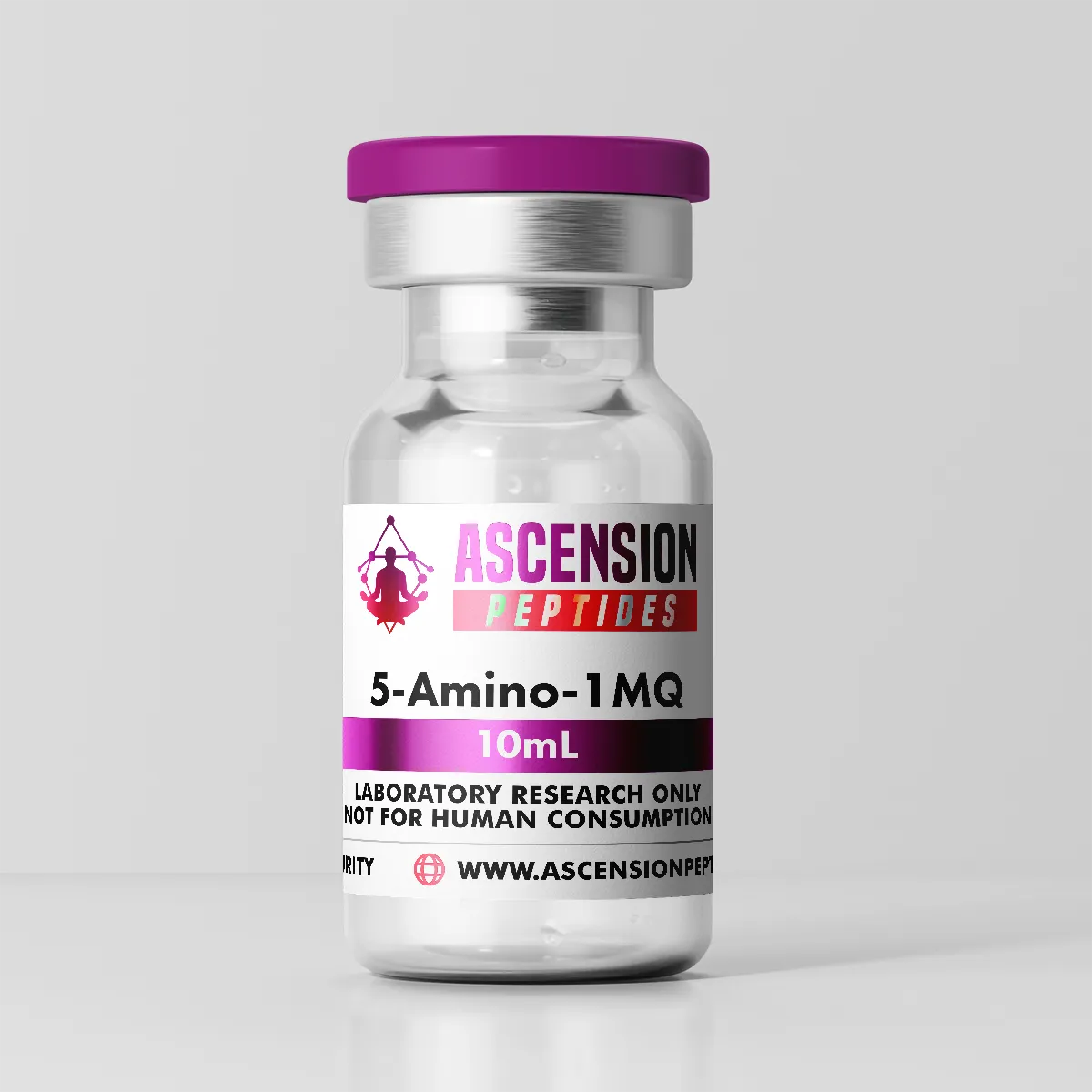
5-Amino-1MQ vials: 2.5 mg a day to start and 5 mg a day as standard, injected under the skin each morning, 8 to 12 weeks on and 4 off. Ascension's vial holds 10 mg. Add 2 mL of bacteriostatic water and you get 5 mg/mL, so 2.5 mg is 50 units on a U-100 insulin syringe and 5 mg is 100 units. With 1 mL instead, 5 mg is 50 units. Capsule and vial milligrams aren't interchangeable: never draw a capsule-sized dose into a syringe. Our 5-Amino-1MQ dosage chart has the full schedule.
MOTS-c: 2.5 mg twice a week for the first one to two weeks to check tolerance, then 5 mg three times a week on non-consecutive days for 8 to 12 weeks, then 4 weeks off. A 10 mg vial with 1 mL of bacteriostatic water gives 10 mg/mL, so 5 mg is 50 units. The three-times-a-week rhythm comes from the mouse study above. Our MOTS-c dosage chart covers the tiers, and the MOTS-c injection guide walks through the shot itself. MOTS-c is a peptide your gut would digest, which is why the oral MOTS-c products deserve skepticism.
Storage is the same for both vials: unmixed powder in the fridge, away from light. Once mixed, keep it at 2 to 8 °C and use it within about 28 days. That window is a convention tied to the preservative in bacteriostatic water; neither compound has a published stability study. Don't freeze mixed solution. For other vial sizes, the peptide calculator does the units math.
Side Effects and Safety
The reported side effects are mild. The real risk is the missing data.
5-Amino-1MQ: people mostly report mild stomach upset (more with capsules), headache early in a cycle, and trouble sleeping if they dose late. There's one lab finding worth knowing: at a test concentration, 5-Amino-1MQ blocked 67% of MAO-A activity, an enzyme that breaks down serotonin and other mood chemicals. No one knows if that happens at human doses. If you take an antidepressant, especially an SSRI or MAOI, ask your doctor before trying it. Our 5-Amino-1MQ side effects page goes through the reports.
MOTS-c: injection-site redness and itch, flushing or histamine-type reactions, fatigue, insomnia if dosed late, and occasional shaky, low-blood-sugar feelings. Those come from user reports, not a safety study. The full list is in our MOTS-c side effects guide.
For both: each can nudge blood sugar down in theory, so if you take metformin, insulin or a GLP-1 drug, talk to your prescriber first, and don't stop a prescribed medication to try either. Neither has FDA approval. MOTS-c is named on the WADA Prohibited List under S4.4.1 (AMPK activators); 5-Amino-1MQ isn't named, but unapproved substances fall under WADA's S0 catch-all, so tested athletes should avoid both.
Cost: What Each Costs Per Week
At the usual doses, it's almost a tie.
Our partner Ascension Peptides lists MOTS-c 10 mg at $62, or $31 with code PEPTIDEDECK, and 5-Amino-1MQ 10 mg at $52, or $26 with the code (October 2026). Ascension's 5-Amino-1MQ comes as powder in a vial for injection, not capsules, which also happens to be the form every study used.
If you're comparing sellers, the checks that matter are the same for both: a lab report for the exact batch, a mass-spec identity test and the net milligrams in the vial. For MOTS-c, our guide on where to buy MOTS-c compares vendors, and our 5-Amino-1MQ for sale page shows the current price and batch reports for the 10 mg vial. PeptideDeck may earn a commission on purchases through these links.
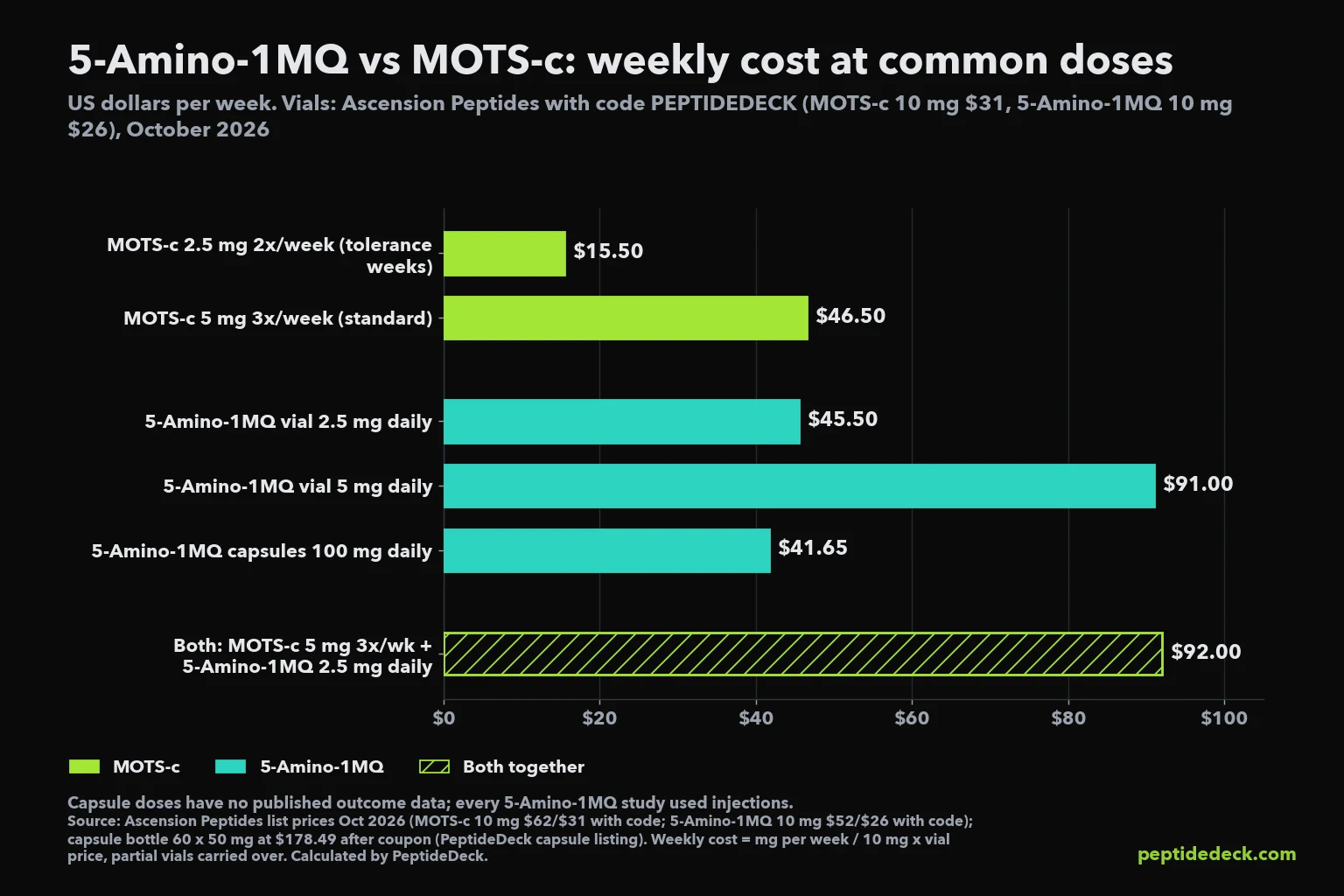
Quick math: MOTS-c at 5 mg three times a week uses 15 mg, or 1.5 vials, about $46.50 a week with the code. 5-Amino-1MQ at 2.5 mg a day uses 17.5 mg, about $45.50 a week. At 5 mg a day it's 3.5 vials, or $91 a week, so the dose you pick matters more than which compound you pick. Capsules at 100 mg a day run about $42 a week, but no study has tested them.
Can You Stack 5-Amino-1MQ and MOTS-c?
People do. No one has studied it.
The logic is easy to see. MOTS-c pushes AMPK, which tells muscle to burn fuel. 5-Amino-1MQ keeps more NAD+ raw material in fat and muscle cells, and NAD+ feeds the sirtuins that AMPK works alongside. One raises demand, the other protects supply. That is a theory, not a result: there is no study of the two together in mice or people, so any extra benefit, or any extra drop in blood sugar, is unknown.
If you stack them anyway, the sensible approach is the boring one:
- Start one at a time, about two weeks apart, so you know which one causes a side effect.
- Use the low tier of each (2.5 mg MOTS-c twice a week, 2.5 mg 5-Amino-1MQ daily or 50 mg in capsules).
- Take both in the morning to protect your sleep.
- Watch for shakiness or lightheadedness, especially if you also take a glucose-lowering drug.
- Budget for it: the stack runs about $92 a week at the standard doses.
MOTS-c is also often paired with GLP-1 drugs; our retatrutide and MOTS-c stack guide covers that combination, and our 5-Amino-1MQ vs AOD-9604 comparison looks at another common fat-loss pairing.
5-Amino-1MQ vs MOTS-c: Which Should You Choose?
Pick by goal, then by format.
Choose 5-Amino-1MQ if fat loss is the main goal and you also train, since its fat and muscle data both point that way. The limitation is real: the fat result needed a dose far above what people take, and there is no human data at all. If you want the version that matches the studies, that's the injectable vial, not the capsule.
Choose MOTS-c if your problem is energy, endurance or blood sugar control, and you're fine with two or three shots a week. Its human picture is a little better, through the CB4211 analog and the exercise data, but it's still not a trial of the peptide itself. The dose people use is close to the mouse obesity dose, which is more than 5-Amino-1MQ can say.
Choose neither yet if you have diabetes on medication, take antidepressants, are pregnant, or compete in tested sport. Both compounds are worth watching, but neither has the evidence to replace a drug with a label.
Frequently Asked Questions
Sources
- Neelakantan H, Vance V, Wetzel MD, et al. Selective and membrane-permeable small molecule inhibitors of nicotinamide N-methyltransferase reverse high fat diet-induced obesity in mice. Biochem Pharmacol. 2018;147:141-152. PMID 29155147. PubMed
- Babula JJ, Bui D, Stevenson HL, Watowich SJ, Neelakantan H. Nicotinamide N-methyltransferase inhibition mitigates obesity-related metabolic dysfunction. Diabetes Obes Metab. 2024;26(11):5272-5282. PMID 39161060. PubMed
- Sampson CM, Dimet AL, Neelakantan H, et al. Combined nicotinamide N-methyltransferase inhibition and reduced-calorie diet normalizes body composition and enhances metabolic benefits in obese mice. Sci Rep. 2021;11:5637. PMID 33707534. PubMed
- Neelakantan H, Brightwell CR, Graber TG, et al. Small molecule nicotinamide N-methyltransferase inhibitor activates senescent muscle stem cells and improves regenerative capacity of aged skeletal muscle. Biochem Pharmacol. 2019;163:481-492. PMID 30753815. PubMed
- Dimet-Wiley AL, Latham CM, Brightwell CR, et al. Nicotinamide N-methyltransferase inhibition mimics and boosts exercise-mediated improvements in muscle function in aged mice. Sci Rep. 2024;14:15554. PMID 38969654. PubMed
- Awosemo O, Neelakantan H, Watowich S, et al. Development and validation of LC-MS/MS assay for 5-amino-1-methyl quinolinium: application to pharmacokinetic and oral bioavailability studies. J Pharm Biomed Anal. 2021;204:114255. PMID 34304009. PubMed
- Lee C, Zeng J, Drew BG, et al. The mitochondrial-derived peptide MOTS-c promotes metabolic homeostasis and reduces obesity and insulin resistance. Cell Metab. 2015;21(3):443-454. PMID 25738459. PubMed
- Kim KH, Son JM, Benayoun BA, Lee C. The mitochondrial-encoded peptide MOTS-c translocates to the nucleus to regulate nuclear gene expression in response to metabolic stress. Cell Metab. 2018;28(3):516-524. PMID 29983246. PubMed
- Reynolds JC, Lai RW, Woodhead JST, et al. MOTS-c is an exercise-induced mitochondrial-encoded regulator of age-dependent physical decline and muscle homeostasis. Nat Commun. 2021;12:470. PMID 33473109. PubMed
- CohBar, Inc. A Phase 1a/1b study of safety, tolerability, and pharmacokinetics of CB4211 in healthy non-obese subjects and subjects with nonalcoholic fatty liver disease. NCT03998514. ClinicalTrials.gov
- CohBar announces positive topline results from the Phase 1a/1b study of CB4211 under development for NASH and obesity. August 10, 2021. BioSpace
- U.S. Food and Drug Administration. Guidance for Industry: Estimating the maximum safe starting dose in initial clinical trials for therapeutics in adult healthy volunteers. 2005. FDA
- DLA Piper. FDA AdComm recommends adding six peptides to bulk list. July 31, 2026. dlapiper.com
- USADA. What is the MOTS-c peptide? usada.org
Medical Disclaimer: This content is for informational purposes only and does not constitute medical advice. Neither 5-Amino-1MQ nor MOTS-c has FDA approval, and neither has been tested for efficacy in human clinical trials. Always consult a qualified healthcare provider before starting any new compound, especially if you take prescription medication. PeptideDeck may earn a commission from affiliate links at no additional cost to you.