TRT, or testosterone replacement therapy, is a prescription treatment that restores testosterone to a normal range in men diagnosed with low testosterone (hypogonadism). As a form of hormone therapy, TRT treatment is medically supervised and monitored with bloodwork, and it is approved for men whose bodies do not make enough testosterone because of a medical problem, not for the gradual decline that comes with age 45. TRT stands for testosterone replacement therapy, sometimes called androgen replacement therapy. The acronym has unrelated meanings elsewhere (it is also a Turkish broadcaster and a film-editing term), but this guide covers only the medical treatment. This is the hub for our entire TRT library, so it explains what TRT is, how it works, its forms, benefits, and risks at an overview level, then links to dedicated deep-dive pages for every subtopic.
| Quick fact | Detail |
|---|---|
| Diagnostic cutoff | Total testosterone below 300 ng/dL is the widely used threshold 12 |
| Confirmation | Two separate early-morning tests (about 7 to 10 am) plus symptoms 28 |
| Delivery forms | About eight, from injections and gels to patches, pellets, oral, and nasal 69 |
| FDA-approved use | Hypogonadism from a medical cause, not age-related low testosterone 45 |
| Legal status | Testosterone is a Schedule III controlled substance (prescription only) 6 |
Key Takeaways
- TRT replaces testosterone the body cannot make enough of. It is a treatment for diagnosed hypogonadism, not a supplement and not an anti-aging or performance product 14.
- Diagnosis needs both symptoms and lab confirmation. Guidelines call for two early-morning total testosterone readings, with a total below 300 ng/dL as the common cutoff 12.
- It comes in about eight forms. Injectable esters are the most common in the United States, gels are the most common non-injectable option, and no single form is best for everyone 6910.
- Benefits are real but conditional. Libido, mood, lean mass, bone density, and anemia can improve in genuinely deficient men, not in men with normal levels 17.
- Monitoring matters. TRT can raise hematocrit, shift estradiol, and interact with SHBG, so periodic bloodwork is part of the treatment, not optional 113.
- The heart data is more reassuring but not a green light. The TRAVERSE trial found testosterone gel noninferior to placebo for major cardiac events, with some other signals, and the FDA still limits approved use to hypogonadism 34.
What Is TRT? (Testosterone Replacement Therapy Meaning)
The TRT meaning is straightforward: testosterone replacement therapy supplies testosterone from outside the body (exogenous testosterone) to restore physiologic levels in men whose own production has fallen too low 614. If you searched "whats trt" or "what is trt therapy," the short answer is that it is a prescribed, medically supervised hormone treatment for a diagnosed deficiency, not an over-the-counter product you can take on your own 16. What does TRT stand for? Testosterone replacement therapy, also called androgen replacement therapy.
Because search engines mix the acronym up, one quick disambiguation: TRT can also refer to the Turkish public broadcaster or to tape run-time in media, but those are unrelated to medicine. Everything on this page is about the male hormone treatment. Testosterone therapy is also used off-label in some women at much lower doses, which is a separate topic covered in TRT for women, and it is worth knowing how it differs from female menopause care in TRT vs HRT. For men, the core idea is simple: replace a hormone the body is missing, under a clinician's supervision, and confirm the deficiency first 1.
TRT vs Testosterone, Testosterone Boosters, and Steroids
One of the most common points of confusion is how TRT relates to plain testosterone, to over-the-counter boosters, and to anabolic steroids. No competitor draws these lines cleanly, so here is the plain version.
Is TRT the Same as Testosterone?
Yes and no. TRT uses testosterone, and the molecule in a TRT prescription is the same hormone the body makes. The difference between TRT and steroid or performance use is dose and intent. TRT (also written as testosterone TRT or trt vs test) aims to restore a normal, physiologic range in a deficient man, which is therapeutic. Anabolic or performance use pushes levels far above normal (supraphysiologic), which is a different practice with a different risk profile. For the full legal and pharmacology answer to "is trt testosterone" and whether it counts as a steroid, see is TRT a steroid?.
TRT vs Testosterone Boosters
TRT and a testosterone booster are not the same thing. Testosterone boosters are over-the-counter supplements (herbs, zinc, vitamins, and similar) that claim to raise your own testosterone but do not reliably do so and are not regulated as medicine 7. Prescription TRT delivers actual testosterone under monitoring, with a diagnosis behind it. If you are weighing a supplement against a prescription, our comparison of testosterone boosters vs peptides explains what the non-prescription options can and cannot do.
What Is TRT in Fitness?
In fitness circles "trt fitness" and "what is trt in fitness" often get used loosely, so an honest answer matters. In a medical context, TRT treats a diagnosed deficiency and is not a bulking tool. Using testosterone purely for muscle or performance, especially at high doses, is a different and often supraphysiologic practice, and outside a valid prescription it can be illegal, since testosterone is a controlled substance 6. We keep the legal details in is TRT legal?. This guide makes no muscle-gain or performance promises; TRT is replacement, not enhancement.
What Does TRT Treat? Signs and Symptoms of Low Testosterone
TRT treats male hypogonadism, meaning clinically low testosterone that causes symptoms. What is TRT treatment for in practice? The symptoms of low testosterone tend to cluster across a few areas 78:
- Sexual: low libido, erectile difficulty, and fewer morning erections.
- Physical: fatigue, loss of muscle and strength, increased body fat, and reduced bone density.
- Mood and cognitive: low mood, irritability, and poor concentration.
Low testosterone comes from named medical causes, which clinicians split into two groups 1. Primary hypogonadism is a problem in the testicles themselves (for example Klinefelter syndrome, injury, or damage from chemotherapy). Secondary hypogonadism is a problem in the pituitary or hypothalamus, the brain centers that signal the testicles to produce testosterone.
Here is the key YMYL point for anyone asking "do i need trt" or "signs you need trt": these symptoms overlap with many other conditions, from thyroid disease to depression to poor sleep, so symptoms alone do not equal low testosterone 78. Feeling tired is not a diagnosis. Confirming low testosterone requires a blood test, discussed next. For symptom-specific reading, see TRT and erectile dysfunction and TRT and weight loss, and note that TRT for men is only appropriate once a deficiency is actually documented.
How Is Low Testosterone Diagnosed?
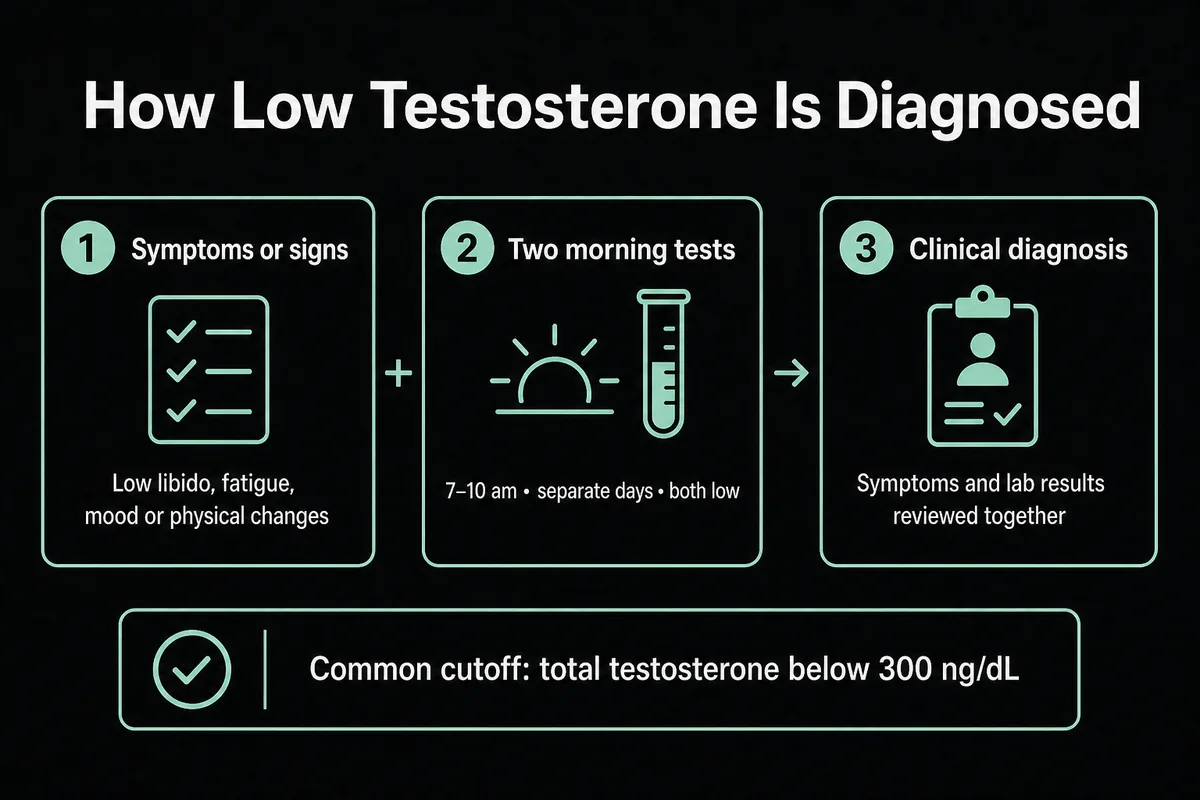
Diagnosis is where a good guide separates itself, because the rule is specific and few pages state it. According to the AUA and the Endocrine Society, a diagnosis of testosterone deficiency needs BOTH of the following 12:
- Symptoms or signs of low testosterone, and
- Two separate total testosterone measurements drawn early in the morning (about 7 to 10 am), on different days, that are low.
A total testosterone below 300 ng/dL is the widely used cutoff for a low reading 2. The morning timing matters because testosterone follows a daily rhythm and is highest in the morning, and a single low value can be misleading because of that diurnal variation, a recent illness, or differences between lab assays 812. That is why one low result is not enough to start treatment, and a "trt test" is really a short series of tests plus a clinical picture.
At or around diagnosis, your clinician typically orders a broader panel to understand the cause and set a baseline: total (and sometimes free) testosterone, LH and FSH, SHBG, hematocrit and hemoglobin, PSA, estradiol, and prolactin 112. Those baseline labs seed the monitoring you will do later. For where levels should sit once you are treated, see target testosterone levels on TRT, and for how age factors into the decision of "when is trt recommended," see the best age for TRT.
How Does TRT Work?
In plain language, how does TRT work? Supplemental testosterone raises the amount of testosterone in your blood back into the normal range, which restores the androgen-dependent functions that had been slipping, from libido to red blood cell production 56. TRT hormone therapy does not teach the body to make more of its own; it supplies the hormone directly.
There is an important trade-off built into the mechanism. When testosterone arrives from outside, the brain senses that levels are adequate and dials down its own signals (LH and FSH) through negative feedback on the hypothalamic-pituitary-gonadal axis. That is why the testicles often shrink and sperm production drops on TRT, which is the fertility issue covered below and in TRT and fertility 1.
The effects of TRT do not all arrive at once. In general, libido and mood tend to shift within weeks, while changes in erections, body composition, and bone density build over months 78. Nothing here is instant, and pushing the dose to speed things up is not how the therapy is managed. For a domain-by-domain schedule, see how long TRT takes to work.
Types of TRT: Forms, Testosterone Esters, and Brand Names
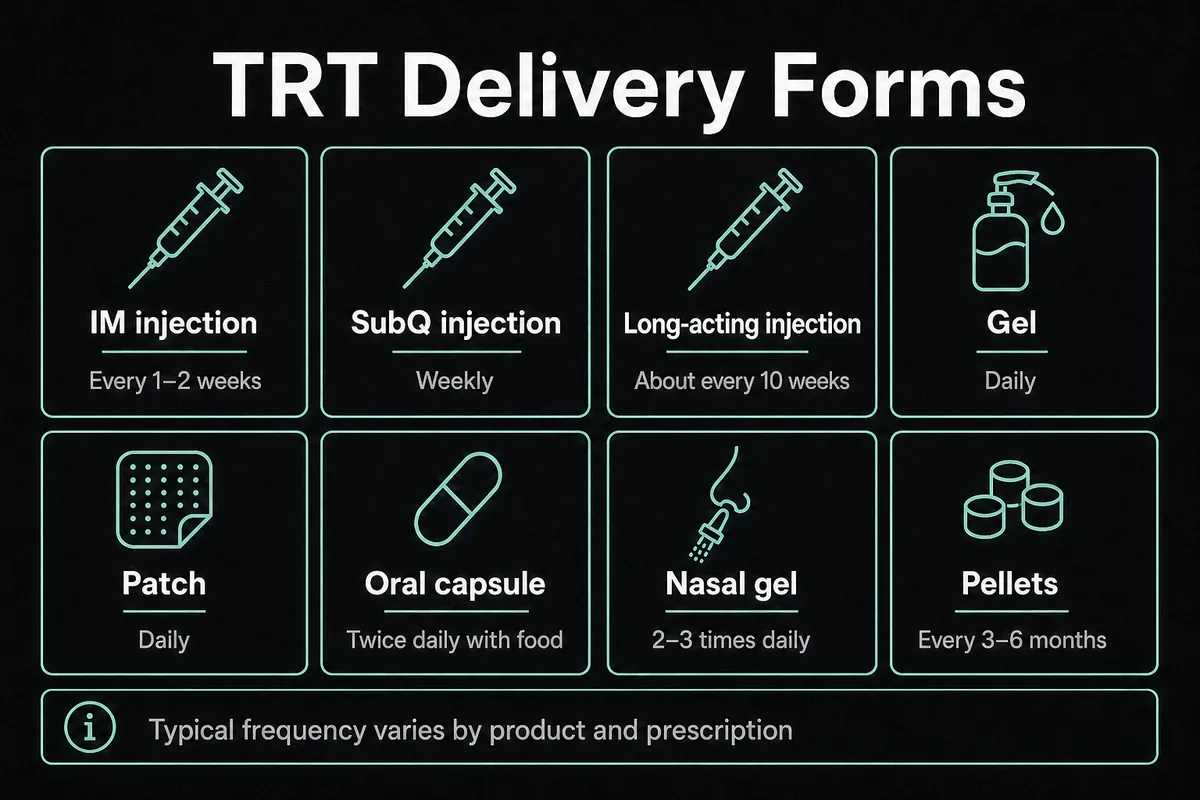
There is no single "trt drug." TRT comes in about eight delivery forms, and the practical questions people ask (what type of testosterone is used for TRT, what testosterone is used for TRT, best trt method, best trt treatment) all come down to the table below. Injectable products use a testosterone ester (the molecule attached to a fatty acid so it releases slowly), while gels, patches, oral capsules, nasal gel, and pellets deliver testosterone in other ways 691011.
| Form | Testosterone type or ester | Example brand names | Typical frequency | Notes |
|---|---|---|---|---|
| Intramuscular injection | Testosterone cypionate or enanthate | Depo-Testosterone; generic enanthate | Every 1 to 2 weeks | Most common in the US; larger peaks and troughs 9 |
| Subcutaneous injection | Testosterone enanthate | Xyosted (auto-injector) | Weekly | Steadier levels; self-administered 9 |
| Long-acting IM injection | Testosterone undecanoate | Aveed | About every 10 weeks | In-office observation after each dose 9 |
| Transdermal gel | Testosterone | AndroGel, Testim, Fortesta, Vogelxo | Daily | Skin-to-skin transfer risk; wash hands and cover the site 510 |
| Transdermal patch | Testosterone | Androderm | Daily | Skin irritation is common 11 |
| Oral capsule | Testosterone undecanoate | Jatenzo, Tlando | Twice daily with food | Newer oral option; take with food 6 |
| Nasal gel | Testosterone | Natesto | 2 to 3 times daily | Lower erythrocytosis and transfer risk 6 |
| Subcutaneous pellet | Testosterone | Testopel | Every 3 to 6 months | Implanted; dose cannot be adjusted once placed 6 |
Sources: 5691011. No prices or milligram doses are listed here on purpose; dosing belongs to the dosage guide.
A few plain takeaways after the table. Injectable esters (cypionate, enanthate, and long-acting undecanoate) are the most common approach in the United States, and gels are the most common non-injectable option 910. The honest answer to "best testosterone for trt" or "which testosterone is best for trt" is that the best form depends on the person: their tolerance for needles, how steady they need their levels, transfer risk if there are children in the home, and cost. There is no universal winner, and any page that names one is selling something. For the injectable options specifically, see our guide to TRT injection sites; for the milligram-level detail, see TRT dosage by form; and to weigh every option side by side, compare all types of TRT.
Benefits of TRT
Does TRT work? For men with genuinely low testosterone and symptoms, yes, and the benefits are well described. In deficient men, TRT can improve libido and sexual function, lift mood, increase lean muscle and reduce fat, raise bone mineral density, and correct the anemia that low testosterone can cause 17. These are the expected clinical effects of restoring a hormone the body was missing.
The critical qualifier, and the reason this section avoids "boost your energy" or "build muscle" marketing language, is that these benefits are established for diagnosed hypogonadism, not for men with normal testosterone 17. A man with normal levels taking testosterone is not correcting a deficiency; he is exposing himself to risk with little to gain. So the best trt therapy is the one that treats a real, confirmed deficiency. For realistic expectations rather than transformation photos, see realistic TRT before and after; for the fuller evidence review, see the full list of TRT benefits; and for the specific question of body weight, see TRT and weight loss.
Risks and Side Effects of TRT
TRT has a real side-effect profile, and knowing it is part of an informed decision. Guideline and label sources list acne and oily skin, fluid retention, testicular shrinkage, reduced sperm production and fertility, worsening of untreated sleep apnea, breast tenderness or gynecomastia, and lab changes such as a rising hematocrit and PSA 15613.
The cardiovascular picture deserves precision. Older observational data raised concern about heart risk. The 2023 TRAVERSE randomized trial, which enrolled 5,246 middle-aged and older men with or at high risk for cardiovascular disease, found that testosterone gel was noninferior to placebo for major adverse cardiac events, but it showed higher rates of atrial fibrillation, pulmonary embolism, and acute kidney injury in the testosterone group 3. On the strength of that trial, the FDA updated testosterone product labeling, but it still limits approved use to diagnosed hypogonadism, not age-related low testosterone 4. The honest summary is that TRT is not "proven safe for the heart," and blood pressure and clotting still warrant attention. See TRT and heart health and TRT and blood pressure.
How Much TRT Is Too Much? Signs Testosterone Is Too High
People also ask "how much trt is too much" and "too much trt symptoms." Signs that a dose is supratherapeutic (too high) include a rising hematocrit, acne, irritability or aggression, fluid retention or edema, elevated estradiol, and headaches 513. The important YMYL point: the fix is a dose adjustment made by your prescriber based on bloodwork, not self-management. Too much testosterone is a monitoring problem, not something to titrate at home.
Who should not use TRT (contraindications): Testosterone is generally avoided in men with active prostate or breast cancer, untreated severe obstructive sleep apnea, uncontrolled or poorly controlled heart failure, an already elevated hematocrit, or in men currently trying to conceive 213. Your clinician screens for these before prescribing and monitors for them during treatment.
For the complete rundown, see the full guide to TRT side effects, and for two commonly searched specifics, see TRT and prostate cancer and TRT and hair loss.
TRT Monitoring: SHBG, Hemoglobin, Hematocrit, Estradiol, and PSA
TRT is not a set-and-forget prescription. It is monitored with periodic bloodwork, and understanding each marker explains why. A common cadence is to recheck testosterone at about 3 and 6 months and then annually, with hematocrit and PSA followed on a similar schedule and bone density reassessed in 1 to 2 years when relevant 13. The Endocrine Society frames this monitoring as a core part of therapy 1. Here is what the most-searched markers mean.
Low SHBG on TRT
SHBG (sex hormone binding globulin) is a protein that binds testosterone in the blood. When SHBG is low, a larger fraction of testosterone is free and active, but it also clears faster, so some men feel the effect of a dose "fade" sooner between administrations and may be followed on free testosterone rather than total 112. Low SHBG on TRT is common in men with obesity or insulin resistance. This is an explanation, not a dosing instruction: how a clinician responds is individual, and it is a conversation for your prescriber.
High Hemoglobin and Hematocrit on TRT
Testosterone stimulates red blood cell production, so hemoglobin and hematocrit can rise on treatment, a change called erythrocytosis 5. Does TRT cause high hemoglobin? It can, and injectable forms tend to raise it more than gels. Clinicians monitor hematocrit and act (by reducing the dose, ordering therapeutic phlebotomy, or pausing therapy) when it climbs too high, with an action point commonly cited around a hematocrit of 54 percent 15. This is the clearest example of why bloodwork matters and why high hemoglobin on TRT is not something to manage on your own.
High Estradiol on TRT
Some testosterone is converted (aromatized) into estradiol, a form of estrogen. Higher doses and higher body fat push estradiol up, and high estradiol on TRT can contribute to fluid retention or breast tenderness 56. It is managed by the prescriber through dose adjustment and, rarely, medication. This guide does not endorse self-sourced aromatase inhibitors; adjusting estradiol is a clinical decision.
One more marker to name for completeness: some men ask about high prolactin on TRT. Prolactin is usually checked at baseline to rule out a pituitary cause of low testosterone, and it is followed as part of the broader picture rather than being a routine TRT side effect 1. For where all these numbers should land once you are stable, see target testosterone levels on TRT.
TRT and Fertility
This is a short but important hand-off. Because exogenous testosterone suppresses the body's own signals, TRT reduces and can stop sperm production, which is why it is a poor choice for a man who wants to conceive soon 1. Men who want to preserve fertility are often managed with alternatives that support the body's own production, such as hCG or enclomiphene, either instead of or alongside testosterone. The full discussion lives in TRT and fertility, with the specific agents covered in our hCG for fertility and enclomiphene guide.
TRT Alternatives
TRT is not the only path, and guidelines favor addressing reversible causes first. That means weight loss, better sleep, treating underlying conditions, and reviewing medications before committing to lifelong hormone therapy 7. Medical alternatives that raise the body's own testosterone (enclomiphene, hCG, and clomiphene) are especially relevant for men who want to protect fertility 1. There are also non-hormonal ways to manage specific symptoms. None of these are magic, and none are a reason to skip a proper diagnosis. Explore the options in TRT alternatives, compare TRT vs sermorelin, MK-677, and enclomiphene, and weigh supplements honestly in testosterone boosters vs peptides.
Is TRT Right for You? Cost, Legality, and Getting Started
Who is a candidate for TRT? Broadly, a man with symptoms of low testosterone plus two low early-morning tests, and without a contraindication, may be a candidate 12. Who is not? A man with normal testosterone, or with an uncontrolled contraindication, generally is not, because the benefits above depend on correcting a deficiency he does not have 7. The gate for everyone is the same: talk to a clinician and get the two morning tests before anything else.
Two neutral notes, since dedicated pages own these topics. On legality, TRT is a prescription treatment and testosterone is a Schedule III controlled substance under federal law, so it is only legal with a valid prescription; the details are in is TRT legal?. On cost and logistics, what you pay depends on the form and where you get care, which ties back to TRT dosage by form and comparing all types of TRT. And if you ever consider stopping, that is a medical transition with its own plan, covered in what happens when you stop TRT.
Questions to bring to your clinician: Do my symptoms and two morning tests actually confirm low testosterone? What is the likely cause, primary or secondary? Do I want to preserve fertility, and does that change the plan? Which form fits my life and risk profile? What will we monitor, how often, and what numbers would prompt a change? These are questions to ask, not self-directed steps to take.
Frequently Asked Questions
TRT stands for testosterone replacement therapy, also called androgen replacement therapy 6. The same three letters have unrelated meanings in broadcasting and media, but in medicine they always mean the testosterone treatment.
TRT uses testosterone, so the molecule is identical 6. The difference from steroid or performance use is dose and intent: TRT restores a normal range rather than pushing levels above normal. The full answer is in is TRT a steroid?.
References
- Bhasin S, et al. Testosterone Therapy in Men With Hypogonadism: An Endocrine Society Clinical Practice Guideline. J Clin Endocrinol Metab, 2018.
- American Urological Association. Evaluation and Management of Testosterone Deficiency: AUA Guideline, 2018 (amended).
- Lincoff AM, et al. Cardiovascular Safety of Testosterone-Replacement Therapy (TRAVERSE). N Engl J Med, 2023;389:107-117.
- U.S. Food and Drug Administration. FDA issues class-wide labeling changes for testosterone products.
- U.S. Food and Drug Administration. AndroGel (testosterone gel) 1.62% Prescribing Information, 2019.
- Cleveland Clinic. Testosterone Replacement Therapy (TRT): What It Is.
- Mayo Clinic. Testosterone therapy: Potential benefits and risks as you age.
- Harvard Health Publishing. Is testosterone therapy safe? Take a breath before you take the plunge.
- MedlinePlus. Testosterone Injection (drug information).
- MedlinePlus. Testosterone Topical (gel and solution).
- MedlinePlus. Testosterone Transdermal Patch.
- MedlinePlus. Testosterone Levels Test.
- WebMD. Testosterone Replacement Therapy: Myths and Facts.
- Healthline. TRT: Uses, Side Effects, and Cost of Testosterone Replacement Therapy.
The information in this article is for educational purposes only and does not constitute medical advice. Always consult a healthcare professional before starting any new supplement or compound. Results vary by individual.