TRT before and after is best understood as a timeline, not a single transformation photo. If you searched "trt before and after" hoping for one dramatic image, the honest answer is that real testosterone replacement therapy changes the body gradually, and how much it changes depends heavily on how deficient you were to begin with, your dose, your diet, and your training. The men in the most striking gallery photos are often either recovering from severe deficiency, using off-label bodybuilding doses, or both. This page lays out what medical testosterone replacement therapy actually does at 3, 6, and 12 months, corrects the face and cycling myths that fill competing pages, and frames the risks in real numbers instead of hype.
Key Takeaways
- Changes are gradual and follow a predictable order: libido and mood shift first (around 3 to 6 weeks), while fat loss, lean mass, and bone changes take months to build 15.
- The "after" depends on your starting point: a man with severely low testosterone will notice more than a man near the low-normal range, and diet plus training drive much of the visible body change 16.
- Face changes are real but soft-tissue, not skeletal: puffiness, a redder face, or leaner cheeks come from fluid, blood flow, and fat loss, and adult facial bone does not reshape on TRT 1.
- TRT is not HGH: they are different hormones with different approved uses, and stacking growth hormone with testosterone is not standard medical care 6.
- Risks are manageable but real: the large TRAVERSE trial found no rise in major cardiac events but did find more atrial fibrillation and blood clots, alongside common effects like raised red blood cell counts and reduced fertility 412.
- TRT is continuous replacement, not a steroid cycle: stopping reverses the gains and does not quickly restore your own production, so "cycling" TRT misunderstands what it is 18.
TRT results timeline at a glance
Before the detail, here is the short version of what tends to change and when. The onset windows below come mainly from a landmark review of when testosterone effects begin and plateau, plus the Testosterone Trials in older men. Timing is a range, not a promise, and your own curve depends on your baseline and dose.
Table 1. TRT results timeline
| Timeframe | What typically changes | Evidence note |
|---|---|---|
| Week 1 to 3 | Energy and mood begin to lift; sexual interest starts to return | Sexual interest and mood effects begin around week 3 1 |
| Week 3 to 6 | Libido rises and tends to plateau near week 6 | Libido effect reaches its plateau at roughly 6 weeks 1 |
| Month 2 to 3 | Erections improve, glycemic control starts to shift, early strength | Erectile and metabolic effects build over 3 months and beyond 15 |
| Month 3 to 6 | Fat mass falls, lean mass rises, waist narrows | Body-composition changes appear over 12 to 16 weeks and continue 1 |
| Month 6 to 12 | Bone density improves, labs stabilize, fuller overall effect | Bone effects are detectable by 6 months and keep building 1 |
What TRT Before and After Really Looks Like
The single biggest reason before/after results vary so much is baseline deficiency. Testosterone replacement is designed to move a genuinely low level back into a normal range, so the man who starts with severe symptoms and a low reading has the most room to improve, while a man near the low-normal range will notice far less 7. That is why two people on identical doses can post very different photos.
Dose and formulation matter too, and so do the things testosterone cannot do on its own. Fat loss and muscle gain still require a calorie balance and resistance training; testosterone makes those efforts more productive, but it does not replace them 6. Much of what looks like a pure "TRT transformation" in a gallery is really TRT plus a serious diet and gym program running at the same time. Our guide to TRT and weight loss covers where testosterone helps and where lifestyle does the heavy lifting.
It is also worth drawing a hard line between medical TRT and the dramatic physique changes tied to anabolic-steroid use. Replacement dosing restores a normal level. The extreme "before and after" bodies people associate with testosterone usually involve doses many times higher than replacement, stacked compounds, and no medical monitoring. Confusing the two sets expectations that honest, prescribed TRT will not meet, a distinction we cover in is TRT a steroid.
TRT Before and After Timeline: Month by Month
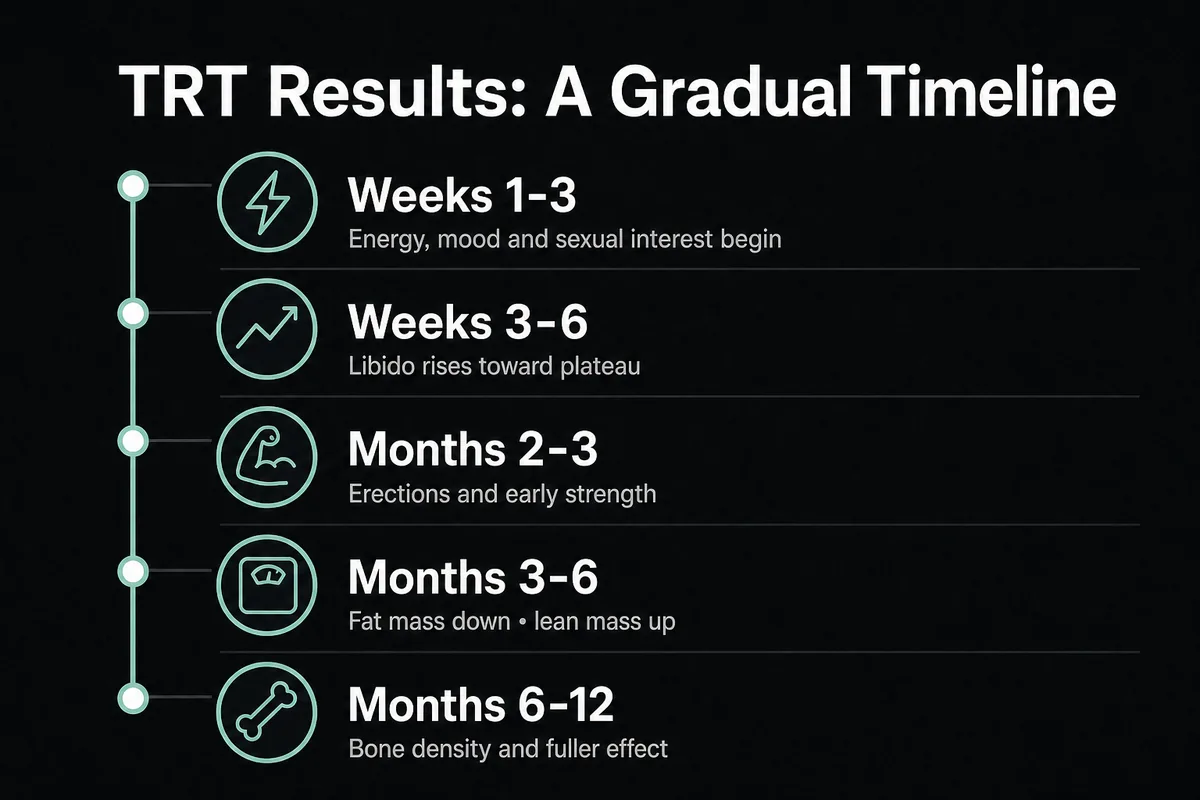
The best evidence on timing comes from a 2011 review that mapped when each testosterone effect begins and when it reaches its maximum 1. The pattern is consistent: mood, energy, and sexual interest come first, physical and metabolic changes take months, and bone changes are the slowest of all. For a deeper walk-through, see our sibling page on how long TRT takes to work.
Weeks 1 to 6: The Early Shifts
The earliest changes are the ones you feel rather than see. Effects on sexual interest appear after about 3 weeks and plateau near week 6, and effects on mood and wellbeing begin in a similar window 1. Many men describe better morning energy and a lifting of mental fog in the first month or two. Some also notice early water retention or a slightly puffier look as fluid balance shifts, which is normal and usually settles. What you will not see yet is meaningful muscle or fat change; that curve has barely started.
TRT Before and After 3 Months
By month 3 the picture broadens. Erectile function and ejaculation continue improving on a slower curve than libido, and effects on blood-sugar control (glycemic effects) become measurable over the 3-to-12-month range 1. Early body-composition change is often underway: strength in the gym may be climbing, and some men see the first visible difference in the mirror. In the Testosterone Trials, sexual function showed clear improvement while gains in vitality and physical function were more modest, a useful reality check against dramatic 90-day claims 5. Three months is also the point at which many clinicians recheck your labs.
TRT Before and After 6 Months
Between 3 and 6 months, body composition tends to move the most. Fat mass falls and lean mass rises over roughly 12 to 16 weeks and keeps developing, and the waistline commonly narrows 1. This is usually when "before and after" differences become genuinely visible in photos, especially in men who paired treatment with training and a controlled diet. Bone-density benefits are also detectable by around 6 months, though those matter more for long-term health than for appearance 1. Your labs should be stabilizing by now.
TRT Before and After 1 Year
At 1 year you are seeing closer to the full effect. Body-composition and strength changes stabilize, bone density continues to build over years rather than months, and most of the lab changes (including red blood cell count and PSA) have reached their plateau 1. This is the honest version of the "1 year TRT transformation": a steadier energy level, better body composition than baseline, and improved sexual function, rather than an overnight physique swap. Beyond the first year, TRT is about maintaining these gains, not chasing new dramatic changes.
TRT Before and After Face: Does TRT Change Your Face?
The face sub-cluster is where competing pages go furthest off the rails, so it is worth being precise. TRT can change how your face looks, but the changes are soft-tissue changes: fat distribution, fluid, skin oil, blood flow, and beard density. What does not happen is a reshaping of the underlying bone.
Does TRT Age Your Face? Moon Face, Puffy Face, and Red Face
Early on, some men notice a puffier, rounder face, sometimes called "moon face." This is usually fluid retention, driven in part by testosterone converting to estradiol (a form of estrogen), and it is dose- and estradiol-related rather than permanent 6. As body composition improves over months, many men actually see leaner cheeks and a more defined jawline, but that comes from fat loss, not new bone 1. A redder or flushed face can come from vasodilation (widened blood vessels) or, less commonly, from a rising red blood cell count that thickens the blood, which is one reason that count is monitored 12.
The claim you will see on several face pages, that TRT stimulates bone growth to enlarge the jaw, brow, or cheekbones, is not supported in adults. Facial bones stop lengthening once the growth plates fuse after puberty, so testosterone does not re-sculpt the adult skeleton. Visible facial change on TRT is fat, fluid, skin, and beard, full stop. Does TRT age your face? If anything, fluid shifts and acne can make some men look temporarily rougher in the first weeks, but there is no evidence it accelerates skeletal aging.
TRT Beard Growth and Skin Changes
Beard growth is androgen-dependent, so restoring testosterone can thicken facial and body hair in men who were deficient, though how much depends heavily on genetics and follicle sensitivity 7. Do not expect a patchy beard to become full if your genetics never supported one. On the skin side, testosterone increases oil-gland activity, so acne and oilier skin are common early side effects and are listed on the standard risk sheets 6. For most men this is mild and settles as the dose stabilizes. Results here vary more by genetics than almost any other TRT effect.
What the Transformation Photos Don't Show
Curated before/after galleries leave out the context that determines whether your results will look anything like them. They rarely state the man's starting testosterone level, so you cannot tell whether he was severely deficient (big room to improve) or barely low. They almost never disclose the dose, and some "TRT" photos actually show supraphysiologic bodybuilding protocols, not replacement. They omit the diet and training that produced most of the visible body change, and they never show the men for whom TRT helped symptoms without transforming the mirror. Photos also cannot show the parts that matter most medically: the lab trends, the side effects managed along the way, and whether the result held up over years. The evidence-based timeline above is a better guide to your own likely "after" than anyone else's photo.
Lab Markers Before and After TRT
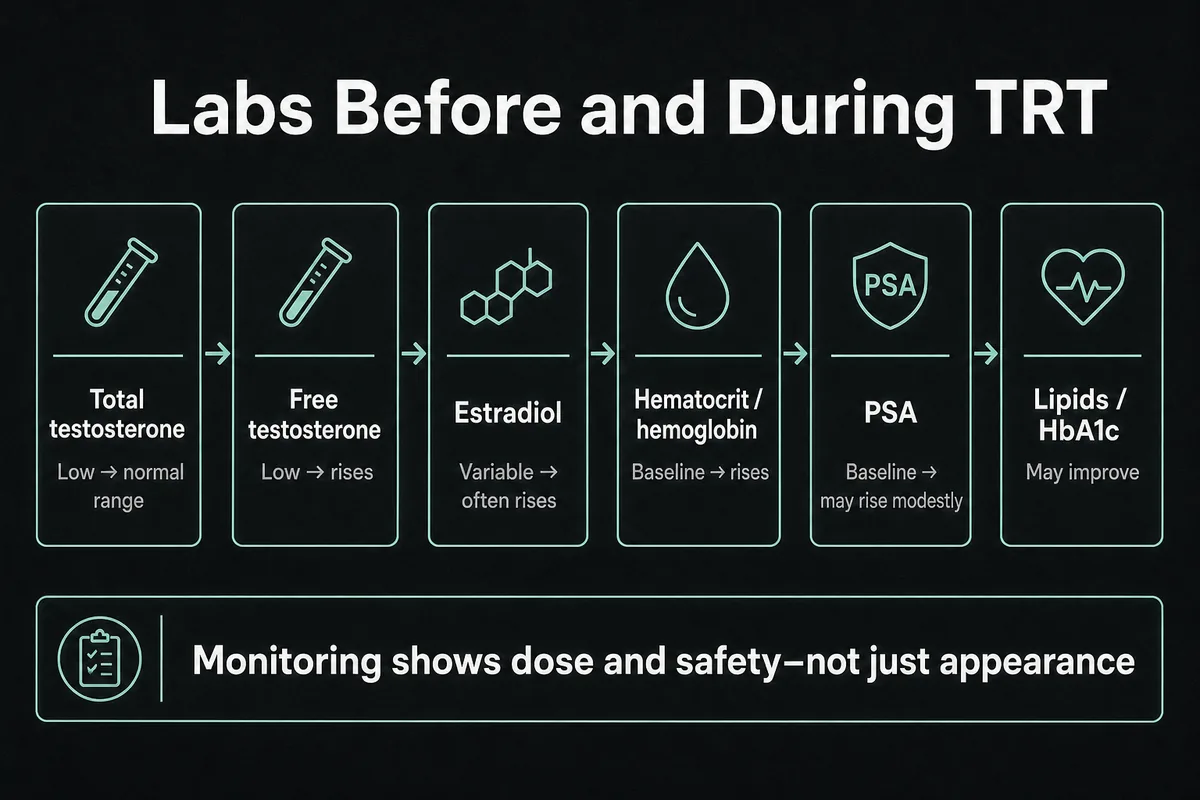
The most reliable before/after in TRT is not a photo, it is your bloodwork. Guidelines and drug labels build monitoring around a specific set of markers, checked at baseline and then on a schedule (commonly around 3 to 6 months in the first year, then roughly annually once stable) 212. The table shows what typically moves and why each is watched. For a deeper look at target ranges, see testosterone levels on TRT.
Table 2. Lab markers before and after TRT
| Marker | Before TRT | Expected direction on TRT | Why it is monitored |
|---|---|---|---|
| Total testosterone | Low (often confirmed below about 300 ng/dL) | Rises into the normal range | Confirms the dose is adequate, not excessive 23 |
| Free testosterone | Low | Rises | Reflects the active, unbound hormone 2 |
| Estradiol (E2) | Variable | Often rises as testosterone converts to estrogen | Guides management of puffiness or breast tenderness 6 |
| Hematocrit / hemoglobin | Baseline | Rises, sometimes above the safe threshold | High red blood cell counts raise clot risk 12 |
| PSA | Baseline | Can rise modestly | Screens the prostate before and during treatment 12 |
| Lipids / HbA1c | Baseline | May improve, especially glycemic control | Tracks metabolic effects over months 1 |
Monitoring is the point of all this. Your clinician uses these numbers to adjust the dose, manage estrogen, arrange a blood draw if the red blood cell count climbs, or pause treatment, which is exactly how a list of scary-sounding risks becomes a managed therapy 212.
HGH vs TRT: Are They the Same Thing?
Because many people search "trt and hgh before and after," it is worth being clear: TRT and HGH are different hormones with different jobs, and they are not interchangeable. Testosterone replacement treats diagnosed low testosterone. Human growth hormone (somatropin) replaces growth hormone and is approved only for diagnosed growth hormone deficiency and a few specific medical conditions. United States law does not permit prescribing growth hormone for anti-aging or athletic enhancement, and stacking it with testosterone is not standard medical care 6. If you are comparing options in this space, our explainer on sermorelin versus TRT, MK-677, and enclomiphene breaks down the growth-hormone side.
Table 3. HGH vs TRT
| Factor | TRT | HGH |
|---|---|---|
| What it replaces | Testosterone | Growth hormone |
| FDA-approved use | Diagnosed hypogonadism (low testosterone) 12 | Diagnosed growth hormone deficiency and select conditions |
| Anti-aging use | Not approved as an anti-aging therapy 69 | Not legal to prescribe for anti-aging or athletics |
| Typical effects | Libido, energy, body composition, bone 1 | Effects on growth and body composition in true deficiency |
| Controlled status | Controlled substance, prescription only 1011 | Prescription only, tightly regulated |
| Standard of care | Continuous replacement with monitoring 2 | Not standard to stack with TRT |
The honest takeaway is that the impressive "TRT and HGH before and after" transformations online are usually not what a clinician would prescribe. Chasing growth hormone for anti-aging is both unproven and outside approved use.
Who Qualifies for TRT
TRT is for men with both symptoms of low testosterone and lab confirmation, not for anyone who wants a boost. Diagnosis generally requires symptoms plus low testosterone measured on two separate morning blood tests, because levels vary through the day and a single low reading is not enough 23. The commonly cited threshold is a total testosterone around 300 ng/dL, with the AUA using 300 ng/dL as a reference point and the Endocrine Society emphasizing consistently low readings alongside symptoms 37. This is the line that separates real hypogonadism care from "low-T" marketing that treats a single borderline number. Harvard Health makes the same point: you need both symptoms and confirmed low labs, and TRT is not a treatment for normal aging in otherwise healthy men 9.
Side Effects and Risks to Weigh
An honest before/after includes the risks. Framed in real terms, most are manageable, and the serious ones are why monitoring exists. Our full TRT side effects page goes deeper; here is the core.
On the cardiovascular question, the large TRAVERSE trial (5,246 men with low testosterone and high cardiovascular risk) found no increase in major adverse cardiac events (heart attack, stroke, or cardiovascular death) versus placebo, but it did find more cases of atrial fibrillation, acute kidney injury, and pulmonary embolism (a blood clot in the lungs) 4. That is the balanced picture: reassuring on the biggest fear, with a few specific risks that remain worth discussing.
Beyond that, the common and well-documented effects include a rising red blood cell count (which can thicken the blood and is managed by dose changes or a blood draw), acne and oily skin, fluid retention, testicular shrinkage, and suppressed fertility, because external testosterone signals the body to pause its own production 812. TRT can also worsen pre-existing sleep apnea in some men 6. Just as important is what TRT will not do: it is not a fountain of youth, it is not proven to sharpen memory or reverse aging in otherwise healthy men, and it will not build a physique on its own 69.
Can You Cycle TRT?
No, not in the way the word "cycle" is used with anabolic steroids, and this is the myth most worth correcting. TRT is continuous replacement therapy. You are topping up a hormone your body is not making enough of, so you take it consistently, the way someone with an underactive thyroid takes thyroid hormone, not in on-and-off "cycles" 8.
Stopping does not lock in your gains. Because external testosterone suppresses your own hormone signaling (the hypothalamic-pituitary-gonadal axis), your natural production is turned down while you are on treatment and does not switch back on quickly when you stop 18. Men who discontinue typically see the low-testosterone symptoms return, often within weeks to months, as their own production slowly recovers. That is why "TRT post cycle therapy" and "TRT cycle length" are the wrong frame: there is no cycle to recover from, only continuous therapy that is best changed or stopped as a planned, clinician-guided decision. Our page on stopping TRT walks through what to expect if you do come off.
Frequently Asked Questions
The felt changes come first: sexual interest and mood begin around 3 weeks, and libido tends to plateau near 6 weeks 1. Visible body changes take longer, with fat loss and lean mass developing over roughly 3 to 6 months and bone density continuing beyond that 1. Expect a timeline measured in months, not days.
Early puffiness or a rounder "moon face" look usually reflects fluid retention, driven partly by testosterone converting to estradiol, and it is dose- and estrogen-related rather than permanent 6. It commonly settles as body composition improves and as your clinician manages estradiol if needed.
They are different hormones. TRT replaces testosterone for diagnosed low testosterone, while HGH replaces growth hormone and is approved only for diagnosed growth hormone deficiency and a few specific conditions 6. Growth hormone is not legal to prescribe for anti-aging, and stacking it with TRT is not standard care.
Not meaningfully in adults. The deep voice change of puberty happens when the vocal cords and larynx are still developing, and once you are through puberty, restoring testosterone does not deepen the voice the way it did back then. Any effect in adult men is minimal.
References
- Saad F, Aversa A, Isidori AM, Zafalon L, Zitzmann M. Onset of effects of testosterone treatment and time span until maximum effects are achieved. Eur J Endocrinol. 2011;165(5):675-685.
- Bhasin S, et al. Testosterone Therapy in Men With Hypogonadism: An Endocrine Society Clinical Practice Guideline. J Clin Endocrinol Metab. 2018;103(5):1715-1744.
- American Urological Association. Evaluation and Management of Testosterone Deficiency: AUA Guideline (2018, amended 2023).
- Lincoff AM, Bhasin S, et al. Cardiovascular Safety of Testosterone-Replacement Therapy (TRAVERSE). N Engl J Med. 2023;389(2):107-117.
- Snyder PJ, et al. Effects of Testosterone Treatment in Older Men (The Testosterone Trials). N Engl J Med. 2016;374:611-624.
- Mayo Clinic. Testosterone therapy: Potential benefits and risks as you age. Accessed 2026.
- Cleveland Clinic. Low Testosterone (Male Hypogonadism). Accessed 2026.
- Cleveland Clinic. Testosterone Replacement Therapy (TRT). Accessed 2026.
- Harvard Health Publishing. Why testosterone levels drop and when to consider treatment. Accessed 2026.
- MedlinePlus. Testosterone Topical. U.S. National Library of Medicine. Accessed 2026.
- MedlinePlus. Testosterone Injection. U.S. National Library of Medicine. Accessed 2026.
- U.S. Food and Drug Administration. AndroGel 1.62% Prescribing Information. 2019.
The information in this article is for educational purposes only and does not constitute medical advice. Always consult a healthcare professional before starting any new supplement or compound. Results vary by individual.