Is TRT a steroid? Technically, yes: testosterone is an anabolic-androgenic steroid, so any testosterone replacement therapy delivers a steroid hormone. But medically supervised TRT is not the same as "using steroids" in the way most people mean that phrase, which is supraphysiologic anabolic-steroid abuse for muscle and performance. Almost every page that ranks for this question dodges the chemistry and says flatly that "TRT is not a steroid," and the more informed searcher knows that is wrong. The honest answer is that the difference is not chemistry, it is dose, intent, medical supervision, and legality. This guide states the chemical truth plainly, then draws a clean line between physiologic testosterone replacement therapy and anabolic-steroid abuse, using clinical guidelines and drug labels rather than gym-floor rumor.
Key Takeaways
- Chemically, yes, it is a steroid: testosterone is an anabolic-androgenic steroid hormone, so "is TRT a steroid" and "is TRT anabolic" are both technically true 34.
- Replacement is not abuse: medical TRT restores a low testosterone level to the normal male range, while anabolic-steroid abuse pushes it far above normal for muscle and performance 12.
- Dose is the biggest divide: TRT aims for the middle of the normal range (roughly 450 to 600 ng/dL), while steroid cycles reach supraphysiologic levels many times higher 1.
- Both are Schedule III: testosterone and anabolic steroids are the same controlled-substance class under the Anabolic Steroids Control Act of 1990; the line is a valid prescription versus illegal non-prescription use 34.
- TRT is not "natty": exogenous testosterone, even therapeutic, is a banned substance in drug-tested sport and is not considered natural.
- Safer, not risk-free: supervised replacement carries far lower risk than unmonitored abuse, but TRT still has real side effects and is only appropriate for diagnosed low testosterone 29.
Is TRT a Steroid? The Honest Answer
Testosterone is a steroid hormone. It belongs to the class called anabolic-androgenic steroids, a name that captures its two effects: anabolic (tissue-building, including muscle and bone) and androgenic (driving male characteristics such as body hair, deeper voice, and libido) 3. TRT is prescribed testosterone, so at the level of chemistry, "is TRT a steroid" is answered yes. The FDA prescribing information for testosterone itself classifies it as a Schedule III controlled substance and describes it as an anabolic-androgenic steroid 4.
That is exactly the point most competitor pages get wrong. When they insist "TRT is not a steroid," they are trying to say something true (TRT is not steroid abuse) in a way that is chemically false. The accurate framing is that the molecule is a steroid, but the way it is used in medicine, at a replacement dose, for a diagnosed deficiency, under monitoring, is worlds apart from how anabolic steroids are misused for enhancement. So the real question is not "is testosterone a steroid" (it is), but "is medical TRT the same as using steroids to get big." It is not, and the rest of this page explains why.
Is TRT the Same as Steroids? Replacement vs Abuse
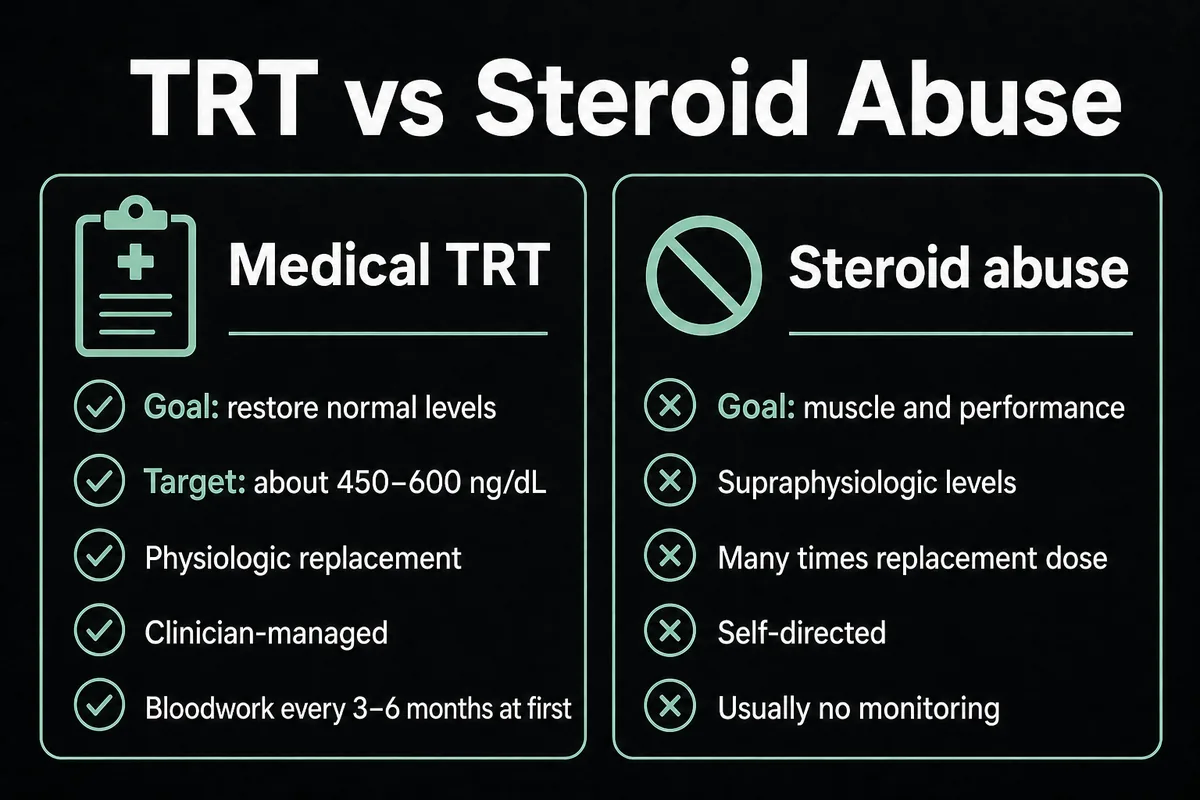
The clearest way to separate the two is a side-by-side comparison. The same molecule can be a carefully dosed prescription medicine or a misused performance drug depending on how much is used, why, who is supervising, and whether it is legal. The table below lays out the differences that actually matter.
Table 1. TRT (medical replacement) vs anabolic-steroid abuse
| Factor | TRT (medical) | Anabolic-steroid abuse |
|---|---|---|
| Goal | Restore a normal testosterone level in diagnosed low T | Muscle and performance beyond natural limits |
| Testosterone level targeted | Middle of the normal male range (about 450 to 600 ng/dL) 1 | Supraphysiologic, multiples above the top of normal |
| Dose magnitude | Physiologic replacement | Many times a replacement dose |
| Molecules used | Bioidentical testosterone 8 | Testosterone plus modified derivatives, often stacked |
| Prescription and supervision | Yes, clinician-managed 4 | No, self-directed |
| Monitoring | Bloodwork every 3 to 6 months at first 1 | Usually none |
| Legal status | Schedule III, legal with a prescription 34 | Schedule III, illegal without a prescription 3 |
Read down that table and the pattern is obvious: TRT and abuse differ on every axis except the base molecule. The medical version is defined by staying inside the normal range and being watched; the abuse version is defined by deliberately exceeding it without oversight. That is why "is TRT the same as steroids" deserves a nuanced answer rather than a slogan.
Anabolic Steroids vs TRT: The Real Differences
Zooming into anabolic steroids vs TRT, four differences carry most of the weight: dose, purpose, legality, and the exact molecules involved. Each one is worth understanding on its own, because together they explain why the same hormone can be a safe therapy or a dangerous habit.
TRT vs steroids dosage: replacement to normal vs supraphysiologic
Dosage is the single biggest divide, and it is where TRT vs steroids dosage becomes concrete. Before treating, guidelines call for confirming genuinely low testosterone with two separate early-morning blood tests, using a total testosterone below roughly 300 ng/dL as a common threshold to diagnose deficiency 1. When treatment is started, the aim is to bring levels back toward the middle of the normal male range (often cited around 450 to 600 ng/dL), not above it 1. That is what "replacement" means: refilling a low tank to normal.
Anabolic-steroid cycles do the opposite. They deliberately drive testosterone to supraphysiologic levels, well past the top of the normal range, to force muscle growth beyond what the body would produce on its own. We do not publish cycle protocols or doses, because that is not medicine and it is not the purpose of this page. The takeaway is directional: replacement targets normal, abuse targets far above normal, and that gap in dose is where most of the added risk lives. Our TRT dosage guide covers how replacement doses are actually set and adjusted.
Purpose: treating low testosterone vs enhancing performance
The intent behind the two uses could not be more different. TRT treats a medical condition, hypogonadism, in which the body does not make enough testosterone and the person has symptoms to match. Guidelines are deliberately conservative here: the Endocrine Society advises diagnosing low testosterone only when there are consistent symptoms plus unequivocally and repeatedly low morning testosterone, and it recommends against routine population screening 2. The FDA likewise approves testosterone products for hypogonadism caused by a medical condition, not for the normal, gradual dip in testosterone that comes with aging alone 6.
Anabolic-steroid abuse has a different goal entirely: enhancing muscle size, strength, or athletic performance in people whose testosterone is often already normal. That is enhancement, not treatment, and it is the reason the safety math is so different. When you take a hormone you are short of, you are correcting a deficiency; when you take large amounts of a hormone you already have enough of, you are creating an excess the body was never built to handle.
Is TRT legal? Are TRT and steroids both controlled substances?
Here is a fact that surprises people: TRT and anabolic steroids sit in the same legal category. Under the Anabolic Steroids Control Act of 1990, anabolic steroids, a class defined to include testosterone, were placed in Schedule III of the Controlled Substances Act 3. Testosterone products are labeled as Schedule III controlled substances to this day 4. So "are TRT steroids" in the eyes of the law is, again, essentially yes: same schedule, same class.
What separates legal from illegal is not the molecule but the prescription. TRT is legal because it is prescribed by a licensed clinician for a diagnosed condition and dispensed by a pharmacy with refills limited by law 7. Possessing or distributing the same substances without a prescription is a federal offense 3. That is the practical meaning of "is TRT legal": yes, when it is prescribed and monitored; the identical drug becomes illegal the moment it is obtained and used outside that system. We go deeper in our explainer on whether TRT is legal.
Is TRT the same as testosterone? Bioidentical vs modified molecules
Another common mix-up is whether "is TRT the same as testosterone." TRT delivers testosterone that is bioidentical, meaning it is the same molecule your body makes, just manufactured and delivered as an injection, gel, patch, or pellet 8. In that sense TRT is testosterone.
Many anabolic steroids are not. To change how they behave (longer action, more anabolic punch, resistance to breakdown), chemists modify the testosterone molecule into derivatives with different names and properties, such as nandrolone, stanozolol, trenbolone, and oxandrolone. Those altered molecules can carry their own risks that plain testosterone does not, which is one reason lumping "TRT" and "steroids" together as a single thing is misleading. Replacement uses the natural molecule at a natural level; a lot of anabolic-steroid use involves engineered molecules at unnatural levels.
TRT and Bodybuilding: What TRT Can and Can't Do
Because so many searches pair TRT with bodybuilding, it is worth being factual and non-promotional about what replacement actually does. In men who are genuinely testosterone-deficient, restoring normal levels can recover some lean muscle and strength that low testosterone had eroded, along with improvements in energy, mood, libido, and bone density 89. That is the body returning to its own normal, not exceeding it.
What TRT does not do is turn a man with normal testosterone into a bigger-than-natural physique. Replacement to the normal range is not a bodybuilding cycle, and using testosterone that way, deliberately overshooting normal for size, is exactly the anabolic-steroid abuse this article distinguishes from medical care. The Mayo Clinic notes that for men without diagnosed deficiency, the benefits of testosterone for age-related changes are unproven and the risks are real 9. If your interest is physique enhancement rather than treating a diagnosed deficiency, TRT is the wrong frame, and the honest answer is that there is no safe shortcut.
Is TRT natty? TRT in drug-tested sport
For the "is TRT natty" and "is TRT anabolic" crowd, the sport-testing answer is clear and not flattering. Exogenous testosterone, including therapeutic TRT at a replacement dose, is a banned substance in drug-tested sport. An athlete on TRT would need a Therapeutic Use Exemption to compete, and even then, taking an external hormone means the result is not achieved on the body's own production. By the plain meaning most people use, TRT is not considered "natural" or "natty." This is not a moral judgment on TRT as medicine; it is simply how anti-doping rules and the "natty" label work.
Stacking TRT with Deca or SARMs: where medical TRT ends
Queries like "low dose deca with trt" and "sarms vs trt" come up constantly, so this section exists purely as risk education, with no doses and no protocols. The moment you add another anabolic compound, such as nandrolone (Deca) or a SARM, on top of testosterone, you have left medical replacement and entered non-medical anabolic use. It is no longer TRT.
That step adds risk rather than benefit for someone whose only medical need is normal testosterone: extra strain on cholesterol and cardiovascular health, deeper suppression of the body's own hormone signaling (the HPTA axis), and greater fertility impact, often from unregulated products of uncertain purity. SARMs in particular are not approved medicines and are sold without the quality controls a prescription carries. If your real concern is preserving fertility or your natural production, the medical route is the opposite of stacking: options like enclomiphene are used specifically to support the body's own testosterone rather than override it, and our TRT alternatives guide covers the legitimate paths. Adding gear to TRT is not one of them.
TRT Steroid Side Effects vs Anabolic Steroid Risks
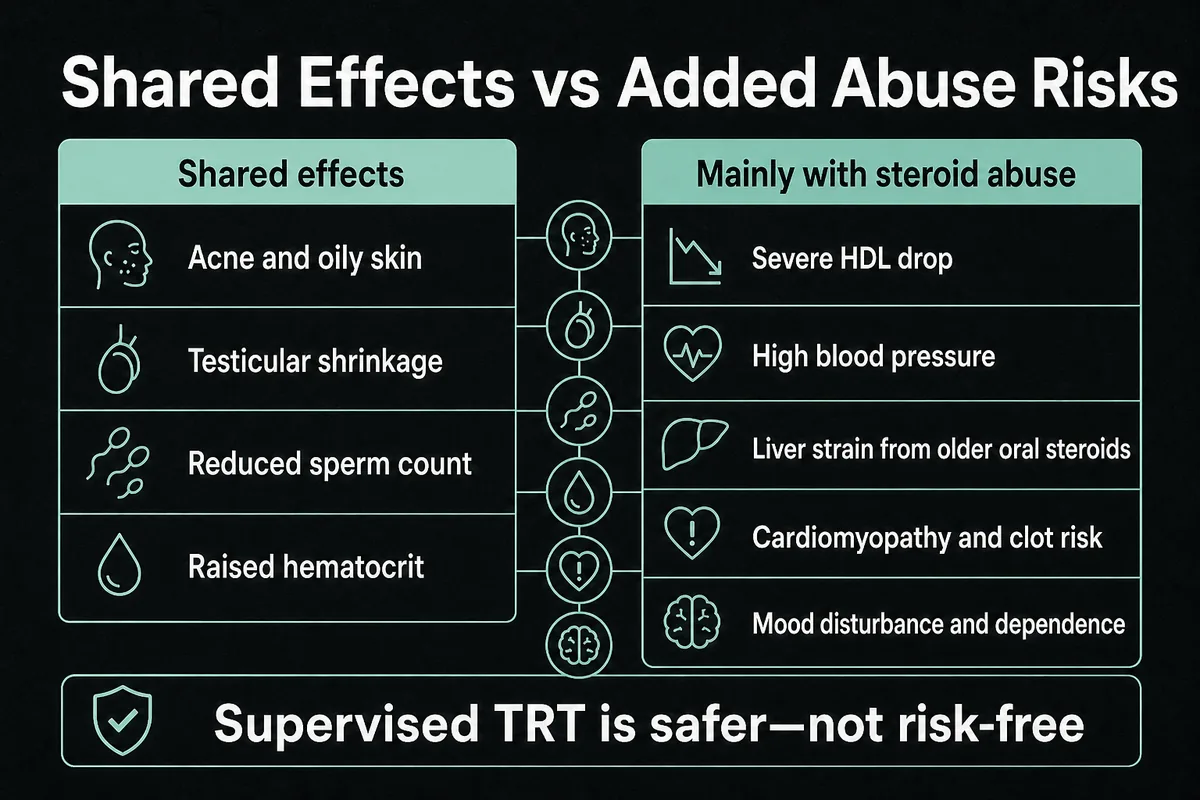
People search "trt steroid side effects" expecting a single scary list, but the honest picture splits in two. Some effects are shared by anything that raises testosterone, including properly dosed TRT, because they come from the hormone itself. Others cluster almost entirely in supraphysiologic abuse, because they are driven by huge doses, engineered oral molecules, and no monitoring. The table separates them.
Table 2. Side effects: shared vs mainly with abuse
| Shared (both raise testosterone) | Mainly with anabolic-steroid abuse |
|---|---|
| Acne and oily skin 78 | Severe HDL (good cholesterol) drop and high blood pressure |
| Testicular shrinkage 8 | Liver strain from oral 17-alpha-alkylated steroids |
| Reduced sperm count and fertility impact 17 | Cardiomyopathy and higher clot risk |
| Raised red blood cell count (hematocrit) 78 | Aggression or mood disturbance and dependence |
The left column is why even well-run TRT needs monitoring: your clinician checks hematocrit, watches for prostate changes, and discusses fertility before you start, and most of these effects are dose-dependent and manageable 18. Fertility suppression in particular is usually reversible and can often be planned around, which we cover in TRT and fertility. The right column is different in kind: the extreme cardiovascular, liver, and psychiatric harms most associated with "steroids" come from supraphysiologic abuse, not from replacement dosing, and the liver toxicity specifically traces to older oral 17-alpha-alkylated steroids rather than the testosterone used in TRT. Our full TRT side effects page details the replacement-dose risks and how they are monitored.
One important and current point most competitors miss: after the large TRAVERSE cardiovascular safety trial, the FDA in February 2025 updated testosterone labeling class-wide, removing the previous heart-attack and stroke language from the boxed warning and adding a new warning that testosterone can increase blood pressure 5. That change reflects better evidence for monitored, replacement-level use, not a green light for abuse. If heart health is your concern, see TRT and heart health and TRT and blood pressure.
Is TRT Safer Than Steroids?
So is TRT safer than steroids? For the intended purpose, treating diagnosed low testosterone, the answer supported by the evidence is yes: supervised replacement that keeps levels inside the normal range, with regular bloodwork and a clinician adjusting the dose, carries far lower risk than unmonitored supraphysiologic abuse 29. Most of the frightening outcomes people picture when they hear "steroids" are products of very high doses, engineered molecules, and the absence of any medical oversight, none of which describe properly run TRT.
That said, safer is not the same as safe. TRT still has real side effects, it is not appropriate for men without a genuine deficiency, and it is only worthwhile when a diagnosis and monitoring are in place 26. The benefits for men who are not deficient are unproven, and the risks do not disappear just because the drug is prescribed 9. The right comparison is not "TRT good, steroids bad" but "replacement for a diagnosed condition, monitored, versus enhancement in someone who does not need it, unmonitored." Framed that way, the safety difference is really a difference in dose, purpose, and supervision.
Frequently Asked Questions
The molecule can be the same; the use is not. TRT is a replacement dose aimed at the normal male range for a diagnosed deficiency, prescribed and monitored 14. Anabolic-steroid abuse uses much larger, supraphysiologic doses, often of modified molecules, for enhancement and without medical oversight 3.
Yes in the sense that TRT delivers bioidentical testosterone, the same molecule the body makes 8. Many anabolic steroids are chemically modified derivatives of testosterone (such as nandrolone or stanozolol) rather than testosterone itself.
No. Exogenous testosterone, even at a therapeutic replacement dose, is a banned substance in drug-tested sport and requires a Therapeutic Use Exemption. Because it is an external hormone, it is not considered "natural" or "natty."
Replacement-dose side effects include acne and oily skin, testicular shrinkage, reduced sperm production, and a raised red blood cell count, most of which are dose-dependent and monitored 78. The severe cardiovascular, liver, and psychiatric harms people associate with steroids come mainly from supraphysiologic abuse, not from monitored TRT.
References
- Mulhall JP, et al. Evaluation and Management of Testosterone Deficiency: AUA Guideline. American Urological Association, 2018 (amended).
- Bhasin S, et al. Testosterone Therapy in Men With Hypogonadism: An Endocrine Society Clinical Practice Guideline. 2018.
- U.S. Drug Enforcement Administration, Diversion Control Division. Anabolic Steroids (Drug Fact Sheet).
- U.S. Food and Drug Administration. Testosterone Cypionate Injection Prescribing Information. 2022.
- U.S. Food and Drug Administration. FDA issues class-wide labeling changes for testosterone products. February 2025.
- U.S. Food and Drug Administration. Testosterone Information. Accessed 2026.
- MedlinePlus. Testosterone Injection. U.S. National Library of Medicine. Accessed 2026.
- Cleveland Clinic. Testosterone Replacement Therapy (TRT). Accessed 2026.
- Mayo Clinic. Testosterone therapy: Potential benefits and risks as you age. Accessed 2026.
The information in this article is for educational purposes only and does not constitute medical advice. Always consult a healthcare professional before starting any new supplement or compound. Results vary by individual.