
TRT side effects range from mild and manageable, like acne, oily skin, and water retention, to a smaller number of serious ones, like a raised red blood cell count, that are why every responsible testosterone program is built around lab monitoring. Most of the common effects are dose-dependent and reversible, and they often settle as your dose is adjusted. A few (higher red blood cell counts, suppressed sperm production, and possible prostate or blood-pressure changes) are the reason clinicians check your blood before you start and at regular intervals afterward. This page separates what is common from what is serious, flags what tends to reverse, and grounds each point in guideline and label-level evidence rather than gym-floor rumor. It also draws a hard line between physiologic testosterone replacement therapy and anabolic-steroid abuse, because most of the frightening harms people associate with testosterone come from the latter, not from properly dosed and monitored treatment.
Key Takeaways
- Most common effects are mild, dose-dependent, and reversible: acne, oily skin, water retention, mild mood or libido shifts, and injection-site soreness usually respond to a dose or formulation change 5611.
- A few effects are serious and drive lab surveillance: a rising red blood cell count (polycythemia), suppressed fertility, and prostate changes are why your clinician monitors hematocrit and PSA on a schedule 16.
- The 2025 FDA heart update matters: after the TRAVERSE trial, the FDA removed the boxed cardiovascular warning class-wide but added a new class-wide blood-pressure warning 34.
- Fertility suppression is usually reversible: TRT shuts down the body's own sperm production, which typically recovers after stopping or can be preserved with fertility-sparing options during treatment 12.
- TRT is not anabolic-steroid abuse: replacement dosing restores a normal testosterone level, while abuse uses many times that amount, and most scare-story harms come from supraphysiologic use 611.
- Monitoring is the safety net: baseline and follow-up testosterone, hematocrit, PSA, and estradiol testing, every 3 to 6 months at first, is how side effects are caught early and managed 16.
Quick reference: common TRT side effects
Before the detail, here is the short version. The table below sorts the effects men most often ask about by how common they are, whether they usually reverse, and what each one is telling your clinician. "Reversible" here means the effect typically improves when the dose is lowered, the formulation is changed, or treatment is stopped, not that it always disappears on its own while you continue.
Table 1. Common TRT side effects at a glance
| Side effect | How common | Typically reversible? | What it signals |
|---|---|---|---|
| Acne and oily skin | Common, especially early | Yes, with dose or skincare adjustment | Higher androgen activity in the skin 59 |
| Water retention and bloating | Common, usually early | Yes, often settles in weeks | Fluid and sodium shifts, sometimes higher estradiol 511 |
| High estrogen or breast tenderness or gyno | Less common | Often, if managed by a clinician | Aromatization of testosterone to estradiol 11 |
| Raised red blood cell count (polycythemia) | Common on higher or injectable doses | Yes, with dose change or phlebotomy | Testosterone stimulating red blood cell production 111 |
| Reduced sperm count and fertility | Common | Usually, after stopping or with adjuncts | Suppression of the body's own hormone signaling 12 |
| Testicular shrinkage | Common | Usually partial recovery after stopping | Same hormonal suppression as fertility loss 6 |
| Mood, irritability, or anxiety shifts | Variable | Yes, often dose-related | Level swings, especially peak-to-trough 5 |
| Worsened sleep apnea | Uncommon | Yes, if identified and treated | Possible aggravation of pre-existing apnea 56 |
| Injection-site or skin reaction | Common but minor | Yes | Local irritation from the shot or gel 910 |
Common side effects of TRT in males
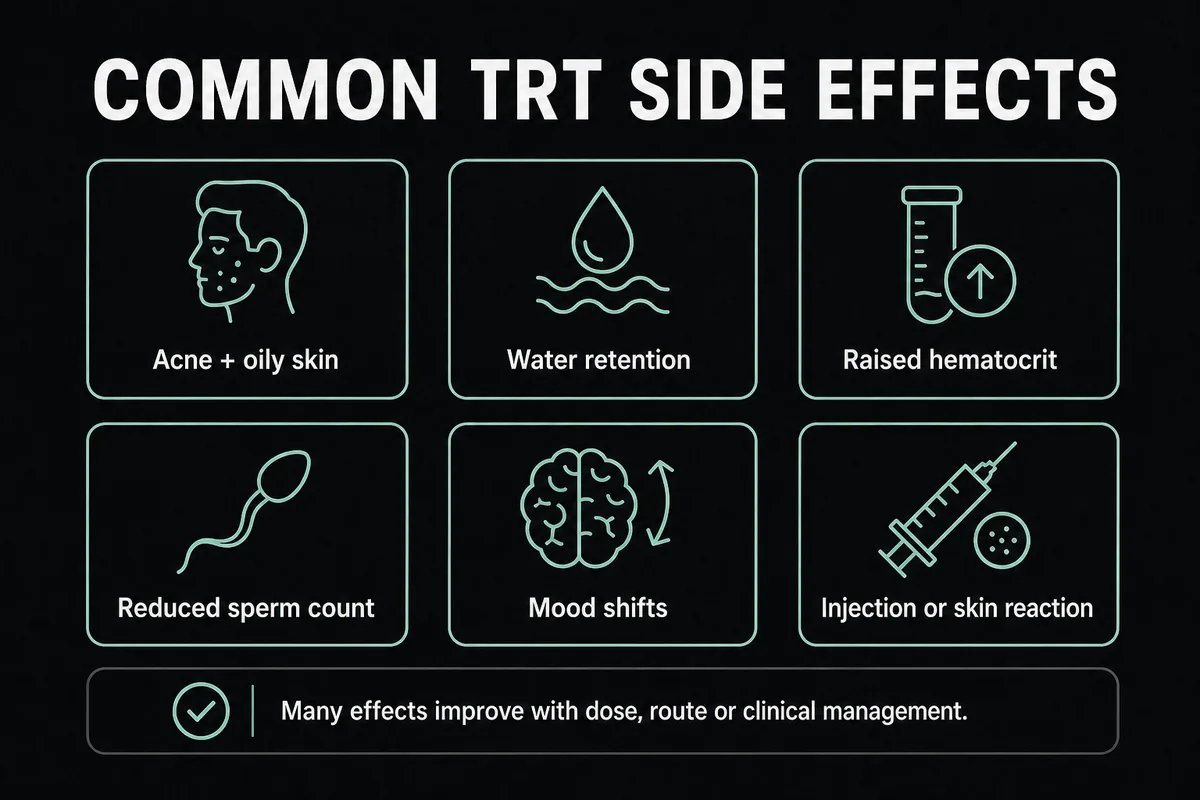
The common side effects of TRT in males are mostly the mild, visible ones. They are not dangerous for most people, and many improve once your dose and formulation are dialed in. The sections below walk through each, with the mechanism so you understand why it happens and what usually helps.
Acne and oily skin
Acne and oily skin are among the most common early complaints, and yes, TRT can cause acne. Testosterone increases activity in the skin's oil glands, which can trigger breakouts on the face, chest, and back, sometimes within the first weeks 59. For most men this is mild and eases as levels stabilize. Standard acne care (a consistent cleansing routine and, if needed, topical or prescription treatments) works the same way it does for anyone, and your clinician may lower the dose or adjust the schedule if breakouts are stubborn 11. Acne that appeared with TRT commonly improves once the dose is optimized, and it typically fades if therapy is stopped.
Water retention and bloating
Mild water retention and a puffy or bloated feeling are common in the first few weeks. Testosterone can shift how the body handles sodium and fluid, and some of the retention is linked to testosterone converting to estradiol (estrogen) 511. For most men this is temporary and settles as the body adjusts. Persistent or marked swelling, especially in the ankles, is worth reporting, because it can occasionally signal fluid overload that matters more in men with heart or kidney conditions 56.
High estrogen on TRT symptoms
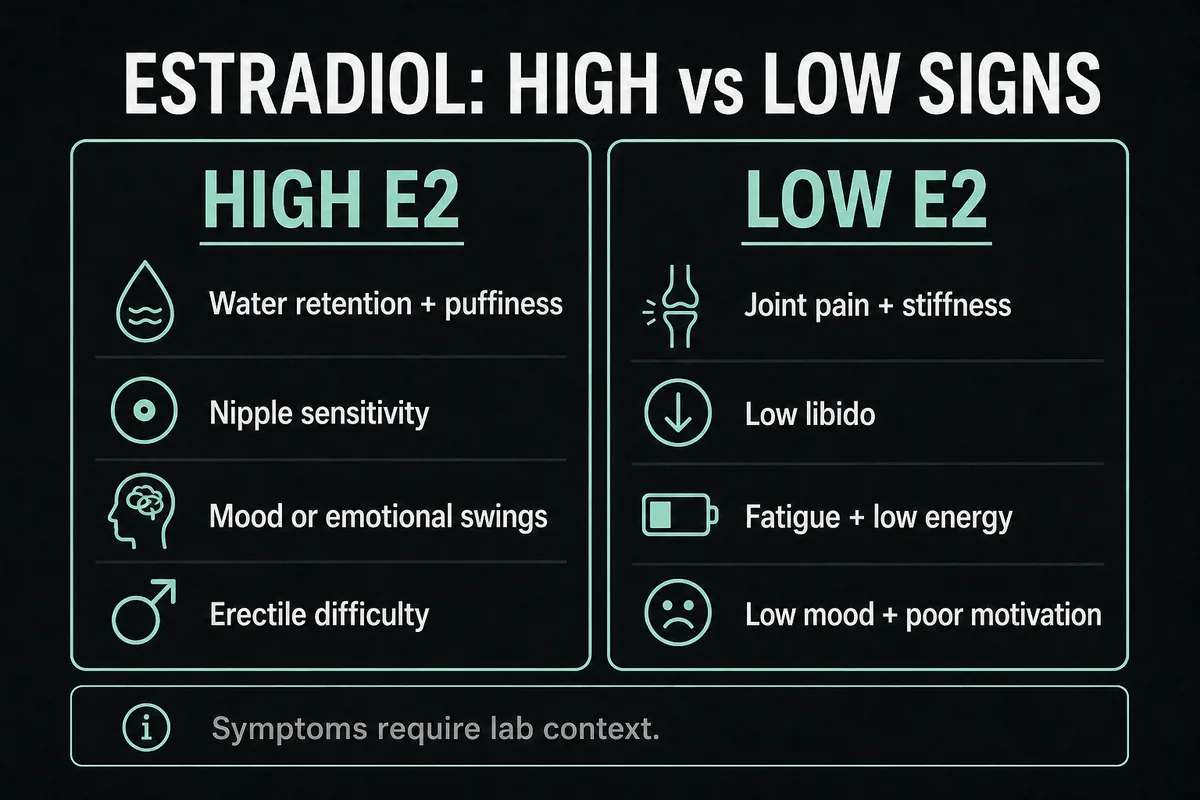
Some of testosterone is naturally converted to estradiol by an enzyme called aromatase, so raising testosterone can raise estrogen too 11. That is normal and even necessary in moderation, but high estrogen on TRT symptoms can include water retention, nipple or breast tenderness, moodiness, and erectile changes. In one management-focused review, an estradiol level above about 60 pg/mL was associated with a higher risk of gynecomastia 11. Estrogen that is too low causes its own problems, which is why chasing "zero estrogen" is a mistake.
Table 4. High vs low estrogen (E2) symptoms on TRT
| High E2 signs | Low E2 signs |
|---|---|
| Water retention and puffiness | Joint pain and stiffness |
| Nipple sensitivity or breast tissue growth | Low libido |
| Moodiness or emotional swings | Fatigue and low energy |
| Erectile difficulty | Low mood and poor motivation |
If your estradiol needs managing, that is a physician-directed decision. Estrogen-blocking medicines such as anastrozole (an aromatase inhibitor) are prescription drugs used carefully, and driving estrogen too low with a do-it-yourself protocol causes the low-E2 problems in the right-hand column 11. This is a lab-guided adjustment, not something to self-manage from a forum.
Gynecomastia (breast tissue growth)
Gynecomastia, the growth of actual breast gland tissue, is a less common but well-recognized effect, and it is driven by that testosterone-to-estradiol conversion rather than by testosterone directly 11. It often starts as tenderness or a small firm disc under the nipple. Caught early, it is frequently managed by adjusting the dose, changing the ester, or using physician-directed medication; established tissue that has been present for a long time may not fully resolve without a specialist opinion 11. Report new breast tenderness or lumps promptly so it can be addressed while it is still reversible.
Mood changes, anxiety, and irritability
TRT can cause anxiety, irritability, or mood swings in some men, though the picture is mixed and many report improved mood as low-testosterone symptoms lift. Large swings between a peak just after an injection and a trough before the next dose can drive mood changes, which is one reason more frequent, smaller doses sometimes help 5. If you feel more anxious, angry, or low after starting, tell your clinician; it is often a dose or scheduling issue rather than a reason to abandon treatment. Any new or worsening depression should be taken seriously and reviewed.
Fatigue, sleep, and appetite changes
People ask whether TRT can make you tired, whether it causes insomnia, and whether it makes you hungry. All three can happen. Fatigue on TRT is sometimes a sign of a rising red blood cell count, disrupted sleep, or a level that is peaking and crashing, so persistent tiredness is worth a lab check rather than just pushing through 15. Some men notice lighter or more broken sleep early on, and TRT can worsen underlying sleep apnea (covered below) 56. Appetite can increase for some men as energy and activity rise, but TRT is not an appetite drug, and any large change in hunger or weight is worth mentioning.
Hair loss and testicular shrinkage
Testosterone is converted in some tissues to dihydrotestosterone (DHT), which can accelerate male-pattern hair loss in men who are genetically prone to it 11. TRT does not create baldness out of nowhere, but it can speed up a pattern that was already coming. Separately, because TRT signals the body to pause its own testosterone production, the testicles usually shrink to some degree during treatment 6. This is expected, is tied to the same mechanism as reduced fertility, and usually partly reverses after stopping. Men who want to preserve testicular size and fertility during treatment sometimes use adjuncts under medical supervision, discussed in our guide to TRT and fertility.
Serious risks of TRT
The serious risks of TRT are fewer, but they are the reason monitoring exists. Whether TRT is dangerous depends heavily on the person: the risks concentrate in men with certain pre-existing conditions, which is why screening before you start matters as much as monitoring after.
Raised red blood cell count (polycythemia)
The most consistent lab risk of TRT is a rising red blood cell count. Testosterone stimulates red blood cell production, which thickens the blood and, if unchecked, can raise the risk of clots 17. Guidelines treat a hematocrit at or above about 52% as a threshold to act, typically by lowering the dose, pausing treatment, or arranging therapeutic phlebotomy (a blood draw similar to donating) 111. This is exactly why hematocrit is checked at baseline and at follow-up visits. The effect is manageable and reversible when caught, which is the whole point of routine bloodwork.
Is TRT bad for your heart?
For years the cardiovascular question hung over TRT. The large TRAVERSE trial (n=5,246 men with low testosterone and high cardiovascular risk) was designed to answer it and found no increase in major adverse cardiac events (heart attack, stroke, or cardiovascular death) versus placebo, though it did observe more cases of atrial fibrillation and pulmonary embolism in the testosterone group 48. Acting on that evidence, in February 2025 the FDA removed the boxed cardiovascular warning from testosterone products class-wide 3. That does not mean "no cautions." It means the strongest available trial did not show the feared heart-attack and stroke signal, while a few other risks remain on the label. If you have heart disease, this is a conversation to have in detail, and our page on TRT and heart health goes deeper.
TRT and blood pressure
At the same time it removed the boxed heart warning, the FDA added a new class-wide warning that testosterone products can raise blood pressure 3. That makes blood-pressure monitoring part of standard follow-up, particularly for men who already have hypertension or are being treated for it. If your readings climb after starting, your clinician may adjust your dose or your blood-pressure management. See TRT and blood pressure for how this is tracked.
TRT, PSA, and prostate cancer risk
TRT can modestly raise PSA (prostate-specific antigen), a blood marker linked to prostate activity, often by roughly 0.3 ng/mL on average, which is why PSA is checked before and during treatment 11. The important nuance: testosterone can stimulate the growth of an existing prostate cancer, so active prostate cancer is a contraindication, but current evidence does not show that TRT causes new prostate cancer in men who did not already have it 7. A meaningful PSA rise or an abnormal exam prompts urology evaluation rather than automatic alarm. More detail is in our guide to TRT and prostate cancer.
TRT and sleep apnea
TRT can worsen obstructive sleep apnea in some men, especially those who already have it or are at high risk 56. Loud snoring, choking or gasping at night, and daytime sleepiness are worth flagging, since untreated apnea carries its own cardiovascular and blood-pressure consequences. Clinicians often screen for sleep apnea before starting, and treating the apnea (rather than stopping TRT outright) is frequently the answer.
TRT and fertility
This is one of the most important effects to understand before starting. Because external testosterone signals the brain to stop the hormones that drive the testicles, TRT suppresses the body's own sperm production and can reduce fertility, sometimes to the point of temporary infertility 12. The reassuring part is that this suppression is usually reversible: sperm production commonly recovers over months after stopping, and men who want to father children during treatment can often preserve fertility with physician-directed adjuncts such as hCG 12. If you may want children, raise this before you start, not after. Our dedicated page on TRT and fertility covers the options.
Side effects of TRT injections vs gels vs pellets
The side effects of TRT injections differ from those of gels or pellets, because how the hormone enters your body changes both the local reactions and how much your red blood cell count rises. The table below compares the main delivery methods. None is universally "safest"; the right one depends on your labs, lifestyle, and preferences, chosen with your clinician.
Table 3. Side effects by TRT formulation
| Formulation | Notable side-effect profile | Hematocrit impact | Extra note |
|---|---|---|---|
| Intramuscular or subcutaneous injection | Injection-site soreness; peak-to-trough level swings that can affect mood and energy | Higher, roughly a 4% rise on average in one review | Frequency and dose can be tuned to smooth swings 1011 |
| Transdermal gel | Skin irritation at the application site | Lower than injections | Transference risk: skin contact can transfer testosterone to partners or children, so cover the area and wash hands 9 |
| Pellets (implanted) | Implant-site pain, bruising, or extrusion; possible infection | Moderate | Hard to dose-adjust once implanted until the pellets wear off 6 |
| Nasal gel | Nasal irritation, runny nose, or headache | Minimal in the referenced review | Requires frequent daily dosing, which affects adherence 11 |
Injectable testosterone tends to raise hematocrit more than gels or nasal preparations, which is one reason men on injections may need closer blood monitoring 11. Gels avoid needles but add the transference caution above. Whichever you use, the monitoring plan is similar; the delivery method mostly changes which nuisance effects you are most likely to notice.
Short-term vs long-term effects of TRT
Separating the short-term from the long-term effects of TRT helps set expectations. Early effects are mostly the mild, reversible ones that appear as your body adjusts. The long-term considerations are the ones that justify ongoing labs rather than a one-time check. This split is also the honest answer to whether TRT is safe long term: it can be, for the right person, when it is monitored.
Table 2. Short-term vs long-term side effects of TRT
| Timeframe | Effects | Reversibility and management |
|---|---|---|
| First weeks | Acne and oily skin, water retention, mood and libido shifts, injection-site soreness | Usually mild and reversible; often settle with time or a dose or formulation change 511 |
| Long term | Raised red blood cell count (polycythemia), suppressed fertility, prostate and PSA changes to monitor, possible blood-pressure rise | Managed with scheduled labs, dose adjustment, phlebotomy if needed, and fertility planning; most are reversible or controllable when tracked 1311 |
Is TRT safe long term? For appropriately selected men who are monitored, guidelines support ongoing use, and the long-term concerns are the manageable ones in the table rather than a hidden catastrophe 16. The risk profile worsens when men skip monitoring, self-dose beyond replacement levels, or ignore contraindications.
TRT is not anabolic-steroid abuse
A lot of the fear attached to testosterone comes from confusing medical TRT with anabolic-steroid abuse, and the two are not the same thing. Physiologic replacement aims to bring a genuinely low testosterone level back into the normal range and is dosed and monitored to stay there 6. Anabolic-steroid abuse for muscle building uses many times that amount, often stacks multiple compounds, and skips medical monitoring entirely. Most of the extreme harms people cite (severe polycythemia, marked gynecomastia, cardiovascular strain, and the old warnings about liver damage) cluster in supraphysiologic abuse; notably, liver toxicity was tied largely to older oral 17-alpha-alkylated steroids, not the injectable esters or testosterone undecanoate used in modern replacement 11. If you are weighing the "is testosterone a steroid" question honestly, our explainer on whether TRT is a steroid draws the distinction in full.
Side effects of stopping TRT
The side effects of stopping TRT are essentially the return of the low-testosterone symptoms you started with, because the body's own production was paused during treatment and takes time to restart 1. Men who stop, especially abruptly, can experience fatigue, low libido, low mood, and other hypogonadal symptoms until natural production recovers, which can take weeks to months 2. This is why stopping is best done as a planned conversation, not a sudden halt, and why some men use a clinician-guided restart protocol to support the recovery of their own hormone signaling. Our page on stopping TRT walks through what to expect and how it is managed.
How TRT side effects are monitored and managed
Monitoring is the single most important safety feature of TRT, and it is what turns a list of scary-sounding risks into manageable ones. Before starting, clinicians typically confirm low testosterone on more than one morning blood test and check a baseline hematocrit and hemoglobin, PSA (for age-appropriate men), and often estradiol 16. After starting, testosterone, hematocrit, and PSA are commonly rechecked at intervals (often around 3 to 6 months in the first year, then roughly annually once stable), with estradiol checked if symptoms suggest it 111. Your clinician uses these numbers to adjust the dose, switch formulations, arrange phlebotomy, or pause treatment.
Some men should not take TRT, or should be treated only with extra caution. Guideline and clinic sources flag contraindications and cautions including active prostate or male breast cancer, an unevaluated prostate nodule or high PSA, a very high baseline red blood cell count, untreated severe sleep apnea, uncontrolled heart failure, a recent cardiovascular event, and a desire to conceive in the near term 16. This is exactly the ground your clinician covers before writing a prescription, and it is why TRT is a monitored medical therapy rather than a supplement.
Frequently Asked Questions
The largest dedicated trial, TRAVERSE, found no increase in major cardiac events (heart attack, stroke, or cardiovascular death) in men on testosterone versus placebo, though it did see more atrial fibrillation and pulmonary embolism 4. On that evidence the FDA removed the boxed cardiovascular warning class-wide in 2025, while adding a new blood-pressure warning 3. If you have heart disease, discuss the specifics with your clinician.
TRT suppresses the body's own sperm production and can cause temporary infertility, so conceiving while on standard TRT is often difficult 12. The effect is usually reversible after stopping, and men who want children during treatment can sometimes preserve fertility with physician-directed options such as hCG. Raise family planning before you start 2.
Some men report more anxiety, irritability, or mood swings, particularly with large swings between dose peaks and troughs, while others find their mood improves as low-testosterone symptoms lift 5. If you feel more anxious after starting, tell your clinician, because it is often a dose or scheduling adjustment rather than a reason to stop.
For appropriately selected men who are monitored, guidelines support long-term use, and the main long-term concerns (a rising red blood cell count, fertility suppression, and prostate and blood-pressure monitoring) are manageable with scheduled labs and dose adjustment 136. Safety depends heavily on ongoing monitoring and honest screening for contraindications.
A raised red blood cell count is managed by your clinician, usually by lowering the dose, switching from an injectable to a formulation that raises hematocrit less, staying well hydrated, and, when the hematocrit reaches about 52% or higher, arranging therapeutic phlebotomy 111. This is why hematocrit is checked at baseline and at follow-up visits.
References
- Bhasin S, et al. Testosterone Therapy in Men With Hypogonadism: An Endocrine Society Clinical Practice Guideline. J Clin Endocrinol Metab. 2018;103(5):1715-1744.
- Mulhall JP, et al. Evaluation and Management of Testosterone Deficiency: AUA Guideline. J Urol. 2018;200(2):423-432 (amended).
- U.S. Food and Drug Administration. FDA issues class-wide labeling changes for testosterone products. February 2025.
- Lincoff AM, Bhasin S, et al. Cardiovascular Safety of Testosterone-Replacement Therapy (TRAVERSE). N Engl J Med. 2023;389(2):107-117.
- Mayo Clinic. Testosterone therapy: Potential benefits and risks as you age. Accessed 2026.
- Cleveland Clinic. Testosterone Replacement Therapy (TRT). Accessed 2026.
- Harvard Health Publishing. Is testosterone therapy safe? Take a breath before you take the plunge. April 2024.
- Harvard Health Publishing. Testosterone therapy may be safe for men at risk for heart attack and stroke. Accessed 2026.
- MedlinePlus. Testosterone Topical. U.S. National Library of Medicine. Accessed 2026.
- MedlinePlus. Testosterone Injection. U.S. National Library of Medicine. Accessed 2026.
- Basheer B, et al. Management of Adverse Effects in Testosterone Replacement Therapy. Int Braz J Urol. 2025;51(3):e20259904.
The information in this article is for educational purposes only and does not constitute medical advice. Always consult a healthcare professional before starting any new supplement or compound. Results vary by individual.