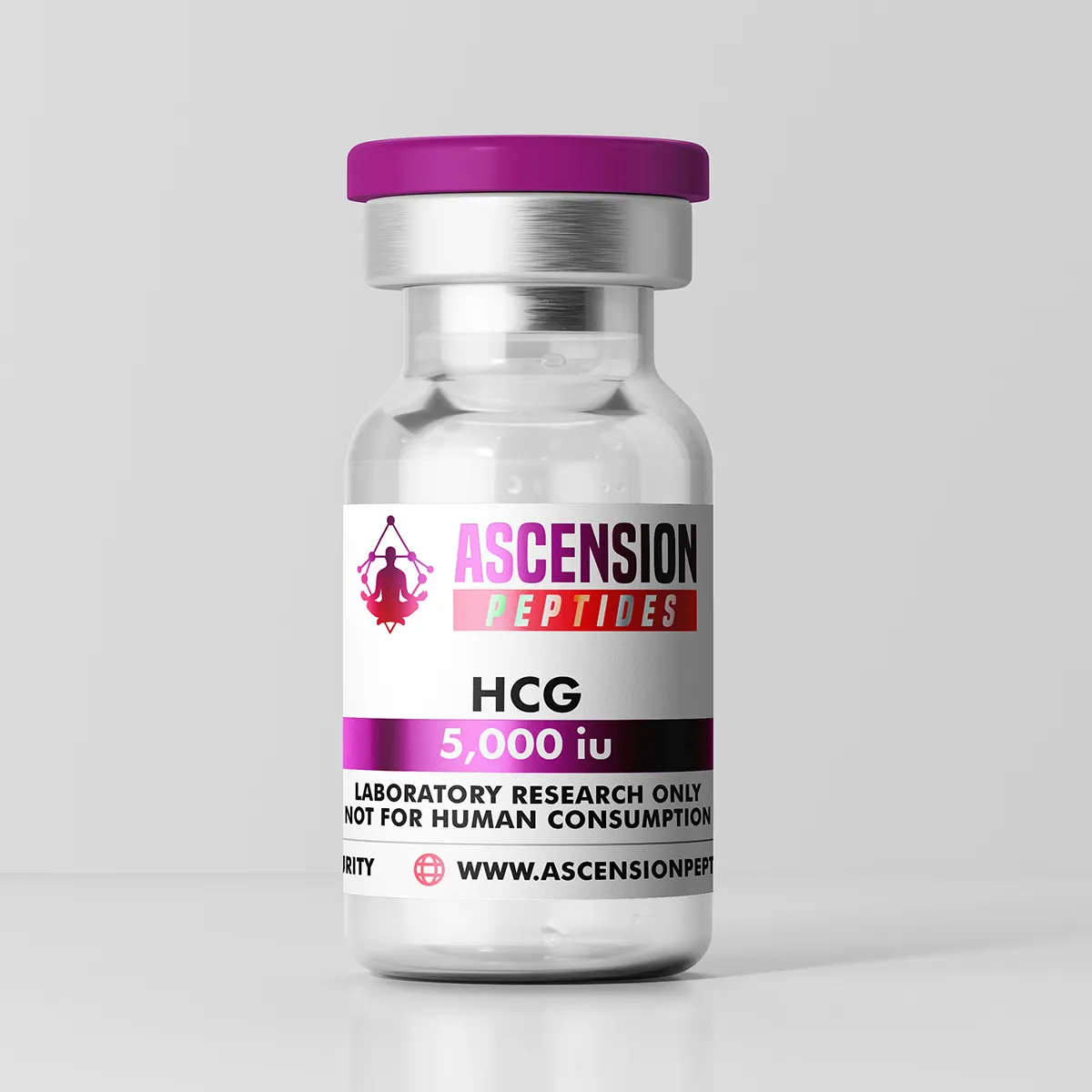
HCG keeps your body's testosterone signal alive.
If you're on TRT and worried about shrinking testicles, falling fertility, or losing the natural pulse your body relied on for years, the HCG peptide is the single most common rescue tool clinicians reach for. It mimics LH, your own pituitary signal, and tells your testes to keep working while exogenous testosterone shuts the rest of the loop down.
🔑 Key Takeaways
- HCG (human chorionic gonadotropin) acts as a long-acting LH analog. It's classified as a glycoprotein hormone, but inside men's health and TRT circles it's commonly grouped with peptide therapies, which is why the term "hcg peptide" stuck.
- The biggest real-world use today is testicular preservation on TRT. Typical dose is 250 to 500 IU subcutaneous, two or three times per week alongside testosterone.
- Fertility-focused men run higher doses (1,000 to 2,000 IU two to three times weekly) for several months to restart sperm production.
- Women receive HCG mainly as a one-time ovulation trigger (5,000 to 10,000 IU) during IVF or IUI cycles.
- The "HCG diet" for weight loss is not supported by evidence and has been flagged by the FDA. Skip it.
- HCG is prescription-only. It is not a self-experiment compound, and it interacts with estrogen levels, so many men also need an aromatase inhibitor on protocol.
What is the HCG peptide?
HCG stands for human chorionic gonadotropin. It is a two-subunit glycoprotein, with an alpha subunit nearly identical to LH, FSH, and TSH, and a unique beta subunit that gives HCG its longer half-life and pregnancy specificity.
The pregnancy origin matters. The placenta secretes HCG in early pregnancy to keep the corpus luteum producing progesterone until the placenta itself takes over. That same molecule, when injected into a non-pregnant body, binds the LH receptor and triggers downstream testosterone or ovulation effects depending on who's receiving it.
The "peptide" label is loose. Strictly, HCG is a glycoprotein hormone, not a small peptide like kisspeptin or CJC-1295. But because it's an injectable hormonal compound used in TRT clinics, on bodybuilder PCT protocols, and in fertility medicine, the men's health world uses "hcg peptide" interchangeably with HCG. That's the search term most people type, and that's how this page treats it.
How HCG works in the body
HCG mimics luteinizing hormone almost perfectly. Both bind the same receptor, called LHCGR, on the Leydig cells of the testes (in men) and on the theca and granulosa cells of the ovary (in women).
In men, that signal does three things:
- Stimulates intratesticular testosterone. Testicular T levels run 50 to 100 times higher than serum T, and they're the part that supports sperm production. TRT alone collapses this. HCG keeps it alive.
- Maintains testicle size. Without LH (or an LH stand-in), the testes atrophy on TRT. HCG prevents the shrinkage by keeping the cellular machinery active.
- Supports spermatogenesis. Indirectly, by maintaining intratesticular testosterone and pairing well with FSH-side support when fertility is the goal.
In women, HCG triggers final egg maturation and ovulation. That's why fertility clinics use a single large HCG injection ("the trigger shot") timed to follicle size during IVF and IUI.
The half-life is the practical edge. LH clears in about 20 to 30 minutes. The HCG peptide hangs around for roughly 29 hours after a recombinant injection. That's why two or three injections per week are enough to keep the LH signal smooth, instead of needing daily shots.
HCG dosage chart by use case
For most men reading this page, the line that matters is the first one: 250 to 500 IU subcutaneous, two or three times a week, alongside their normal testosterone. That's the protocol the majority of TRT clinics in the US default to in 2026.
HCG on TRT: why it's the default add-on now
Five years ago, men on TRT were told to accept testicular atrophy and infertility as the cost of feeling normal again. That's no longer the standard answer. The hcg peptide changed it.
By keeping the LH signal alive, HCG lets the testes keep producing intratesticular testosterone and sperm during ongoing TRT. The practical effects men report:
- Testicles stay full-sized instead of shrinking visibly within months
- Mood and libido often feel smoother (some men describe TRT-only as "flat" until HCG is added)
- Sperm production is preserved so future fertility doesn't require a 6-month restart protocol
- Bloodwork sometimes shows higher free testosterone at the same TRT dose, because the upstream signal is intact
If you're starting TRT, ask whether your provider includes HCG by default. Many concierge and telehealth clinics now build it into the protocol from week one. For a deeper, TRT-specific walkthrough including injection timing relative to testosterone shots, see our HCG on TRT guide.
HCG for fertility: men and women
Fertility is where HCG started clinically, and it remains FDA-approved for that use.
For men with hypogonadotropic hypogonadism (low testosterone caused by pituitary or hypothalamic problems rather than testicular failure), HCG can stimulate the testes directly to produce testosterone and sperm without exogenous testosterone at all. Doses run higher than TRT support, often 1,500 to 3,000 IU two or three times weekly, sometimes paired with HMG (which provides FSH activity) for several months.
For men coming off anabolic steroids or long-term TRT who want to conceive, HCG bridges the gap while the HPTA recovers. Typical restart looks like 1,000 to 2,000 IU three times a week for 4 to 6 weeks, then a SERM (clomiphene or enclomiphene) to push endogenous LH and FSH back online. Sperm parameters often need 3 to 6 months to fully recover.
For women in IVF or IUI cycles, HCG is given as a single trigger shot at 5,000 to 10,000 IU, timed to follicle maturity, to induce final egg maturation and ovulation roughly 36 hours later.
HCG vs gonadorelin, kisspeptin, Clomid, and enclomiphene
Several compounds aim at the same goal of keeping endogenous testosterone or fertility intact. They work at different points in the loop.
Practical read on this: if you're on TRT and want testicular preservation and fertility, HCG is still the standard. Gonadorelin is a reasonable swap if you want a gentler estrogen profile and don't mind dosing more often. SERMs like clomiphene or enclomiphene are an alternative to TRT itself, not an add-on to it.
Side effects and what to monitor
HCG is well tolerated at TRT-support doses, but it's a hormone and it has real downstream effects. Common things to watch:
- Estrogen rise. HCG drives intratesticular testosterone, which aromatizes to estradiol. Many men need a low-dose aromatase inhibitor (anastrozole) added once HCG is in the protocol.
- Acne, oily skin, mood swings. Usually a sign the dose is too high or estrogen is climbing.
- Gynecomastia. Rare at 250 to 500 IU twice weekly. More common above 1,000 IU per shot without estrogen control.
- Headaches and water retention. Common in the first 1 to 2 weeks, usually settle.
- LH receptor desensitization. Long, high-dose runs (above 2,000 IU per shot for many weeks) can blunt the testicular response. Tapering or cycling avoids this.
- Ovarian hyperstimulation syndrome (OHSS). A real risk in women receiving HCG triggers during IVF. This is why fertility cycles are clinic-supervised, never DIY.
Bloodwork to run if you're using HCG long-term: total and free testosterone, estradiol (sensitive assay), LH, FSH, SHBG, and a CBC every 8 to 12 weeks once stable.

How to inject HCG
HCG is shipped as a lyophilized powder in vials, usually 5,000 IU or 10,000 IU. It's reconstituted with bacteriostatic water and injected subcutaneously (most TRT use) or intramuscularly (older fertility protocols).
- Reconstitute the vial. For a 5,000 IU vial mixed with 5 mL of bacteriostatic water, every 0.1 mL contains 100 IU. So 250 IU = 0.25 mL on a U-100 insulin syringe.
- Store the reconstituted vial in the fridge. Reconstituted HCG stays stable for about 30 days refrigerated.
- Inject subcutaneously, usually into the abdomen, with a 27 to 31 gauge insulin syringe.
- Rotate sites and keep frequency steady. Most men do Monday/Thursday or Monday/Wednesday/Friday alongside their TRT shots.
If you want help with the math, the peptide dosage calculator handles vial size, water volume, and target dose without guesswork.
HCG for weight loss: what the evidence actually says
You'll still see clinics market the "HCG diet" of low-dose HCG (125 to 200 IU daily) plus 500 calories a day. The data on this is consistent: weight loss comes from the 500-calorie diet, not from the HCG. Multiple controlled trials show no difference between HCG and placebo for fat loss when calories are matched.
The FDA has formally warned against over-the-counter "homeopathic" HCG weight loss products. If you're looking for compounds with real metabolic data, GLP-1 medications and modern peptide options like retatrutide or the broader peptides-for-weight-loss overview are where the evidence actually is.
Related comparison: gonadorelin vs HCG.
Where HCG fits in 2026
The hcg peptide is no longer a niche bodybuilding tool. It's standard issue in modern TRT clinics, a core part of male fertility medicine, and the most commonly used ovulation trigger in fertility treatment. The structure-of-the-molecule conversation (peptide vs glycoprotein) matters less than the receptor it activates and the outcomes men and women see when it's used correctly.
If you're starting TRT, ask about HCG up front. If you're trying to recover fertility after a cycle, HCG plus a SERM bridge is still the reference protocol. If you've been told the HCG diet will melt fat, the molecule is fine, the diet is the only thing doing the work, and there are better tools for that goal now.
Medical disclaimer. This article is educational and is not medical advice. HCG is a prescription medication. Decisions about TRT, fertility treatment, post-cycle therapy, and hormone replacement should be made with a qualified clinician who can review your bloodwork, history, and goals. Do not start, stop, or change a hormone protocol based on a web article.
Deciding between HCG and a SERM? Enclomiphene vs HCG compares them on LH, FSH, estradiol behaviour and what happens if you are already on TRT.