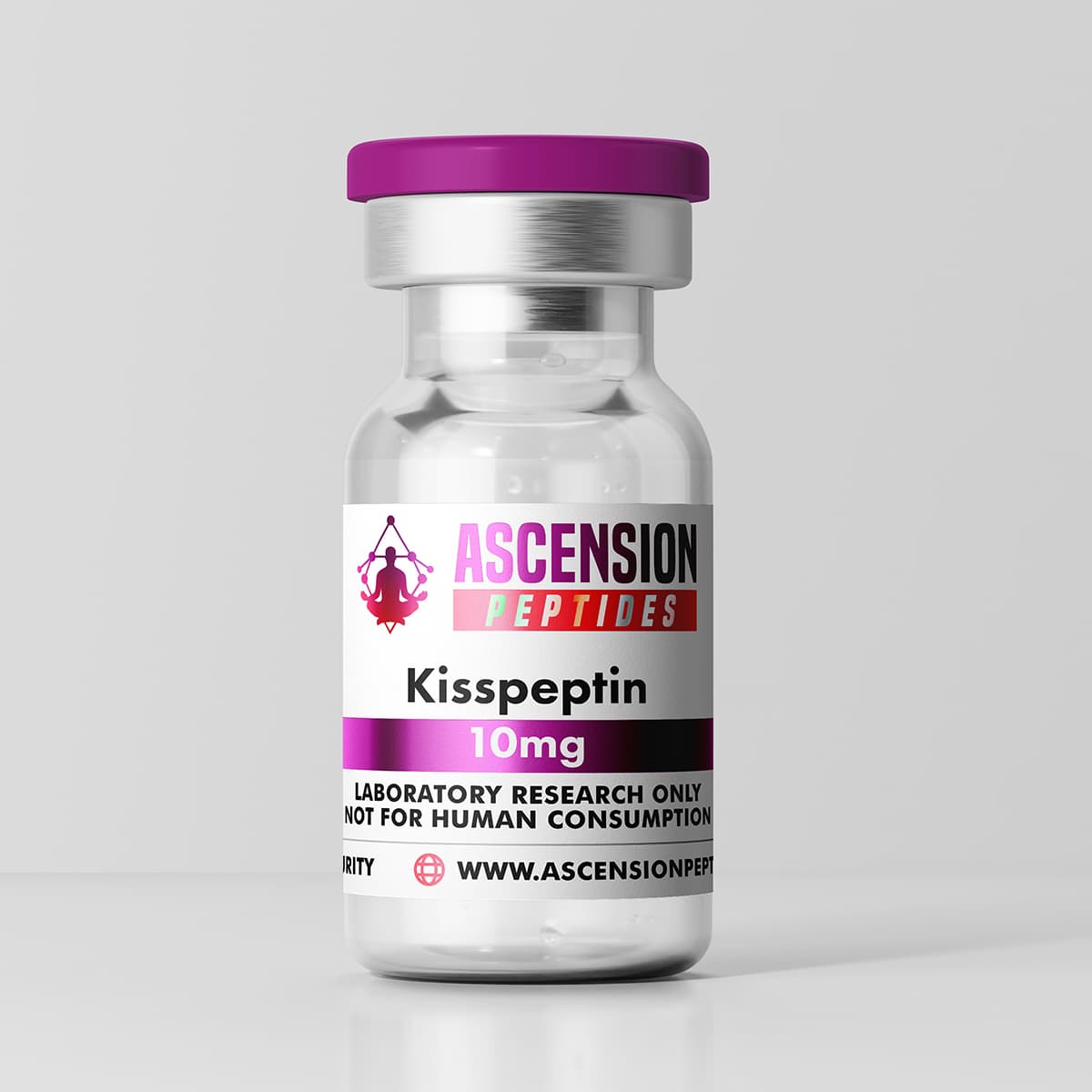
Kisspeptin is the upstream hormone signal that controls almost everything downstream in the male and female reproductive system — yet most people have never heard of it. If testosterone is the engine, kisspeptin is the ignition switch. This guide breaks down what kisspeptin is, what it actually does, the benefits people use it for, dosing protocols, and what to realistically expect.
🔑 Key Takeaways
- Kisspeptin is a hypothalamic neuropeptide encoded by the KISS1 gene that triggers GnRH release, which in turn drives LH and FSH from the pituitary.
- It is the master upstream regulator of the entire HPG (hypothalamic-pituitary-gonadal) axis — the hormonal cascade that produces testosterone, estrogen, and supports fertility.
- The most-used form in research protocols is Kisspeptin-10, the shortest active fragment.
- Primary benefits cluster around testosterone support, fertility, libido, and HPG axis recovery — without the suppression risks of exogenous TRT.
- Typical dose: ~100 mcg subcutaneously, daily or several times weekly.
- Kisspeptin is being studied clinically for hypogonadotropic hypogonadism, IVF protocols, and male hormonal decline.
Kisspeptin-10 is sold as a research peptide; a 10mg vial from Ascension covers roughly 100 doses at the common 100mcg protocol.
What Is Kisspeptin?
Kisspeptin is a neuropeptide produced by neurons in the hypothalamus, encoded by the KISS1 gene. It was originally discovered in 1996 as a metastasis-suppressor gene (the "KISS" came from Hershey's Kisses — the lab was in Hershey, Pennsylvania), but its more important role turned out to be in reproduction and hormone regulation.
It binds to the GPR54 receptor (also called KISS1R) on GnRH-producing neurons. When kisspeptin activates GPR54, those neurons release GnRH (gonadotropin-releasing hormone), which then signals the pituitary to release LH and FSH — the two hormones that tell the testes or ovaries to produce sex hormones.
In short: kisspeptin sits at the very top of the reproductive hormone cascade. Without kisspeptin signaling, the entire downstream system stops working. People with mutations in the KISS1 or GPR54 gene fail to enter puberty.
Kisspeptin-10 vs Kisspeptin-54
Two forms come up in research and protocols:
- Kisspeptin-10: The shortest active fragment — 10 amino acids. Shorter half-life but full biological activity. Most common in peptide protocols.
- Kisspeptin-54: Full-length 54-amino-acid version. Longer half-life, used in some clinical IVF studies.
For practical purposes, when people say "kisspeptin peptide" they almost always mean Kisspeptin-10.
How Kisspeptin Works (The HPG Axis)
The hypothalamic-pituitary-gonadal (HPG) axis is the master hormone control loop. Here is the cascade kisspeptin sits at the top of:
- Kisspeptin neurons in the hypothalamus fire and release kisspeptin.
- Kisspeptin binds GPR54 on GnRH-producing neurons.
- GnRH is released from the hypothalamus into the portal blood supply to the pituitary.
- The pituitary responds by releasing LH and FSH.
- LH stimulates the testes (Leydig cells) to produce testosterone, and supports ovarian function in women.
- FSH supports sperm production in men and follicular development in women.
- Testosterone and estrogen feed back to the hypothalamus and pituitary, regulating the loop.
This cascade is why kisspeptin is described as the "master switch" of reproductive hormones. Hit the top of the chain, and everything downstream responds — but only if the rest of the chain is functional.
Kisspeptin Benefits
The benefits of kisspeptin cluster around the HPG axis it controls. Here is what people actually use it for, with the realistic framing for each.
1. Natural Testosterone Support
This is the headline benefit and the main reason kisspeptin gets attention in the men's hormone optimization space. Because kisspeptin acts at the very top of the cascade, it prompts the body to produce its own testosterone through the natural pathway — LH → Leydig cells → testosterone.
Unlike exogenous TRT, kisspeptin does not shut down endogenous production. It does the opposite: it activates it. This makes it interesting for men who want to support testosterone without committing to lifetime TRT and the testicular shutdown that comes with it.
2. Fertility and Sperm Production
Kisspeptin's role in driving FSH release makes it directly relevant to fertility. FSH supports spermatogenesis in men and follicular development in women. Clinical research has explored kisspeptin (particularly kisspeptin-54) as a trigger for ovulation in IVF protocols, where it appears to reduce the risk of ovarian hyperstimulation syndrome compared to standard hCG triggers.
For men with low sperm counts or hypogonadotropic hypogonadism (where the brain isn't sending enough hormonal signal to the testes), kisspeptin is being studied as a way to restore the upstream signal.
3. Libido and Sexual Desire
Kisspeptin neurons project into brain areas involved in sexual arousal and emotional processing — not just the reproductive cascade. Clinical studies in healthy men have shown that kisspeptin administration can enhance limbic brain activity in response to sexual and bonding stimuli, independent of testosterone changes.
The effect is more subtle than something like PT-141, which acts directly on melanocortin pathways, but it is meaningful for users who feel their libido has flattened over time.
4. HPG Axis Recovery (Post-Cycle or Post-TRT)
For people coming off testosterone or anabolic protocols, the HPG axis needs to restart. Standard PCT (post-cycle therapy) tools work downstream — clomiphene and tamoxifen block estrogen feedback, hCG mimics LH at the testes. Kisspeptin offers an upstream option that more closely mimics the natural restart pathway.
5. Mood and Emotional Regulation
Beyond reproduction, kisspeptin neurons connect to mood-regulating regions of the brain. Some users report subtle improvements in motivation, drive, and emotional resilience — though this benefit is less well-characterized and more anecdotal than the hormonal effects.
6. Studied for Hypogonadism and Reproductive Disorders
Kisspeptin is in active clinical trials for hypogonadotropic hypogonadism, delayed puberty, and infertility. Its upstream mechanism makes it especially relevant for cases where the problem is signaling failure rather than gland failure.
💡 Where Kisspeptin Fits Best
Kisspeptin is most useful for people whose reproductive system is intact but under-signaled — younger men with low natural testosterone, post-cycle users restarting their HPG axis, fertility cases tied to upstream signaling issues, or men over 40 noticing the upstream cascade slowing down. It is not a fit for primary testicular failure, where the testes themselves can't respond.
Kisspeptin Peptide Dosage
Most kisspeptin protocols use Kisspeptin-10 at relatively small doses, administered subcutaneously. The compound is dosed in micrograms (mcg), not milligrams.
Subcutaneous injection in the abdomen is the standard route. Reconstitute with bacteriostatic water, refrigerate, and use within 2–3 weeks. Like most peptides, kisspeptin is sensitive to heat and degradation — handle and store carefully.
Kisspeptin Side Effects
Kisspeptin has a generally favorable side effect profile because it works upstream and at low doses. Side effects tend to be mild and infrequent.
- Injection site reactions: Mild redness or irritation, typical of any subcutaneous peptide.
- Mild headache: Occasional, more common in early-cycle days.
- Transient nausea: Reported by a small subset of users at higher doses.
- Hormonal shifts: Because kisspeptin activates the HPG axis, downstream hormone changes (testosterone, LH, FSH) are the intended effect — but they can produce subtle mood or libido shifts, especially in the first 1–2 weeks.
- Bloating or water retention: Uncommon, usually transient.
For comprehensive coverage of peptide side effects across categories, see our peptide side effects guide.
Who Should Consider Kisspeptin?
Kisspeptin is a niche peptide, and it fits well for specific profiles:
- Men with low testosterone looking for an upstream alternative to TRT that doesn't suppress endogenous production.
- Men over 40 noticing the natural HPG cascade slowing down — kisspeptin targets the actual upstream cause, not just the downstream symptom.
- Post-cycle users restarting the HPG axis after testosterone or anabolic protocols.
- Fertility cases where upstream signaling is the issue — particularly hypogonadotropic hypogonadism.
- People with low libido who haven't responded to testosterone alone.
Not a good fit for:
- People with primary testicular or ovarian failure — the gland needs to be functional for kisspeptin to do anything.
- Anyone looking for dramatic or rapid effects. Kisspeptin works through the natural cascade and takes weeks to show results.
- Users who want a simple "more testosterone" tool — TRT is more direct if that's the only goal and lifetime use is acceptable.
Kisspeptin vs Other Hormonal Peptides
Kisspeptin is the most upstream tool of the bunch. It is not the most powerful in raw effect, but it is the one that works closest to the natural starting point of the cascade.
Related comparison: kisspeptin vs PT-141.