Coming off TRT is possible, and for many men their natural testosterone does come back, but recovery takes months, not days, and it isn't guaranteed for everyone. When you stop testosterone replacement therapy, the outside supply of testosterone falls before your own hormone system reboots, which creates a temporary low-testosterone window that can feel rough. How fast and how fully you recover depends on how long you were on it, your dose, your age, and above all why you had low testosterone in the first place 12. The one rule that never changes: never stop, taper, or restart a testosterone prescription on your own, because your prescribing clinician needs to manage the process and the labs 10.
This guide answers the fear with data: what happens when you stop, how long recovery takes, whether natural production returns, what changes after 6 months versus 5 or 10 years on therapy, and the physician-directed tools used to help the system restart.
| Quick fact | What it means |
|---|---|
| Testosterone cypionate has a terminal half-life of roughly 8 days | Injected testosterone clears over about 1 to 3 weeks, so levels fall gradually, not instantly 6 |
| In the largest pooled recovery analysis, production returned to normal in a median of about 3.4 months | Recovery is measured in months, and most men do recover 2 |
| About 67% recovered by 6 months, 90% by 12 months, and essentially 100% by 24 months | The odds climb steadily over the first 2 years 2 |
| TRT is FDA-approved for hypogonadism from a medical condition, not for age-related low T alone | Whether you need it "for life" depends on the cause of your low T, not on TRT being addictive 7 |
Key Takeaways
- Recovery usually happens, but it takes months. For most men the hypothalamic-pituitary-gonadal (HPG) axis restarts and natural testosterone returns, with a median around 3.4 months and roughly 90% recovered by a year in the largest pooled analysis 2.
- Stopping abruptly causes a temporary "crash." The gap between outside testosterone clearing and your own system rebooting is a low window that drives fatigue, low mood, and low libido; a supervised taper softens it 610.
- Longer, higher-dose, and older means slower. Short, low-dose, younger use recovers faster and more completely than years of high-dose therapy in an older man 12.
- The cause of your low T matters most. Primary (testicular) hypogonadism is often permanent, so stopping just returns you to symptoms; secondary or reversible causes have a better shot at recovery 1.
- Prior anabolic-steroid abuse worsens the odds. Recovery after steroid-induced hypogonadism can be prolonged or incomplete, which is a different situation from replacement-dose TRT 34.
- The restart is a medical process, not bodybuilding PCT. Tapering, lab monitoring, and optional hCG or SERMs like clomiphene and enclomiphene are clinician-directed, not self-dosed 35.
- Not everyone needs TRT for life. Some men can taper and recover; others should stay on it because the underlying condition is chronic. Decide with your clinician, not a forum 17.
Can You Stop TRT Once You Start?
Yes, you can stop TRT, and you can stop TRT once you start. It is not a chemical trap that locks you in for life. What is true is that stopping should be planned and medically supervised rather than done cold turkey, because your body has adapted to the outside testosterone and needs time to take over again 910.
Almost everyone asking "can I stop TRT" is really asking two separate questions: (1) what will happen to me when I stop, and (2) will my own testosterone come back. Those have different answers. The short version is that the immediate stop causes a temporary dip, and the long-term outcome (whether natural production recovers) depends on your biology and history 29. MedlinePlus is blunt on the mechanics: do not stop taking testosterone without talking to your doctor, because your clinician manages how you come off it and what to watch 10.
What Happens When You Stop TRT?
To understand what happens when you stop TRT, you have to understand what TRT was doing while you were on it. Your brain constantly measures how much testosterone is in your blood. The hypothalamus releases GnRH, which tells the pituitary to send out luteinizing hormone (LH) and follicle-stimulating hormone (FSH), and those signals tell the testicles to make testosterone and sperm. When you add testosterone from outside, the brain senses plenty and dials the whole loop down, so LH and FSH drop and the testicles idle 19.
When you stop, the external supply falls before that axis wakes back up. For a stretch of time you have neither much outside testosterone nor much of your own, and that trough is what people feel as the rough part of coming off. It is temporary for most men, but it is real 69.
Does TRT stop natural testosterone production?
Yes. While you are on TRT, your natural testosterone production is suppressed, and does TRT stop natural testosterone production is one of the most common fears in this cluster. The Cleveland Clinic explains it plainly: because your body detects the testosterone you are taking, it reduces or stops making its own 9. This shutdown, sometimes phrased as "does TRT shut down natural production," is expected and, for most men, reversible once the outside supply is removed and the axis restarts 19. It is a pause, not a permanent deletion, for the majority of people on replacement-dose therapy.
TRT withdrawal symptoms and the "TRT crash"
The TRT withdrawal symptoms men describe (sometimes searched in despair as "trt ruined my life") map directly onto that low-testosterone trough: fatigue, low mood or depression, low libido, erectile changes, brain fog, disrupted sleep, and the loss of the energy and strength that therapy had provided 69. These feel worse after abrupt cessation than after a supervised taper, because a sudden stop maximizes the gap before your own production catches up 6. The FDA prescribing information for testosterone cypionate documents that testosterone can be associated with dependence and withdrawal-type symptoms, which is part of why it is a controlled substance and why stopping is meant to be managed 6.
The important reframe: these symptoms usually reflect a temporary window, not permanent damage. Most ease as the axis reboots over the following weeks and months 2. If erectile changes are your main worry, our guide to TRT and ED covers that specifically, and TRT side effects puts withdrawal in context alongside on-therapy effects.
How Long Does It Take to Recover After Stopping TRT?
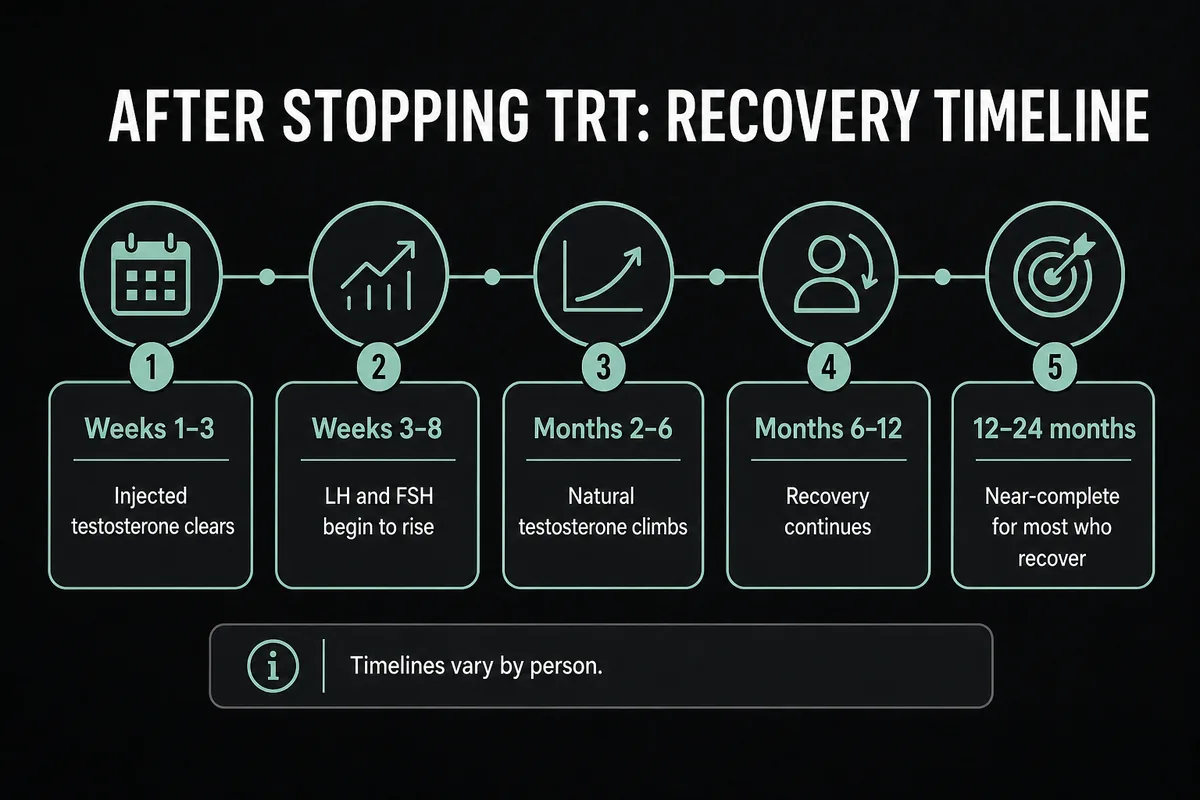
Here is where the data replaces the fear. Will my natural testosterone come back after TRT? For most men, yes, and we can put rough numbers on it.
| Timeframe | What is happening | What to expect |
|---|---|---|
| Week 1 to 3 | Exogenous testosterone clears (cypionate and enanthate esters over about 1 to 3 weeks) | Levels fall; early trough symptoms begin 6 |
| Weeks 3 to 8 | HPG axis begins to reboot; LH and FSH slowly rise | Withdrawal symptoms often peak, then start to ease 9 |
| Months 2 to 6 | Endogenous testosterone climbing | Many men approach their own baseline 2 |
| Months 6 to 12 | Continued normalization; fertility recovery lags testosterone | About 67% of men recovered by 6 months, about 90% by 12 months 2 |
| 12 to 24 months | Full recovery in most who will recover | Near-complete by about 24 months; a minority stay low 2 |
The load-bearing evidence comes from an integrated analysis by Liu and colleagues, published in the Lancet, which pooled men who had their testosterone production suppressed and then tracked recovery. Production returned to normal in a median of about 3.4 months, with roughly 67% of men recovered by 6 months, about 90% by 12 months, and essentially 100% by 24 months 2. Recovery of your testosterone level itself often comes before full fertility recovery, so hitting a normal blood level does not automatically mean sperm counts have caught up 2.
Individual variation is large, so treat the timeline as a map, not a guarantee. To see what a "recovered" number looks like, our guide to testosterone levels on TRT covers reference ranges, and how long does TRT take to work is the mirror image of this recovery question.
Factors that speed or slow recovery
Several things predict how quickly and completely you bounce back 12:
- Age. Younger men generally recover faster; the aging axis is slower and sometimes less complete.
- Length of use. A few months of therapy suppresses the axis less durably than several years.
- Dose. Replacement doses recover better than supraphysiologic (steroid-range) doses.
- Ester and delivery form. Longer-acting injectables and pellets keep the axis suppressed longer than short-acting or topical forms, so clearance takes longer 6.
- Baseline testicular function. If your testicles worked well before TRT, they are more likely to restart.
- Primary versus secondary cause. If your low T came from a testicular (primary) problem, stopping simply returns you to that problem; secondary or reversible causes have a better recovery outlook 1.
Coming Off TRT by Duration: 6 Months to 10 Years
One of the most searched patterns is duration-specific: coming off TRT after 6 months versus after years. The honest through-line is that shorter, lower-dose, younger use recovers faster and more completely, while longer and higher-dose use in older men is slower and less certain 12.
Coming off TRT after 3 to 6 months
Coming off TRT after 3 months, or coming off TRT after 6 months, involves a relatively short period of suppression. The axis has not been idle for long, so recovery tends to be faster and more reliable, though you should still expect a trough of several weeks and let a clinician confirm with labs that your own production is rising 29. A short course does not guarantee an instant rebound, but it is the most favorable scenario.
Coming off TRT after 1 to 2 years
Coming off TRT after 1 year or coming off TRT after 2 years still usually ends in recovery for men whose original low T was reversible, but the reboot can take several months to a full year 2. The Liu pooled data still apply, with most recovering within 12 months, but the tail is longer than after a brief course 2. Patience and lab monitoring matter more the longer you have been on.
Coming off TRT after 5 or 10 years
Coming off TRT after 5 years, or coming off TRT after 10 years, is the hardest band. Longer suppression plus older age means recovery is slower and less certain, and a subset of men stay hypogonadal 1. The crucial nuance: when a long-term user does not recover, it is very often because the original cause was permanent to begin with (for example primary testicular failure), not because TRT "broke" a system that would otherwise have worked 1. That distinction matters, because it means the honest answer for many long-term users is that stopping simply reveals the underlying condition they had before therapy.
Is TRT for Life? Is It Permanent?
Is TRT for life? Is TRT permanent? Not necessarily, and the answer hinges on cause rather than on any addictive property. TRT is often long-term because the underlying hypogonadism is chronic, especially primary (testicular) hypogonadism, where the testicles cannot make enough testosterone no matter what the brain signals 1. Men whose low T comes from a secondary or reversible cause (for example certain pituitary issues, medications, obesity, or untreated sleep apnea) may be able to address that cause, taper, and recover 1.
So whether you have to stay on TRT for life, or take TRT forever, depends on why you have low testosterone, not on the therapy trapping you. The FDA is clear that testosterone products are approved for hypogonadism due to a medical condition, not for the low testosterone of aging alone 7. Mayo Clinic makes a similar point about age-related decline, where the benefit picture is far less certain and lifelong therapy is not an automatic conclusion 12. If you are still weighing whether to be on it at all, start with our pillar on testosterone replacement therapy and the age-specific considerations in the best age for TRT.
Does TRT shorten your life?
Does TRT shorten your life? On the current evidence, appropriately monitored replacement does not appear to shorten lifespan. The large TRAVERSE cardiovascular safety trial did not show an increase in cardiovascular death in men treated for hypogonadism, and in 2025 the FDA updated testosterone labeling accordingly, replacing older cardiac warning language while adding a blood-pressure caution 811. That is reassuring, but it cuts both ways: TRT is not a longevity drug or an anti-aging tonic either, and Harvard Health urges a cautious risk-and-benefit conversation before committing to long-term therapy 11. For the cardiovascular details, see TRT and heart health.
Physiologic TRT vs Anabolic-Steroid-Induced Hypogonadism
Here is the distinction almost no consumer page makes, and it changes the whole recovery conversation. Legitimate replacement-dose TRT for diagnosed hypogonadism has a different recovery prognosis than the hypogonadism that follows anabolic-steroid abuse, known as anabolic-steroid-induced hypogonadism (ASIH) 34.
Supraphysiologic steroid use (doses far above replacement, often stacked and cycled) suppresses the axis harder and for longer, and recovery afterward can be prolonged or incomplete 34. Coward and colleagues documented persistent hypogonadism in young men after anabolic-steroid use, and Rahnema and colleagues describe ASIH as a distinct clinical entity with variable, sometimes incomplete, recovery even with treatment 34. The practical takeaway: if what you were doing was actually supraphysiologic steroid use rather than a prescribed replacement dose, expect a harder road back, and be honest with your clinician, because it changes the plan. Our explainer on whether TRT is a steroid unpacks the pharmacology.
How to Come Off TRT Safely
How to come off TRT safely is a medical process, not a self-administered post-cycle therapy protocol copied from a forum. The tools below are real and evidence-based, but they are described here for understanding only, because the doses, timing, and monitoring have to be managed by a prescriber 3510.
Tapering vs stopping cold turkey
A gradual taper (reducing dose or lengthening the interval between doses under a clinician) softens the trough compared with stopping cold turkey, because it gives the axis a gentler signal to begin waking up rather than a sudden cliff 10. There is no single universal taper, which is exactly why it belongs with your prescriber and your labs rather than a fixed internet schedule. The core safety rule from MedlinePlus stands: do not stop a controlled testosterone prescription without medical guidance 10. Our TRT dosage guide covers how dose and interval are set in the first place, which is the same lever a taper adjusts.
Restart medications: hCG, clomiphene, and enclomiphene
Three medication classes are commonly used to help the axis restart, and understanding the mechanism explains why supervision is structurally required, not optional 35:
- hCG mimics LH, so it signals the testicles directly to resume producing testosterone (and helps preserve size and sperm production). Learn more in our hCG peptide guide.
- Clomiphene is a selective estrogen receptor modulator (SERM) that nudges the pituitary to release more LH and FSH, restarting the signal from the top.
- Enclomiphene is the isolated isomer of clomiphene used to raise LH and FSH with a cleaner profile; see our enclomiphene guide.
Supervision is not a formality here. These drugs shift LH, FSH, testosterone, and estradiol at the same time, and getting the timing and balance wrong can worsen symptoms, spike estradiol, or raise hematocrit. A clinician sequences them against your labs. For the broader menu of off-ramp and non-TRT routes, see TRT alternatives.
Labs to monitor after stopping TRT
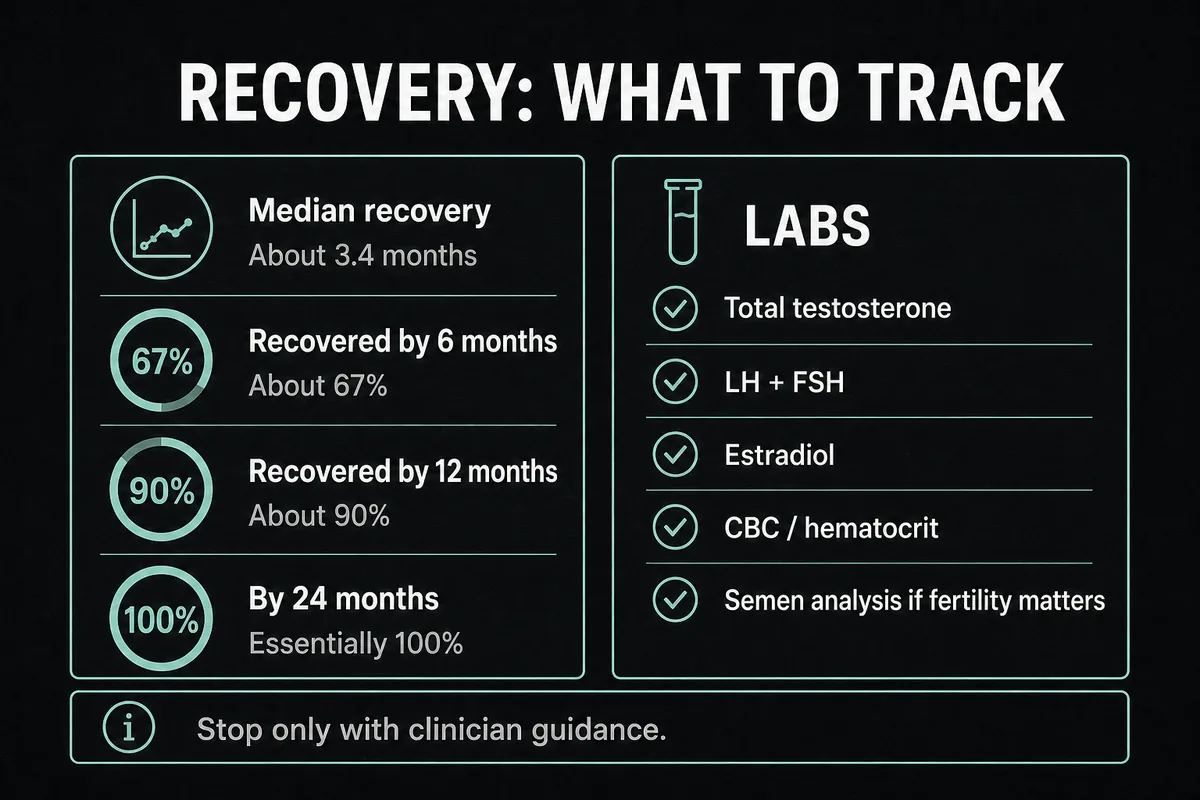
Recovery is confirmed by bloodwork, not by feel. The panel below is what clinicians typically track after stopping 5.
| Test | What it shows | Rough timing |
|---|---|---|
| Total testosterone | Whether endogenous production is returning | About 6 weeks, then periodically |
| LH and FSH | Whether the pituitary signal has restarted (the earliest recovery marker) | About 6 weeks, then periodically |
| Estradiol | Estrogen balance during recovery | With testosterone draws |
| Hematocrit / CBC | Red-cell level normalizing off TRT | Baseline, then follow-up |
| Semen analysis | Fertility recovery, if trying to conceive | About 3 and 6 months |
Timing and targets here are illustrative and clinician-directed, not a self-treatment schedule. A recovery target often cited is total testosterone above 300 ng/dL, roughly the diagnostic threshold used in guidelines, but interpretation is individual and symptom-based, not a single number 5. LH and FSH rising is often the first sign the axis is coming back online, sometimes before testosterone itself climbs.
If you want to preserve or restore fertility
If fertility is your reason for coming off, remember that sperm recovery lags testosterone recovery, so a normal testosterone level does not mean your sperm count has caught up 2. The fertility-oriented approach usually pairs hCG with or without a SERM, and the only way to track progress is a semen analysis at intervals 3. Our dedicated guide to TRT and fertility covers the recovery odds and the physician-directed options in depth.
When You Should NOT Stop TRT (or Should Restart)
Coming off is not always the right call. If your low testosterone comes from a permanent primary cause, stopping just returns you to symptomatic hypogonadism, and sometimes the correct answer is to resume therapy 1. There is no medal for toughing out symptoms from a chronic, treatable condition. The decision to stop, stay, or restart is a clinical one made with your prescriber based on your cause, your labs, and how you feel, not from a forum thread or a bad week 110.
The "Natural TRT" Question
Searches for natural TRT, TRT vs natural, and is TRT natural usually come from men hoping a supplement can replace a prescription. It cannot. No over-the-counter product replicates prescription testosterone, and there is no "boost T naturally" pill that matches replacement therapy. What "natural" testosterone optimization legitimately means is treating the reversible causes of low T: improving sleep, addressing weight and alcohol, and reviewing medications that lower testosterone 1. If that is your direction, see testosterone boosters vs peptides and the medical off-ramp options in TRT alternatives.
Frequently Asked Questions
Your outside testosterone clears over about 1 to 3 weeks while your own hormone axis is still suppressed, creating a temporary low-testosterone trough that can cause fatigue, low mood, low libido, and brain fog 69. For most men the axis then reboots over the following months and symptoms ease, but stopping abruptly makes the trough worse than a supervised taper 210.
For most men, yes. In the largest pooled analysis, production returned to normal in a median of about 3.4 months, with roughly 67% recovered by 6 months, 90% by 12 months, and essentially all by 24 months 2. Recovery is slower with longer use, higher doses, older age, and prior anabolic-steroid abuse 13.
Not necessarily. TRT is often long-term because the underlying hypogonadism is chronic, especially primary (testicular) hypogonadism, but men with secondary or reversible causes may be able to taper and recover 1. Whether it is "for life" depends on why you have low testosterone, not on TRT being addictive 7.
Under medical supervision. That usually means a clinician-directed taper (rather than a sudden stop), lab monitoring of testosterone, LH, FSH, estradiol, and hematocrit, and sometimes restart medications like hCG or a SERM to help the axis reboot 510. Never self-administer a stopping or restart protocol from the internet 10.
References
- Endocrine Society. Testosterone Therapy in Men With Hypogonadism: Clinical Practice Guideline (2018). Accessed 2026.
- Liu PY, Swerdloff RS, Christenson PD, et al. Rate, extent, and modifiers of spermatogenic recovery after hormonal male contraception: an integrated analysis. Lancet. 2006;367(9520):1412-1420.
- Rahnema CD, Lipshultz LI, Crosnoe LE, et al. Anabolic steroid-induced hypogonadism: diagnosis and treatment. Fertil Steril. 2014;101(5):1271-1279.
- Coward RM, Rajanahally S, Kovac JR, et al. Anabolic steroid induced hypogonadism in young men. J Urol. 2013;190(6):2200-2205.
- American Urological Association. Testosterone Deficiency: AUA Guideline. Accessed 2026.
- U.S. FDA. Testosterone Cypionate Injection Prescribing Information (2022). Accessed 2026.
- U.S. FDA. Testosterone Information. Accessed 2026.
- U.S. FDA. FDA Issues Class-Wide Labeling Changes for Testosterone Products (2025). Accessed 2026.
- Cleveland Clinic. Testosterone Replacement Therapy (TRT). Accessed 2026.
- MedlinePlus (U.S. National Library of Medicine). Testosterone Injection. Accessed 2026.
- Harvard Health Publishing. Is testosterone therapy safe? Take a breath before you take the plunge. Accessed 2026.
- Mayo Clinic. Testosterone therapy: Potential benefits and risks as you age. Accessed 2026.
The information in this article is for educational purposes only and does not constitute medical advice. Always consult a healthcare professional before starting any new supplement or compound. Results vary by individual.