
How long does TRT take to work depends on which benefit you are asking about, because different effects arrive on different curves. The earliest changes, in energy, mood, and sexual interest, tend to appear in about 3 to 6 weeks, while the fullest changes, in body composition and bone density, build over 6 to 12 months 1. How fast you respond depends on how deficient you were to start with, which formulation you use, your dose, and how consistently you take it 18. This page maps testosterone replacement therapy effect by effect and formulation by formulation, so you get a realistic timeline instead of the week-by-week transformation promises that fill most clinic pages. For the wider picture, see our pillar guide to testosterone replacement therapy.
Key Takeaways
- Earliest effects arrive in about 3 to 6 weeks: energy, mood, and sexual interest are the first things most men notice, with libido tending to plateau near week 6 1.
- Full effects take 6 to 12 months: fat loss, lean mass, and bone changes build slowly, and some markers keep improving beyond a year 17.
- Formulation changes the onset: daily gels reach a steady level in about 1 to 2 weeks, while injectable esters take roughly 4 to 6 weeks 45.
- "Stays in your system" is not the same as "cleared": one half-life is not full clearance, which takes about 5 to 6 half-lives 4.
- TRT is continuous replacement, not a cycle: for diagnosed low testosterone it is usually taken long term, not in on-and-off blocks like a steroid cycle 810.
- Monitoring runs on its own clock: red blood cell count and PSA rise on their own curves, which is why lab checks are scheduled rather than optional 25.
TRT effects timeline at a glance
Before the section-by-section detail, here is the short version of what tends to change and roughly when. The onset windows below come mainly from a landmark review of when testosterone effects begin and reach their maximum, supported by the Testosterone Trials in older men 17. Every window is a range, not a promise, and your own curve depends on your baseline and dose.
Table 1. TRT effects timeline by symptom
| Effect | When it typically begins | When it peaks |
|---|---|---|
| Energy and mood | ~3 weeks | ~18 to 30 weeks 1 |
| Libido and sexual interest | ~3 weeks | Plateau near 6 weeks 17 |
| Erections and ejaculation | Weeks | Up to ~6 months 1 |
| Insulin sensitivity and glycemic control | ~3 months | 3 to 12 months 1 |
| Fat mass down, lean mass up | ~12 to 16 weeks | 6 to 12 months and beyond 17 |
| Bone mineral density | ~6 months | 3+ years 1 |
| Hematocrit (red blood cell) rise | Ongoing | ~9 to 12 months 1 |
How Long Does TRT Take to Work? The Short Answer
The honest one-paragraph answer is that the first changes you feel usually begin around week 3, and the first thing to plateau is sexual interest, near week 6 1. Mood and energy lift in a similar early window, then keep improving for several months 1. Erections, blood-sugar control, and body composition build over months rather than weeks, and the fuller effect on fat, muscle, and bone lands somewhere between 6 and 12 months, with some markers still improving after that 18. In practical terms, expect a timeline measured in months, not days. The men who report dramatic change in the first few weeks are usually either severely deficient at baseline, which leaves the most room to improve, or noticing the early mood and libido shift rather than a physical transformation 17.
TRT Timeline: What Changes and When
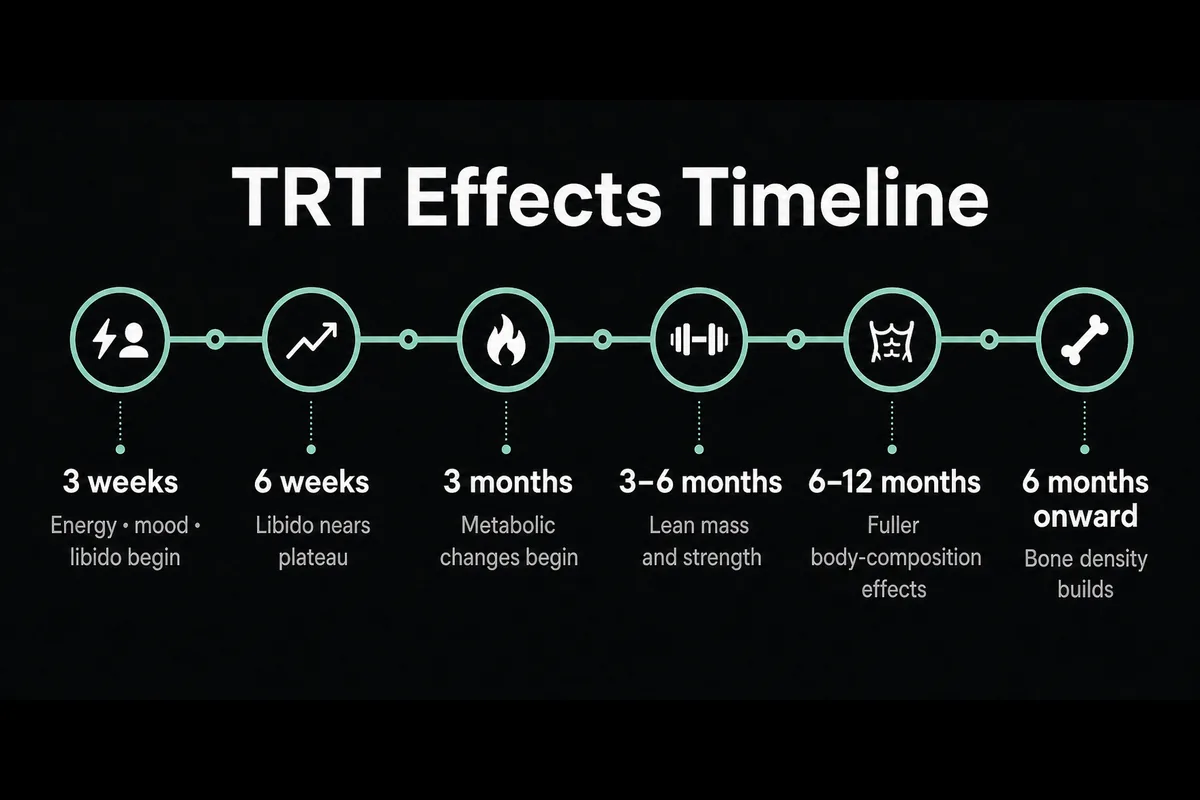
The best evidence on timing comes from a 2011 review that mapped when each testosterone effect starts and when it reaches its maximum 1. The pattern is consistent across studies: subjective effects on mood, energy, and sexual interest come first, metabolic and body-composition changes take months, and bone is the slowest of all. The month-by-month TRT timeline below follows that order. For the visual version of the same journey, our sibling page on TRT before and after walks through what tends to change at 3, 6, and 12 months.
Weeks 1 to 3: When Does TRT Start Working?
Very little is visible in the first two weeks, but the groundwork is being laid as your level climbs toward a steady state. Effects on energy, mood, and anxiety begin to register at around 3 weeks in most men 1. Some of the fastest measurable effects are ones you cannot feel at all: markers of arterial stiffness, such as pulse-wave velocity, can start shifting within days to weeks, though that is a research measurement rather than a symptom 1. So when people ask when TRT starts working, the accurate answer is that internal changes begin almost immediately, while noticeable ones typically start around week 3.
Weeks 3 to 6: Libido, Mood, and How Fast You Feel It
This is the window where most men first say they feel different, which is usually what "how fast does TRT work" really means. Sexual interest and desire rise from about week 3 and tend to plateau by roughly week 6 1. Mood and sense of wellbeing improve on a similar early curve and then keep building over the following months, with the maximal mood effect landing around 18 to 30 weeks 1. If you are going to feel the effects of TRT as a clear lift in drive and outlook, this 3-to-6-week band is usually when it happens. What you will not see yet is meaningful change in the mirror, because the physical curve has barely started.
Months 2 to 3: Erections, Energy, and Blood Sugar
Erectile function and ejaculation improve on a slower curve than libido and can continue building for up to about 6 months 1. Around this stage, effects on blood-sugar control and insulin sensitivity also become measurable, developing over a 3-to-12-month span 1. In the Testosterone Trials, sexual function showed a clear improvement by roughly 3 months and held, while gains in vitality and physical function were more modest, which is a useful reality check against dramatic 90-day claims 7. Month 3 is also when many clinicians schedule the first follow-up blood test to see how your level and other markers are tracking 23.
Months 3 to 6: Body Composition and Strength
Between about 12 and 16 weeks, body composition starts to move: fat mass tends to fall and lean mass tends to rise, and the change continues well past the 6-month mark 1. This is usually when a genuine visible difference appears, especially in men who paired treatment with resistance training and a controlled diet, because testosterone makes those efforts more productive rather than replacing them 9. Bone markers begin shifting in this window too, ahead of measurable density changes. If your dose is on the right track, this is often the most satisfying stretch of the TRT therapy timeline. Our guide to TRT dosage explains why the right dose, not a higher one, is what drives a steady response.
Months 6 to 12: Maximum Effects
By 6 to 12 months you are approaching the fuller effect. Body-composition and strength gains keep developing and then stabilize, and bone mineral density becomes measurable by around 6 months and continues improving over years, not months 1. Some lab markers are still moving: the rise in hematocrit (red blood cell concentration) commonly peaks around 9 to 12 months, which is one reason bloodwork is repeated on a schedule 15. This is the honest version of the full TRT effects timeline: better energy, better body composition than baseline, and improved sexual function, reached gradually, rather than an overnight transformation.
How Long Does It Take TRT to Kick In by Delivery Method
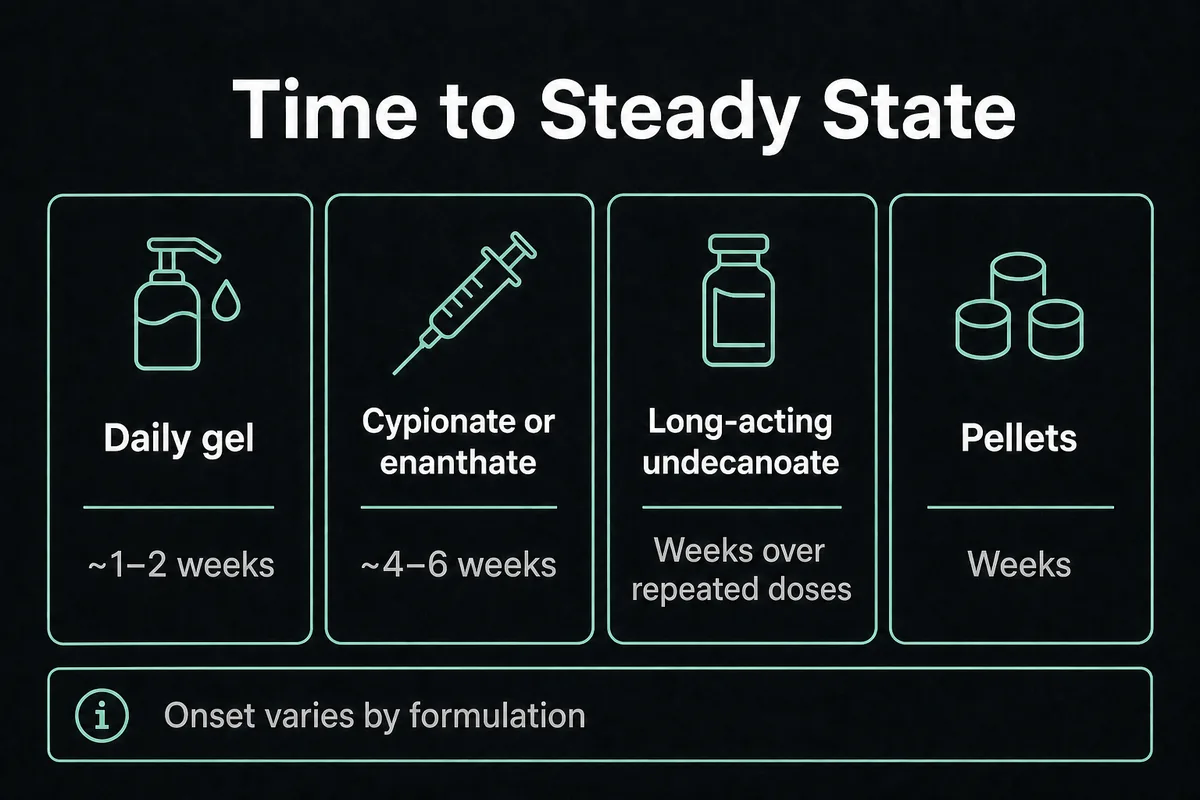
How quickly TRT works depends heavily on the formulation, because each one reaches a steady blood level on its own schedule. Injectable esters such as cypionate and enanthate are absorbed slowly from the muscle and take roughly 4 to 6 weeks of regular dosing to reach a stable steady state 413. Daily transdermal gels reach a steady level much faster, in about 1 to 2 weeks, because you redose every day 514. Long-acting testosterone undecanoate injections are given only about every 10 weeks and build up over a series of doses 13. Implanted pellets, placed every 3 to 6 months, release testosterone steadily over weeks 10. The table summarizes the differences. To compare the options in more depth, see our overview of the types of TRT.
Table 2. Onset by delivery method
| Formulation | Dosing frequency | Time to steady state |
|---|---|---|
| Testosterone cypionate or enanthate (injection) | Every 1 to 2 weeks | ~4 to 6 weeks 413 |
| Testosterone gel (transdermal) | Daily | ~1 to 2 weeks 514 |
| Testosterone undecanoate (long-acting injection) | Every ~10 weeks | Weeks, over repeated doses 13 |
| Testosterone pellets (implant) | Every 3 to 6 months | Weeks 10 |
How Long Does TRT Stay in Your System?
This is where competing pages get it wrong most often. The half-life of a testosterone ester tells you how long it takes for half of a dose to leave, but that is not the same as full clearance. It takes roughly 5 to 6 half-lives for a drug to essentially clear the body, so a formulation with an 8-day half-life is not gone in 8 days or even 2 weeks. Testosterone cypionate has a half-life of about 8 days, which means it takes roughly 5 to 6 weeks to essentially clear after the last injection 4. Enanthate is a little shorter at about 4.5 days, undecanoate is much longer, and a transdermal gel clears within days of stopping because there is no depot in the muscle 414. So "how long does TRT stay in your system" and "how long does TRT last" have different answers for different formulations, as the table shows.
Table 3. How long TRT stays in your system
Half-life is not the same as full clearance. Plan around the roughly 5-to-6-half-lives rule if you need to know when a formulation has genuinely left your system, for example before an unrelated lab test 4.
How Long Can You Stay on TRT? Is It a Cycle?
For diagnosed hypogonadism, TRT is continuous replacement therapy, and the honest answer to how long you can stay on it is usually indefinitely, as long as it keeps helping your symptoms and your monitoring stays clean 810. You are topping up a hormone your body is not making enough of, the same way someone with an underactive thyroid takes thyroid hormone every day, so it is normal for treatment to continue for years or for life 10. That also means TRT is not a fixed "cycle." The phrase "how long is a TRT cycle" imports a steroid-culture idea that does not apply to medical replacement: there is no set number of weeks after which you stop and recover, because the goal is to maintain a normal level, not to run a temporary boost 8. Your clinician will review whether to continue based on how you feel and how your labs look, not a calendar. For why replacement dosing is a different thing from anabolic-steroid use, see is TRT a steroid.
TRT Withdrawal Timeline: What Happens When You Stop
If you stop TRT, your blood testosterone falls over days to weeks according to the ester's half-life, so a gel washes out within days while cypionate takes several weeks to clear 4. As the level drops, the symptoms of low testosterone that treatment was managing, such as low energy, low libido, and low mood, tend to return 10. There is a second, slower part of the TRT withdrawal timeline: while you were on treatment, external testosterone suppressed your own hormone signaling (the hypothalamic-pituitary-gonadal axis), and that native production does not switch back on quickly 8. Recovery of your own testosterone is variable, ranging from a few weeks to many months, and in some men it takes longer than 6 to 12 months or does not fully return 8. Because of that, stopping is best planned with a clinician rather than done abruptly. Our page on stopping TRT covers what to expect and how discontinuation is usually managed.
How Long for Anastrozole to Work With TRT?
Some men on TRT are prescribed an aromatase inhibitor such as anastrozole (brand name Arimidex) to lower estradiol, the estrogen that testosterone can convert into. As a drug, anastrozole lowers estradiol quickly: it begins reducing estrogen within a day or two and reaches close to its full effect within about a week 15. The important caveat is that routine aromatase-inhibitor use is not endorsed by guidelines. The Endocrine Society does not recommend adding an aromatase inhibitor as a matter of course, and it is an off-label use reserved for men with symptomatic high estradiol or gynecomastia (breast tissue growth) under supervision 2. So while the "how long for anastrozole to work with TRT" answer is roughly a week, the more important point is that most men on well-dosed TRT do not need it, and it should only be used when a clinician has a specific reason 215.
What Affects How Fast TRT Works, and What It Won't Do
Several factors modulate how fast you respond. The severity of your baseline deficiency matters most, because a severely low starting level leaves more room to improve than a borderline one 811. The right dose, taken consistently, drives a steadier response than a higher or erratic one 2. Sleep, resistance training, and body-fat level all influence how much benefit you feel and how visible the body change becomes 9. It is just as important to be clear about what TRT will not do. It is not a fountain of youth, and it is not proven to sharpen memory or reverse aging in otherwise healthy men, so symptoms driven by non-hormonal causes will not resolve just because your testosterone is topped up 912. Monitoring also runs on its own clock: hematocrit and PSA rise on their own curves, which is why they are checked at baseline and on a schedule 25. On safety, the large TRAVERSE trial (5,246 men with low testosterone and high cardiovascular risk) found no increase in major adverse cardiac events versus placebo, but it did record more atrial fibrillation, acute kidney injury, and pulmonary embolism, which is the balanced picture worth discussing with your clinician 6. To see how the benefits are framed against the risks, our page on TRT benefits puts the two side by side, and testosterone levels on TRT explains what the monitored numbers mean.
Frequently Asked Questions
References
- Saad F, Aversa A, Isidori AM, Zafalon L, Zitzmann M, Gooren L. Onset of effects of testosterone treatment and time span until maximum effects are achieved. Eur J Endocrinol. 2011;165(5):675-685.
- Bhasin S, et al. Testosterone Therapy in Men With Hypogonadism: An Endocrine Society Clinical Practice Guideline. J Clin Endocrinol Metab. 2018;103(5):1715-1744.
- American Urological Association. Evaluation and Management of Testosterone Deficiency: AUA Guideline (2018, amended 2023).
- FDA / DailyMed. Testosterone Cypionate Injection, USP: Clinical Pharmacology. Accessed 2026.
- U.S. Food and Drug Administration. AndroGel 1.62% Prescribing Information. 2019.
- Lincoff AM, Bhasin S, et al. Cardiovascular Safety of Testosterone-Replacement Therapy (TRAVERSE). N Engl J Med. 2023;389(2):107-117.
- Snyder PJ, et al. Effects of Testosterone Treatment in Older Men (The Testosterone Trials). N Engl J Med. 2016;374:611-624.
- Al-Zoubi RM, et al. The Ideal Goal of Testosterone Replacement Therapy: Maintaining Levels or Managing Symptoms? (review). Accessed 2026.
- Mayo Clinic. Testosterone therapy: Potential benefits and risks as you age. Accessed 2026.
- Cleveland Clinic. Testosterone Replacement Therapy (TRT). Accessed 2026.
- Cleveland Clinic. Low Testosterone (Male Hypogonadism). Accessed 2026.
- Harvard Health Publishing. Is testosterone therapy safe? Take a breath before you take the plunge. Accessed 2026.
- MedlinePlus. Testosterone Injection. U.S. National Library of Medicine. Accessed 2026.
- MedlinePlus. Testosterone Topical. U.S. National Library of Medicine. Accessed 2026.
- MedlinePlus. Anastrozole. U.S. National Library of Medicine. Accessed 2026.
The information in this article is for educational purposes only and does not constitute medical advice. Always consult a healthcare professional before starting any new supplement or compound. Results vary by individual.